Entertainment
After 'Cobra Kai,' Xolo Maridueña is ready for his next challenge

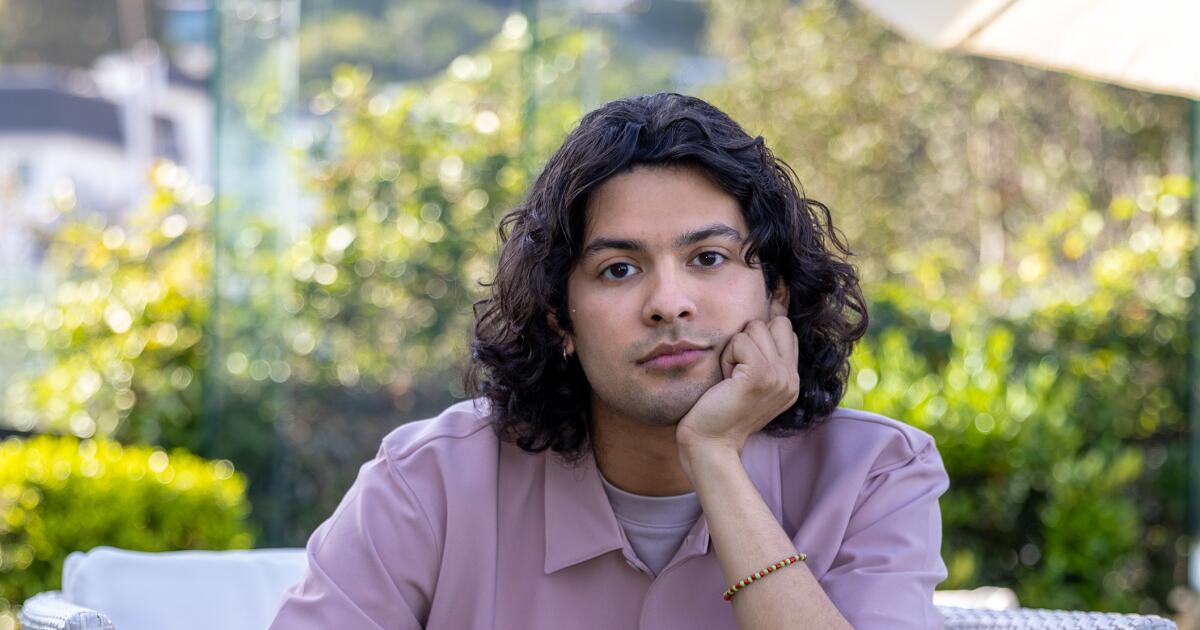
Xolo Maridueña received two phone calls the day he found out he’d been cast in “Cobra Kai,” the spinoff series set three decades after the 1984 “The Karate Kid” movie ended.
The first came from show creators Josh Heald, Jon Hurwitz and Hayden Schlossberg, who confirmed that he had landed the protagonist role of Miguel Diaz, the scrappy Reseda teen that learns martial arts after being bullied.
Maridueña, then 16, couldn’t believe his luck.
“Oh my God, what is going on?” the now 23-year-old said via Zoom, recounting the events of that afternoon like a play-by-play commentator.
Then, his phone rang again. This time, it was Ralph Macchio, the karate kid himself.
“Is this Zolo?” asked Macchio.
Though Maridueña laughs now at the wrong pronunciation of his name (it’s “sho-low”), the young actor was too preoccupied at the time to correct his new co-star. With his phone’s battery at 1%, he worried that the call would drop, giving Macchio the impression that he was a bratty kid who’d hung up on him. If that were to happen, Maridueña thought, surely they’d boot him off the show before shooting even began.
That worst-case scenario never came to pass, and as Macchio can attest, Maridueña “is the antithesis of a bratty kid.” In truth, he was tailor-made for a role that saw him grow from a brace-faced teen into a full-fledged adult. Now, seven years after that fateful day, the actor is getting ready to say goodbye to Miguel Diaz — the first part of the sixth and final season of “Cobra Kai” was released on Netflix on Thursday, with Part 2 coming out Nov. 15, and Part 3 coming out sometime in 2025.
“There was just something about him that we just fell in love with right off the bat,” said William Zabka, who plays Johnny Lawrence, the antagonist in the first “The Karate Kid” movie who gets a shot at redemption in the Netflix series. “We knew right away that that was our Miguel.”
“He was lanky and had that LaRusso kind of long-limbed awkwardness,” Macchio said, alluding to the fact that Miguel Diaz is a modern take on his own character. “He was perfect from the start.”
In taking the major role, Maridueña shouldered the responsibility of being one of the few Latino characters in the show — Miguel was intentionally written to better reflect the demographics of the San Fernando Valley. He says writers consulted with him to further develop his storyline with an Ecuadorian ethnicity in mind — Maridueña himself is of Mexican, Cuban and Ecuadorian heritage.
“[It’s important] to have these roles where people are allowed to just be in their character and the first bullet point is not their ethnicity,” Maridueña said. “As we have more of these diverse roles, people will start to get used to [seeing us].”
(Sarahi Apaez / Los Angeles Times)
“They were honest in their lack of knowledge in [Miguel’s] culture,” he said, making sure to point out that this unfamiliarity with Latinos is an industrywide issue.
“You throw a rock in [Los Angeles] and 1 in 2 people are Latino” said Maridueña, who grew up in El Sereno. “Hollywood needs to catch up in that regard because if you throw a rock on set, 1 in 2people are definitely not Latino.”
He also credits the writers for not making Miguel one-dimensional.
“[It’s important] to have these roles where people are allowed to just be in their character and the first bullet point is not their ethnicity,” Maridueña said. “As we have more of these diverse roles, people will start to get used to [seeing us].”
Despite his age, the actor is a veteran at portraying nuanced characters that happen to be Latino. Prior to “Cobra Kai,” he gave life to Victor Graham in the popular NBC drama “Parenthood.” He also spent years refining his craft at Casa 0101, the Boyle Heights theater company founded by “Real Women Have Curves” playwright Josefina López.
“He approached the work with a lot of humility. There wasn’t any pompousness about him,” said Edward Padilla, former lead youth educator at Casa 0101 and a family friend. “He really came in there with dedication and willingness to be molded into the role that he was working on.”
Padilla credits part of Maridueña’s love of acting to the “Cobra Kai” star’s family members who are involved in community art activism. Maridueña’s younger sister Oshún Ramirez was a voice actor on Disney’s “Future-Worm!,” his mother, Carmelita Ramirez-Sanchez, leads the Boyle Heights Arts Conservatory, and his father, Omar G. Ramirez, is a Chicano artist.
“The family wanted him to start expanding beyond the types of things that he had already done,” Padilla said.
Maridueña’s face lights up at the mention of Casa 0101, and even hints at the possibility of returning to the theater if given the opportunity to direct a play of his own now that “Cobra Kai” is wrapping up.
“I can’t help but feel like the community that I was fostered in, El Sereno, Los Angeles, my family, my friends, Casa 0101, everyone that helped raise me and made me feel so comfortable in my skin — I was allowed to be myself,” he said.
As Maridueña enters a new phase in his career, Padilla says he hopes that his former student doesn’t feel obligated to always take on the weight of representing his community on screen.
“I want him to choose projects that really lift his spirit, because that’s the only way that we’re all going to make an impact [is] if we continue to choose things that lift our own individual spirits,” Padilla said.
Besides, Maridueña has done more than enough to highlight the richness and complexity of Latino culture. The actor gave life to Jaime Reyes in last year’s “Blue Beetle,” the first live-action superhero movie with a Latino lead. And just as Jaime was chosen by the alien scarab that gave him super powers, Maridueña was handpicked for this groundbreaking role.
“I thought it was Xolo and it had to be Xolo,” said “Blue Beetle” director Angel Manuel Soto, who endearingly refers to his lead as “mijo” or “my son.” Soto said working with Maridueña was a “dream come true,” noting his charisma, talent, energy and lack of ego among the many qualities that make him a standout actor.
“He really went far and beyond to the extent of almost doing a lot of his own stunts and prepping for it even on the hardest days,” Soto said, crediting Maridueña’s martial arts experience in “Cobra Kai.”
Despite the historic nature of “Blue Beetle,” the film had the misfortune of being released in the middle of the Hollywood SAG-AFTRA strikes, which meant that Maridueña and his castmates couldn’t promote the movie.
Strike or not, Maridueña’s family, friends and community rallied behind the film’s release. The Boyle Heights Arts Conservatory, led by his mother, hosted free “Blue Beetle” showings in Alhambra, Montebello and Hollywood.
“This is our way of saying, ‘Look, we know you cannot be in front, but we want you to know that you have thousands behind you,’” Ramirez-Sanchez told The Times last year. “When one of us can’t be there, none of us are as strong as all of us.”
Maridueña could have easily been cynical about how the film’s release panned out. Instead, he chose to focus on what “Blue Beetle” managed to accomplish.
“I remember having conversations with Angel and him telling me that this is bigger than all of us,” he said. “I remember that hitting me so hard in the moment and really allowing that to be the tone for the movie while we’re shooting.”
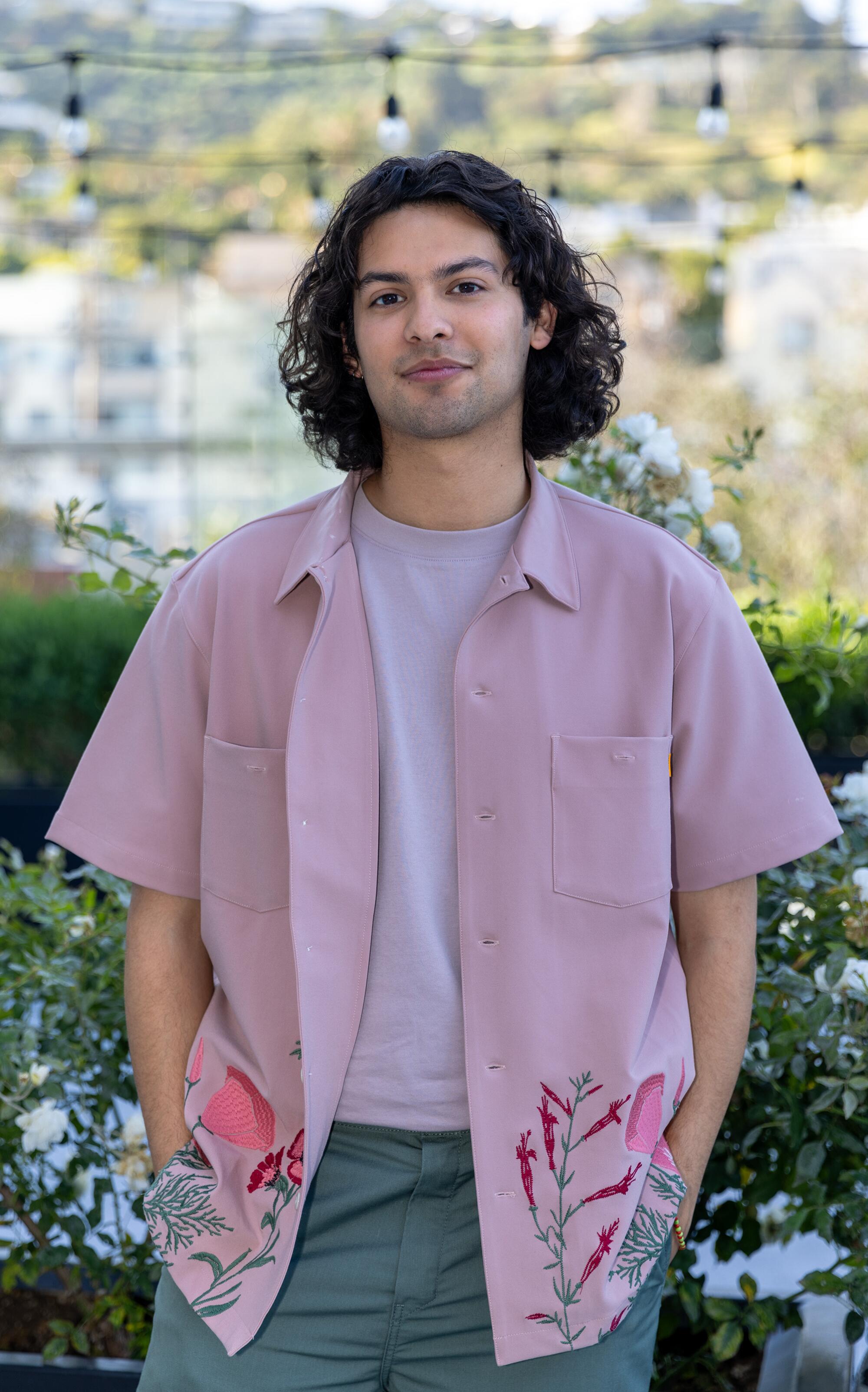
“I can’t help but feel like the community that I was fostered in, El Sereno, Los Angeles, my family, my friends, Casa 0101, everyone that helped raise me and made me feel so comfortable in my skin — I was allowed to be myself.”
(Sarahi Apaez / Los Angeles Times)
In talking about “Blue Beetle,” Maridueña remembers how his fear of looking bad on screen was immediately replaced by a sense of pride.
“As soon as I sat down in that chair for the first screen I was deathly terrified,” he said, re-spiraling in real time. “What if I’m bad? What if it’s terrible?
“But then we watched it and all of that love protrudes so heavily in the movie. I just couldn’t help but feel like, ‘Oh man, my family is going to feel proud because they are seeing themselves reflected.’ This movie is to show a whole new generation that they can have a superhero that looks like them.”
And though acting has claimed a huge part of his life, Maridueña still finds time to express himself off screen. He is an avid photographer who stands behind his Leica Q2 as he shoots his friends on their foodie outings. He’s also a self-proclaimed love doctor on his highly rated podcast “Lone Lobos,” which he co-hosts with fellow “Cobra Kai” actor and best friend Jacob Betrand. He’s even dabbled in music, releasing a hip-hop track last October.
Maridueña also has several acting projects in the works. He’s slated to star alongside Al Pacino in the thriller “Killing Castro,” and will form part of the star-heavy cast of next year’s “The Smurfs Movie.”
“I feel very gracious for having worked with this impeccable [‘Cobra Kai’] cast and crew for seven years now. At the same time I feel [I’ve] grown from this part of my life,” he said.
“I’m ready to show what I’ve learned in other spaces now.”

Entertainment
Lucas Museum to give free annual passes to South L.A. neighbors, host community preview day

The Lucas Museum of Narrative Art, which is moving at light speed toward its Sept. 22 opening, announced Thursday that it will give free annual passes to its South L.A. neighbors living in the 90037 ZIP Code. The 300,000-square-foot, $1-billion museum located in Exposition Park will also host a special community preview day on Sept. 13, more than a week before the general public gets to step inside.
The 90037 ZIP Code has a population of more than 65,000 and is bordered roughly by the 110 Freeway to the west, Slauson Avenue to the south, Central Avenue to the east and Martin Luther King Jr. Boulevard to the north. Residents can register for passes at lucasmuseum.org/lm37 and will be alerted in August when the program launches. Pass holders can reserve tickets for themselves and one guest.
Tickets for non-pass holders go on sale July 21. They cost $25 for adults and $21 for seniors. Kids 17 and under are free.
“Storytelling has the power to bring people together and create a sense of community,” said Lucas Museum Chief Executive Tracey Bates in a news release about the program. “Through LM37, we are inviting our South Los Angeles neighbors to make the museum part of their lives and take their own path of discovery through the art, programs and experiences that will help shape this new cultural hub for Los Angeles.”
The community preview day is designed to give local business owners, community partners, civic leaders and registered LM37 pass holders a sneak peak of the 10,000 square feet of exhibition space, as well as the expansive gardens with 11 acres of park space.
The opening programming, curated by co-founder George Lucas, features 20 inaugural exhibitions across more than 30 galleries, including one titled “Star Wars in Motion,” containing vehicle designs, high-speed racers, flying vessels, props, costumes and illustrations from the first six films in the beloved franchise.
More than 1,200 objects will be on display from Lucas’ personal collection of narrative art. Highlights include work by Norman Rockwell and Dorothea Lange, as well as a variety of manga, children’s book illustrations and comics.

Last year’s “Superman” ended with Iggy Pop singing “Because I’m a punk rocker, yes I am” — an ironic coda for a superlatively square hero. But it rings straightforwardly true for Superman’s cousin.
Milly Alcock’s Kara Zor-El, or Supergirl, sports not a spandex suit but a Blondie T-shirt. When we meet her in Craig Gillespie’s “Supergirl,” she’s been on an interstellar bender for days. She’s more Courtney Love than Clark Kent.
Nonchalant and sarcastic, Kara is also a little Han Solo-ish, you might say, given that she moves capriciously through the galaxy in her junky spaceship while getting in fights in extraterrestrial bars. She’s a welcome, jagged riff on more buttoned-up superheroes, and Alcock is terrific in the role. If only “Supergirl” was as good as she is.
While the latest DC release, and second under James Gunn’s stewardship, has its moments, “Supergirl” struggles to match Kara’s punk-rock energy with an equally spirited supporting cast and story.
Skepticism seems to have gathered for “Supergirl” ahead of its release. Many fans have argued it wasn’t the right next step for DC Universe. But I’m not so sure. Alcock’s breezy cameo in “Superman” was one of that movie’s highlights. Handing the follow-up to her, and her faithful floating dog Krypto, strikes me as an extremely natural next step. When in doubt, follow the dog.
And much of “Supergirl” is winning. It resides almost entirely in space, touching down only momentarily on Earth. In its consistently creative production design, clever needle drops and underdog story arc, “Supergirl” resides a little closer to Gunn’s “Guardians of the Galaxy” movies than other DC entries. Its outer space is filled with cosmic detritus, mean characters and cute critters. Seth Rogen as the voice of a tiny alien co-piloting a space bus is an inspired concoction, as is a shabbier sci-fi realm with rest stops along the intergalactic highway.
Entertainment
Justin Baldoni and wife break silence after ‘It Ends With Us’ legal battle with Blake Lively

Justin Baldoni has broken his silence after reaching a settlement in a lengthy and highly publicized legal dispute with Blake Lively.
Baldoni and his wife, Emily Baldoni, presented a united front in an Instagram video the couple shared Wednesday that began, “So we have not spoken publicly for the better part of the last two years, and it’s not because we haven’t had anything to say, because Lord knows we have.”
The “It Ends With Us” actor and director said that although they’d wanted to address the debacle that involved dueling lawsuits with Lively, nearly two years of tit-for-tat fodder and culminated in a confidential settlement, “something was telling us not to.”
The couple said they prayed about when to make a public statement. “This feels like the moment,” Emily said.
“What does feel important,” she continued, “is that we can genuinely say that we are sitting here today feeling immense gratitude for so many things and so many people and so many things that have happened to us.”
“Gratitude has saved us,” Justin added.
“I also feel that it’s important as we say that — in that gratitude — it doesn’t negate the injustice and the pain that we have also felt in the last few years, and we’ve had to wrestle with so many things and try to understand so many things,” Emily said. “How could something like this even happen? Let alone disguised as a fight for women. So much to unpack. And the truth is, reality is, is that there’s been a lot of trauma for us to move through as a family, which also makes it hard to speak.”
“We don’t even know this is the right thing to say, but we just know we need to share something,” Justin said. “What I will say is that there have been so many painful things that have been spoken into existence — “
“Untruthful,” Emily broke in.
“We didn’t want to add to the noise, so we just wanted to let the justice system run its course,” he said.
“And the truth and the facts have spoken for themselves,” Emily said.
The couple’s statement comes a year and a half after Lively filed a bombshell lawsuit against Baldoni alleging sexual harassment, retaliation and several other charges on the heels of a messy “It Ends With Us” summer release and press tour that fueled rumors of on-set turmoil.
Less than a month after the allegations against Baldoni rallied Hollywood against him, he countersued Lively, her publicist Leslie Sloane and her husband, Ryan Reynolds, for $400 million in damages, claiming they’d smeared his name in the press and wrestled away his control of the film. His suit was later dismissed.
In May, two weeks ahead of the trial, Lively and Baldoni reached an agreement to resolve their legal dispute, bringing an abrupt end to the contentious battle.
“The parties in the Blake Lively and Wayfarer Studios litigation have reached an agreement to resolve the matters,” lawyers for both sides said in a joint statement.
“The end product — the movie ‘It Ends With Us’ — is a source of pride to all of us who worked to bring it to life. Raising awareness, and making a meaningful impact in the lives of domestic violence survivors — and all survivors — is a goal that we stand behind. We acknowledge the process presented challenges and recognize concerns raised by Ms. Lively deserved to be heard. We remain firmly committed to workplaces free of improprieties and unproductive environments. It is our sincere hope that this brings closure and allows all involved to move forward constructively and in peace, including a respectful environment online.”
In June, a federal judge ordered Baldoni and his production company to pay Lively’s attorney fees related to his unsuccessful defamation lawsuit against her, but rejected her bid for additional damages.
“So, how are we doing?” the filmmaker said in the Instagram video. “We are healing, and if you’ve ever been through something traumatic, you know that healing isn’t linear. It lives different every day, and we have had to rethink for ourselves what is real. What matters, and it’s this. It’s our family. It’s our friends. It’s our community. It’s our faith.”
Times staff writer Josh Rottenberg contributed to this report.
-
Culture40 minutes ago
Which Version of the ‘Odyssey’ Should You Read?
-
 Lifestyle43 minutes ago
Terry Tempest Williams on why women with big ideas get labeled ‘crazy’ : Wild Card with Rachel Martin
-

 Technology55 minutes ago
Google’s Nest Thermostat has hit its best price of the year
-

 World58 minutes ago
Argentinian flight instructor jumps to death from plane, 22-year-old student forced to land alone
-

 Politics1 hour ago
Omar’s disclosures erased millions, leaving her with potential negative net worth. She won’t explain why.
-

 Health1 hour ago
Dr Oz links obesity to chronic disease surge, says GLP-1s can ‘jumpstart’ better health
-

 Sports1 hour ago
Pirates star pitcher makes unfortunate history after being taken out in middle of perfect game bid
-

 Technology1 hour ago
Medical identity theft follows you into the doctor’s office

