Connect with us

Entertainment

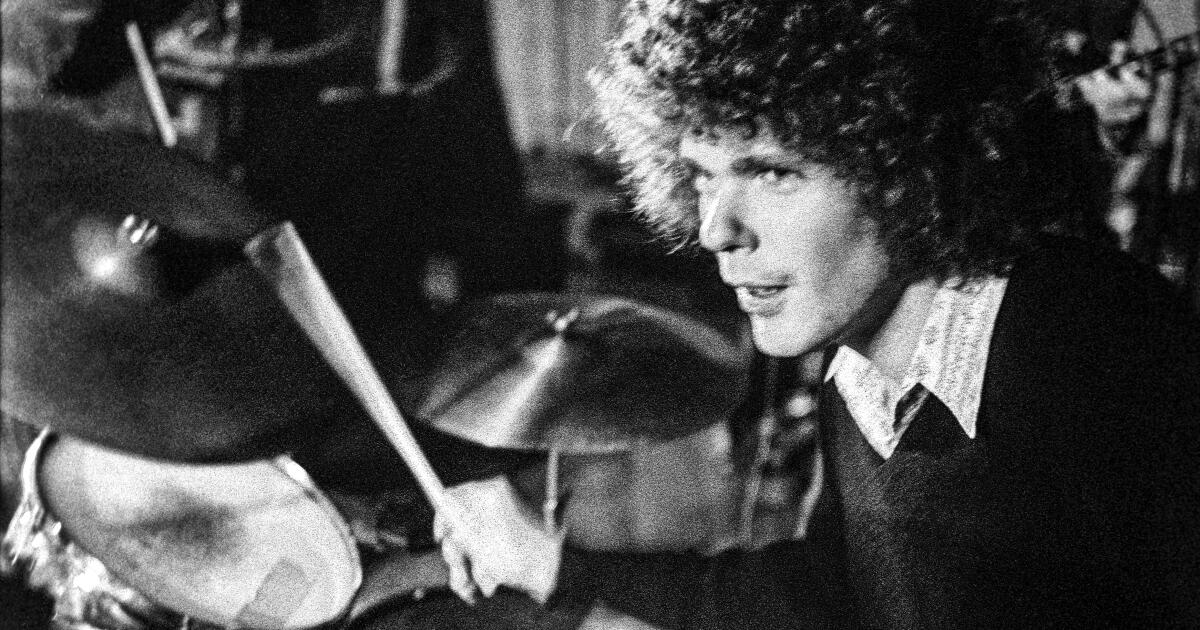
A harrowing look at drummer Jim Gordon's descent from rock talent to convicted murderer

Published

on

A harrowing look at drummer Jim Gordon's descent from rock talent to convicted murderer

Book Review

Drums & Demons: The Tragic Journey of Jim Gordon

By Joel Selvin
Diversion Books: 288 pages, $29

If you buy books linked on our site, The Times may earn a commission from Bookshop.org, whose fees support independent bookstores.

Advertisement

The year was 1970, and Jim Gordon was in rock ‘n’ roll heaven.

The drummer was on part of Joe Cocker’s infamous Mad Dogs and Englishmen revue, a traveling circus of sex, drugs and legendary music, featuring bandleader and keyboardist-guitarist Leon Russell; saxophonist Bobby Keys, a sideman for the Rolling Stones; and singer Rita Coolidge. The bacchanalian troupe astonished audiences with their transcendent performances, leaving fans wanting more.

For Gordon, not yet 25, the moment was particularly sweet. A well-known session musician whose inventive percussion helped propel songs by the Beach Boys, the Byrds, Paul Revere and the Raiders and Glen Campbell to the top of the charts, he relished stepping out of the studio’s shadows onto a larger stage. Gordon would go on to play drums for Eric Clapton’s Derek and the Dominos, adding the song’s indelible piano coda to “Layla,” and record with John Lennon and George Harrison. Clapton and Ringo Starr considered him the best drummer in rock.

But beneath the sunshine, storm clouds lurked.

Advertisement

One night after a Mad Dogs and Englishmen show, Gordon was hanging out in a hotel room with his girlfriend Coolidge and bassist Carl Radle, his future Derek and the Dominos bandmate. After drinking and snorting coke, Gordon asked Coolidge if he could speak to her in the hall. Given how close they had become, she thought he might propose. Instead, he punched her in the face, knocking her unconscious.

Mad Dogs and Englishmen members chalked up Gordon’s erratic behavior to the craziness surrounding the tour. But there was more to it. “For Jim, it was a crack in the mask he wore,” writes Joel Selvin, the former San Francisco Chronicle music critic, in his deeply reported and well-written book “Drums and Demons: The Tragic Journey of Jim Gordon.” “His herculean self-control had failed him, letting the dark forces he had kept under tight wraps peek out, dark forces that would have shocked anyone who knew sunny Jim.”

As recounted by Selvin, Gordon heard voices that would only grow more hostile and dangerous over time, even causing him intense physical pain if he dared to disobey them. Years later, Gordon would commit one of the most horrific acts in the annals of rock history: On June 3, 1983, he murdered his 71-year-old mother by bludgeoning her with a hammer and stabbing her repeatedly in the chest. Gordon said her voice had ordered him to commit the grisly act.

Gordon died in 2023 at 77 after nearly four decades in prison, still haunted by voices, still harboring resentment toward his long-deceased mother for her “controlling” behavior.

In “Drums and Demons,” Selvin aims to restore Gordon’s humanity and reputation by showing his professional triumphs in the context of his struggles with addiction and mental illness.

Advertisement

Selvin largely succeeds by adding flesh, blood and soul to the Gordon story. He does an especially nice job of capturing the optimism and creative explosion of the Southern California pop scene in the 1960s and Gordon’s role in it. Selvin shows the handsome, blond, 6-foot, 4-inch drummer in the studio playing on Brian Wilson’s masterpiece “Good Vibrations” and driving the beat of a 24-piece orchestra on the Mason Williams 1968 instrumental hit “Classical Gas.”

In one memorable scene, producer Richard Perry tapped Gordon to play drums on Carly Simon’s “You’re So Vain” after two other drummers failed to give him the sound he wanted. “The drum kit was an extension of his being, and he danced all over it,” Selvin writes. Gordon “made the track sound like a big, juicy hit record on the first take, and at the end of the evening, he left no doubt in the minds of everyone in the room that was exactly what they now had.”

Selvin vividly charts Gordon’s decline in harrowing detail, including his alarming violence toward women, myriad psychotic episodes and banishment from rock royalty because of his increasing unreliability and frightening behavior. In the months before murdering his mother, for instance, a bloated, dull-eyed Gordon had been reduced to playing four sets a night for $30 with a faceless outfit called the Blue Monkeys in a gritty Santa Monica bar. The voices in his head continued to torment him.

The biggest problem with the book is that despite Selvin’s laudable efforts to make Gordon whole, the drummer just wasn’t that interesting, especially compared with the artists he worked with.

“Jim moved through life like a ghost. He was friendly, but he had no friends,” Selvin writes. “He hid himself from close observation. His smile served him; it kept him safe and unchallenged. Nobody really knew him.”

Advertisement

That this is such a strong book reflects Selvin’s prodigious journalistic talents. The author of more than 20 works including “Altamont,” which chronicles the ill-fated 1969 rock festival headed by the Stones, he is one of the best rock writers out there. Still, I’m not convinced that session-man Gordon merits a 250-page biography. John Bonham, the thundering soul of Led Zeppelin, certainly does. So too does Starr, the heartbeat of the Beatles. But Jim Gordon? Perhaps a long magazine piece.

Ballon, a former Times and Forbes reporter, teaches an advanced writing class at USC. He lives in Fullerton.

Movie Reviews

‘Hokum’ movie review: Damian McCarthy’s nasty little ghost story is undone by its own explanations 

Published

on

‘Hokum’ movie review: Damian McCarthy’s nasty little ghost story is undone by its own explanations 

A stil from ‘Hokum’
| Photo Credit: NEON

For those of you already familiar with Damian McCarthy’s work, the Irish filmmaker has spent the past few years turning cramped Irish spaces into elaborate, nerve-racking machines for dread. His 2020 debut, Caveat, trapped us inside a decaying rural house with a chained protagonist and a grotesque toy rabbit, while 2024’s Oddity transformed an isolated farmhouse into a relay system for jump scares built from negative space and the sound of somebody knocking at the wrong moment. His latest, Hokum, pushes that approach into a larger setting without sacrificing the intimate unpleasantness that makes his work so effective. 

The film takes place almost entirely inside the Bilberry Woods Hotel, a fading property buried in the Irish countryside where the final few guests arrive for a Halloween celebration. At the same time, staff members quietly prepare to shut the building down for winter. Into this atmosphere walks Ohm Bauman, played by Adam Scott, an American novelist carrying two urns containing his parents’ ashes and a personality abrasive enough to make even the resident ghouls feel hospitable.

Hokum (English)

Director: Damian McCarthy

Cast: Adam Scott, Peter Coonan, David Wilmot, Florence Ordesh, Michael Patric, Will O’Connell, Brendan Conroy, Austin Amelio

Runtime: 107 minutes

Advertisement

Storyline: When novelist Ohm Bauman retreats to a remote inn to scatter his parents’ ashes, he’s consumed by tales of a witch that haunts the honeymoon suite

McCarthy introduces Ohm through his work. The opening sequence shows him writing the conclusion to a historical adventure novel about a conquistador stranded in the desert with a dying child, and the scene initially appears disconnected from the main story until the camera pulls back to reveal that the entire episode exists inside Ohm’s manuscript.

This intro establishes the emotional logic driving the film. Ohm writes stories where people wander toward death because he has spent most of his adult life emotionally entombed inside the loss of his parents, who died shortly after honeymooning at the same Irish hotel he now visits. McCarthy avoids turning this into a tidy psychological diagnosis and attempts to reveal the damage through behaviour — Ohm humiliates a bellhop named Alby by heating a spoon over an open flame and pressing it against the young man’s hand after Alby asks him to read an aspiring manuscript.

That ugliness becomes central to Scott’s performance. Hokum strips away the comic cushioning that often softens his cynicism, especially in his recent Severance escapades. Scott keeps Ohm emotionally rigid even as the character begins to unravel inside the hotel’s sealed honeymoon suite, and the refusal to chase sympathy lends the film a sourness that works in its favour. When Ohm eventually risks himself to search for the hotel bartender Fiona, the motivation grows from guilt and loneliness over his botched suicide attempt. Fiona disappears after warning him about the suite’s resident witch, a local legend the hotel staff accepts with weary practicality, and her absence pushes Ohm deeper into the building’s sinister secrets.

A stil from ‘Hokum’

A stil from ‘Hokum’
| Photo Credit:
NEON

Cinematographer Colm Hogan lights the hotel with weak lamps, muddy greens, and heavy shadows that preserve spatial clarity even when characters crawl through near-total darkness. Production designer Til Frohlich fills the honeymoon suite with damp wallpaper, antique furniture, and cramped architectural dead ends that make it feel physically hostile before anything malicious even appears. McCarthy then uses sound with vicious precision, as ringing bells ring, creaking floorboards, and a mutated, uncanny-valley children’s TV program begin flooding the ominous silence.

The film loses some momentum once McCarthy begins unpacking the mystery behind Fiona’s disappearance and the crimes attached to the hotel’s past. Several supporting characters remain thinly drawn, particularly the hotel management, and the screenplay occasionally mistakes withholding information for complexity. The final stretch also leans too heavily on explanatory reveals and heightened confrontations, with the climactic encounter involving the witch pushing the film toward bluntness when the earlier sections had earned their power through suggestion alone.

Advertisement

Even so, Hokum succeeds because McCarthy understands the mechanical pleasures of horror filmmaking at a level many contemporary prestige directors seem embarrassed by. Though the scares land with diminishing returns this time, McCarthy still stages them with the acute understanding of just how long we will stare into a dark hallway before resenting ourselves for it. His folklore imagery still carries the grubby charm of an R.L. Stine paperback pulled from a damp school library shelf, which gives the film a pulpy nastiness that suits it well. McCarthy never fully organises many of these elements into a clean mythology. What he does create is a horror film with texture and personality, even if it barely holds up against the mastery of its predecessors.

Hokum is currently running in theatres

Continue Reading

Entertainment

Spotify doubles down on video podcasts at its Hollywood studios

Published

on

Spotify doubles down on video podcasts at its Hollywood studios

On a recent weekday morning inside a studio in the heart of Hollywood, Rachel Lindsay and Van Lathan, co-hosts of The Ringer’s “Higher Learning,” were getting ready to roll.

By the time the podcasters came into the Spotify Sycamore Studios for their show, which covers all things in Black culture and politics, the overhead lights were set, and the cameras were precisely angled. Decorative books were propped up between their seats and a big red “Higher Learning” logo stood behind them.

As soon as everyone silenced their phones, the hosts began to banter like two old friends. Lindsay complimented Lathan on his recent foray into stand-up comedy at the Netflix is Joke Fest at the Laugh Factory.

“I just have to say … basically a star is born,” said Lindsay, grinning. “I have to talk about it. Now I never doubted you.”

The pair helms one of the many shows on The Ringer podcast network, known for its roster of A-list celebrity hosts and sports and culture commentators that recently moved into Spotify’s newest podcasting studios.

Advertisement

The 11,000 square-foot space on Sycamore Avenue was designed as both a home base for The Ringer’s production and a video podcasting hub for select Spotify creators.

Since its opening earlier this year, the space has welcomed more than 25 podcasters and shows, on top of the dozens of shows that still record at Spotify’s Mateo studios in the Arts District.

The company estimates that over the last five years it has contributed more than $10 billion to the podcasting industry, including payouts to creators and investments in new content.

Podcasts are just one arm of Spotify’s business, as the audio giant has over 100 million songs and 700,000 audiobooks on its platform. But video podcasts have become an increasingly important way for the company to keep listeners tuned in — and paying for subscriptions amid growing competition from Apple Music and YouTube Music. Despite a surge in profits in the first quarter, Spotify’s share price has fallen 25% this year as investors worry about a slowdown in subscriber growth.

Van Lathan and Rachel Lindsay record their podcast, “Higher Learning with Van Lathan and Rachel Lindsay,” at Spotify’s Sycamore Studios in Hollywood on May 7. The podcast is distributed on Spotify through The Ringer.

Advertisement

(Allen J. Schaben/Los Angeles Times)

One of the main drivers behind opening the Sycamore studios was to create a central hub for The Ringer, a media company Spotify acquired for $250 million in 2020.

Geoff Chow, Spotify‘s head of podcast studios and The Ringer’s managing director, said the investment is already paying off “in terms of the productivity and the quality of the content we’re able to produce from here.”

The Ringer is one of the streamer’s most popular assets. Spotify includes nine Ringer shows in its list of the top U.S. podcasts.

Advertisement

“They’re pouring into this space and their creators,” Lathan said, before recording a new “Higher Learning” episode. “We really have the freedom to do so much.”

He and Lindsay said the studio has elevated their show by switching up their workflow and increasing in-person work.

Thanks in part to its centralized location, tucked between the offices of SiriusXM and music and sports entertainment company Roc Nation, they say guests are more eager to visit and record in person. Lathan joked that even while walking down the street, he’ll run into radio personalities like Sway Calloway, who hosts his own successful “Sway in the Morning” show on SiriusXM, and convince them to come up for a tour of the space.

Sycamore has already seen guest appearances from Snoop Dogg on “Game Over with Max Kellerman and Rich Paul,” Pennsylvania Gov. Josh Shapiro on “Higher Learning with Van Lathan and Rachel Lindsay” and “Project Hail Mary” author Andy Weir on “House of R.”

“This street is so cool,” Lindsay added. “It’s just a different energy here.”

Advertisement

The duo first started recording at Spotify’s Arts District campus, which is more focused on audio-driven programs. But as the podcasting landscape evolves and video becomes a more important element, “Higher Learning” is now able to maximize on the new studio’s video-first capabilities.

Chris Thomas, studio operator, works in the control room on the podcast, "Higher Learning."

Chris Thomas, studio operator, works in the control room on the podcast, “Higher Learning with Van Lathan and Rachel Lindsay.”

(Allen J. Schaben/Los Angeles Times)

Spotify also employs a combination of full-time employees and freelancers that staff each show, including sound engineers, lighting specialists and set designers who help keep the place running.

The Ringer, founded by media mogul Bill Simmons, exists online as a website, a podcast network and video production house, anchored in sports, pop culture and politics coverage. Some of its most popular programs include “The Bill Simmons Podcast,” “The Rewatchables” and the inaugural Golden Globe winner “Good Hang with Amy Poehler.”

Advertisement

Many of the hosts overlap within The Ringer’s podcasting ecosystem. Just between Lathan and Lindsay, they host and appear as regular guests on as many as five shows, so they work from the studio three to five times a week. By being in close quarters together, a greater sense of collaboration has enveloped The Ringer’s team. Chow said there are some days when Simmons will walk onto four shows a day, just to share his thoughts on a topic.

“This is my dream of what The Ringer is. We’re all here talking, we’re all existing together,” Lathan said. “We’re all popping in and out of different rooms all the time.”

Exterior view of Spotify's Sycamore Studios, the company's newest podcasting facility.

Exterior view of the building that houses Spotify’s new Sycamore Studios. The company takes up one floor of the facility.

(Allen J. Schaben/Los Angeles Times)

The Ringer was first founded in 2016. At the time, Simmons had recently been ousted from ESPN due to a strained relationship with higher-ups. Simmons had spearheaded the network’s Grantland sports blog, which focused on cultural commentary that is similar to what The Ringer does today. The Ringer soon established itself as one of the fastest-growing independent podcast networks.

Advertisement

The brand still keeps its roots in fandom — whether it’s through football or “Game of Thrones,” said Chow. So, to have a space that reflects the diversity of its programming often makes recording more fruitful, especially during key moments like the NFL draft or awards season.

As The Ringer continues to expand its roots in Hollywood, the network remains focused on maximizing its content.

In January, The Ringer started airing select podcasts on Netflix to reach a wider audience. Chow said the partnership is off to a promising start. Each of the five recording studios at the Sycamore site is fully equipped with live-streaming technology — making the weekly Netflix live shows possible.

“Podcasts have become like a cultural hub and curator of things that are happening in the world,” Chow said. “We always want to innovate and test. That’s something that was exciting to us to think about bringing our audience new content in different places.”

Advertisement
Continue Reading

Movie Reviews

Jordan Firstman’s ‘Club Kid’ Sparks Eight-Figure Offers: Cannes

Published

on

Jordan Firstman’s ‘Club Kid’ Sparks Eight-Figure Offers: Cannes

Jordan Firstman‘s buzzy Cannes UCR title Club Kid has been the talk of the festival and market this past 24 hours.

Multiple suitors are in for the movie and what’s interesting is the size of those suitors. Multiple major studios have kicked the tyres on the project. Contrary to reports, the offers are already in the eight-figure range. They were there last night, we heard at the time.

Many have assumed this will be an A24 title come the final reckoning but there is strong competition for a movie one studio buyer just told me at an event is “the most commercial movie at the festival by far: it works on a number of different levels to different age groups”. Another festival regular I spoke to said they see it as an awards movie “for sure”. The domestic credentials are certainly strong. Some international buyers we’ve spoken to were a little cooler but ultimately who doesn’t want a heartfelt good-vibe movie.

UTA Independent Film Group is in the middle of the deal. Charades handles international.

Advertisement

Club Kid follows a washed-up party promoter who is forced to turn his life around when an unexpected visitor arrives. Reviews have been strong.

During the film’s seven-minute Cannes ovation yesterday, lead actress Cara Delevingne teared up. Firstman, who also wrote and stars, picked up costar Reggie Absolom (who plays the son of Firstman’s character in the film) and started a chant in his honor. It was a continuation of the hijinks the two got up to at the film’s photocall earlier in the day. 

There are multiple projects in the market also drawing good offers. Things should become clearer in next 48 hours.

Continue Reading
Advertisement

Trending