Entertainment
2024 Tony Awards winners list: 'Stereophonic,' 'The Outsiders,' Jeremy Strong, Daniel Radcliffe

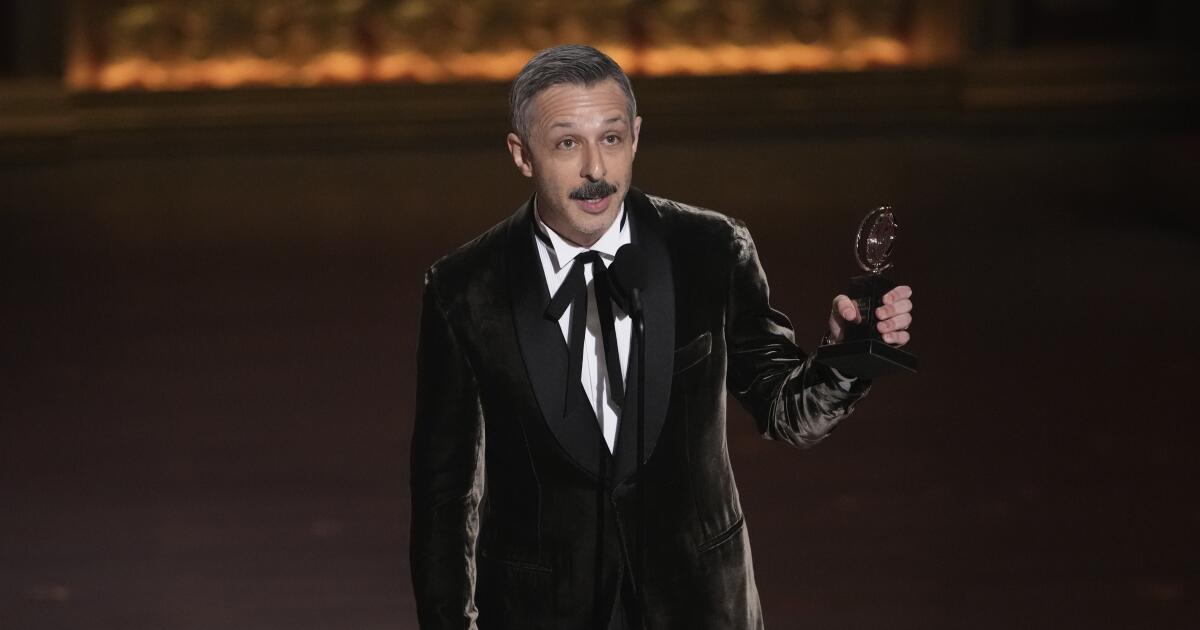
David Adjmi’s “Stereophonic” scored five Tony Awards including best play, and “The Outsiders” took home four trophies including an upset win for best musical as Broadway honored its finest on Sunday night.
Jonathan Groff won lead actor in a musical and co-star Daniel Radcliffe won featured actor for “Merrily We Roll Along,” which took home four awards total including best revival of a musical. Heading into the ceremony, the Alicia Keys musical “Hell’s Kitchen” and “Stereophonic” led with 13 nominations each, and a starry list of contenders included Eddie Redmayne for “Cabaret at the Kit Kat Club,” Jessica Lange and Jim Parsons for “Mother Play,” Rachel McAdams for “Mary Jane,” Leslie Odom Jr. for “Purlie Victorious,” and Sarah Paulson and Corey Stoll for “Appropriate.” The ceremony can now be streamed on demand; here’s how.
The complete winners list:
The company of “The Outsiders” performs during the 77th Tony Awards on Sunday.
(Charles Sykes / Invision / AP)
Best musical
“Hell’s Kitchen”
“Illinoise”
WINNER — “The Outsiders”
“Suffs”
“Water for Elephants”
Best play
“Jaja’s African Hair Braiding”
“Mary Jane”
“Mother Play”
“Prayer for the French Republic”
WINNER — “Stereophonic”
Best revival of a musical
“Cabaret at the Kit Kat Club”
“Gutenberg! The Musical!”
WINNER — “Merrily We Roll Along”
“The Who’s Tommy”
Best revival of a play
“An Enemy of the People”
WINNER — “Appropriate”
“Purlie Victorious: A Non-Confederate Romp Through the Cotton Patch”
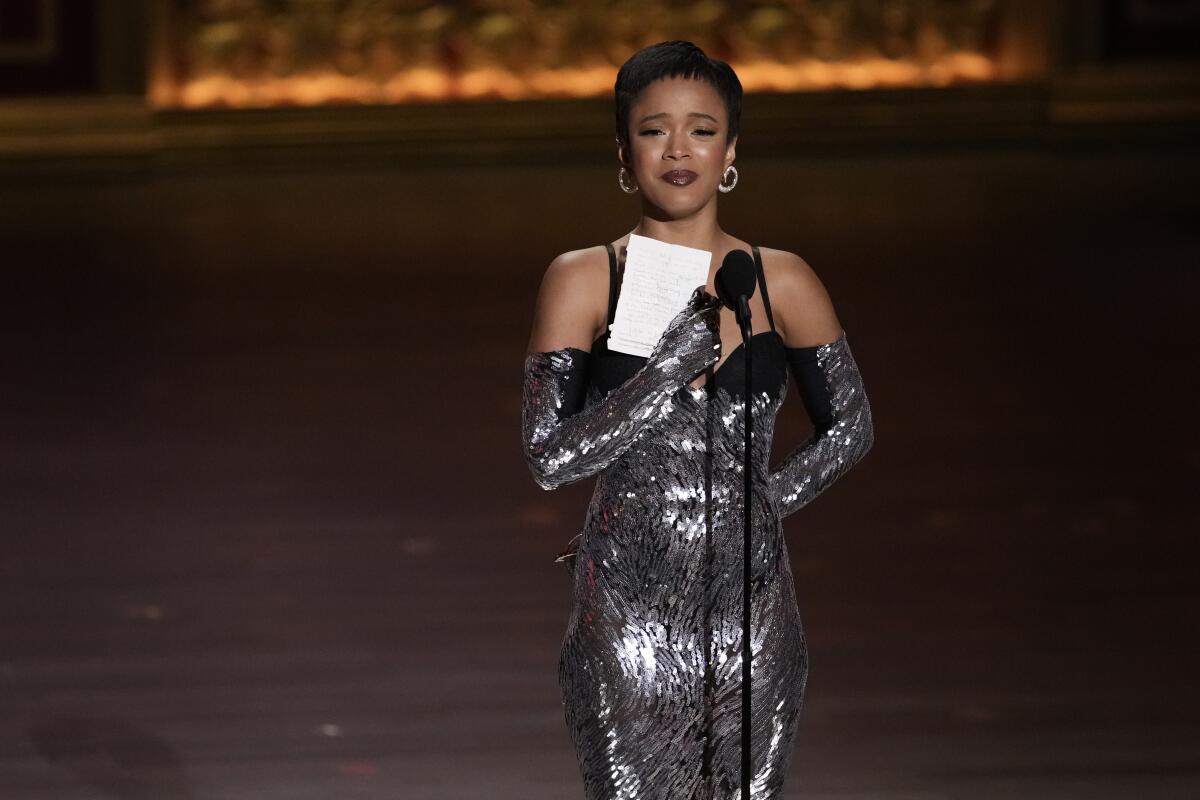
In the most moving speech of the night, Maleah Joi Moon accepts the Tony for lead actress in a musical for “Hell’s Kitchen.”
(Charles Sykes / Invision / AP)
Lead actress in a musical
Eden Espinosa, “Lempicka”
WINNER — Maleah Joi Moon, “Hell’s Kitchen”
Kelli O’Hara, “Days of Wine and Roses”
Maryann Plunkett, “The Notebook”
Gayle Rankin, “Cabaret at the Kit Kat Club”
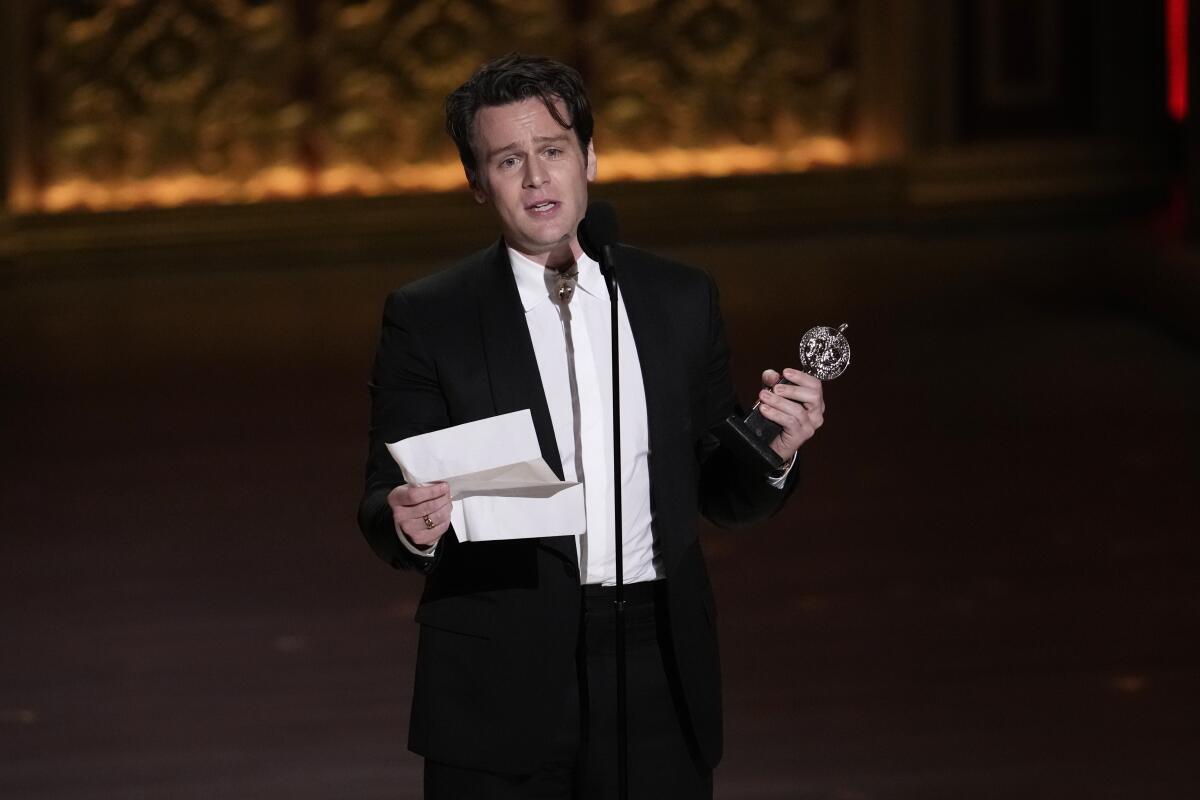
An emotional Jonathan Groff accepts the award for lead actor in a musical for “Merrily We Roll Along.”
(Charles Sykes / Invision / AP)
Lead actor in a musical
Brody Grant, “The Outsiders”
WINNER — Jonathan Groff, “Merrily We Roll Along”
Dorian Harewood, “The Notebook”
Brian D’Arcy James, “Days of Wine and Roses”
Eddie Redmayne, “Cabaret at the Kit Kat Club”
Lead actress in a play
Betsy Aidem, “Prayer for the French Republic”
Jessica Lange, “Mother Play”
Rachel McAdams, “Mary Jane”
WINNER — Sarah Paulson, “Appropriate”
Amy Ryan, “Doubt: A Parable”
Lead actor in a play
William Jackson Harper, “Uncle Vanya”
Leslie Odom Jr., “Purlie Victorious”
Liev Schreiber, “Doubt: A Parable”
WINNER — Jeremy Strong, “An Enemy of the People”
Michael Stuhlbarg, “Patriots”
Features actress in a play
Quincy Tyler Bernstine, “Doubt: A Parable”
Juliana Canfield, “Stereophonic”
Celia Keenan-Bolger, “Mother Play”
Sarah Pidgeon, “Stereophonic”
WINNER — Kara Young, “Purlie Victorious: A Non-Confederate Romp Through the Cotton Patch”
Featured actor in a play
WINNER — Will Brill, “Stereophonic”
Eli Gelb, “Stereophonic”
Jim Parsons, “Mother Play”
Tom Pecinka, “Stereophonic”
Corey Stoll, “Appropriate”
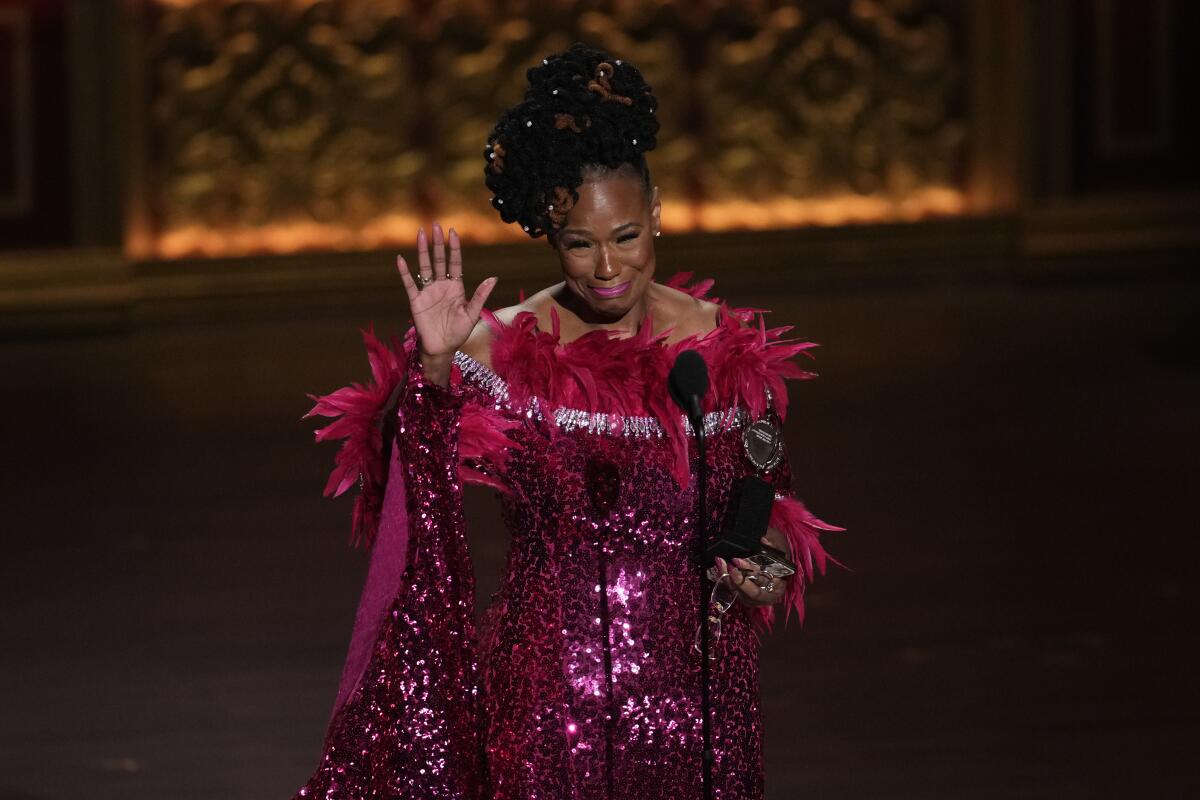
Theater veteran Kecia Lewis, winner for featured actress in a musical for “Hell’s Kitchen.”
(Charles Sykes / Invision / AP)
Featured actress in a musical
Shoshana Bean, “Hell’s Kitchen”
Amber Iman, “Lempicka”
Nikki M. James, “Suffs”
Leslie Rodriguez Kritzer, “Monty Python’s Spamalot”
WINNER — Kecia Lewis, “Hell’s Kitchen”
Lindsay Mendez, “Merrily We Roll Along”
Bebe Neuwirth, “Cabaret at the Kit Kat Club”
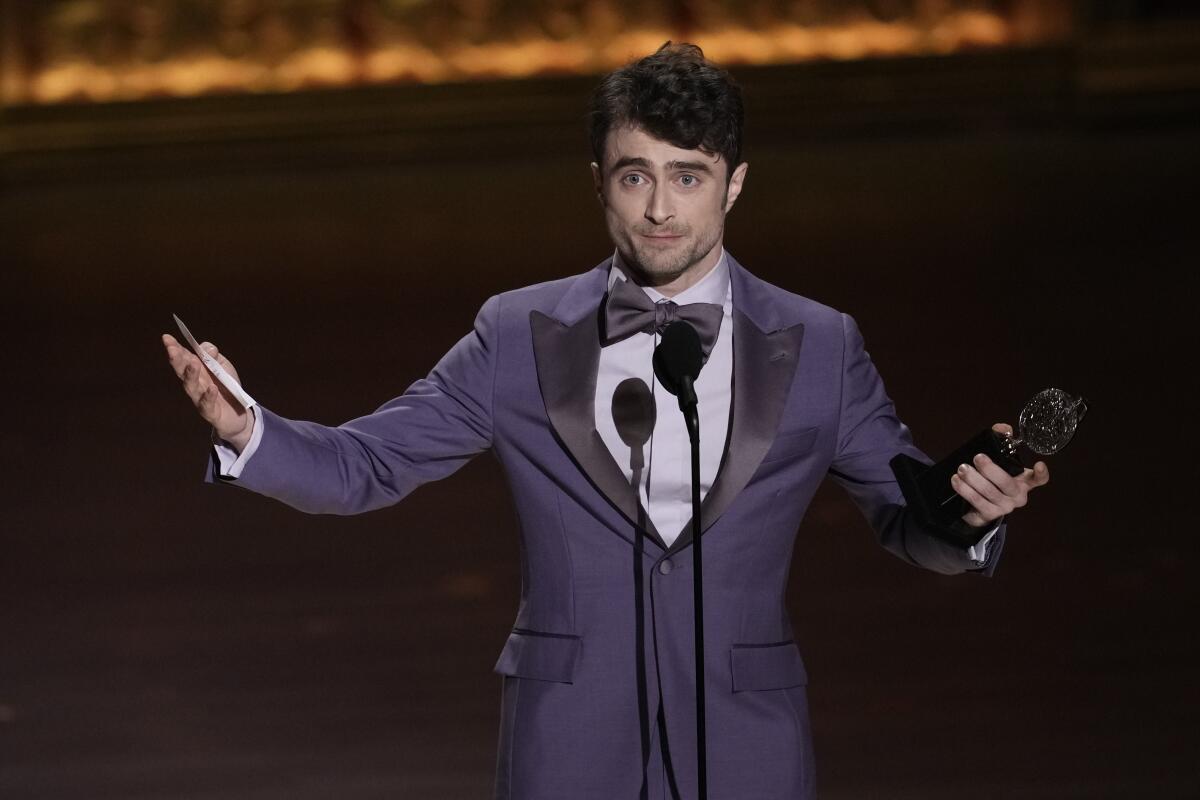
Daniel Radcliffe accepts the Tony Award for best actor in a featured role in a musical for “Merrily We Roll Along.”
(Charles Sykes / Invision / AP)
Featured actor in a musical
Roger Bart, “Back to the Future: The Musical”
Joshua Boone, “The Outsiders”
Brandon Victor Dixon, “Hell’s Kitchen”
Sky Lakota-Lynch, “The Outsiders”
WINNER — Daniel Radcliffe, “Merrily We Roll Along”
Steven Skybell, “Cabaret at the Kit Kat Club”
Direction of a play
WINNER — Daniel Aukin, “Stereophonic”
Anne Kauffman, “Mary Jane”
Kenny Leon, “Purlie Victorious: A Non-Confederate Romp Through the Cotton Patch”
Lila Neugebauer, “Appropriate”
Whitney White, “Jaja’s African Hair Braiding”
Direction of a musical
Maria Friedman, “Merrily We Roll Along”
Michael Greif, “Hell’s Kitchen”
Leigh Silverman, “Suffs”
Jessica Stone, “Water for Elephants”
WINNER — Danya Taymor, “The Outsiders”
Book of a musical
Kristoffer Diaz, “Hell’s Kitchen”
Bekah Brunstetter, “The Notebook”
Adam Rapp and Justin Levine, “The Outsiders”
WINNER — Shaina Taub, “Suffs”
Rick Elice, “Water for Elephants”
Orchestrations
Timo Andres, “Illinoise”
Will Butler and Justin Craig, “Stereophonic”
Justin Levine, Matt Hinkley and Jamestown Revival (Jonathan Clay and Zach Chance), “The Outsiders”
Tom Kitt and Adam Blackstone, “Hell’s Kitchen”
WINNER — Jonathan Tunick, “Merrily We Roll Along”
Choreography
Annie-B Parson, “Here Lies Love”
Camille A. Brown, “Hell’s Kitchen”
Rick Kuperman and Jeff Kuperman, “The Outsiders”
WINNER — Justin Peck, “Illinoise”
Jesse Robb and Shana Carroll, “Water for Elephants”
Scenic design of a play
dots, “Appropriate”
dots, “An Enemy of the People”
Derek McLane, “Purlie Victorious: A Non-Confederate Romp Through the Cotton Patch”
David Zinn, “Jaja’s African Hair Braiding”
WINNER — David Zinn, “Stereophonic”
Scenic design of a musical
AMP featuring Tatiana Kahvegian, “The Outsiders”
Robert Brill and Peter Nigrini, “Hell’s Kitchen”
Takeshi Kata, “Water for Elephants”
David Korins, “Here Lies Love”
Riccardo Hernández and Peter Nigrini, “Lempicka”
Tim Hatley and Finn Ross, “Back to the Future: The Musical”
WINNER — Tom Scutt, “Cabaret at the Kit Kat Club”
Costume design of a play
Dede Ayite, “Appropriate”
WINNER — Dede Ayite, “Jaja’s African Hair Braiding”
Enver Chakartash, “Stereophonic”
Emilio Sosa, “Purlie Victorious: A Non-Confederate Romp Through the Cotton Patch”
David Zinn, “An Enemy of the People”
Costume design of a musical
Dede Ayite, “Hell’s Kitchen”
WINNER — Linda Cho, “The Great Gatsby”
David Israel Reynoso, “Water for Elephants”
Tom Scutt, “Cabaret at the Kit Kat Club”
Paul Tazewell, “Suffs”
Lighting design of a play
Isabella Byrd, “An Enemy of the People”
Amith Chandrashaker, “Prayer for the French Republic”
Jiyoun Chang, “Stereophonic”
WINNER — Jane Cox, “Appropriate”
Natasha Katz, “Grey House”
Lighting design of a musical
Brandon Stirling Baker, “Illinoise”
Isabella Byrd, “Cabaret at the Kit Kat Club”
Natasha Katz, “Hell’s Kitchen”
Bradley King and David Bengali, “Water for Elephants”
WINNER — Brian MacDevitt and Hana S. Kim, “The Outsiders”
Sound design of a play
Justin Ellington and Stefania Bulbarella, “Jaja’s African Hair Braiding”
Leah Gelpe, “Mary Jane”
Tom Gibbons, “Grey House”
Bray Poor and Will Pickens, “Appropriate”
WINNER — Ryan Rumery, “Stereophonic”
Sound design of a musical
M.L. Dogg and Cody Spencer, “Here Lies Love”
Kai Harada, “Merrily We Roll Along”
Nick Lidster for Autograph, “Cabaret at the Kit Kat Club”
Gareth Owen, “Hell’s Kitchen”
WINNER — Cody Spencer, “The Outsiders”
Original score (music and/or lyrics) written for the theater
“Days of Wine and Roses”
Music & Lyrics: Adam Guettel
“Here Lies Love”
Music: David Byrne and Fatboy Slim
Lyrics: David Byrne
“The Outsiders”
Music & Lyrics: Jamestown Revival (Jonathan Clay and Zach Chance) and Justin Levine
“Stereophonic”
Music & Lyrics: Will Butler
WINNER
“Suffs”
Music & Lyrics: Shaina Taub


Earnest, preachy and melodramatic to a fault, “Mississippi Scholar” is exactly the sort of movie that the independent cinema was born to create.
Director and co-writer Marcus Bleecker’s film may traffic in tropes and cliches. But it has a vivid sense of place and a clear notion of the message it wants to send, and that message’s relevence.
Set in an unnamed small Mississippi city — it was filmed in Baldwyn, Saltillo and Fulton — the film is “a mind is a terrible thing to waste” in cinematic form. Our “Scholar” was born into a world of substance abuse, the racist legal traps of the country’s remaining marijuana laws and has a baby-mama-in-waiting and a drunken parent whom our teen hero is responsible for as his burdens.
But he has a world of promise that one dedicated teacher, his dead father (whom he still converses with) and even he himself can see if he can just “stay focused” and keep his eyes on this very personal prize — college and a better life beyond Ole Miss.
Shannon Brown is James, a kid with great grades and an ill-tempered mother (Gisla Stringer) who crawled into the bottle a long time ago and has no interest in crawling out.
But he’s got an ad hoc support system helping him through his senior year. His aunt (GiGi Marie Gaines) feeds him and keeps him advised of his mother’s latest tumbles. His dead dad (co-writer Obba Babatundé) passes on wisdom about his mother in fortune cookie-sized bites when father and son chat — at the cemetary or elsewhere.
“Hurt people hurt people.”
His English teacher, Mr. Keating (Sonny Marinelli) has high hopes for him, hopes he’s willing to nag the kid to achieve — “It takes only five seconds to get in trouble, and 25 years to get out of it!”
His school principal (Lance E. Nichols) expects greatness, but has learned to never get his hopes up over any Black boy at his integrated high school.
Even Ray-Ray (Jeremy Isaiah Earl), the ex-con drug dealer, takes a brotherly interest in the kid who is his “best distributor.” That money is what keeps a roof over James’ and his mother’s heads, and pays for his Jordans.
His white boy bestie (Dominic Arvielo) may act “Black,” but will he have James’ back when things get real?
And girlfriend Tammy (Aysa Branch) may be far and away the prettiest girl in school. But she’s taking the easy route, relying on her looks to achieve the limited goals the script sketches out for her.
“We’re gonna have ourselves a baby as soon as we graduate!”
Bleecker’s film covers all of the bases, all of the tropes and most of the cliches as James faces Big Choices with perils to his plan at every turn. Maybe taking him to visit the football-mad University of Mississippi isn’t the deal-maker his teacher hopes it is, as James doesn’t “see anybody who looks like me.”
Only a real civil rights hero (Dr. Donald Cole) can set him straight, relating the story of what James Meredith and generations before him did to give James this chance. Or can he?
“Mississippi Scholar” is well-crafted and an easy film to like, with relatable if “stock” characters and decent performances from all but the most amateurish (James’ classmates) cast members. But it’s entirely too predictable to surprise and too pre-digested to have an edge.
Worthy subject and novel setting aside, we’ve seen this story on the big screen and the small one too many times to count, seen this kid’s hand played out in every variation the cards have to offer.
But it makes a fine calling card for its cinematographer turned director, and let’s hope we see Bleecker’s name and hear his voice in another Deep South indie film, and soon.

Rating: TV-14, violence, profanity
Cast: Shannon Brown, Gisla Stringer, Sonny Marinelli, Jeremy Isiaah Earl, Aysa Branch and
Obba Babatundé
Credits: Directed by Marcus Bleecker, scripted by
Obba Babatundé, Marcus Bleecker and P.J. Leonard. A Narrative Distribution release on Amazon Prime.
Running time: 1:24

Entertainment
Dan Finnerty profaned Bonnie Tyler’s hit in ‘Old School.’ He regrets the f-bombs at her shows

For a certain swath of millennials, Dan Finnerty’s rendition of Bonnie Tyler’s “Total Eclipse of The Heart” in the frat comedy “Old School” is its definitive performance.
In the 2003 film, the Dan Band’s sweaty, inappropriately exuberant version of the ’80s power ballad upstages Will Ferrell’s wedding. The scene forever changed the lyrics of Tyler’s hit to something much more profane, but no less yearning.
After Tyler’s death at 75, Finnerty (who played a similar role in “The Hangover,” among many other comedies) reflected on his sideways journey into Tyler’s career, and how one quick scene on a two-decade-old comedy still endures.
You’ve had a pretty unique relationship to Bonnie Tyler’s music, how are you feeling after she passed?
It’s definitely sad. Everybody is texting me. I never met her, but what an impact she had on me. I grew up right when “Total Eclipse” came out in the ’80s, and it was such a huge song at the time. It had never left my head. I was always just belting that song out because it’s so epic, from Jim Steinman’s writing to Bonnie’s performance.
Why does that moment from “Old School” still endure? It arrived at the last cusp of the DVD era before culture transitioned into the internet and streaming video.
Without YouTube and the internet, you really had to grab pop culture moments from your memory. That’s definitely one of the reasons why pulling it out seemed obscure when we did “Old School.” People were like, “Oh my God, yes, I love this f— song.” Which is so different now because everything’s at your fingertips, so you can’t really rely on like pulling back some nostalgia moment because it’s always around anyway now with the internet. But people were reacting as much to me dropping the f-bombs as the nostalgia of the song, and rediscovering it and realizing that the song kicks ass and never stops kicking it.
Was the song already in your repertoire when you filmed “Old School?”
I was doing my show with the Dan Band in Los Angeles, and [director] Todd Phillips ended up coming to one of the performances. I met him afterwards, and he was like, “There’s actually a wedding scene in this movie. What song would you sing at a wedding?” I had just started working on a medley of “Total Eclipse,” and I think at the time I was going to do “Holding Out for a Hero,” but then I just merged it with “Private Dancer,” and he was like, “Oh my God, I love it.” The following Monday, he called and he’s like, “Can you put that together?”
The bit works because you totally commit to the song’s hugeness, and the profanity slips by like it’s spontaneous. You can tell you love the song on the merits.
I had never done it before. But Todd had seen my show, and when we went to do the first take, I didn’t think I was allowed to swear. But I obviously was swearing during my live show in all my little medleys. He came running up and he’s like, “Are you gonna swear like you do in the show?” I’m like, “Am I allowed to?” And he’s like, “Yeah.” So I’m like, “Buckle the f— up.”
But basically, what I was doing was honestly trying to match Bonnie’s commitment at the level she did with her voice, which is what I loved about all of her performances and Jim Steinman’s music. It’s just over-the-top commitment and drama. The swearing was just me being like, “How can I bump this up one notch when they’ve already just nailed it?”
Did you ever hear from either of them about what they thought about the film?
I’d tried to get Bonnie to do a duet of “Total Eclipse,” and I reached her management. He was like, “Well, Bonnie’s willing to do the song as long as there’s no profanity because she’s not a profane person.” I was like, “Well, neither the f— am I. I was an altar boy.” It didn’t end up working out, because I knew if I did the song without the swearing, people would be like, “What the f—?” But later, met Jim Steinman. I mentioned it to Steinman, and he was like, “Oh, I wish they called me because I can make Bonnie do anything, she’d love the swearing,” which killed me.
You did kind of alter her song forever for a certain generation.
I was just picturing them both hating how I bastardized their song. So when I finally met Steinman, he was like, “No, no, no! I f—ing loved it. In fact, I’ve always thought of all those epic booms, the Kurzweil, all the big hits in ‘Total Eclipse,’ those were musical f—s.”
Mostly I wanted to just find Bonnie and apologize to her for all the drunk guys I have pictured over the years at her concert screaming “F—” ever since that movie.
That song became your biggest hit as a comedian. How’d it change your life?
It got funnier the older we got. When I would do “Total Eclipse” right after “Old School” came out, it would get the biggest reaction. There was one set early on at the Playboy Mansion, we were hired to play some party there. There were just a bunch of drunk guys at the mansion and a couple Playboy bunnies that were contractually hired to walk around and wave. They’re like, “Play ‘Total Eclipse,’” and so I did. Then they’re like, “Play it again.” I’m like, “OK.” Then “Play it again.” I was like, “Here we go, give them what they want.” It was the least amount of work I had to do for a song that was pre-loved from a moment in a movie.
God, I hope she knew how much I loved her and apologize for all the drunk guys that had probably f-bombed the hell out of her concerts.
Before that song, people were like, “Do you have a flier for your next show?” I’m like, “For what?” But once “Old School” happened, suddenly a record label was like, “We want to do a live album.” I’m like, “Who’s gonna buy it?” But my manager is like, “Don’t say s— like that. There’s a record label that wants to make an album with you, dumbass.”
The whole thing has just been a surprise, but it’s been a good one. We’re playing this festival in Canada next weekend, and God, that song’s going to be such a big moment.

By ABBIE BERNSTEIN / Staff Writer
Posted: July 11th, 2026 / 10:07 PM
EVIL DEAD BURN movie poster | ©2026 New Line Cinemas / Screen Gems
Rating: R
Stars: Soheila Yacoub, Tandi Wright, Hunter Doohan, Luciane Buchanan, Errol Shand, Maude Davey, George Pullar, Greta van den Brink
Writers: Sébastien Vaniček & Florent Bernard, based on characters created by Sam Raimi
Director: Sébastien Vaniček
Distributor: New Line Cinema/Screen Gems
Release Date: July 12, 2026
The first THE EVIL DEAD was released in 1982, launching the careers of (among others) filmmaker Sam Raimi and actor Bruce Campbell. The film had two direct sequels, 1987’s EVIL DEAD II and 1992’s ARMY OF DARKNESS, both also directed by Raimi and starring Campbell. A three-season TV series, ASH VS EVIL DEAD (2015-2018), executive-produced by Raimi and again starring Campbell, continued the narrative.
The franchise was resurrected for the big screen with a quasi-remake, 2013’s EVIL DEAD, followed by 2023’s EVIL DEAD RISE, and now EVIL DEAD BURN. The latter three have Raimi and Campbell among the producers, but not as immediate creative participants.
The Raimi-directed EVIL DEAD movies centered on Campbell’s Ash, who found himself battling relentless Deadites (think chatty, sadistic rotting undead) summoned by the (fictional) forbidden text THE NECRONOMICON (originally invented by writer H.P. Lovecraft in the 1920s for his Cthulhu Mythos). The Deadites delight in transforming luckless humans into, well, the evil dead.
The first three films and the TV series were splat-stick comedy, with jokes cheek and jowl with the gore.
The subsequent films have flashes of humor, but they are much more focused on straight horror, as well as family drama.
This is absolutely the case with EVIL DEAD BURN, written by Sébastien Vaniček & Florent Bernard and directed by Vaniček.
Here, the family at the center of events is on the verge of imploding, even without demonic intervention.
EVIL DEAD BURN is tangentially related to EVIL DEAD RISE, insofar as the earlier film’s wraparound deposited Deadite Jessica (Anna-Maree Thomas) in a lake. At the start of BURN, two unfortunate fishermen snag a Deadite played by Greta van den Brink, who was Thomas’s stunt double on RISE, so this may be the same character.
Meanwhile, Joseph (Hunter Doohan) is in a dusty upstairs room, curiously perusing clippings, writings, reel-to-reel tape recordings and more amassed by his grandfather. We’ll learn that Grandpa is considered the family flake because he declined to spend time with his wife and daughters in favor of traveling the world investigating the occult.
A recording Joseph’s grandfather left behind conveniently provides us with what we (and Joseph) need in terms of exposition. This includes a bit about the Kandarian dagger, which the Deadites want to obtain and destroy, as it’s the only item that can permanently kill them. Grandad has left it somewhere on the premises.
It’s Joseph’s birthday, and there’s a celebration for him at the party club owned by his older brother Will (George Pullar) and Will’s French wife Alice (Soheila Yacoub). Joseph’s supportive girlfriend Thya (Luciane Buchanan) tries to mediate as Will first condescends to his little brother, then gets into an aggressive fight with Alice.
The argument spills into the club parking lot, where we see further evidence of Will’s controlling, contemptuous and violent personality before he gets into his car and drives away at top speed.
Meanwhile, our lake Deadite has taken to the road, where she easily causes Will to crash. The car erupts in flames.
At the sparse funeral held at a crematorium, Alice is wearing running shoes, to the great displeasure of her grieving in-laws Susan (Tandi Wright) and Edgar (Errol Shand). Susan’s elderly mother Polly (Maude Davey) is in a wheelchair and keeps confusing Susan with Susan’s deceased sibling Bonnie.
Susan and Edgar generally resent Alice and blame her for Will’s death. They also disapprove of Joseph, who they view as a slacker. He hasn’t done a good job of maintaining the isolated two-story family home he’s been given by his parents, and Susan takes a very dim view of Joseph’s investigation into his grandfather’s interests.
So, this is a toxic setup even before Edgar decides he must take one last look at Will in his coffin before the cremation. Then everybody heads back – Edgar is infected, but not “showing” yet – to the house.
From here, EVIL DEAD BURN goes pretty much where we anticipate, and where the subgenre demands, with almost nonstop violence, excellent practical effects, lots of gore, and admirable acting of that encompasses unhappiness, terror, and taunting Deadite glee.
Director Vaniček makes sure to incorporate some of the EVIL DEAD touchstones, including the racing low-to-the-ground shots (using one for a nice in-joke), chainsaws, and some catchphrases. At the same time, there are plenty of new set pieces and types of physical altercations.
With no forcing at all, EVIL DEAD BURN serves as a solid metaphor for both spousal abuse and what happens when parents turn a willful blind eye to the nature of a favored child, to the detriment of everyone and everything in the vicinity.
For those who care about these things (does this really even count as a spoiler?), the dog dies, albeit there’s at least a plot logistics reason here.
There are a couple inconsistencies, like why some people become infected so fast while others take much more time and still others seem immune. Mostly, though, EVIL DEAD BURN does what it’s supposed to do as a horror movie overall and as part of its specific lineage.
Related: Movie Review: CORPORATE RETREAT
Related: Movie Review: TIME OF DEATH
Related: Movie Review: CHAPTER 51
Related: Movie Review: MINIONS & MONSTERS
Related: Movie Review: LOCKBOX
Related: Movie Review: SUPERGIRL
Related: Movie Review: THE GET OUT
Related: Movie Review: CAMP
Related: Movie Review: LEVITICUS
Related: Movie Review: DISCLOSURE DAY
Related: Movie Review: KRAKEN
Related: Movie Review: FIND YOUR FRIENDS
Related: Movie Review: CHUM
Related: Movie Review: CAROLINA CAROLINE
Related: Movie Review: THE SUMMONING
Related: Movie Review: BACKROOMS
Related: Movie Review: SPEED DEMON
Related: Movie Review: PRESSURE
Related: Movie Review: PASSENGER
Related: Movie Review: I LOVE BOOSTERS
Related: TV Review: GREAT PERFORMANCES: STAGEBOUND
Related: Movie Review: OBSESSION
Related: Movie Review: LIFEHACK
Related: Movie Review: IS GOD IS
Related: Movie Review: AFFECTION
Related: Movie Review: ITCH!
Related: Movie Review: HOKUM
Related: Movie Review: ANIMAL FARM
Related: Movie Review: OVER YOUR DEAD BODY
Related: Movie Review: LEE CRONIN’S THE MUMMY
Related: Movie Review: HAPPY HALLOWEEN
Related: Movie Review: NORMAL
Related: Movie Review: FACES OF DEATH
Related: Movie Review: EXIT 8
Related: Movie Review: READY OR NOT 2: HERE I COME
Follow us on Twitter at ASSIGNMENT X
Like us on Facebook at ASSIGNMENT X
Article Source: Assignment X
Article: Movie Review: EVIL DEAD BURN
Related
Related Posts:
-
 Sports50 seconds ago
Dodgers swept by Diamondbacks in first winless series of season as they stagger into All-Star break
-

 World13 minutes ago
At least 27 dead as fire engulfs popular Bangkok pub near Chatuchak market
-
 News43 minutes ago
Want to own a real T. rex? It could cost you $30 million
-

 Los Angeles, Ca2 hours ago
Rare, corpse flower double bloom underway at Huntington Library
-

 Detroit, MI3 hours ago
Around 400 pairs of shoes intended for charity giveaway stolen from Detroit nonprofit, organization says
-

 San Francisco, CA3 hours ago
How to watch San Francisco Giants vs. Colorado Rockies
-

 Dallas, TX3 hours ago
3 unanswered questions before training camp: Dallas Cowboys edition
-

 Miami, FL3 hours ago
“Love & Hip Hop: Atlanta” star Tommie Lee among 6 arrested during World Cup match in Miami, sheriff says

