Politics
After raids, U.S. citizens and immigrants seek millions for shootings, injuries, trauma


WASHINGTON — Last June 16, armed immigration agents broke the locks to forcibly enter an Oxnard auto body shop. Juan Carlos Ramirez, a U.S. citizen, filmed as they arrested his father.
Then the agents pepper-sprayed Ramirez, slammed him onto the hoods of two vehicles, punched his face and kneed him in the side, according to a legal claim he later filed against the federal government.
Local attorney Vanessa Valdez denounced Ramirez’s arrest at an Oxnard City Council meeting the next day. The following month, Valdez found herself in a similar situation when agents raided the cannabis company Glass House Farms.
Despite identifying herself as a legal observer, she said, agents — or possibly National Guard — deployed tear gas and shot her six times with rubber bullets. She ran and then, unable to see, crawled on all fours to escape.
Vanessa Valdez, a Ventura-based attorney, has filed a claim against the federal government, alleging she was hit with tear gas and six rubber bullets during the Glass House Farms raid last July.
(Christina House / Los Angeles Times)
“They were just shooting aimlessly, it seemed like,” she said. “I thought maybe they had fractured a rib because that’s how painful it was. I couldn’t sleep face down for three weeks.”
Ramirez and Valdez are among the dozens of U.S. citizens and immigrants who are seeking financial compensation for damages they say they suffered during President Trump’s immigration dragnet. For Valdez, that includes the cost of hospital visits, lost wages as she recovered, anxiety medication and seeing a therapist.
After reviewing public accounts and legal documents and interviews with more than a dozen lawyers and immigrants, The Times found that claimants from across the country are seeking at least $260 million.
In a statement, Homeland Security spokesperson Lauren Bis wrote that ICE officers are held to the highest professional standard and receive regular training. Bis said that when agents are faced with danger, they use their training to protect themselves and the public.
“The pattern is NOT of law enforcement using force. It’s a pattern of violent agitators attacking our law enforcement,” she wrote.
Asked about Valdez, Bis said law enforcement deployed chemical irritants including pepper balls, but not rubber bullets, after agitators attempted to breach the perimeter at Glass House Farms. She said Ramirez refused officer’s commands and physically attacked them, so they pepper-sprayed him in self-defense.
Lawyers who are experts in tort claims said the bureaucratic process is lengthy and complex, and any damage award would likely be lower than what a claimant is seeking.
Still, seeking redress through the Federal Tort Claims Act is one of the few legal remedies available for those seeking financial compensation for deaths, physical injuries, emotional trauma, unlawful detention or property damage caused by federal employees.
The number of claims is expected to rise.

Federal agents, some wearing street clothes and some wearing uniforms and protective gear, form a defensive line against hundreds of protesters outside the Metropolitan Detention Center in Los Angeles on Jan. 30.
(Allen J. Schaben / Los Angeles Times)
In recent months, advocacy organizations have prepared practice advisories for attorneys interested in filing tort claims, and law groups across the country have begun holding training sessions on the process.
“There is no question in my mind that a lot of people — hundreds, thousands — have been harmed significantly and will be legally entitled to large damages payouts, which are going to come from the federal government,” said Jonathan Feinberg, a Philadelphia-based attorney.
Feinberg, who specializes in cases involving excessive use of force by police and abuses of detained immigrants, is president of the board of directors for the National Police Accountability Project, which focuses on law enforcement misconduct.
“We’re going to be talking about Minneapolis in 2030,” he added.
Before they can sue in federal court, individuals must first request a review by the agency that they say is responsible, such as Immigration and Customs Enforcement or Customs and Border Protection. The agency has six months to respond and deny the claim or offer a settlement.
If the agency doesn’t respond or denies a claim, the claimant can then file suit.
Unlike civil rights lawsuits, in which juries decide the verdict, in tort cases, judges make that call. Only the agencies are named as defendants, not individuals.
The Times reviewed the claims of nearly 80 people filed since the start of 2025. The vast majority remain in the review stage. Lawyers anticipate most will not be settled, unleashing a flood of lawsuits starting this summer.
Federal law since 1871 has established that people can sue state and local officials for violating their constitutional rights. But the law left out federal actors.
One hundred years later, the Supreme Court allowed for damages lawsuits against federal officials who violate a person’s civil rights, though decisions in recent years have substantially narrowed that ability.
Democrats in California are pursuing legislation that would make it easier for residents to seek financial damages for constitutional violations committed by federal agents. Similar laws were already enacted in Maryland, Illinois and Connecticut, though the Trump administration has sued to block the latter two.
But there is a different route — tort claims.
Tort cases can be difficult to win, in part because the government can claim a “discretionary function exception,” which shields the agency from liability when the situation involves a policy-driven judgment call.
“So that’s what a lot of plaintiff’s lawyers are really anxious about, that the Trump administration is going to say, ‘Well, we’ve got our own immigration policies. Of course a lot of people disagree with them, but the statute is designed to give us the right to make those policy judgments,’” said Benjamin Zipursky, a Fordham University law professor who studies torts.
“Now, if I were the plaintiff’s lawyer, I would say, ‘Yeah, but shooting somebody in cold blood because you’re just mad about their political views, and they’re not really threatening your life at all — that’s not a policy judgment,’” he said.
The law office of John Burris, an Oakland-based attorney who represented Rodney King after he was severely beaten by Los Angeles police officers in 1991, has taken on damages clients in Minnesota. He said he anticipates filing around 80 tort claims stemming from the immigration enforcement actions there.

A memorial for Renee Good at the location where she was fatally shot in Minneapolis.
(Eric Thayer / Los Angeles Times)
Burris said the experience has given him flashbacks to the period before King’s beating and the subsequent protests over police brutality, when officers felt they could act with impunity.
“There’s 1779825246 a more fundamental understanding that bad stuff does happen,” he said. “Everyday people are not as willing as they once were to just accept a police officer’s perspective.”
Public disapproval over immigration enforcement rose after federal immigration agents in Minneapolis shot and killed two 37-year-old U.S. citizens, Renee Good, a mother of three, and Alex Pretti, an ICU nurse, in separate incidents.
Other deaths took place before the Minnesota operation: 23-year-old Ruben Ray Martinez, who was killed by an ICE agent in Texas who fired repeatedly through the open window of his car; Keith Porter, 43, who was killed in Los Angeles by an off-duty ICE agent after shooting his gun into the air on New Year’s Eve; and Jaime Alanis Garcia, 57, who fell 30 feet from atop a greenhouse while fleeing agents at the Glass House Farms site in Camarillo.
Lawyers for the families of Good, Martinez and Garcia confirmed they are pursuing tort claims. Lawyers for the other families did not respond to requests for comment.
Additional highly publicized cases have also resulted in tort claims: Marimar Martinez, who was shot five times by a Border Patrol agent in Chicago; Mahmoud Khalil, the Columbia University student and Palestinian rights activist who spent 104 days detained after the administration labeled him a national security threat; Aliya Rahman, a disabled woman on her way to a doctor’s appointment in Minneapolis who blacked out at a detention facility after ICE agents detained her.
New claims appear to be filed weekly. Seventeen men, women and children who were detained in a military-style raid at a Chicago apartment complex filed claims this month seeking about $5 million each.
In many of the cases, Bis said, the claimants impeded or assaulted agents. Pretti’s death remains under investigation, she said.

Willy Wender Aceituno stands in the parking lot where he was arrested last November by ICE agents in Charlotte, N.C.
(Jesse Barber / For The Times)
Willy Wender Aceituno was already a plaintiff in a class-action lawsuit filed by the ACLU of North Carolina challenging the policy allowing warrantless immigration arrests after he was stopped twice in a span of minutes by immigration agents last November. In March, he also submitted a tort claim.
Aceituno is a Honduran-born U.S. citizen who voted for Trump. On the day he was arrested, a group of masked agents checked his identification and left. Aceituno then filmed as a second group surrounded his red truck.
“If you break it, you will pay for it,” he tells them in Spanish seconds before one agent smashes the window with a baton. “Why did you do that, sir?”
Aceituno suffered cuts when agents threw him to the ground, which was covered in shattered glass. They placed him in an SUV with other detainees and drove him around Charlotte, N.C., before releasing him, still bleeding, more than 2 miles from his vehicle.
The moment brought back Aceituno’s childhood memory of watching his father be arrested by the Honduran military and disappeared.
“I remember they broke down the door, entered, put him in handcuffs and threw him to the ground,” he said. “I thought, ‘It’s happening again.’ To see the other Hispanics in the car made it feel like this is racial persecution. This is about skin, not criminality.”
Bis, the Homeland Security spokesperson, said Aceituno acted erratically, escalated the situation and refused to comply with officers’ commands.
Lawyers said many people, especially immigrants, who have viable claims have chosen not to pursue them out of fear of being targeted for deportation. Some were deported before they could sue.
“Even now, our clients wake up some days thinking, ‘What am I doing suing the federal government?’” said Iván Espinoza-Madrigal, executive director of the Massachusetts-based Lawyers for Civil Rights. “You have to have a lot of courage to be able to stand up against an administration that has put a bull’s-eye on you and that has targeted you based on your identity.”
Others have turned to mutual aid or online fundraisers to pay for medical bills or to repair property damage. On the website GoFundMe, donation campaigns describe shattered car windows, broken limbs, head trauma and mounting bills.
Some damage can’t be fully recompensated, Espinoza-Madrigal added.

Members of the Haitian community hold signs in support for the extension of Temporary Protected Status during a rally last month in Miami.
(Carl Juste / Miami Herald / Getty Images)
One of the organization’s clients is Jose Pineda, a Salvadoran man with Temporary Protected Status. A year ago, Pineda was stopped by ICE officers on his way to work in East Boston as a landscaper. They wouldn’t accept his Social Security and work authorization cards as proof enough that he was not deportable, and detained him without explanation, according to his tort claim.
So Pineda spent nearly two days in a holding cell at the ICE Boston Field Office with around 50 other people. He couldn’t sit or sleep and received minimal water and food.
Bis said agents “briefly questioned” Pineda because he matched the description of the subject of an operation, and that he was released after being identified.
When he was released, the claim alleges, his documents were returned but $600 in cash that he was saving to pay rent was not. The incident left him with frequent headaches, anxiety and memory loss, and exacerbated his gastritis. His absence from work resulted in a demotion from lead foreman to an assistant role.
“Whenever I drive, if someone stays behind me for three, four or five minutes, I start to imagine that it’s them again,” he said in an interview.
Pineda’s arrest also caused recurring nightmares that leave him shouting and thrashing around in bed. Out of fear that he could inadvertently harm his wife, they now sleep in separate beds.


James Gagliano on anti-ICE protests and threats against agents
Retired FBI Special Agent James Gagliano discusses anti-ICE protests and threats against agents in Newark, New Jersey. A new curfew has curbed chaos after violent clashes, with one Brooklyn man arrested for threatening to kill an ICE agent. DHS Secretary Markwayne Mullin vows ‘zero tolerance’ for attacks, while Sen. Cory Booker, D- N.J., calls ICE ‘out-of-control.’ Gagliano warns against allowing these protests to continue.
NEWYou can now listen to Fox News articles!
A Canadian national accused of slapping a teen wearing political clothing at the Jersey Shore has been turned over to Immigration and Customs Enforcement, a representative for the local jail told Fox News Digital on Wednesday.
Over the Fourth of July weekend, Kaitlyn Tracey, 33, was reportedly seen on surveillance video confronting a group of teens in Point Pleasant Beach, some of whom were wearing pants with the words “Trump” and “ICE” on them, local media reported.
Tracey, a Canadian national who entered the U.S. on a passport in 2024, then allegedly struck one of the girls and recorded the confrontation, according to court documents reported by NJ.com.
An official who picked up the phone at the Ocean County Jail in Toms River confirmed to Fox News Digital that Tracey had been released into ICE custody as of Monday.
ICE CLASHES WITH AGITATORS INTENSIFY OUTSIDE DELANEY HALL
She was reportedly taken to Delaney Hall in Newark – the site of months-long clashes between left-wing agitators and ICE.
NEW JERSEY GOVERNOR, DEMOCRATIC SENATOR SPEND MEMORIAL DAY PROTESTING ICE FACILITY
Billboard at Trump rally in Wildwood declaring historical blue New Jersey is “Trump Country.” (The Image Direct for Fox News Digital)
Tracey’s criminal charges include endangering the welfare of a child and simple assault, according to reports.
The alleged victim was reportedly uninjured.
NJ TAXPAYERS ON THE HOOK FOR $12M MORE AS DEM GOVERNOR PROTECTS ILLEGAL ALIENS BATTLING DEPORTATION
CLICK HERE TO DOWNLOAD THE FOX NEWS APP
While New Jersey at a state level has adopted sanctuary-type policies, Ocean County is known as one of the few Republican strongholds remaining, and retains the state’s longest-serving lawmaker of any party: Rep. Chris Smith, R-N.J., in office since 1981.
People enjoy the Jersey Shore in Seaside Heights, N.J., as businesses prepare for the holiday weekend on May 23, 2025. (Asbury Park Press via IMAGN)
SIGN UP TO GET THE POLITICS NEWSLETTER
It was not immediately clear on what immigration basis ICE initiated proceedings against Tracey. Fox News Digital reached out to DHS for clarification and comment.
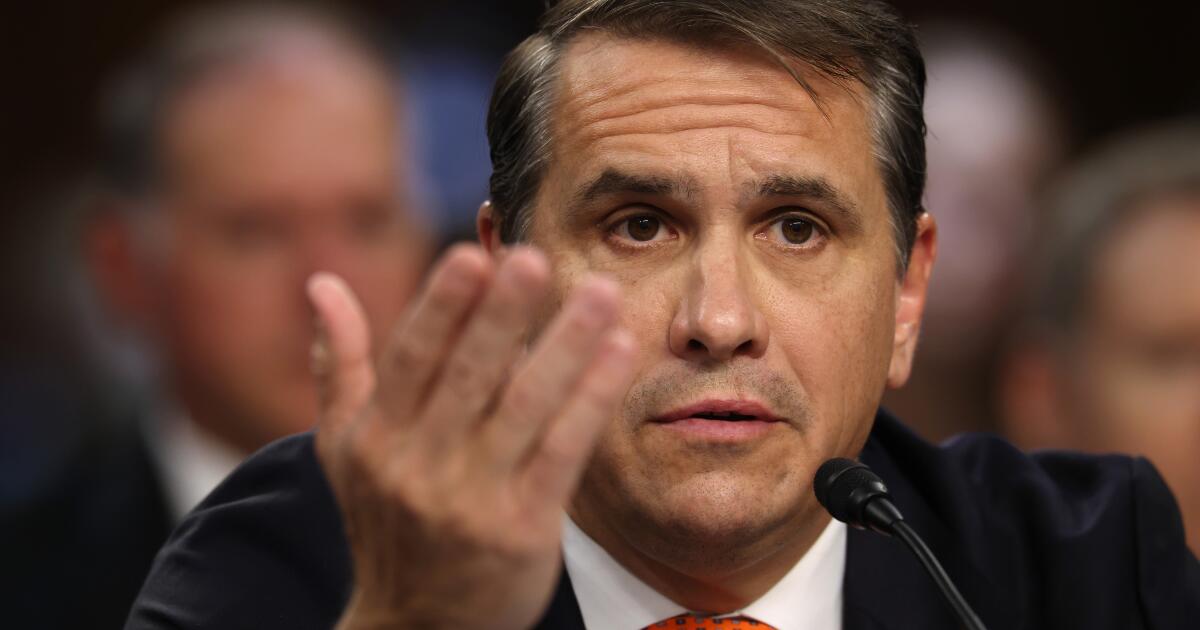
WASHINGTON — The Senate confirmation hearing Wednesday for Todd Blanche, President Trump’s pick for attorney general, will be a referendum on far more than his individual merits.
Blanche, the acting attorney general, served as Trump’s defense attorney before taking office and has been closely linked to many of the most consequential — and controversial — issues that have dominated the first two years of Trump’s second term.
Blanche is set to appear before the Senate Judiciary Committee, which will decide whether to approve his nomination and send it to the full Senate for a confirmation vote. The committee hearing will continue Thursday.
“I would expect committee Democrats to treat Mr. Blanche’s hearing as an opportunity to conduct oversight of the Department of Justice,” said Phil Brest, president of the American Constitution Society, a progressive legal nonprofit and a former top Democratic staffer on the committee. “It’s a test of the Senate’s willingness to probe the department’s operations and to actually serve as a check on the department and the administration more broadly.”
Democrats on the committee are expected to push Blanche on a host of topics, including the $1.8-billion “anti-weaponization fund” that critics derided as a slush fund for the president’s allies, the Justice Department’s rollout of the so-called Epstein files, and the department’s prosecution of several perceived enemies of Trump, notably former FBI Director James Comey.
“While deploying the Justice Department as a shield for the president and his cronies, Blanche has also used our top law-enforcement agency as a sword against Trump’s political opponents,” said Sen. Dick Durbin (D-Ill.), the ranking Democrat on the committee last month. “The independence of DOJ has been decimated under Blanche’s authority.”
Blanche was confirmed by the Senate as deputy attorney general in March, 2025, and was elevated to his current role after Atty. Gen. Pam Bondi was fired in April.
More critical to the success of Blanche’s nomination will be whether he can win the support of two lame-duck Republican senators, Thom Tillis of North Carolina and John Cornyn of Texas, who expressed some reservations about Blanche soon after his nomination was announced.
Cornyn raised concern about Blanche’s independence from Trump, while Tillis said Blanche’s stance on protesters who violently stormed the U.S. Capitol on Jan. 6, 2021, would be critical to his consideration.
Some of those Jan. 6 protesters were expected to be the beneficiaries of the $1.8-billion fund announced as part of a settlement to a lawsuit Trump and his sons and business brought against the IRS.
In a scathing ruling this week, the federal judge wrote that the lawsuit was improper and recommended sanctions against two Justice Department attorneys who worked on the case, though not Blanche himself.
Cornyn told Semafor on Tuesday that the ruling raised a number of issues, including “the potentially collusive nature of the lawsuit.”
He has said previously that he will hold off on making a decision about whether to approve Blanche until after the hearing.
Tillis, meanwhile, told CNN’s Manu Raju on Tuesday that the weaponization fund would need to be completely off the table for him to support Blanche’s nomination.
Trump touted Blanche’s record ahead of the hearing.
“Todd Blanche is doing a PHENOMENAL job as Acting Attorney General of the United States,” the president wrote on Truth Social. “He is a great lawyer, always very fair, and every Republican Senator should vote to CONFIRM Todd Blanche, ASAP!”
Sen. Lindsey Graham’s death means that Republicans currently only enjoy a one-seat majority, but a replacement for Graham on the committee could be in place before it votes on whether to move his nomination to the Senate floor, which will likely come two weeks after the hearing.
Blanche, 51, spent 12 years working for the U.S. attorney’s office for the Southern District of New York, working largely on drug and violent crime cases, and rose to the level of co-chief of the district’s White Plains division.
He left the office in 2014 for private practice and joined the prominent law firm Cadwalader, Wickersham & Taft in 2017 as a partner. He left the firm in 2023 and went independent after other partners expressed concern when he took Trump on as a client.
Blanche went on to represent Trump in several criminal matters, including the New York case about hush money payments to porn star Stormy Daniels, and cases brought by Special Counsel Jack Smith about Trump’s alleged efforts to block the transfer of power after the 2020 presidential election and his alleged retention of classified documents.
He listed all three as among the 10 most significant cases of his career in the questionnaire he completed ahead of the hearing, along with his work at the Justice Department on a lawsuit challenging the construction of a new White House ballroom.
A group of more than 1,200 former Justice Department attorneys wrote a letter opposing Blanche’s nomination, asserting that his leadership has resulted in mass departures of career staff. That has “meant that much of the department’s vital work isn’t being done, or isn’t being done as well – leaving communities less safe, Americans’ rights less protected, and our national security more vulnerable,” the lawyers wrote.
Former Justice Department pardon attorney Liz Oyer is scheduled to testify as a witness for Democrats on Thursday. She has said she was fired for refusing to recommend the restoration of actor Mel Gibson’s gun rights.
Oyer will be joined Thursday by Dani Bensky, one of many victims of the deceased sex abuser Jeffrey Epstein who has criticized Blanche’s handling of the release of the so-called Epstein files — millions of pages of records detailing the Justice Department’s investigations into Epstein’s crimes.
Numerous victims have said that their names and other sensitive information were not properly redacted in the files and criticized Blanche and the department for failing to investigate Epstein’s potential co-conspirators.
Blanche has also come under criticism from survivors of Epstein’s abuse for the interview he conducted in July, 2025, with Epstein accomplice Ghislaine Maxwell, who is serving a 20-year prison sentence for her role in facilitating and participating in Epstein’s abuse.
Days after their interview, Maxwell was moved from her prison in Florida to a minimum-security prison in Texas.
Politics
Biden special counsel’s ‘runaway train’ scooped up sensitive lawmaker info: ‘Abuse of power’

NEWYou can now listen to Fox News articles!
Former special counsel Jack Smith’s investigation into President Donald Trump swept up text messages from nearly 50 members of Congress, bypassing a required review process in what one victim alleged is a direct constitutional violation.
Senate Judiciary Committee Chairman Charles Grassley, R-Iowa, said the situation is more proof Smith’s probe was a “runaway train” of abuses of power, and the elder statesman and Senate Investigations Subcommittee Chairman Ron Johnson, R-Wis., jointly released their filings Tuesday evening.
Grassley and Johnson’s findings were from a full-scale probe of Operation Arctic Frost, the code name for Smith’s endeavor to investigate Trump for alleged corruption and election malfeasance, an operation top Senate Republicans call “worse than Watergate.”
LEGAL WAR ON TRUMP’S AGENDA GAINS FIREPOWER AS FEDERAL LAWYERS DEFECT TO DEMOCRATS
Jack Smith, former U.S. special counsel, arrives for a closed-door deposition before the House Judiciary Committee in Washington, D.C., Dec. 17, 2025. (Getty Images)
Forty-four members of Congress had the contents of their text messages obtained and reviewed by Smith’s team in a way that bypassed protocol. A “filter team” was tasked with reviewing millions of documents in the case and should have had first crack at determining whether such messages were relevant or potentially violated statute or ethics.
Rep. Elise Stefanik, R-N.Y., one of the lawmakers whose texts were swept up in this way, said Tuesday such reviews amounted to clear violations of the Constitution’s speech and debate clause that protects lawmakers from being questioned in “any other place” than the Capitol for legislative acts.
Internal communications have been historically included in that clause in the courts as technology has advanced.
SUPREME COURT JUSTICES HEAD TO CAPITOL HILL FOR FIRST CONGRESSIONAL APPEARANCE SINCE 2019
Stefanik said in a statement that the new records prove Smith’s team “unlawfully and unconstitutionally accessed my private text messages, along with 43 other Members of Congress, in clear violation of the Constitution.”
She said she long suspected there had been “unconstitutional spy[ing] on members of Congress.”
The records were provided by the Trump Justice Department to Grassley and Johnson, which the chairmen said indicated Smith’s team had “circumvented its own filter review process.” The process is additionally meant to protect attorney-client privilege, they said in a statement.
OBAMA-APPOINTED JUDGE TORCHES TRUMP ADMIN IN LATEST COURTROOM SHOWDOWN, REFERS ATTORNEY FOR BAR REVIEW
Former special counsel Jack Smith says the Pledge of Allegiance before he prepares to testify during a hearing before the House Judiciary Committee in the Rayburn House Office Building on Capitol Hill Jan. 22, 2026, in Washington, D.C. (Al Drago/Getty Images)
The news also complicated some of Smith’s prior depositions under oath, including an excerpt in which he answered “no” to a question from a congressional counsel whether records he requested from congresspeople included text messages.
Johnson called the situation a “grotesque example” of Biden-era “weaponization” of the executive branch.
“Jack Smith’s criminal investigation of President Trump was a runaway train that had no brakes,” Grassley added Tuesday.
“Based on the information that’s been produced to me and Senator Johnson, Biden DOJ and FBI investigators apparently ignored their own routine investigative protocols to obtain and review work-related messages from me and dozens of my Republican and Democrat colleagues who were outside the scope of the government’s investigation.”
Grassley added that he hopes Democrats caught up in the otherwise bipartisan text tranche will finally discard their partisanship and recognize the severity of the alleged violations by Smith.
He also indicated he planned to recall Smith before Congress to “hold him accountable.”
Of the 44 members swept up in the text reviews, several were Democrats, including Los Angeles Mayor Karen Bass, Rep. Josh Gottheimer, D-N.J., Sen. Cory Booker, D-N.J., and the top Democrat on the House Armed Services Committee, Rep. Adam Smith of Washington.
Grassley, Johnson and Stefanik were also swept up in the situation, along with top figures like senators Mike Lee, R-Utah; Josh Hawley, R-Mo.; Dan Sullivan, R-Alaska; Rand Paul, R-Ky., former Senate Republican Conference Chairman Lamar Alexander, R-Tenn.; and the late Lindsey Graham, R-S.C.
SIGN UP TO GET THE POLITICS NEWSLETTER
Former House Intelligence Chairman Devin Nunes, R-Calif., was one of the victims, along with current House Judiciary Committee Chairman Jim Jordan, R-Ohio, as well as House Freedom Caucus member Scott Perry of Pennsylvania, EPA Administrator Lee Zeldin of New York, Veterans Affairs Secretary Doug Collins of Georgi, and prominent Trump critic Rep. Thomas Massie of Kentucky.
CLICK HERE TO DOWNLOAD THE FOX NEWS APP
Several lawmakers sounded off on the news soon after Grassley announced his findings, including Hawley, who called for “everyone involved [to] be prosecuted.”
“Joe Biden’s DOJ not only tapped my phone; I just learned they illegally obtained my texts with members of President Trump’s administration,” the Missourian fumed.
Paul called the allegations a “blatant abuse of power and exactly what our Founders warned about,” while citing Smith’s past denial under oath.
Fox News Digital reached out to a representative for Smith for comment.
-

 California2 minutes ago
California DMV orders 11,000 drivers to retake exams due to suspected cheating
-

 Colorado8 minutes ago
CPW implements voluntary fishing closures on stretches of the Rio Grande
-

 Connecticut14 minutes ago
Connecticut Technical Education and Career System under investigation by U.S. Department of Education
-

 Delaware20 minutes ago
Delaware man identified after fatal pedestrian crash
-

 Florida26 minutes ago
Cyclosporiasis cases in Florida, US could be undercounted, health expert says
-

 Georgia32 minutes ago
Created in a small Georgia town, a cup has become 1 of the World Cup’s biggest souvenirs
-
Hawaii38 minutes ago
Kilauea eruption’s Episode 51 begins
-

 Idaho44 minutes ago
Idaho AG warns Idaho renters about growing scam targetting home seekers


