Crypto
New cryptocurrency GBTC hits 5M: What is Green Bitcoin, and why are traders backing it for its upside potential?


With the presale rapidly progressing, the early adopter’s opportunity to get positioned at the lowest price is quickly running thin as the price consistently increases in the unique fundraising design.
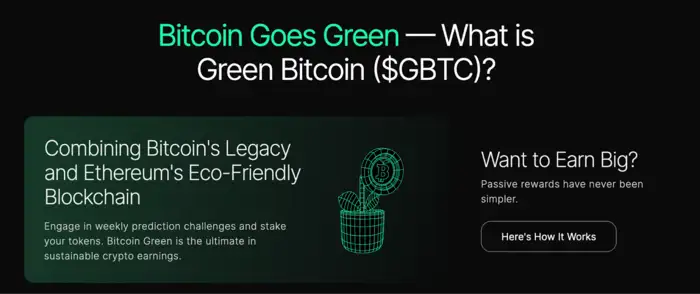
Green Bitcoin officially crossed the $5 million fundraising milestone, as traders back the predict-to-earn protocol for considerable gains in the coming weeks. The project has created a unique staking mechanism that allows users to place forecasts on the future price of Bitcoin to earn massive rewards scaled to their level of investment while earning staking rewards simultaneously.Green Bitcoin is being hailed as a greener alternative to Bitcoin. It combines Bitcoin’s legacy with Ethereum’s co-friendly proof-of-stake mechanism. As a result, Green Bitcoin has birthed an ecosystem tied to Bitcoin’s price through price predictions with no environmental impact.
The project intends for its blockchain to experience a high level of activity. Its users will consistently stake $GBTC to participate in the daily price contests and earn massive rewards. The price contests are rooted in the staking system, and the team will release new daily and weekly challenges based on Bitcoin’s price action to keep the content fresh.
What is Green Bitcoin, and how does it reward users for accurate price forecasts?
 Spotlight Wire
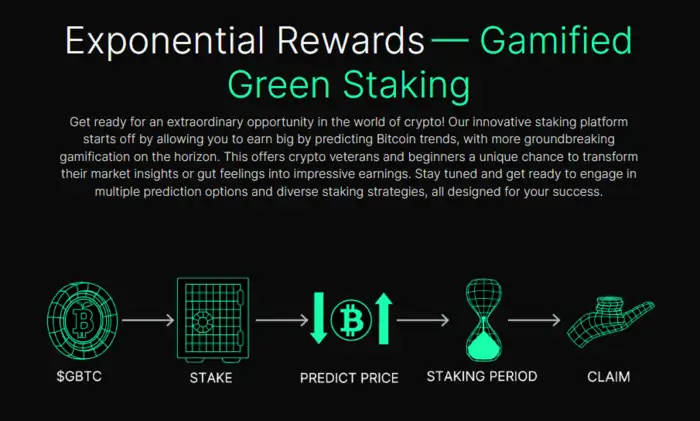
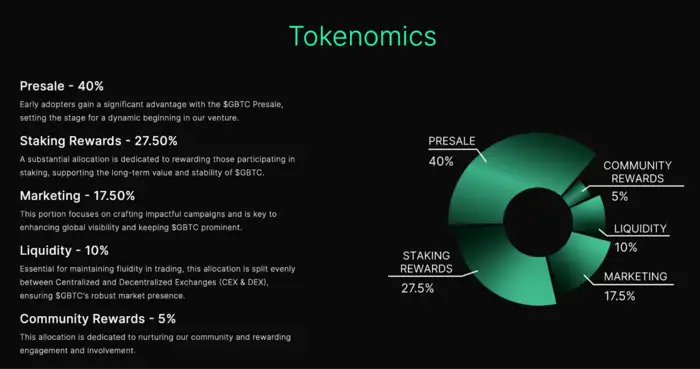
Green Bitcoin introduces a novel staking ecosystem called Gamified Green Staking. This ecosystem allows users to stake $GBTC tokens to be eligible to place daily price predictions on Bitcoin’s value. Those who accurately place correct forecasts are proportionally rewarded from the daily mining rewards pool, scaled to their level of commitment to the ecosystem.Green Bitcoin pays homage to Bitcoin’s legacy. Its rewards are distributed to winners every ten minutes, in line with the original Bitcoin block schedule. Contestants can claim their accumulated rewards from the protocol once every 24 hours to keep transaction costs low. The team has allocated an enormous 27.5% of the entire $GBTC supply to provide the rewards for accurate predictions for the next two years.
 Spotlight Wire
Users must lock their $GBTC into the Gamified Green Staking mechanism and submit their forecast before 11:30 PM EST to participate. At midnight, the smart contract will tally the day’s stakes against the actual price of Bitcoin and reward forecasts that land in the ‘Green Zone.’
As mentioned, the rewards earned depend on the level of investment made and the duration committed to the ecosystem. For example, those who have staked their $GBTC tokens in the Gamified Green Staking mechanism for more than a week are entitled to a 5% bonus on top of their regular daily rewards to recognise their extended commitment.
Those staking their tokens while participating in the daily price contests also earn an APY reward on top of their holdings through daily passive staking. The staking currently provides a 110% APY return, further incentivising users to keep their $GBTC locked into the ecosystem.
Why are traders backing it for huge upside potential?
 Spotlight Wire
Traders are quickly flocking to the presale, expecting upside potential for $GBTC due to its supply constraint dynamics.
Influential YouTubers ClayBro and Matthew Perryare backing the project with bullish views. They believe the unique staking system will cause $GBTC to surge following its exchange listing.
Users are required to stake their $GBTC into the ecosystem to participate in the price contests, so the tokens aren’t available for purchase on the open market. As a result, these experts predict that there might be a supply shock on centralised and decentralized exchanges as most $GBTC will be locked into the ecosystem.
Therefore, newcomers to $GBTC will likely be forced to pay higher prices to acquire the token and participate in the predict-to-earn ecosystem following the presale.
Investors are comparing the supply dynamics for Green Bitcoin as very similar to those of Bitcoin itself, which is currently experiencing a pre-halving rally ahead of its block reward cut. Both cryptocurrencies will likely experience massive supply shocks on the open market, causing prices to surge.
How to buy $GBTC today
$GBTC can be purchased at presale prices through the project’s website. Green Bitcoin is utilising the Web3Payments gateway to ensure the safety and security of everybody investing.
- Go to the official $GBTC presale page.
- Fund your wallet with $ETH or $USDT and connect to the Web3Payments widget.
- Use the presale widget to swap your currency for $GBTC, entering the desired amount you wish to purchase.
- If you prefer plastic, order $GBTC tokens to your wallet using your credit/debit card.
Once purchased, your $GBTC will be automatically staked, allowing you to start earning a return on your investment throughout the presale stage. You can claim your $GBTC through the same portal when the token officially launches.
Overall, it’s unsurprising to see investors rushing to the $GBTC project, which, with its unique staking dynamics, is about to cause a supply shock on the open market, leading to much higher prices following the presale.
Buy $GBTC today.
Disclaimer: The above content is non-editorial, and TIL hereby disclaims any and all warranties, expressed or implied, relating to the same. TIL does not guarantee, vouch for or necessarily endorse any of the above content, nor is it responsible for them in any manner whatsoever. The article does not constitute investment advice. Please take all steps necessary to ascertain that any information and content provided is correct, updated and verified.



Key Takeaways
- The Beacon Deposit Contract holds 88.29 million ETH, 73.16% of the top 12 wallets tracked.
- Binance controls 3.19 million ETH across three separate wallets, the most of any exchange.
- Arbitrum and Base bridges combined lock 1.63 million ETH as Layer 2 activity expands.
The list spans staking infrastructure, a token wrapping contract, five exchange wallets, two layer two ( L2) bridges, and one address unlabeled on Etherscan but identified through Arkham Intelligence. Together, they show where concentrated ETH sits across the network, and why two of the top spots are not “holders” in the traditional sense.
Beacon Contract Tops the List, But It Is Not a Whale
As of this weekend, the Ethereum Beacon Deposit Contract holds 88,289,814 ETH, equal to 73.16% of the top 12 wallets combined. The contract does not belong to a person, fund, or company. Every validator staking ETH to secure the network through proof-of-stake (PoS) sends funds through this single address, which functions as protocol-level escrow rather than discretionary holdings.
Curiously, the Beacon Deposit Contract also holds $109,690 worth of the ERC-20 token PIKA, after 7.112 trillion of the coins found their way into the address. It also holds roughly $8,500 worth of USDT for reasons that remain unclear, alongside dozens of largely meaningless ERC-20 tokens.
The Wrapped Ether contract ranks second with 2,443,063 ETH, or 2.02% of the total. It works the same way. ETH gets locked as collateral so it can circulate as an ERC-20 token called WETH across decentralized exchange ( DEX) platforms and lending platforms. Neither the Beacon Contract nor Wrapped Ether represents an entity with control over how the funds move. Wrapped ether (WETH) is simply an ERC-20 representation of ether.
Binance Holds Three Spots on the List
Binance controls more separate addresses than any other exchange. The wallet dubbed “Binance 7” ranks third with 1,996,008 ETH and around 2,481 transactions, a pattern consistent with a wallet used for large, infrequent transfers rather than daily retail flow.
Another address labeled “Binance Hot Wallet 20” holds 739,595 ETH with 20,981 transactions, supporting active withdrawal liquidity. A third address known as “Binance-Peg Tokens” holds 454,999 ETH, collateral backing wrapped versions of ETH that Binance issues on other chains such as BNB Chain.
Combined, Binance’s three wallets hold 3,190,602 ETH, worth roughly $5.9 billion at $1,860 per coin. That makes Binance the single largest exchange holder among the top 12 wallets by a wide margin.
Robinhood, Upbit, Bitfinex and Gemini Round Out Exchange Custody
Robinhood holds ETH across two separate wallets. Its main operational address ranks fourth with 1,220,494 ETH. A second wallet, unlabeled on Etherscan but identified by Arkham as Robinhood’s cold storage, ranks 12th with 368,050 ETH. Combined, the two addresses hold 1,588,545 ETH, worth about $2.9 billion.
Upbit, South Korea’s largest exchange by volume, holds 1,046,015 ETH in a wallet tagged as “Upbit 41.” That address logged 54,671 transactions, the highest transaction count of any exchange wallet among the top 12, pointing to heavy retail deposit and withdrawal activity from its user base.
Bitfinex holds 450,118 ETH in the address known as “Bitfinex 19.” It is worth noting that the aforementioned exchanges listed among Ethereum’s largest holders also rank among bitcoin’s largest holders. In 11th place, Gemini keeps 385,262 ETH in a cold wallet that recorded just 945 transactions, a low figure typical of offline storage that moves infrequently for security reasons.
L2 Bridges Lock Over 1.6 Million ETH
Presently, two Ethereum scaling networks also made the top 12. Arbitrum Bridge holds 819,716 ether, backing ETH that circulates on the Arbitrum network. Base Portal, operated for the Coinbase-incubated L2 network, holds 807,076 ETH and logged 1,140,867 transactions, the second-highest transaction count on the entire list behind only the WETH contract.
The size of these bridge balances tracks growing activity on both networks, as traders and applications continue moving funds off Ethereum’s base layer in search of lower fees and faster settlement.
What the Concentration Means for Traders
Setting aside the Beacon Contract and Wrapped Ether as network infrastructure, the remaining 10 wallets hold 8,287,337.60 ETH combined. Of that, exchange-controlled wallets alone account for 6,660,544 ETH, or roughly 5.52% of a 120,682,850 ETH reference supply.
For traders who track exchange reserves as a signal of selling or accumulation pressure, the data shows custody split across multiple addresses per exchange rather than concentrated in one. Binance and Robinhood both operate separate hot and cold wallets, meaning analysts need visibility into all of an exchange’s tagged addresses, not just the most active one, to draw accurate conclusions about reserve trends.
The bridge wallets add a separate signal. Rising balances at Arbitrum and Base point to sustained L2 activity, a trend that has shaped trading volume and gas costs across the Ethereum ecosystem.

Key Takeaways
- Foundry Digital, AntPool, ViaBTC and F2Pool held 70%+ of Bitcoin hashrate on Jun. 23, 2026.
- D-Central put Bitcoin’s Nakamoto coefficient at 3, raising centralization concerns in H1 2026.
- ViaBTC scrutiny in 2026 may push miners toward EMCD, which advertises 1.5% FPPS fees.
Bitcoin mining is looking less like a wide-open competition and more like a tight club. A CryptoSlate partner article published on 07/08/2026, citing miningpoolstats.stream data as of 06/23/2026, says Foundry Digital, AntPool, ViaBTC, and F2Pool together account for more than 70% of the network’s hashrate. The shift is fueling what the coverage calls a “two-tier market,” with the biggest pools increasingly tuned for institutional clients while independents and mid-size operators get squeezed. Some smaller miners are already quietly reconsidering where they point their machines, especially as ViaBTC faces added regulatory scrutiny in 2026.
Bitcoin mining is often talked about like a wide-open frontier, but mid-2026 looks more like a handful of toll roads. A July 8, 2026 CryptoSlate article (partner content) points to a June 23, 2026 snapshot showing just a few pools taking an outsized role in where blocks get made, and what kind of miners get served best.
The rise of four dominant players in Bitcoin mining
As of that June 23 snapshot, four pools controlled more than 70% of Bitcoin’s hashrate: Foundry Digital, AntPool, ViaBTC, and F2Pool. The estimated split was stark: Foundry at 31%, AntPool at 18%, ViaBTC at 13%, and F2Pool at 10%, per 31%, 18%, 13%, 10% figures cited in the coverage.
One detail that matters for US operators is that Foundry is US-based and backed by Digital Currency Group. The pool is described as being built primarily for large-scale, institutional operators and publicly traded mining companies, with strict KYC requirements baked into how it onboards clients.
A two-tier market takes shape
CryptoSlate frames the concentration as a “two-tier market,” where the biggest pools increasingly optimize for institutional miners. That kind of optimization is usually invisible until you are the one fighting for responsiveness, predictable payouts, or account support, and it is why independent and mid-size miners are described as quietly rethinking where they point their machines.
The key shift is less about any single pool’s branding and more about what scale buys you. When a pool’s business is tuned for fleets and compliance-heavy customers, smaller miners can end up feeling like edge cases instead of the core product.
Scrutiny, switching costs, and the search for alternatives
ViaBTC, which held 13% in the mid-2026 share estimates, has faced increasing regulatory scrutiny this year that has particularly affected miners tied to Russia and other CIS countries. The reporting describes account restrictions, sudden KYC demands, and temporary fund freezes, the kind of friction that can make even loyal miners reconsider their setup.
In the same coverage, EMCD is positioned as an alternative: it claims over 30 EH/s of hashrate, with fees starting at 1.5% under FPPS, compared with roughly 4% charged by many comparable pools. EMCD was founded in 2017 and made its first pool available in February 2018.
What centralization looks like in the metrics
In D-Central’s H1 2026 snapshot (data as of June 19, 2026), Bitcoin mining pools had a Nakamoto coefficient of 3, meaning only 3 pools were needed to exceed half of all blocks mined, with Foundry USA at roughly 27% of blocks, per Nakamoto coefficient data.
And the leaderboard keeps moving. In the latest 7-day window posted on July 16, 2026, Simple Mining’s rankings list Foundry USA at 27.0%, with F2Pool and AntPool both at 17.2%, ViaBTC at 9.5%, and SpiderPool at 5.5%.

Global cybersecurity firm Kaspersky has identified a malware framework called OkoBot that targets crypto users by stealing wallet seed phrases, credentials and other sensitive data through a collection of more than 20 malicious components.
The campaign, first identified in January 2026, has compromised hundreds of victims across more than 25 countries, with Brazil, Vietnam, Canada, Mexico and Türkiye among the most affected.
During the investigation, researchers found that attackers distribute the malware through ClickFix social engineering schemes and fake software downloads hosted on GitHub, allowing the framework to infect devices and deploy additional malware, including the Rilide browser stealer.
The framework consists of more than 20 payloads capable of stealing crypto wallets, harvesting credentials, recording video, downloading malicious browser extensions and executing remote commands.
Among OkoBot’s components are TookPS, which exfiltrates wallet seed phrases, OkoSpyware, which monitors Chromium-based browsers and records user activity, and SeedHunter, which injects malicious code into Trezor and Ledger wallet software to display phishing pages requesting recovery phrases.
Kaspersky said the campaign is still active and while its operators have not been identified, its techniques and code artifacts suggest links to Russian-speaking cybercriminals.
-

 Montana2 minutes ago
Montana Auto Museum: Thunderbirds (photo diary)
-

 Nebraska8 minutes ago
Weather Alert Day: Dangerous heat grips Nebraska Monday; relief coming Tuesday
-

 New Hampshire20 minutes ago
New Hampshire Fisher Cats vs. Harrisburg Senators July 19, 2026
-

 New Jersey26 minutes ago
GALLERY: President and Melania Trump watch World Cup final in New Jersey on Sunday
-

 New Mexico32 minutes ago
Another round of showers, storms ahead for New Mexico
-

 North Dakota44 minutes ago
Man suffers life-threatening injuries after motorcycle crash
-

 Ohio50 minutes ago
Ohio governor signs bill designating ‘Tuscarawas Valley Memorial Highway’
-

 Oklahoma56 minutes ago
Two killed, three injured in overnight shooting at southwest Oklahoma City party

