Crypto
Why Bitcoin and Trump Are Once Again Crypto’s Biggest Story


It’s day two of Nashville’s Bitcoin Conference, but many attendees are waiting for day three.
The reason? Saturday (July 27), at 2 p.m., is when U.S. Republican presidential nominee Donald Trump will give a keynote address to the conference.
The former president and current hopeful, who once dismissed bitcoin as a “scam” competing against the U.S. dollar, is now positioning himself as a proponent of the crypto industry.
Trump has already raised more than $4 million in crypto for his campaign war chest, and the crypto audience represents an attractive and lucrative voting bloc, particularly given their ongoing disillusionment with the current state of existing domestic digital asset policy.
A free T-shirt being offered to attendees of the conference reads “Vote Trump.”
Per a Barron’s report, the prevailing sentiment among certain bitcoin investors and enthusiasts is that Trump will use his speech to make a major announcement, something along the lines of throwing his support behind having the U.S. government buy bitcoin as a “strategic reserve” asset, akin to foreign currencies, or oil.
Central banks’ investment in bitcoin would lend credibility to cryptocurrency, potentially elevating it to a status similar to gold in terms of being a store of value. Any such move could have a far-ranging influence on discussions around digital currencies and monetary sovereignty.
Trump, who has pitched himself as the “crypto president,” isn’t the only politician speaking at the crypto festival. Republican former candidate Vivek Ramaswamy, independent U.S. presidential candidate Robert F. Kennedy Jr., and lawmakers from both parties — including Sen. Cynthia Lummis of Wyoming — are also slated to speak.
See also: Trump Running Mate J.D. Vance’s Antitrust Views Divide Business Leaders
Crypto Industry Looks to Increase Beltway Influence
Trump’s rebranding as a crypto-friendly candidate is part of a larger trend among Republicans to embrace digital currencies and blockchain technology. This strategy aims not only to attract a young and tech-savvy demographic but also to tap into the substantial financial resources of the crypto sector. By aligning with the interests of cryptocurrency enthusiasts, Trump and his party are seeking to leverage the political and economic potential of this burgeoning industry.
Trump’s running mate, J.D. Vance, has maintained a positive view on the digital asset sector throughout his political career, and voted as a senator accordingly.
The Republican Party’s platform states that the GOP will “end Democrats’ unlawful and unAmerican Crypto crackdown” and “defend the right to mine Bitcoin.”
And as PYMNTS wrote earlier this month, the need for clear regulatory frameworks remains one of the most pressing issues facing the crypto industry.
“What we are seeing, where it’s the UK, Japan, Singapore … even the European Union, more than two dozen countries have come together to provide a framework for crypto regulation,” Ripple’s CEO Brad Garlinghouse said last week (July 17). “It’s frustrating that we as a country can’t get that framework in place. And instead, we have this interminable litigation coming from the SEC that really isn’t solving the problem.”
Ripple earlier this year donated $25 million to the crypto industry super PAC Fairshake, with Garlinghouse saying at the time that those donations would continue each year, as long as the sector had its naysayers.
Read more: Blockchain’s Benefits for Regulated Industries
As the 2024 elections approach, the cryptocurrency sector is poised to play an increasingly significant role in American politics, across both parties.
Per a Politico report on Tuesday (July 23), billionaire investor and bitcoin enthusiast Mark Cuban believes that Democratic Presidential Nominee Kamala Harris would be “far more open” to crypto, though he noted that was “certainly not confirmed by the VP.”
Potentially contributing to the more mainstream embrace of crypto is the fact that institutions are starting to warm up to digital assets, too.
Coinbase Asset Management is reportedly creating a tokenized money market fund, while asset manager BlackRock introduced a tokenization of real-world assets: a fund called BUIDL that holds U.S. Treasurys and gained $500 million of assets following its launch in March.
The tokenization of real-world assets is a function of the blockchain landscape that has captured the imagination of various players across payments, finance and commerce, PYMNTS reported in April.
As PYMNTS Intelligence’s latest report revealed, regulated industries, including healthcare and financial services, must adhere to numerous requirements, such as know your customer (KYC), anti-money laundering (AML) and data privacy regulations. Blockchain could help these industries in that regard.



Key Takeaways
- LAB token cratered 90% over 48 hours, wiping out billions in market cap.
- ZachXBT slammed top centralized exchanges for failing to halt the July manipulation.
- Investors surged to avoid trading LAB as team token unlocks are set for later in July 2026.
LAB Trade Blames ‘Large Market Participants’
LAB, the native token of the multi-chain trading platform LAB Trade, suffered a catastrophic collapse this week, plunging from just over $7 to $1.25 on Wednesday—a staggering 80% decline in under 24 hours. This crash followed an equally brutal sell-off on Tuesday, which saw the token slide from nearly $17. In total, LAB wiped out nearly 90% of its value in just 48 hours.
The financial fallout was swift: a market capitalization that exceeded $5 billion on Tuesday morning evaporated to just $390 million by 3:30 p.m. EST on Wednesday. The freefall prompted the LAB Trade team to address the panic on X, where they expressed disappointment and deflected blame toward external heavy-sellers:
“While today’s market activity is disappointing, our product roadmap and long-term focus remain unchanged. We’re seeing significant selling pressure from large market participants. Several independent trading firms also hold substantial LAB positions that are not affiliated with our team. We’re working closely with our liquidity partners and continue to monitor market conditions,” the team said on X.
With this crash, LAB joins a notorious lineup of volatile tokens, such as RAVE, RIVER and SIREN. Each of these projects experienced meteoric rises followed by near-instantaneous erasures, sparking widespread “pump-and-dump” allegations against their respective teams and murky distribution networks.
Crypto Sleuth Slams Centralized Exchanges
Prominent on-chain detective ZachXBT, who previously flagged suspicious insider loans and market-maker coordination back in May, blasted major centralized exchanges ( CEXs) for failing to protect retail investors. Taking to X, ZachXBT criticized the lack of proactive intervention:
“Disappointing to see how no action was taken by Binance, Bitget, and Gate earlier to prevent it. If CEXs cared, profits from the accounts manipulating the price would be distributed to users at a minimum. Unlocks for investors were scheduled to begin later this month, however, multiple late vesting changes occurred in the past.”
ZachXBT reiterated his previous warnings that insiders have effectively controlled the entire circulating supply, allowing market makers to orchestrate extreme price manipulation on major exchanges. His final advice to the community was blunt: avoid trading LAB under any circumstances.

ZachXBT Names RAVE, RIVER, SIREN, and LAB as Victims of Bitget-Enabled Market Maker Fraud
Blockchain investigator ZachXBT has renewed his assault on Bitget, accusing the exchange of knowingly enabling market makers to run supply…


ZachXBT Names RAVE, RIVER, SIREN, and LAB as Victims of Bitget-Enabled Market Maker Fraud
Blockchain investigator ZachXBT has renewed his assault on Bitget, accusing the exchange of knowingly enabling market makers to run supply…
ZachXBT Names RAVE, RIVER, SIREN, and LAB as Victims of Bitget-Enabled Market Maker Fraud
Blockchain investigator ZachXBT has renewed his assault on Bitget, accusing the exchange of knowingly enabling market makers to run supply…

STARKVILLE – Potentially higher utility bills and sound pollution topped the list of concerns raised by six residents who addressed the board of aldermen Tuesday about a cryptocurrency mining facility proposed for Industrial Park Road.
Vice Mayor Roy Perkins, who represents Ward 6, said he has fielded similar concerns from constituents following the board’s June 12 work session, during which members heard a presentation about the potential project.
“I know these things need to have full accountability, full transparency and different things,” Perkins said. “… Well you can rest assured the vice mayor is going to be on assignment. I’m going to do my part. I’m not going to do anything that’s going to negatively impact this community.”
The proposed facility would be a specialized type of data center designed to mine cryptocurrency, a digital currency that operates independently of government-backed financial systems. It is stored in digital wallets and fluctuates in value.
Mining facilities use specialized computers that draw large energy loads to secure the digital transactions that take place. The center proposed in Starkville would be much smaller than “hyperscale data centers” that store and process data for large tech companies.
Utility usage topped the concerns of most residents with Pam Jones, the first to speak, set the tone.
“I understand that this is on a smaller scale than the hyper-scale facilities, and I just wanted to be sure that we had ordinances in place that will count the noise, especially at night and that there will be water and power management,” Jones said.
Other residents took issue with what they see as a lack of transparency around the proposed project.
“I was quite disappointed to learn (the mining facility) was not an agenda item today,” said Eadie Keenan, a Ward 7 resident. “… Quite frankly, I have more questions than can fit in three minutes.”
Tiffany Womack, another Starkville resident, echoed Kennan’s concerns, adding utility usage and market volatility to her own list of issues.
“If (the center was) to go bankrupt or something like that, would that possibly fall back on the responsibility of Starkville citizens?” Womack asked.
Mayor Lynn Spruill did not answer each question individually, instead encouraging those with questions to watch the June 12 presentation. Due to the project’s early stage, she noted the board does not yet know answers to all the questions raised during Tuesday’s meeting.

“I brought (the center) to the board as an opportunity for us to begin that process of learning so we are nowhere near making a decision,” Spruill said. “Which is why it isn’t on the agenda and won’t be on the agenda for some time.”
Spruill said the proposed center is currently going through the staff vetting process. Once the process is complete, staff will make a recommendation to the board on whether to pursue the center. At that time, Spruill expects to be able to answer residents’ remaining questions.
Spruill said transparency is important to her and the board while going through the process of vetting the mining center.
“Nothing is being hidden. It’s all out there for everybody to see, and we’ll make decisions based on facts not on Facebook craziness,” Spruill said. “… We want facts, and we want all decisions to be made with facts. And so hopefully that will put some of your concerns (to rest), at least to the extent that this is nowhere near something that will be on the agenda.”
Quality, in-depth journalism is essential to a healthy community. The Dispatch brings you the most complete reporting and insightful commentary in the Golden Triangle, but we need your help to continue our efforts. In the past week, our reporters have posted 24 articles to cdispatch.com. Please consider subscribing to our website for only $2.30 per week to help support local journalism and our community.
Quality, in-depth journalism is essential to a healthy community. The Dispatch brings you the most complete reporting and insightful commentary in the Golden Triangle, but we need your help to continue our efforts. In the past week, our reporters have posted 24 articles to cdispatch.com. Please consider subscribing to our website for only $2.30 per week to help support local journalism and our community.
-
 Lifestyle10 seconds ago
Meow Wolf taps famed L.A. animation house for its new Los Angeles venue
-
Politics7 minutes ago
Column: Trump decries ‘communism’ while his government takes ownership of companies
-
 Science10 minutes ago
‘I’d rather my house burn down than get cancer’: Herbicide use upends California’s fight to save forests
-
 Sports15 minutes ago
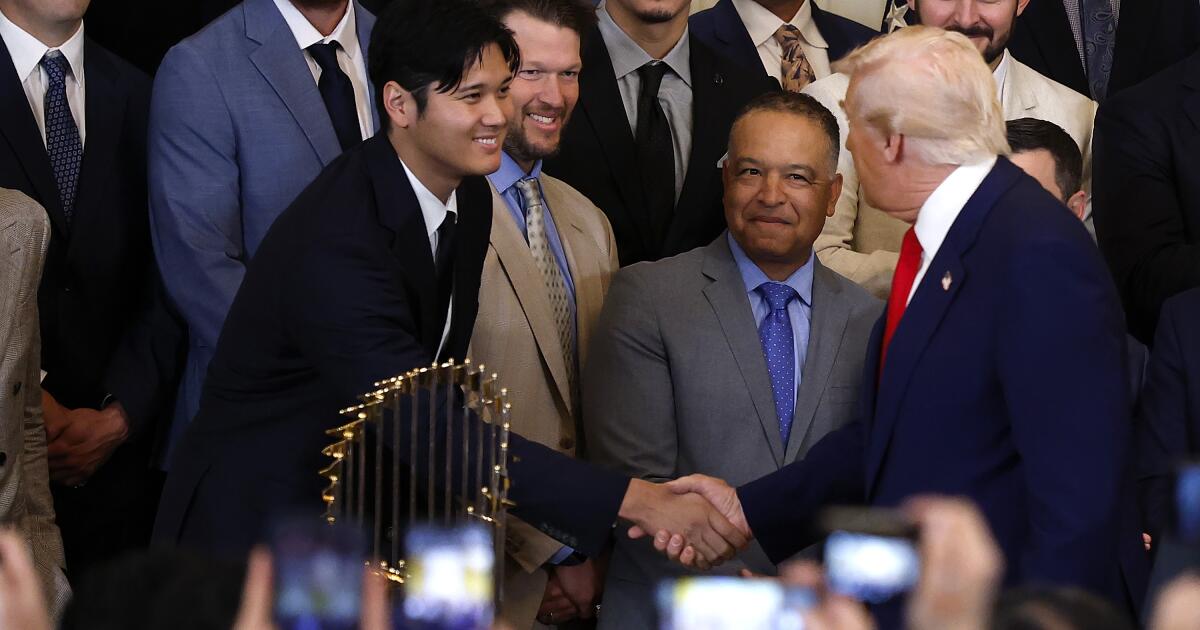
Dodgers scheduled to visit White House in late July to celebrate 2025 World Series win
-

 World25 minutes ago
Former US Olympian pleads not guilty in DC reflecting pool vandalism case
-
 News52 minutes ago
Former Olympian pleads not guilty in reflecting pool vandalism charges
-

 Los Angeles, Ca2 hours ago
Heat advisory, beach hazards in effect as Southern California sizzles
-

 Detroit, MI3 hours ago
Teen on moped hit by car after cruising through stop sign in Detroit


