Business
What SpaceX and its record IPO have riding on the new race to the moon

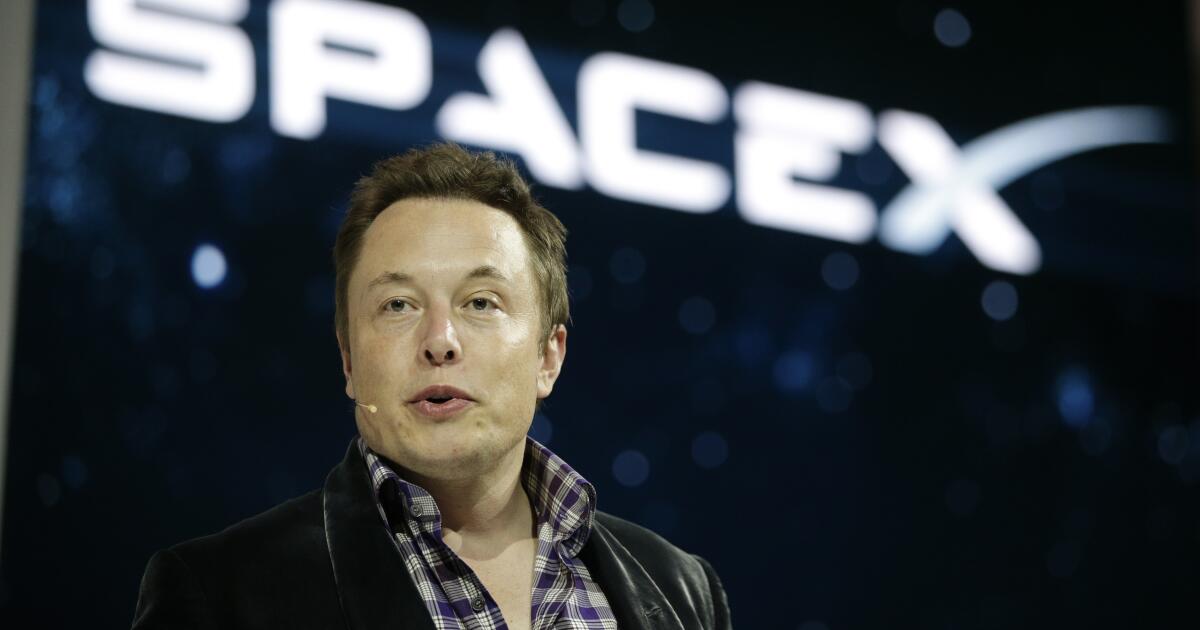
A recent policy change by NASA has given Elon Musk’s SpaceX a greater role in the Artemis moon program just as the company contemplates a record initial public offering.
When the first American crew since 1972 orbits around the moon this month, SpaceX’s stylized logo will be nowhere to be found — but it might as well be plastered everywhere.
Elon Musk’s rocket company is preparing what is expected to be the largest initial public offering in history, and it has as much, if not more, riding on NASA’s Artemis program as Boeing and the other contractors that built the SLS rocket that will blast the astronauts into space and the Orion capsule carrying them on their mission — a fly-by of our closest celestial neighbor.
Radical changes announced in February by new NASA Administrator Jared Isaacman to speed up the country’s return to the moon could make the program more reliant on SpaceX on future launches.
That includes using its massive Starship rocket to ferry crews and construction materials to the moon, where Isaacman said NASA now plans to build a research and exploration station as it faces competition from a joint China-Russian team.
SpaceX, which maintains a large presence in Southern California’s burgeoning aerospace sector, is readying an initial public offering possibly for this summer that is expected to be the largest in history, perhaps raising as much as $75 billion. It follows Musk’s merging of his xAI artificial intelligence company into his rocket company in February.
The funds would help pay for Musk’s equally giant if quixotic plans: building his own Moonbase Alpha colony, manufacturing millions of driverless cars and robots, and putting artificial intelligence data centers into space, using satellites that use solar energy to do AI computations.
Here’s what to know about what this means for SpaceX, which has large operations in Hawthorne and launches its workhorse Falcon 9 rockets from Vandenberg Space Force Base in Santa Barbara County.
How important is it for SpaceX that NASA is returning American astronauts to the moon?
Wedbush analyst Dan Ives calls the Artemis launch a “watershed” event for the company, which he expects will be a leader in the new space economy where trillions will be spent on artificial intelligence, space infrastructure and related businesses.
“The moon ultimately represents the golden goose for Musk and SpaceX,” he said. “It’s a fourth industrial revolution and we just happen to live in it.”
What plans does SpaceX have for the moon?
Musk has long said that his life’s ambition is to colonize Mars, but in February the world’s richest man posted on X that his company first planned to build “a self-growing city on the Moon, as we can potentially achieve that in less than 10 years.”
What would be the purpose of such a city?
A moon outpost would solve some of the same technological challenges a Mars colony would face without the same level of cost and risk, given how much faster and less expensive it is to reach the moon. Musk also has sketched out a futuristic vision of building AI data centers on the moon with the help of the company’s Optimus robots and catapulting them into space.
Catapulting data centers into space from the moon sounds like science fiction. How is that even possible?
At a February presentation, Musk said that the lower gravity of the moon would allow the satellites to be shot into space using a magnetic accelerator — what he called a “mass driver” — radically reducing the cost compared with Earth launches, in which rockets expend tons of fuel to escape gravity. “I want to just live long enough to see the mass driver on the moon, because that’s going to be incredibly epic,” he said. That timeline doesn’t even consider that SpaceX has yet to launch a data center satellite from Earth.
How does this fit into NASA’s plans?
In March, Isaacman announced the government’s own highly ambitious plans to spend $20 billion to start building a sustained human presence on the moon within seven years. While the SLS rocket would still lift the Orion capsule into Earth’s orbit, Artemis could now rely on the Starship rocket, still in its testing and development phase, to dock with the capsule in Earth’s orbit and ferry astronauts to the moon, where it would land the crew and building materials. A spacecraft being developed by Jeff Bezos’ Blue Origin could serve as another moon lander given the vast payload needed for a moon colony. The first crewed mission to the moon’s surface is planned for 2028.
How does this tie in to SpaceX’s IPO?
SpaceX has confidentiality filed for an IPO expected later this year sources told Bloomberg on Wednesday. It could value the company at $1.75 trillion, which would allow it to sell just a fraction of its shares yet still raise more than twice as much as the current largest IPO on record: Saudi Aramco’s $29.4-billion oil-and-gas offering in 2019. Given its massive size, SpaceX is in talks with at least 21 banks to sell the securities to investors, Reuters reported.
The company has a massive need for capital if it is going to pull off Musk’s dreams, which he said rely on vast numbers of AI chips. In February, he announced the construction of a giant chip fabrication plant in Austin, Texas, because of a lack of supply from existing chipmakers.
How are financial markets reacting to Musk’s plans?
The IPO has drawn huge attention given its size and SpaceX’s prospects for growth.
“As an investor, I’m excited. As a human being, I’m excited. It’s just opening a whole different world, a universe, essentially, that we were not exposed to before. We went to the moon over 50 years ago, and that was it. Nothing has happened really since then,” said Mike Alves, founder of Pasadena’s Vida Vision Fund, which has a stake in SpaceX and xAi that accounts for 45% of his AI and robotics fund.
An analysis of the IPO by PitchBook assigns no revenue to Musk’s AI data centers or his Moonbase Alpha plan but estimates that the company earned $7.5 billion in profit last year on nearly $16 billion of revenue from its Starlink satellite network, commercial launch services for third parties and other businesses.
It estimates that growth from the company’s Starlink internet, launch and nascent satellite phone service could boost profit to $60 billion and revenue to $150 billion by 2040 — making an IPO that values the company at $1.5 trillion “expensive but not irrational.”
Are there skeptical voices about SpaceX and its IPO?
Yes, plenty. There are technological hurdles for SpaceX to carry out its plans. Most immediately, the Starship rocket that NASA is relying on — even bigger than Apollo’s Saturn V — has suffered some bad test flights. SpaceX also must master a key technological hurdle: refueling the rocket while it’s in Earth’s orbit so it has enough fuel to carry out its flight to the moon, land there and return to Earth. Beyond that, Musk’s plans to manufacture millions of chips and robots aren’t close to becoming a reality.
“There is an AI-hungry market at the moment and there’s a lot of investors waiting for those opportunities to happen,” said Igor Pejic, author of “Tech Money.” “But you face the likelihood that it might never happen, or it might happen in three years, five years, 10 years from now.”


Ford Motor Co. is suing a prominent Los Angeles lemon law firm for allegedly inflating their fees by as much as 7,000%, the company’s latest attempt to crack down on California attorneys who it says are exploiting the state’s unique law to protect consumers from defective cars.
Quill & Arrow, a personal injury firm that represents drivers suing over so-called “lemons” — vehicles with significant, unfixable manufacturing flaws — has long been a thorn in the side of Ford. Since 2021, Ford said its has paid them more than $100 million, roughly half in attorney fees.
That profit, Ford alleges in a federal lawsuit filed Thursday, came from billing records that were “utter fabrications.”
Quill & Arrow used an overseas “army” of low-paid, non-lawyers to help file thousands of lemon lawsuits and then pretended the work was done by California attorneys, who billed as much as $950 per hour, Ford alleged in its complaint.
Ford claims that the bulk of the work was actually done by non-lawyers in countries such as Mexico and the Philippines, who got paid as little as $13 per hour.
Quill & Arrow was founded in 2019 by attorneys Kevin Jacobson and Jonathan Shirian, according to the firm’s website, which touts recovering $500 million in lemon law payouts. The partners called Ford’s lawsuit “nothing more than an attempt to silence firms who would dare to hold them responsible and seek justice for consumers.”
“It grossly mischaracterizes the facts and the claim that Quill & Arrow created fabricated attorney billing records is absurd,” the firm said in a statement.
California’s lemon law, considered one of the strongest consumer protections in the nation, allows drivers to get a refund or replacement of a broken car if the manufacturer can’t fix it. If the driver is not satisfied, they can sue.
If the driver wins, the law allows attorneys to collect their fees from the car maker — rather than take a percentage of the client’s winnings, as is common in personal injury cases. This fee structure, Ford argues, has turned the law into a bonanza for plaintiff attorneys. The longer the case drags on, the company argues, the more the law firm can reap in profit.
Ford alleges the firm intentionally slowed down its clients’ cases to drive up their billable hours, instructing drivers not to communicate with Ford and pushing them toward filing a lawsuit.
“California’s Lemon Laws are in need of reform and the courts need to exercise more oversight, given the fraud we continue to expose,” said Doug Lampe, counsel at Ford, in a statement. The law is “being blatantly abused by the lemon law plaintiffs lawyers, the bar is not policing its own and the courts need to monitor fee awards with far more skepticism and scrutiny.”
The cases, he said, “have become about the lawyers for the lawyers.”
Lemon law cases have exploded in California in the last decade from about 4,500 cases in 2015 to roughly 30,000 in 2024, according to an analysis from the Assembly Judiciary. These cases, officials warned, “are poised to cripple the entirety of California’s civil justice system.”
In 2024, the legislature tightened the state’s lemon law, requiring additional steps before a driver could sue. The bill seems to have put little dent in the caseload: Lemon lawsuits surged to record levels the following year.
Ford’s lawsuit marks the second attempt by one of America’s largest car manufacturers to go on the offense against lemon law attorneys in Southern California.
Ford sued a cohort of local lemon law firms in May 2025, accusing attorneys of collecting at least $100 million in “phantom legal fees” by billing for hours they never worked. The case, which was brought under the Racketeer Influenced and Corrupt Organizations Act, or RICO, alleged lawyers worked together to file a flurry of fraudulent cases with billable hours that defied logic.
A partner at Knight Law Group, an L.A.-based lemon law firm, once billed an “ostensibly heroic but physically impossible” 57.5-hour workday, Ford alleged.
Knight Law Group denied inflating their billing, calling the suit a “thinly veiled attempt to silence firms who would dare to hold them responsible and seek justice for consumers.”
A judge threw out the suit in March on the grounds that lawyers were protected under the 1st Amendment from being sued for the content of their lawsuits unless the case was proved fraudulent. Ford says it plans to appeal.
After Quill found about the Knight Law Group case, Ford alleged, Quill dedicated a team to “scrubbing” their own timesheets of “impossible time entries.”

Ranch dressing is having a moment thanks to the World Cup and Kraft is ready to meet it.
The company said Thursday that it is working on a “TSA Compliant Ranch” for those looking to travel with the quintessentially American condiment. The announcement follows the influx of social media videos showing international soccer fans sampling the dressing for the first time.
“Some visitors leave with souvenirs. Others leave with America’s favorite dressing,” Kraft wrote in a caption accompanying an AI image of a TSA-approved clear bag packed with ranch dressing packets posted to social media. The image showed the bag — complete with a luggage tag resembling a ranch dressing bottle — placed in an airport security screening bin along with other travel essentials.
Additional details will be announced later, the company said.
TSA has also leaned into ranch’s apparent newfound popularity among international travelers, providing some helpful tips (and warnings) on social media.
“If you’re visiting for a very large sporting event & you happen to discover RANCH while you’re here… pls pack it in your CHECKED BAG on your way home,” the agency posted on Instagram Tuesday. It also asked travelers to “avoid chugging your ranch outside security” lines.
“Who knew dip-lomacy could be achieved through addressing the obvious: ranch is the king of condiments,” TSA wrote in the caption accompanying its carousel of humorous ranch-related quips. “If you’re traveling within the U.S., make sure to keep your carry-on sauces to 3.4 oz or less and place any larger containers in your checked bags.”
“Some heroes wear capes. Others bring ranch,” it added.
According to 1987 Times reports, ranch dressing was invented by Steve Henson, who opened the Hidden Valley Guest Ranch in Santa Barbara in the mid-1950s with his wife, Gayle. The unnamed condiment originally mixed herbs and spices with buttermilk and mayonnaise and its popularity with guests led to it being jarred so they could take some home. The more travel-friendly powdered form followed.

A landmarked downtown Los Angeles apartment building designed by famed Los Angeles architect John Parkinson is on the market as its owners face foreclosure.
Residences in the Metropolitan, a 10-story tower built in 1913, are nearly filled with tenants but its ground floor retail spaces on Broadway and 5th Street are unoccupied, as are other street-level stores in downtown’s Historic Core.
The historic building was once considered one of the best in the city and is owned by the Fallas family, which operated a chain of value-priced clothing stores based in Gardena including one called Fallas Paredes in the Metropolitan.
Fallas-Paredes at 449 S. Broadway, Los Angeles, CA 90013.
(Google Maps)
Around 2011, Michael Fallas, who once worked in family’s downtown store as a stock boy, converted the upstairs floors from offices to apartments while continuing to operate Fallas Paredes. The store closed more than five years ago in the wake of a 2018 filing by its parent company for Chapter 11 bankruptcy protection.
Earlier this month in state Superior Court, a special servicer representing Fallas’ lender asked for a judicial foreclosure of the property, alleging that Fallas had stopped making payments on a $32 million loan dating to 2017. After leasing the property for years, Fallas bought the building in the 1990s.
Fallas didn’t respond to requests for comment.
The location of the Metropolitan where the buildings stands was hailed in a Times story in 1912, saying “it is regarded by many realty men as the most valuable piece of real estate in Los Angeles.”
The building today is recognized as a city historic-cultural monument because “Broadway became the commercial center of the Southland, a title it retained until well after World War II,” with its development, the city said. One of the architects who designed the Metropolitan in the Beaux-Arts style was John Parkinson, who is credited with designing such well-known local structures as City Hall, the Los Angeles Memorial Coliseum and Union Station.
Notable tenants in the Metropolitan have included the Los Angeles Public Library, Owl Drug Co., variety store J.J. Newberry and real estate company Janns Investment Co., which sold the land where UCLA is built and developed Westwood Village, among other Los Angeles neighborhoods.
In recent years, the buildings around the Metropolitan have struggled to keep retail tenants after a spurt of residential conversions of historic buildings starting in the early 2000s brought commerce to the neighborhood. Many downtown businesses have struggled since the pandemic reduced occupancy in offices downtown and reduced the flow of visitors.
“The lack of bodies on the street is generally hurting downtown, and that’s one of the reasons that has building has problems,” said downtown real estate broker Hal Bastian, who lives in the Historic Core.
There are close to 1,000 residential units in historic buildings at the intersection of Broadway and 5th Street, Bastian said, but all the ground floor stores are closed. Drug stores there suffered substantial losses from shoplifting he said, and now, “our challenge on Broadway is leasing.”
The 88 apartments in the Metropolitan are 91% rented, according to a listing for the property by the Zacuto Group, which also touts its roof deck with pool, fitness center and barbecue grills. No sale price is set.
-

 World10 minutes ago
Trump vows Iran will not charge Strait of Hormuz tolls, but says US might
-
 News33 minutes ago
DOJ memo stokes fear among disability advocates of a return to institutionalization
-

 Los Angeles, Ca2 hours ago
Armed home invasion in L.A.’s Fairfax District leaves resident assaulted
-

 Detroit, MI2 hours ago
Tigers top Chicago White Sox 4-1; Detroit pitcher Troy Melton allows 1 hit in 6 innings
-

 San Francisco, CA2 hours ago
MLB Rumors: Latest Intel on Potential Matt Chapman Trade for San Francisco Giants
-

 Dallas, TX2 hours ago
Dallas’ Fair Park to Get $2.5M Boost From McKesson – Dallas Weekly
-

 Miami, FL3 hours ago
Air quality alert in effect in Miami-Dade and Broward counties: National Weather Service
-

 Boston, MA3 hours ago
Boston Signs Big Blueliner Rylind MacKinnon To One-Year Extension

