Business
We Asked A.I. to Create the Joker. It Generated a Copyrighted Image.


User
A.I.
Generated by A.I.

User
A.I.
Generated by A.I.
User
A.I.
Generated by A.I.
User
A.I.
Generated by A.I.
When Reid Southen, a movie concept artist based in Michigan, tried an A.I. image generator for the first time, he was intrigued by its power to transform simple text prompts into images.
But after he learned how A.I. systems were trained on other people’s artwork, his curiosity gave way to more unsettling thoughts: Were the tools exploiting artists and violating copyright in the process?
Inspired by tests he saw circulating online, he asked Midjourney, an A.I. image generator, to create an image of Joaquin Phoenix from “The Joker.” In seconds, the system made an image nearly identical to a frame from the 2019 film.
Reid Southen Create an image of Joaquin Phoenix Joker movie, 2019, screenshot from a movie, movie scene
Midjourney’s response Generated by A.I.
Copyrighted image from Warner Bros.
Note: Mr. Southen’s full prompt was: “Joaquin Phoenix Joker movie, 2019, screenshot from a movie, movie scene –ar 16:9 –v 6.0.” The prompt specifies Midjourney’s version number (6.0) and an aspect ratio (16:9).
He ran more tests with various prompts. “Videogame hedgehog” returned Sonic, Sega’s wisecracking protagonist. “Animated toys” created a tableau featuring Woody, Buzz and other characters from Pixar’s “Toy Story.” When he typed “popular movie screencap,” out popped Iron Man, the Marvel character, in a familiar pose.
“What they’re doing is clear evidence of exploitation and using I.P. that they don’t have licenses to,” said Mr. Southen, referring to A.I. companies’ use of intellectual property.
Mr. Southen popular movie screencap
Midjourney’s response Generated by A.I.
Copyrighted image from Marvel Note: Mr. Southen’s full prompt was: “popular movie screencap –ar 1:1 –v 6.0.” The prompt specifies Midjourney’s version number (6.0) and an aspect ratio (1:1).
The tests — which were replicated by other artists, A.I. watchdogs and reporters at The New York Times — raise questions about the training data used to create every A.I. system and whether the companies are violating copyright laws.
Several lawsuits, from actors like Sarah Silverman and authors like John Grisham, have put that question before the courts. (The Times has sued OpenAI, the company behind ChatGPT, and Microsoft, a major backer of the company, for infringing its copyright on news content.)
A.I. companies have responded that using copyrighted material is protected under “fair use,” a part of copyright law that allows material to be used in certain cases. They also said that reproducing copyrighted material too closely is a bug, often called “memorization,” that they are trying to fix. Memorization can happen when the training data is overwhelmed with many similar or identical images, A.I. experts said. But the problem is found also with material that only rarely appears in the training data, like emails.
For example, when Mr. Southen asked Midjourney for a “Dune movie screencap” from the “Dune movie trailer,” there may be limited options for the model to draw from. The result was a frame nearly indistinguishable from one in the movie’s trailer.
Mr. Southen
Create an image of Dune movie screencap, 2021, Dune movie trailer
Midjourney’s response
Generated by A.I.
Copyrighted image from Warner Bros.
Note: Mr. Southen’s full prompt was: “dune movie screencap, 2021, dune movie trailer –ar 16:9 –v 6.0.” The prompt specifies Midjourney’s version number (6.0) and an aspect ratio (16:9).
A spokeswoman for OpenAI pointed to a blog post in which the company argued that training on publicly accessible data was “fair use” and that it provided several ways for creators and artists to opt out of its training process.
Midjourney did not respond to requests for comment. The company edited its terms of service in December, adding that users cannot use the service to “violate the intellectual property rights of others, including copyright.” Microsoft declined to comment.
Warner Bros., which owns copyrights to several films tested by Mr. Southen, declined to comment.
“Nobody knows how this is going to come out, and anyone who tells you ‘It’s definitely fair use’ is wrong,” said Keith Kupferschmid, the president and chief executive of the Copyright Alliance, an industry group that represents copyright holders. “This is a new frontier.”
A.I. companies could violate copyright in two ways, Mr. Kupferschmid said: They could train on copyrighted material that they have not licensed, or they could reproduce copyrighted material when users enter a prompt.
The experiments by Mr. Southen and others exposed instances of both.
Mr. Southen
Create an image of “The Last of Us 2,” Ellie with guitar in front of tree
Midjourney’s response
Generated by A.I.
Copyrighted image from Naughty Dog, the video game developer
Note: Mr. Southen’s full prompt was: “the last of us 2 ellie with guitar in front of tree –v 6.0 –ar 16:9.” The prompt specifies Midjourney’s version number (6.0) and an aspect ratio (16:9).
A.I. companies said they had established guardrails that could prevent their A.I. systems from producing material that violates copyright. But critics like Gary Marcus, a professor emeritus at New York University who is an A.I. expert and creator of the newsletter “Marcus on A.I.,” said that despite those strategies, copyrighted material still slips through.
When Times journalists asked ChatGPT to create an image of SpongeBob SquarePants, the children’s animated television character, it produced an image remarkably similar to the cartoon. The chatbot said the image only resembled the copyrighted work. The differences were subtle — the character’s tie was yellow instead of red, and it had eyebrows instead of eyelashes.
N.Y.T. Create an image of SpongeBob SquarePants
ChatGPT’s response Generated by A.I.
Here is the image of the character you described, resembling SpongeBob SquarePants.
When Times journalists omitted SpongeBob’s name from another request, OpenAI created a character that was even closer to the copyrighted work.
N.Y.T. Create an image of an animated sponge wearing pants. ChatGPT’s response Generated by A.I.
Here is the image of the animated sponge wearing pants.
Copyrighted image from Viacom
Prof. Kathryn Conrad, who teaches English at the University of Kansas and has collaborated with Mr. Marcus, started her own tests because she was concerned that A.I. systems could replace and devalue artists by training off their intellectual property.
In her experiments, she asked Microsoft Bing for an “Italian video game character” without mentioning Mario, the famed character owned by Nintendo. The image generator from Microsoft created artwork that closely resembled the copyrighted work. Microsoft’s tool uses a version of DALL-E, the image generator created by OpenAI.
Professor Conrad Could you create an original image of an Italian video game character?
Microsoft Bing’s response Images
Generated by A.I.
Since that experiment was published in December, the image generator has produced different results. An identical prompt, input in January by Times reporters, resulted in images that strayed more significantly from the copyrighted material, suggesting to Professor Conrad that the company may be tightening its guardrails.
N.Y.T. Could you create an original image of an Italian video game character?
Microsoft Bing’s response Images
Generated by A.I.
“This is a Band-Aid on a bleeding wound,” Professor Conrad said of the safeguards implemented by OpenAI and others. “This isn’t going to be fixed easily just with a guardrail.”




A New York coffee startup known for its TikTok-friendly matcha drinks is making its West Coast debut.
Blank Street, the fast-growing, venture capital-backed coffee chain that launched during the pandemic, plans to open four stores in Los Angeles County this year, starting in Beverly Hills and Studio City. The first two stores will open in June.
Blank Street Chief Executive Issam Freiha told The Times he has long romanticized L.A. — the place where he fell in love with his wife — and hoped to open stores in the region, but held off until the company was fully ready.
Blank Street has spent several years refining its menu, sharpening its brand identity and developing a hospitality experience that can be scaled, he said. The “handoff” step, in which a barista calls a customer’s name and finishes making their drink in front of them, is a key part of that experience. Customers often record the moment and share it on TikTok.
The chain has nearly 100 global stores, many in New York City and London. Blank Streets are expected to open at the Sunset Plaza in West Hollywood and off the Pacific Coast Highway in Malibu in late fall.
Blank Street wanted to kick off its California expansion in Beverly Hills because of its high profile.
The city represents what most people envision when they think of L.A.: Rodeo Drive, the Beverly Hills Hotel and towering palm trees, said Evan Mateen, head of U.S. real estate for Blank Street. The location, a Tudor Revival-style building on Bedford Drive, was attractive for its visibility, parking spaces and proximity to daily services and salons, he said.
Blank Street’s roots trace back to 2020, when co-founders Freiha and Vinay Menda began selling coffee out of a pale-green coffee cart in the Williamsburg neighborhood of New York City.
They believed there was a gap in the coffee industry. On one end, there were innovative, high-end specialty coffee brands. On the other, there were chains setting the industry standard. They hoped to offer something in the middle, providing high-quality drinks in high-volume settings at an affordable price point.
“We don’t need to be the most amazing cup of coffee you’ve ever had,” Freiha told the New York Times in 2022. “We want to be the really good cup of coffee that you drink twice a day, every day.”
Investors loved the concept. The company raised $67 million in 2021 from investors including General Catalyst, the venture capital firm that funded Airbnb, and Tiger Global, the investment firm that backed shoe brand Allbirds, according to the New York Times. In 2023, a third co-founder, Ignacio Llado, joined, and the company transitioned from carts to small retail stores.
Freiha declined to disclose financials but said Blank Street has a $500-million valuation, is profitable and sells about three times as many drinks per store as it did three years ago.
Blank Street’s target demographic appears to be Gen Z. The company has partnered with celebrities like influencer Emma Chamberlain and singer Sabrina Carpenter, who “worked” a shift at a Blank Street in London to promote her 2024 song “Espresso.”
The chain is set to land on the West Coast on Friday, serving strawberry shortcake matchas and cherry glaze cold brew lattes to an invite-only crowd at Kendall Jenner’s 818 Outpost at Coachella.
Freiha thinks Blank Street’s speed can help it compete in the L.A. region’s competitive coffee and matcha scene.
The best cafes in L.A. tend to have “extremely long lines,” he said. “It’s a very large market with a lot of opportunity.”
Blank Street stores use automatic espresso machines, which improve consistency and reduce labor costs. Matcha, which has recently skyrocketed in popularity and represents half the chain’s business, is prepared in batches for cold drinks, he said. The chain aims to finish assembling drinks within two minutes and thirty seconds from the moment an order is placed.
Blank Street has since shifted to a larger store concept with trendy interior design and ample seating. Freiha said the change was to accommodate the afternoon crowd, which tends to arrive in groups and wants a place to socialize.
The company does not have immediate plans to further expand on the West Coast until the first four stores have “solidified” and have regular customers, Freiha said.
“We need to prove that we meet that bar that people in L.A. have for what a great coffee shop can be,” Freiha said. “That’s our work now.”
Business
Commentary: Trump wants you to invest your 401(k) in crypto and private equity. Should you bite?
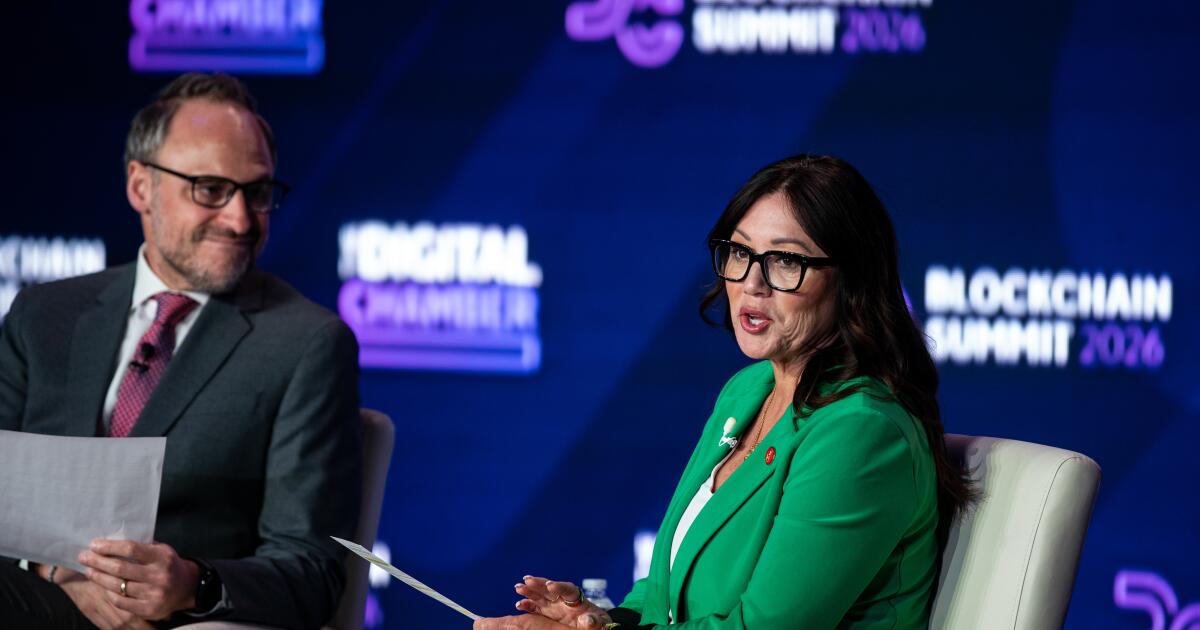
Trump is opening the door to risky ‘alternative investments’ such as crypto and private equity in 401(k) plans. But employers have had good reasons to keep them out of their plans.
If you believe Labor Secretary Lori Chavez-DeRemer, American 401(k) accounts are about to get much better.
Thanks to President Trump’s “bold new vision of a new golden age for America,” Chavez-DeRemer wrote in the Wall Street Journal on March 30, her agency is taking steps to open these crucial retirement accounts to a raft of new investment options, such as cryptocurrencies and private equity funds.
Her goal, she wrote, is to “unwind regulatory overreach and litigation abuse that have stifled innovation.” Her instrument is a proposed regulation that in effect would provide a safe harbor for plan sponsors — that is, employers — to offer those options in their employees’ plans without risking lawsuits or government scrutiny over whether they’re sufficiently prudent for workers to choose.
We have seen a number of proposals from private equity funds where the returns are really not calculated in a manner that I would regard as honest.
— Warren Buffett (2019)
Notwithstanding Chavez-DeRemer’s assertion that this change would be all to the good for workers, the truth is that she and Trump are acting at the behest of alternative investment promoters, who have long slavered for access to the nearly $14 trillion in assets held in 401(k)s and other such defined contribution retirement plans.
Far be it for me to offer anyone investment advice. But there are a few things that Trump and DeRemer aren’t telling you about these proposed new options. Namely, the dangers they present to unwary small investors.
The first clue that something is being hidden appeared in DeRemer’s op-ed, in which she blamed “Washington bureaucrats” and “plaintiff lawyers” for stifling the financial innovation that people supposedly have been clamoring to put in their retirement accounts.
You know who rails against “Washington bureaucrats” and “plaintiff lawyers”? Businesses that are fearful that government regulators and juries will clamp down on their wrongdoing. These critiques are often described as efforts to get government off the backs of the people. What they don’t explain is that once government has climbed off, big business will saddle up.
(As I’ve reported, among the businesses that have recently been demonizing plaintiff lawyers is Uber, which is pushing a ballot measure in California that would all but shut the courthouse doors to some passengers injured during Uber rides.)
So let’s examine the unacknowledged issues with “innovative” alternative investments. Private equity firms are known for buying companies that are either held privately, or are public companies due to be taken private. In many cases, they turn profits for their investors by cutting payrolls and reducing services at their portfolio companies, then draining what’s left until there is nothing left. Cryptocurrencies, as I’ve written, are a scam all their own.
We’ll start with the implicit and explicit rules guiding employers when they decide what investment choices to offer workers in their 401(k)s.
“Employers are fiduciaries, which means they must make decisions about retirement investments that are in their employees’ best interest,” observes Eileen Applebaum of the Center for Economic and Policy Research. “They must be prudent in curating a menu of retirement plan options for their workers. And they have been successfully sued for lack of prudence by workers whose retirement accounts held high fee, illiquid, risky investments that failed to perform.”
The fiduciary standards are developed in part by government bureaucrats. And the successful lawsuits? They’re brought by plaintiff lawyers.
In 2021, the Biden-era Labor Department warned that most sponsors of 401(k) plans and other defined contribution plans “are not likely suited to evaluate the use of [private equity] investments” in those plans. The administration shied away from outlawing such investments outright in 401(k)s. Nevertheless, employers understandably saw the warning as a yellow light, if not a flashing red light.
As of 2024, only about 4% of plan sponsors offered alternative investments, Applebaum reported. The threat of litigation also stayed their hand; 66 lawsuits were filed against plan sponsors that year, according to Encore Financial, a personal finance firm. High fees and other fiduciary failures were at the heart of most of the cases.
This isn’t the first time that Trump has tried to wedge private equity investments into 401(k)s. In 2020, during his first term, then-Labor Secretary Eugene Scalia issued an opinion that the mere presence of private equity investments among 401(k) choice was not in itself a fiduciary violation.
Scalia said his goal was to “remove barriers to the greatest engine of economic prosperity the world has ever known: the innovation, initiative, and drive of the American people.”
Until then, individuals were effectively barred from the investments by a Securities and Exchange Commission rule allowing only “accredited” investors — those who could show annual income of more than $200,000 or net worth of $1 million or more, not including their homes.
I didn’t offer an opinion then about the wisdom of these investments, but wrote only that “if I were inclined to invest my 401(k) money in private equity, I would hope that my family would arrange to have my head examined.”
My reasoning then was that private equity funds produce limited disclosure, or no useful disclosure at all; there are no commonly accepted formulas to measure their returns; and they’re subject to management fees immensely higher than conventional stock, bond or money market funds.
No less an experienced investor than Warren Buffett warned his own shareholders away from the sector, I pointed out.
“We have seen a number of proposals from private equity funds where the returns are really not calculated in a manner that I would regard as honest,” Buffett said at the May 2019 annual meeting of Berkshire Hathaway, which held his corporate investment portfolio.
Since then — indeed, since the Great Recession of 2007-2009 — the private equity sector has been promoting itself as a source of financial returns superior than those of conventional stock portfolios while glossing over cavils such as Buffett’s.
The promoters boast that their funds have low correlations with public markets — that is, when the public markets falter, the private markets gain; that they’re skilled at finding bargains among targeted businesses; and that they impose profit-gaining efficiencies on their acquired businesses.
In recent years, however, the private equity argument has faded. “Current data raises questions concerning these predicate assumptions,” wrote Nori Gerardo Lietz of Harvard Business School in 2024. Private equity fund performance, she observed, has “eroded materially.”
That’s true. From 2022 through the first three quarters of 2025, according to the research firm MSCI, private equity firms turned in annualized returns of 5.8%, while the Standard & Poor’s 500 index of public firms yielded 11.6%. Institutional investors such as public employee pension funds have begun to ask whether the sector deserves their money.
In the last year, the Yale University endowment and the public employee pension fund of New York City have sold off billions of dollars in private equity investments, some at a discount to their stated values. (To be fair, the California Public Employees’ Retirement System, or CalPERS, has remained a fan, attributing its recent improvement in overall returns to a strengthened investment in private equity.)
The doubts being voiced by these major investors has turbocharged the push by the private equity sector to reach into individual retirement accounts. By some measures, however, individual investors have even less tolerance for some of the features of private equity than do institutions. Unlike publicly traded stocks, these investments are illiquid, meaning they can’t be sold at will and they can’t be reliably priced.
As for crypto, the other major alternative investment being touted by Trump, its shortcomings are well documented.
In contrast to conventional stocks and bonds, they don’t represent stakes in anything concrete and as a result are extremely volatile.
Bitcoin, for instance, ran as high as $126,000 in October; as of Thursday it was priced below $72,000. Among other queasy-induced crashes, bitcoin lost 35% of its value in less than four weeks between mid-January and early February, falling from $96,929 on Jan. 13 to $62,702 on Feb. 4.
These are all factors demanding notice from small investors contemplating adding these sectors to their retirement funds. For that reason, some retirement professionals doubt that even the Trump administration’s favor will persuade many plan sponsors to open their doors to alternative investments. Trump’s regulators may be taking a hands-off approach to these sectors, but plaintiff lawyers aren’t likely to back off.
For individual investors, these are sectors that were made for the phrase “caveat emptor.” If you don’t know your Latin, it means “buyer beware.”
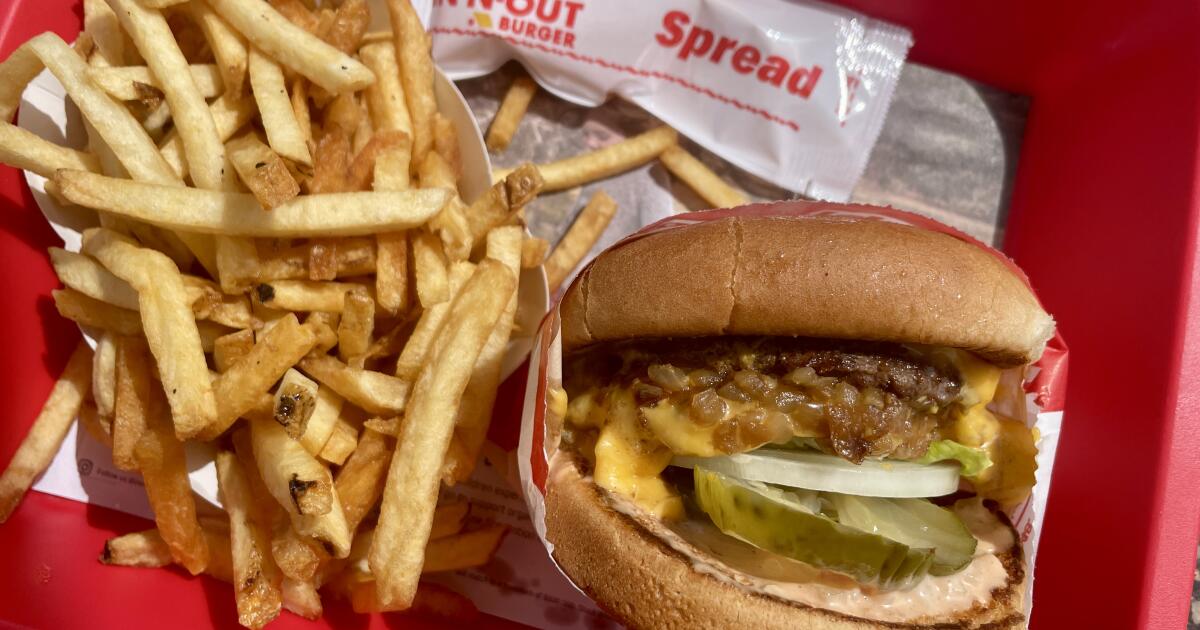
In-N-Out is known for hewing to convention.
So don’t expect the popular burger chain to embrace mobile ordering anytime soon.
That was a message Lynsi Snyder-Ellingson, owner of the family-run chain, delivered in a speech posted this week on YouTube.
Snyder expressed concern that such automation would taint the company’s efforts to sustain its in-person customer service and fresh food.
“What makes In-N-Out and the experience so special is the interaction and the customer service that we’re able to give, the smile, the greeting. Just that warmth and feeling, the culture,” Snyder-Ellingson said. “The mobile ordering will definitely take a piece of that away.”
The owner spoke and took audience questions during an event at Pepperdine University.
Snyder-Ellingson intends to keep operations as close to how it was when her grandparents, the founders, were at the helm, she said.
Snyder-Ellingson, who took charge of the family-run chain in 2010, spoke about her 2023 book, “The Ins-N-Outs of In-N-Out Burger,” and opened up during the talk about her journey reconnecting with God, the struggles she faced with drinking, as well as her divorce.
The beloved burger chain, whose long lines often wrap around the block, has stood out against fast food competitors in its resistance to automated ordering.
The company was born in 1948, when Harry and Esther Snyder opened a small food stand in Baldwin Park. For decades, the burgers could only be found in Southern California, until the chain eventually expanded, mostly to nearby states.
The original location gave birth to drive-thru ordering, and revolutionized fast food culture in the state.
To this day, all orders are custom-made and nothing is frozen, a practice that stays true to the founding couple’s promise of “Quality, Cleanliness and Service.” The menu is simple, and has remained mostly the same.
“My passion in leading is making sure that I’m preserving um the legacy of my grandparents and my family,” Snyder-Ellingson said. “I want to make them proud. I want to champion everything that they would want, especially in today’s world.”
The company’s future in Southern California has been shaky since Snyder-Ellingson announced she was moving to Tennessee, where the company plans to open a second headquarters. The company has scaled back in the Golden State, consolidating its corporate operations to Baldwin Park.
“There’s a lot of great things about California, but raising a family is not easy here. Doing business is not easy here,” Snyder said on a podcast in July. Her comments come amid a broader corporate exodus from California, with businesses like Tesla and Chevron jumping ship.
Today, there are locations in 10 states across the country, mostly in the west coast and as far east as Tennessee. The company recently announced five new locations set to open soon outside California.

WATCH: Artemis II astronauts splash down on Earth

How David Cross Gets Ready for a Night of ‘Dangerous’ Comedy

“Moon tree” in Metro Detroit rediscovered following Artemis II mission

San Francisco store created and run by AI

Wembanyama drops 40 as Spurs beat Mavericks, reach award eligibility

Florida High School Football Rankings: Top 25 teams – Oct. 21

How old is Bo Nix? What to know about Oregon quarterback ahead of 2024 NFL Draft

Cleary's 21 help Le Moyne down Central Connecticut State 69-64 in OT

99th annual Pony Swim held in Virginia

Indiana Members Credit Union announced as new anchor tenant at Bottleworks District
WATCH: Artemis II astronauts splash down on Earth

Swalwell’s former female staffer drops bombshell allegations of sexual assault, exposing himself: report

NASA’s Artemis II prepares for splashdown on Earth

Trump proposes painting executive office building white

Hummingbird feeds newly hatched chick
-

 Atlanta, GA6 days ago
1 teenage girl killed, another injured in shooting at Piedmont Park, police say
-

 Education1 week ago
Video: Toy Testing with a Discerning Bodega Cat
-

 Movie Reviews1 week ago
Vaazha 2 first half review: Hashir anchors a lively, chaos-filled teen tale
-

 Georgia4 days ago
Georgia House Special Runoff Election 2026 Live Results
-

 Pennsylvania4 days ago
Parents charged after toddler injured by wolf at Pennsylvania zoo
-

 Arkansas17 hours ago
Arkansas TV meteorologist Melinda Mayo retires after nearly four decades on air
-
 Milwaukee, WI5 days ago
Potawatomi Casino Hotel evacuated after fire breaks out in rooftop HVAC system
-
 Entertainment1 week ago
Inside Ye’s first comeback show at SoFi Stadium