Business
The robot puppeteers of Silicon Valley teaching humanoids how to make your morning coffee


Fernando Flores can spend eight hours a day pouring the same cup of coffee.
He is not a barista. He’s a robot puppeteer, trying to train humanoids.
He manipulates mechanical arms remotely, using hand and arm sensors to make them pick up a pot of coffee, pour it into a mug and put the pot back in the coffee maker. Flores checks for spills, then empties the mug back into the pot by hand and does it again — hundreds of times.
“The repetitiveness, it can cause some discomfort,” said Flores, who has the title of senior robotic pilot at San Francisco startup Encord. “It becomes second nature after a while.”
This Sisyphus of Silicon Valley is on the front lines of a rapidly expanding industry of robot trainers, preparing to teach and operate the army of humanoid robots scheduled to march out of nearby factories in the coming year. Encord practices, records and sells data about movement to the companies racing to bring humanoids to homes, offices and factories.
If tech companies’ optimistic plans are to be believed, a swarm of American-built robots is about to hit the market.
Tesla’s Fremont factory stopped car production this year to make way for production lines for its Optimus robots, with unbelievable plans to ramp up capacity to 1 million units a year. Palo Alto-based 1X Technologies is already manufacturing its 66-pound, 5-foot-6 humanoid named Neo at its factory in Hayward. The company received 10,000 preorders, and its first shipment is expected later this year. Figure AI’s humanoid factory in San Jose has increased its manufacturing capacity to produce one Figure 03 robot an hour, with the goal of producing 12,000 a year.
Fernando Flores demonstrates the articulation of a robot performing a whisking motion at Encord on May 21.
(Paul Kuroda / For The Times)
Goldman Sachs projects the global market for humanoids could reach $38 billion by 2035.
The AI of these humanoid robots needs an immense amount of data on human movement. How humans write, speak, code and compose was easily scraped off the internet, but the bots need more information to master how to stand, step, lift, squeeze, pour and perform other physical movements. That is where companies like Encord come in.
The $10 billion invested in robotics in 2026, according to CB Insights, has spawned an industry focused on training robots. Initially, that meant humans strapping iPhones to their foreheads, recording actions like cooking, cleaning and performing household chores. That, however, doesn’t capture the exact torque, force and grip required for a robot hand to work flawlessly.
Now, humans are directly guiding robots through expensive rigs that let them control the robots’ movements. Data collected using robot arms offer richer insights into motor skills and object manipulation. Encord charges clients up to $1,000 per hour for training data.
The information gathered from trainers controlling robots is “super important to bridge the next level of learning,” where robots will learn to correct mistakes and do the chores on their own, said Vineeth Velmurugan, head of robotics learning at Encord.
The company is already working with some of the top companies in robotics, but said it couldn’t share most names. Among the clients it could mention were Toyota Research Institute and Weave, which already has laundry-folding robots in a few homes.

Brian Gonzalez pulls an ethernet cable using a robotic arm at startup Encord on May 20.
(Paul Kuroda / For The Times)
Many of the new robotic data companies are focusing on industrial use cases. Robots can perform better in a structured, predictable environment, like a factory or warehouse.
Home tasks are tougher, as layouts and tasks are more varied and messy. While many bots have mastered walking, they still struggle to open doors, fridges and washing machines smoothly. They don’t know where or how to grasp a doorknob, handle or door edge or how much pulling, pushing or twisting force to apply.
Flores has mastered making the robot arms pour coffee, but he still often spills. When that happens, he deletes records of the attempt.
“Typically, we don’t want any mistakes,” he said. “If we have more than three consecutive mistakes within a 15‑second window, that’s not going to be good data.”
Inside Encord’s test facility in Hayward, it has replicated a standard American home with a fully furnished living room, kitchen and bathroom.
In the living room, a pilot rearranges an untidy study desk. She first scatters AA-size batteries, pens and scissors on the table, and walks back to the nearby control rig to make the robot arms place each one inside the tray of a desk organizer.
Depending on the day’s training, the pilots could be opening and closing refrigerator doors, whisking liquids in a bowl, sorting silverware or turning a water faucet on and off over and over until the robot arms get it right.

Cortney Weintz, left, and Tony Schiller record data with cameras at Encord.
(Paul Kuroda / For The Times)
In another corner of the facility, people wearing smart glasses place and pick up playing cards and sort plastic plates by hand, collecting first-person videos.
One key skill for the coming bot invasion: plugging in cables.
Companies want robots that can crawl into duct spaces, identify ports and plug cables to help build the massive data centers needed for AI. Encord replicated a real data center server rack, where an operator inserts blue cables into penny-sized sockets all day.
Many companies have entered this business. Meta-backed Scale AI and Palo Alto-based Micro1 are major players in the space. China has more than 40 state-owned robot data-collection facilities where hundreds of on-site humans mimic train bots how to move in the real world.
In Watertown, Mass., Tutor Intelligence has set up a 100-robot facility dedicated to harvesting movement data. Its robot arms, which are being trained to do factory work, are controlled by a human team split across Mexico, the Philippines and Boston. This is in part to train its robot, Sonny, which will hit the market later this year.

Elaine Batchlor sorts screws and bolts with a robot in a mockup at Encord.
(Paul Kuroda / For The Times)
“We built the Data Factory to bootstrap the initial intelligence for the Sonny robot, so that we can begin to deploy Sonny into the field,” said Josh Gruenstein, co-founder of Tutor. Ten of its remote operators are based in Boston, and the rest are international.
Remote operation is emerging as an integral part of the humanoid robot business. Employing teleoperators in countries where wages are much lower than in the U.S. could, in theory, mean a robot controlled by a human in another country could do a task at a fraction of the cost of having an American do it.
This month, a humanoid robot cleaning service in San Francisco called Gatsby completed a robot cleaning of a U.S. home using a teleoperator in Mexico.
The technology is still evolving, said Aron Frishberg, co-founder of Gatsby, but being a first mover means Gatsby is getting more training.
“There’s obviously stuff that goes wrong,” he said. “It’s really hard to get precise hand movements or arm movements and grab something.”
Encord co-founder Ulrik Hansen said it will be setting up a teleoperations center in its Hayward facility in the next three months. Even as more robots are deployed and master increasingly sophisticated tasks, they will still need humans to occasionally take control remotely.
“They will need some exception handling when they get things wrong,” he said.
Hundreds of teleoperators will learn where the system succeeds, where it breaks and step in when needed. Once those patterns emerge, Hansen said, they can move teleoperations to cheaper locations abroad or to the Midwest.
Back in Hayward, Flores created new coffee-pouring challenges for his robot arms. He changed what was on the counter around the coffee maker and moved the mug to different spots. It takes a lot of know-how to puppet and train a robot, he said.
“A lot of people would (guess) this might be easy, this is dumb,” Flores said. “There actually is thought here. There actually is critical thinking.”

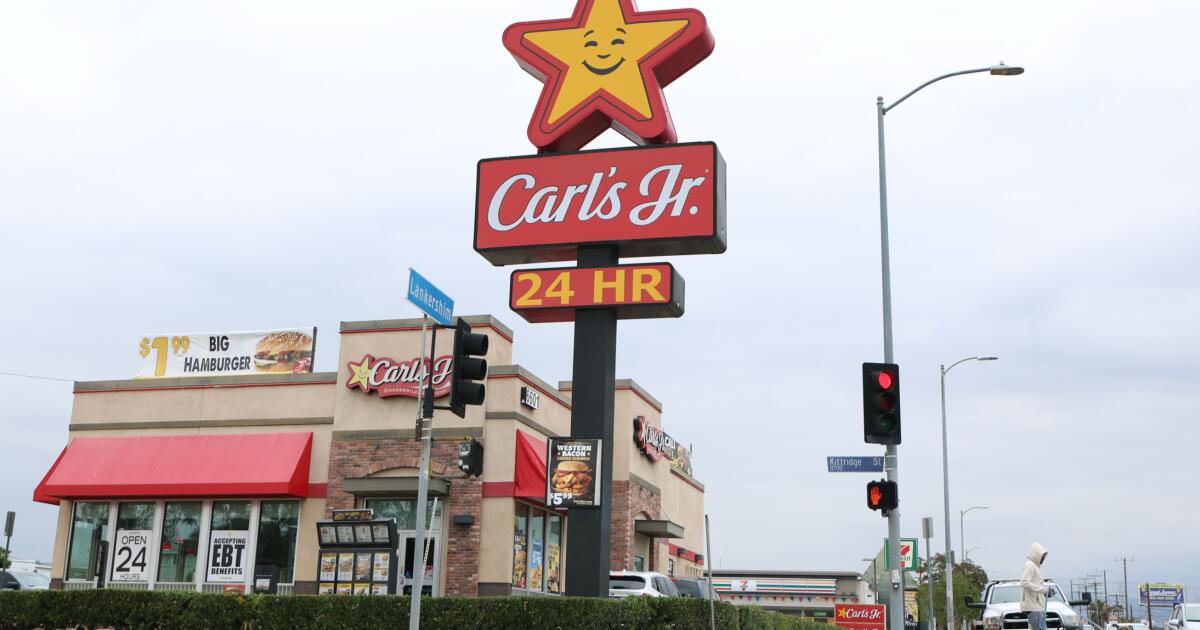
A Carl’s Jr. franchisee is trying to close and sell his 59 locations in California after filing for bankruptcy protection in April.
The franchisee, Harshad Dharod, who has branches mostly in Southern California, intends to close 10 of the branches he controls and find a buyer for the remainder, according to a broker helping find buyers.
In earlier bankruptcy filings, Dharod had blamed California and Carl’s Jr. for his stores’ struggles. Dharod said a lack of support and innovation from Carl’s Jr. and an increase in labor costs from a $20 minimum wage left him unable to cover his expenses.
Dharod couldn’t be reached for comment.
A spokesperson for Carl’s Jr. and its parent company CKE Restaurants, said they are aware of Dharod’s decision to sell.
“This situation is specific to this individual franchisee’s financial and business circumstances,” said the spokesperson. “This has no impact on the operations of any other Carl’s Jr. locations.”
National Franchise Sales will oversee the sale, which spans Southern and Northern California.
A spokesperson for the broker said it already has interest from prospective buyers. The spokesperson said that when a franchise changes owners, employees and managers usually keep their jobs.
Carl’s Jr. began in 1941 as a hot dog cart on the corner of Florence and Central in Los Angeles and grew into one of the region’s best-known burger chains. It opened its first sit-down restaurants with expanded menus in Anaheim in 1946. Its smiling yellow star was born in the 1950s and rapidly spread across California throughout the 1970s.
Although it moved its headquarters from Carpinteria to Tennessee in the last 10 years, its menu still reflects its California origins, with items such as the Cali XL, a double cheeseburger. The chain was among the first to spot the meat-free trend and introduced plant-based burgers and the charbroiled turkey burger. In the early 2000s, it made a splash with commercials pointing to its California origins.
It has had a tough time this year remaining relevant amid new competitors and fast-food consumers who are becoming more picky about what they will pay for and eat, analysts say.
Like most restaurants, Carl’s Jr. has been struggling to attract customers at a time when many are increasingly concerned about inflation and the health of the economy. Some chains are slashing prices. Smaller chains can’t compete well in the price wars. Those without a strong brand identity and fan base have been suffering.
Dharod told the bankruptcy court that business had become particularly bad in the last two years, leaving him without sufficient access to cash to cover wages, rent, supplies and insurance. Although his outlets have generated more than $6 million in monthly revenue, they have been losing more than $600,000 per month this year.
He had to ask for special permission to use his daily cash flow to fund expenses, or risk running out of money and being forced to close his outlets.
A small group of the close to 1,000 employees working for the franchisee say the efforts to cut costs to the bone have left them overworked, understaffed and exposed to violence.
Some say they are getting injured as they have to do the work of multiple people. Some detailed violent interactions with customers, including robberies and physical assaults, and said the company didn’t provide safety training. Some have staged multiple walkouts in recent months to bring attention to their concerns.

A Delaware Court of Chancery judge delivered a blow to wrestling impresario Vince McMahon and other World Wrestling Entertainment officials earlier this week.
Judge J. Travis Laster, vice chancellor of the Delaware Court of Chancery, issued sanctions for “spoliation of evidence” in the shareholder lawsuit over the 2023 merger between Ultimate Fighting Championship and WWE.
Laster ruled on Tuesday that WWE executives destroyed evidence by using the auto-delete setting on the messaging app Signal, enabling potentially relevant communications to be deleted.
The ruling means the court will operate under the assumption that five potentially damaging statements are true while allowing the defendants to rebut them.
The statements, according to the ruling, include that McMahon’s decision on the merger was “influenced” by Endeavor Executive Chairman Ari Emanuel’s “promise” to provide him with a continued role at the company and to indemnify him and provide legal support as federal investigators were looking into claims of alleged sexual misconduct.
McMahon pursued a deal with Endeavor in 2022 before WWE initiated its strategic review process, and both McMahon and then-WWE President Nick Khan worked with The Raine Group, a strategic financial advisor, “to steer the process to Endeavor and away from other potential bidders,” the ruling states.
In September 2023, entertainment giant Endeavor, the parent company of UFC, acquired WWE and merged the two sports entities to form a new, publicly traded company, TKO Group Holdings, in a deal worth $21.4 billion.
A month later, a group of shareholders filed suit against McMahon and other company officials in Delaware Chancery Court, claiming McMahon orchestrated a “sham sale process.”
Representatives for McMahon, WWE and TKO were not immediately available for comment.
According to the suit, McMahon, WWE’s controlling shareholder, turned down higher offers and excluded other bidders who would have ousted him and instead chose a deal that favored Endeavor’s Emanuel, a “close friend and longtime ally,” enabling McMahon to continue running WWE and shielding him from federal investigations related to a raft of sexual misconduct claims.
The complaint also alleges that the $21.4-billion deal undervalued the company and was “far below the offers” WWE’s board could have received from other interested parties had they “made any effort to negotiate in good faith.”
The litigation is related to the 2022 investigation by WWE’s board that found that McMahon made at least $14.6 million in payments between 2006 and 2022 for “alleged misconduct.” McMahon has denied claims of misconduct.
The settlements were made to women, including WWE employees, who alleged that McMahon initiated unwanted sexual contact and coerced women into performing sexual acts on him. In one case, first reported by the Wall Street Journal, a woman claimed that McMahon sent her unsolicited nude photos of himself.
McMahon’s alleged misconduct became the subject of ongoing investigations by the Securities and Exchange Commission and the U.S. Department of Justice.
“I am confident that the government’s investigation will be resolved without any findings of wrongdoing,” McMahon said in a statement to The Times in 2023.
Last January, the SEC announced it had settled charges against McMahon alleging he had violated federal securities laws by failing to disclose a pair of settlement agreements to WWE worth $10.5 million.
McMahon agreed to pay more than $1.7 million in a civil penalty and in reimbursement to WWE, without admitting or denying the agency’s findings. Federal prosecutors also have dropped their criminal investigation.
In January 2024, McMahon resigned as executive chairman of the board of TKO Group, one day after a former WWE employee, Janel Grant, sued the company, McMahon and former head of talent relations John Laurinaitis, alleging sexual assault, trafficking and emotional abuse.
Grant claimed that McMahon agreed to pay her $3 million in exchange for her silence.
The shareholder trial is set to begin on June 8. McMahon, Emanuel, Khan, TKO President Mark Shapiro, and WWE Chief Content Officer Paul “Triple H” Levesque are expected to testify.

In a high-stakes decision that will shape California’s economy for years, air officials late Friday approved a sweeping overhaul of the state’s signature climate program, cap-and-invest.
The 10-3 vote from the California Air Resources Board determines how aggressively the Golden State will curb planet-warming greenhouse gas emissions in the years ahead — and how billions of dollars in revenue will flow through communities, businesses and public programs statewide.
Cap-and-invest was nation-leading when it launched in 2013. The program forces major polluters to pay for their share of emissions by buying allowances at auctions or being granted them for free. It uses the revenue to fund public transit projects, wildfire prevention, affordable housing, clean energy, electric vehicles and safe drinking water.
The pollution limit — or cap — declines each year, reducing the total amount of emissions in the state and helping California reach its ambitious climate targets, including 100% carbon neutrality by 2045.
The Legislature voted last year to extend cap-and-invest through 2045. Officials at the Air Resources Board then spent the last several months drafting and revising the plan voted on this week, which received considerable feedback from oil and gas companies, environmental groups, lobbyists and lawmakers all jockeying for different priorities.
Some 200 people testified in person during the marathon two-day meeting preceding the vote, and the final proposal received more than 1,000 written comments.
Industry groups warned that capping emissions too much and too quickly would push refineries out of the state and drive up already soaring energy costs. But environmentalists and other stakeholders said giving too many concessions to fossil fuel interests would defeat the program’s purpose, which is to drive down emissions along a pathway consistent with what scientists say could preserve a recognizable climate.
The program was always planned to become stricter as the years unfolded, to give businesses more time to make the stronger reductions in their emissions.
Officials were under legal, market and budgetary pressure to pass a plan without delay, and also said it’s important for California to signal market certainty.
“It is no secret that climate policy is at a crossroads — under attack by an openly hostile and well-funded opposition and upended by global economic upheaval,” CARB chair Lauren Sanchez said during the meeting. “At a moment of uncertainty at the federal and international levels, California has the opportunity to lead with consistency.”
Among the key updates to the program are the removal of 118 million pollution permits, or allowances, from the market by 2030, and 900 million after 2030. Officials say this will amount to a steep, 11% annual lowering of the cap by the end of this decade, and 7% from 2031 to 2045, in keeping with the state’s mandated targets.
Critically, however, the update will also create a new pool of 118 million allowances above the cap that polluters can apply for and receive if they invest in decarbonization projects, a program dubbed the Manufacturing Decarbonization Incentive.
The incentive program is intended to discourage regulated industries from leaving the state. Two major refineries have announced exit plans in recent years, including Valero’s Benecia refinery and Phillips 66’s Los Angeles refinery, which shut down in 2025.
But many critics — including transit, affordable housing, environmental justice and clean water groups — said this amounts to a dismantling of the program.
“CARB has proposed creating exactly 118.3 million additional allowances … outside the cap, the precise number of allowances that must be removed from the cap to keep us on track for our 2030 targets,” said Caroline Jones, a senior analyst with the nonprofit Environmental Defense Fund. “This undermines the cap’s role in actually limiting climate pollution, which is the core function of this program.”
The board approved the decarbonization incentive but committed to additional workshops and evaluations of the program before issuing any allowances for it.
Other updates include more free allowances for industrial facilities and refineries, which regulators said will help reduce pressure on gasoline prices. Critics described the free permits as subsidies for oil and gas.
The update will also shift some allowances from gas to electric utilities, and increase funding for the California Climate Credit, a rebate that appears automatically on people’s utility bills.
But perhaps most controversial is how the update will affect the program’s multibillion-dollar revenue, which flows into the state’s Greenhouse Gas Reduction Fund each year and is distributed to various programs. Cap-and-invest has delivered $35 billion for climate projects in California since its inception.
The new incentive pool will mean the loss of $2 billion annually to the fund, or roughly half the amount it has received in recent years, according to an analysis from the Legislative Analyst’s Office.
While the Air Resources Board does not determine how the fund is divvied up — that’s the Legislature — opponents warned that this could amount to significant cuts for the Affordable Housing and Sustainable Communities Program, the Low Carbon Transit Operations Program, the SAFER drinking water program and the Community Air Protection Program, among many others that rely on revenue from cap-and-invest.
“This could create serious consequences, including a potential zeroing out of the state’s support for critical emission reduction programs,” said Phillip Fine, executive officer at the Bay Area Air District. “Striking the right balance is critical, but all consequences must be fully considered.”
It was a sentiment echoed by many who delivered comments during the board meeting.
“These additional allowances would not only endanger our emissions targets, they would also flood the auction market and depress cap-and-invest revenues,” said Pam Odell of the group Climate Action California. “These revenues fund vital programs, promote climate resilience, clean transit and transportation, and public health, especially in the most heavily exposed front-line communities.”
Some groups came out in support of the update, however, including Southern California Edison and Pacific Gas & Electric. The plan strikes a “balance between program stringency and affordability,” Fariya Ali, air and climate policy manager with PG&E, said during the meeting.
Assemblymember Jacqui Irwin (D-Thousand Oaks), who authored the bill that reauthorized the program last year, was cautiously supportive, noting that she would like to see more guardrails around the incentive program to ensure it aligns with state climate targets. But delaying the update would only create more uncertainty at a time when the Trump administration is already canceling clean energy funds and revoking California’s authority to set clean vehicle standards, she said.
“If we fail now to adopt the proposed amendments to cap-and-invest, it would be without a doubt the greatest victory that the Trump administration could possibly hope for to achieve against California’s climate policies this year,” Irwin said.
Oil and gas groups were tepid. Jodie Muller, chief executive of the Western States Petroleum Assn., said the update provides some near-term relief for refineries, but leaves too much uncertainty after 2030 to drive continued investment.
Brian McDonald, regulatory affairs manager with Marathon Petroleum Corp., said similarly that the oil company is “deeply concerned that the current proposal does not go far enough to provide the regulatory certainty needed to sustain in-state fuel production.”
In a briefing ahead of the vote, California climate economist Danny Cullenward said the update threatens both the “cap” aspect of the program by introducing the new allowance pool, and the “invest” aspect by threatening to reduce the program’s revenues.
The proposal is “being presented as a compromise when in fact it is sacrificing both of the key goals of the program,” he said.
The new plan is slated to go into effect Sept. 1.
-

 Oregon3 minutes ago
Oregonians can go crabbing, fishing fee-free for 1 weekend in June
-

 Pennsylvania6 minutes ago
Pennsylvania man rubs raw chicken on door, dumps oil on vending machine: police
-

 Rhode Island11 minutes ago
9 Offbeat Rhode Island Towns To Visit In 2026
-

 South-Carolina18 minutes ago
Clyburn’s redistricting win fuels SC’s pitch to keep early primary position. An army of influencers are helping.
-

 South Dakota21 minutes ago
South Dakota State baseball loses to Arizona State, season ends
-
 Tennessee26 minutes ago
Nashville’s Eastpoint Neighborhood groundbreaking marks largest affordable housing project in Tennessee
-

 Texas33 minutes ago
Andy Beshear says ‘Texas is in play’ for Democrats after Ken Paxton’s Senate GOP primary win
-

 Utah36 minutes ago
A Utah Utes coach was ‘too negative’ with his players. Here’s how he’s changing his approach now.

