Business
Paramount sheds another 1,600 workers as David Ellison team digs in


Tech scion David Ellison marked his 96th day running Paramount by disclosing an upbeat financial outlook for next year and a plan to reduce an additional 1,600 workers.
Monday’s conference call with analysts was the first time Ellison, Paramount’s chairman and chief executive, directly addressed Wall Street after merging his production company, Skydance Media, with Paramount in August — an $8-billion deal that ushered the Redstone family from the entertainment stage.
One of Ellison’s top priorities will be to reverse decades of under-investment in programming. Paramount plans to increase content spending by $1.5 billion next year, including nearly doubling the number of movies that it releases. The Melrose Avenue studio intends to boost output from eight releases to 15 that are planned for next year.
Investing in technology is another priority, which Ellison referred to as one of its “north stars.” Executives want to build streaming service Paramount+ as the economics crumble for Paramount’s once profitable cable television division, which includes Nickelodeon, MTV and Comedy Central. Paramount also owns CBS stations and the CBS broadcast network.
Paramount announced it will be hiking streaming subscription fees — Paramount+ plans now are offered at $7.99 a month and $12.99 a month — although executives declined to say how much. The goal is to turn its streaming operations profitable this year.
Paramount said the workforce reduction of 1,600 people stemmed from the company’s divestiture late last month of television stations in Chile and Argentina. This comes on top of 1,000 job cuts last month, primarily in the U.S. The company said one of its goals was to operate more efficiently.
More than 800 people — or about 3.5% of the company’s workforce — were laid off in June, prior to the Ellison family takeover.
Ellison and his team have been looking to reduce the company’s workforce by 15%.
On Monday, Paramount executives said they should be able to realize about $3 billion in cost cuts — $1 billion more than initially advertised. The company’s goal is to complete its cost reductions within two years.
The earnings report comes as Paramount has been pursuing Warner Bros. Discovery, a proposed merger that would unite two of Hollywood’s original film studios and bulk up Paramount by adding the HBO Max streaming service, a larger portfolio of cable channels, pioneering cable news service CNN and the historic Warner Bros. studio lot in Burbank.
Paramount executives declined to discuss its dealings for Warner Bros. Discovery, which has rejected three offers, including a $58-billion bid for the entire company. Ellison’s father, billionaire Larry Ellison, has agreed to back Paramount’s bid.
However, his son spoke broadly about its motivations for any acquisition during the conference call.
“First and foremost, we’re focused on what we’re building at Paramount and transforming the company,” David Ellison said. “There’s no must-haves for us. …. It’s always going to be, how do we accelerate and improve our north-star principles?”
Total revenue for Paramount’s third quarter was $6.7 billion, flat compared with the year-earlier period. Paramount reported a net loss of $257 million for the quarter.
Paramount+ and other streaming services grew by 1.4 million subscribers to 79 million, although 1.2 million of those consumers benefit from free trials. Quarterly Revenue for the streaming operations, including Pluto TV, was up 17%.
The cost-cutting comes as Ellison, 42, has accelerated spending in other areas, including agreeing to pay $7.7 billion for the rights to UFC fights and $1.25 billion over five years to Matt Stone and Trey Parker to continue creating their “South Park” cartoon.
His team, including former Netflix programming chief Cindy Holland, also lured Matt and Ross Duffer, the duo behind “Stranger Things,” away from Netflix. Paramount also paid $150 million to buy the Free Press and bring its co-founder, Bari Weiss, to the company as CBS News editor in chief.
The company also signed a 10-year lease on a film and television production facility under construction in New Jersey, a move that will give the entertainment company access to that state’s tax incentive program.
In a blow, however, Taylor Sheridan, the prolific creator behind the “Yellowstone” franchise, will be packing his bags. Sheridan, who is under contract with Paramount through 2028, made a deal to develop movies and future shows for NBCUniversal after executives he worked with at Paramount departed the company when Ellison took over.
For 2026, the company expects to generate total revenue of $30 billion and adjusted operating income before depreciation and amortization of $3.5 billion.
Shares closed at $15.25, up 1%, before the earnings were announced.



As electric vehicle makers struggle to remain relevant, a new competitor is about to hit California’s roads.
It is stuffed to the sunroof with speakers and screens, and it’s a Sony.
Sony’s joint venture with Honda, Sony Honda Mobility, will launch a luxury EV brand called Afeela just in California this year.
-
Share via
The sedan is a brash bet that the two old-guard brands can succeed where others have struggled.
“We believe customers are looking for more than just a means of transportation” in their luxury EVs, said Sony Honda Mobility President and Chief Executive Shugo Yamaguchi in a statement to The Times. “They are looking for technology, safety, design, and a personalized experience.”
Afeela vehicles aim to do for driving what the Sony Walkman did for walking.
They have 28 speakers, wraparound screens, an AI assistant and an entertainment system for Karaoke or playing Sony PlayStation games.
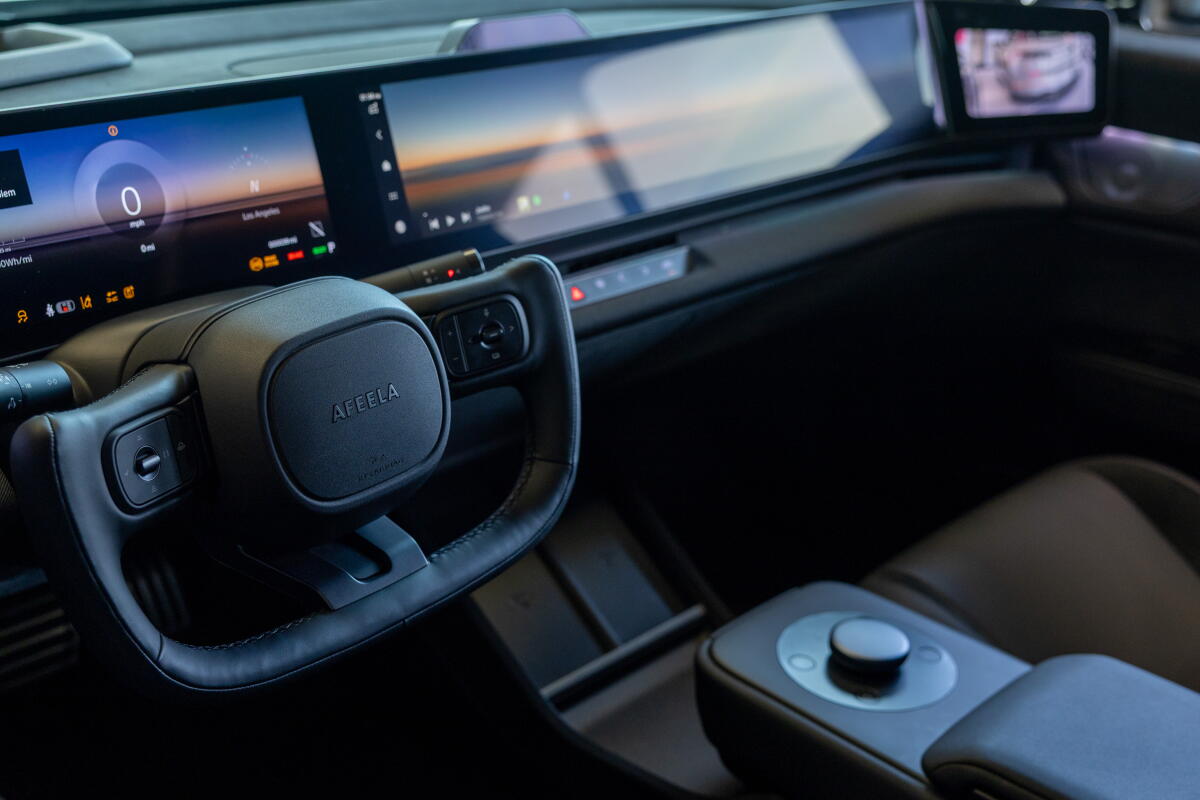
The interior of the Afeela vehicle at Afeela Studio in Beverly Hills.
(Ronaldo Bolanos/Los Angeles Times)
Even as the end of government incentives for EVs has taken the air out of the market, Sony and Honda are hoping there are enough high-end Tesla buyers who may be looking to try something different.
Some EV enthusiasts have been alienated by Tesla Chief Executive Elon Musk’s affiliation with President Trump, who has strangled government support for green vehicles.
In West Los Angeles, a big Afeela ad above a Tesla dealership puts the EV leader squarely in its crosshairs.
“Get stares, not glares,” the billboard reads, with a glamour shot of a sleek, silver Afeela 1.
Tesla’s market share in California slipped to 48% last year from around 53% a year earlier.
Honda’s own EVs haven’t been wildly successful but their market share in California edged up to 3.8% last year compared to 1.8% a year earlier.
Afeela is entering the market at a time when federal support for EVs is low and public enthusiasm is faltering.
Major automakers including Ford, General Motors and Stellantis are paring back their EV ambitions. Lucid, a Newark, Calif.-based EV maker, has been struggling to turn a profit and recently laid off more than 300 employees.
Irvine-based luxury EV maker Rivian said last year that it was laying off more than 800 workers as it looked to cut costs.
Afeela has showrooms in San José, Beverly Hills and Century City. The company is manufacturing the cars at a Honda plant in Marysville, Ohio, and will make its first deliveries at the end of the year.
The Sony and Honda joint venture is in the midst of legal obstacles as it aims to build a solid reputation. Last August, the California New Car Dealers Assn. filed a lawsuit against American Honda Motor Company and Sony Honda Mobility, alleging that the companies violated franchise law by selling Afeela vehicles directly to consumers rather than through Honda dealerships.

Various display screens inside the Afeela vehicle at Afeela Studio, Beverly Hills.
(Ronaldo Bolanos/Los Angeles Times)
For now, Californians can reserve an Afeela 1 for a $200 deposit. Selling only in the Golden State at first will allow the company to learn from an engaged customer base, said Yamaguchi.
“California is one of the most advanced markets for EV adoption, grid infrastructure, and new mobility technology,” he said. “It also represents a culture of innovation and creativity that aligns well with the Afeela vision.”
The company is planning to begin sales in Arizona next year.
The car comes in two trims, starting at $89,900 and $102,900. Both trims come with level two automation. When using a vehicle with level 2 automation, the driver must remain in control and attentive while the system assists with braking, acceleration or steering.

While some of Afeela’s tech may have a leg up on the competition, the brand will have to prove there’s healthy demand for it at that price, said Brian Moody, an auto industry analyst.
(Ronaldo Bolanos/Los Angeles Times)
Sony and Honda are looking to capitalize on growing interest in self-driving technology and plan to eventually equip all their vehicles for full autonomy. The Afeela 1 comes with 18 cameras, nine radars, 12 ultrasonic sensors, and lidar, a laser-based radar that Waymo uses to power its autonomous taxis.
“You do have to pay attention and we definitely don’t want people to believe that they can just go to sleep behind the wheel,” said Raisu Williams, an Afeela engagement operations associate. “But we are aiming for that level four autonomy, where you don’t have to drive at all.”
While some of Afeela’s tech may have a leg up on the competition, the brand will have to prove there’s healthy demand for it at that price, said Brian Moody, an auto industry analyst.
“Tesla and its platforms are aging, and the Lucids and Afeelas of the world feel more modern, more futuristic,” Moody said. “We’ll see if the car can make the jump from early adopters and tech-type people to the mainstream.”

The AFEELA logo sits on top of a rear cameras of a Afeela vehicle.
(Ronaldo Bolanos/Los Angeles Times)
Afeela is hoping to have more success than Lucid with attracting a wide audience. Lucid laid off more people this year after laying off around 6,800 people in 2024 and hiring actor Timotheé Chalamet as a brand ambassador.
“I do think Afeela is in danger of heading down the same road as as Lucid,” Moody said. “If those cars can be successful in California, will that translate to success throughout the rest of the country and the world?”
Sony Honda Mobility got its start when the two founding companies formed a strategic alliance in 2022. The new company unveiled its first Afeela prototype in 2023 at the Consumer Electronics Show in Las Vegas.

AFEELA 1 unveiled during a Sony news conference at the Consumer Electronics Show in Las Vegas last year. ,
(Ian Maule/AFP via Getty Images)
Auto industry experts said Honda’s bet on Afeela is somewhat risky for the major automaker, but it could pay off. Because Sony and Honda each own 50% of Sony Honda Mobility, the companies reduce their liability by sharing risk, said auto analyst Kristin Shaw.
Honda has popular gas-powered models such as the Pilot and the CR-V to fall back on if their ambitions with Sony fall through.
“Honda’s bread and butter is still in their production vehicles,” Shaw said. “Honda is hedging its bets across the board, and Afeela is one way for them to explore what could happen.”

new video loaded: Indian Kitchens Face Fuel Shortage From War in Middle East
By Shawn Paik
March 13, 2026

Universal Pictures will now keep its new films in theaters for at least five weekends, a reversal from the studio’s previous policy of at least 17 days that was set during the pandemic.
The change takes place immediately, the studio said Thursday. That means it will apply to its newest film, the Colleen Hoover romance “Reminders of Him,” which is out in theaters this weekend. Other upcoming films include Christopher Nolan’s “The Odyssey,” which will be released in July.
“Our windowing strategy has always been designed to evolve with the marketplace, but we firmly believe in the primacy of theatrical exclusivity and working closely with our exhibition partners to support a healthy, sustainable theatrical ecosystem,” Donna Langley, chair of NBCUniversal Entertainment, said in an email to the New York Times, which first reported the news.
Focus Features, Universal Pictures’ specialty film arm, will keep its existing theatrical exclusivity policies, which vary on a case-by-case basis. Chloé Zhao’s “Hamnet,” for instance, was in theaters for 99 days, while 2024’s “Nosferatu” played for 58 days. The minimum is 17 days.
The amount of time films are available exclusively in theaters — known as “windowing” in industry jargon — has become a contentious topic of conversation in Hollywood.
That debate ramped up during the pandemic, when some studios shortened theatrical exclusivity periods in order to move films to release for video on demand or streaming.
Prior to the pandemic, those windows could be as long as 90 days. Now, the average is around 30 days.
Theater owners have argued that shorter windows cut into box office profits and train audiences to wait to watch a movie at home. Distributors have countered that a one-size-fits-all approach doesn’t necessarily work for smaller or mid-budget films, which may find a bigger audience via at-home viewing.
At last year’s CinemaCon trade conference, top theater lobbyist Michael O’Leary called on distributors to establish a minimum 45-day window, arguing there needed to be a “clear, consistent starting point” to set moviegoers’ expectations and affirm commitment to theatrical exclusivity.
The debate has become even more fierce as box office profits still have not recovered from the pandemic. Last year, theatrical revenue in the U.S. and Canada totaled about $8.87 billion, just 1.5% above 2024’s disappointing $8.74-billion tally.

Bay Area 5th grader competing in MLB Players STEM League championship in Miami

New Cowboys CB Cobie Durant Shares Vision For Impact on Dallas Defense

North Miami Beach 2024 murder suspect appears in bond court

Commuter rail train derails at South Station, causing dozens of cancellations and delays

First Look: Acclaimed L.A. Chef Debuts Intimate Denver Chef’s Counter

Florida High School Football Rankings: Top 25 teams – Oct. 21

Cleary's 21 help Le Moyne down Central Connecticut State 69-64 in OT

How old is Bo Nix? What to know about Oregon quarterback ahead of 2024 NFL Draft

99th annual Pony Swim held in Virginia

Indiana Members Credit Union announced as new anchor tenant at Bottleworks District

Video: Welcome to the Neighborhood. It’s Sinking.

Hegseth cranks up pressure on US war colleges

Thousands march worldwide in solidarity with Palestine, Iran on al-Quds Day

All 6 U.S. crew are dead after a military aircraft goes down in Iraq

Video: F.B.I. Investigating Synagogue Attack as ‘Targeted Act of Violence’
-

 Detroit, MI1 week ago
U.S. Postal Service could run out of money within a year
-

 Miami, FL1 week ago
City of Miami celebrates reopening of Flagler Street as part of beautification project
-

 Pennsylvania1 week ago
Pa. man found guilty of raping teen girl who he took to Mexico
-

 Sports1 week ago
Keith Olbermann under fire for calling Lou Holtz a ‘scumbag’ after legendary coach’s death
-

 Oklahoma5 days ago
OSSAA unveils Class 6A-2A basketball state tournament brackets, schedule
-

 Michigan4 days ago
Operation BBQ Relief helping with Southwest Michigan tornado recovery
-

 Southeast4 days ago
‘90 Day Fiancé’ alum’s boyfriend on trial for attempted murder over wild ‘Boca Bash’ accusations
-

 Health5 days ago
Ancient herb known as ‘nature’s Valium’ touted for improving sleep and anxiety