Politics
Sen Schmitt reups push for expanding denaturalization after recent acts of violence by naturalized citizens


NEWYou can now listen to Fox News articles!
Sen. Eric Schmitt, R-Mo., on Thursday renewed the push for his bill to expand the denaturalization process for people who commit fraud, serious felonies or join terrorist organizations.
Schmitt brought up his legislation, the Stop Citizenship Abuse and Misrepresentation (SCAM) Act, after a naturalized citizen originally from Lebanon allegedly rammed his vehicle into a Michigan synagogue and a naturalized citizen originally from Sierra Leone allegedly opened fire at Old Dominion University in separate incidents on Thursday in the latest violent attacks in the U.S. committed by naturalized citizens.
“After the SAVE America Act, we must pass the SCAM Act so we can denaturalize & deport those who are here to hurt Americans,” Schmitt said on X, referring to the Safeguard American Voter Eligibility (SAVE) Act, which would require voters in federal elections to prove citizenship by providing a photo ID and other documentation, such as a passport or birth certificate.
OLD DOMINION UNIVERSITY SHOOTER IDENTIFIED AS MOHAMED JALLOH, FORMER NATIONAL GUARD MEMBER, ISIS SUPPORTER
Sen. Eric Schmitt renewed the push for his bill to expand the denaturalization process for people who commit fraud, serious felonies or join terrorist organizations. (Chip Somodevilla/Getty Images)
“We must denaturalize those who shouldn’t be here,” the senator continued.
Ayman Mohamad Ghazali, 41, was shot and killed by security officers on Thursday after driving through Temple Israel in West Bloomfield Township near Detroit before the vehicle caught on fire, according to authorities.
Ghazali arrived in the U.S. 15 years ago on an immediate relative visa as the spouse of a U.S. citizen and was granted citizenship in 2016, the Department of Homeland Security said.
PAXTON DEMANDS STRICTER VETTING AFTER DEADLY TEXAS RAMPAGE BY SUSPECT WHO WAS NATURALIZED CITIZEN
Police arrive outside Old Dominion University’s campus in response to an active shooter on Thursday, March 12, 2026, in Norfolk, Virginia. (AP Photo/John Clark)
Mohamed Bailor Jalloh, 36, served in the Virginia National Guard from 2009 until he received an honorable discharge in 2015. Previously convicted of attempting to offer material support to the Islamic State, Jalloh reportedly shouted “Allahu Akbar” before opening fire in a classroom at Old Dominion University on Thursday, killing one person and wounding two others. The gunman was also killed.
In another incident earlier this month, a shooting was carried out outside a bar in Austin, Texas, by a naturalized citizen, Ndiaga Diagne, 53, who was born in Senegal, leaving three people dead and more than a dozen wounded.
Schmitt’s SCAM Act was originally introduced in January in response to allegations of fraud by Somalians in Minnesota.
Mohamed Bailor Jalloh, the individual identified as the shooter at Old Dominion University on Thursday, March 12, 2026. (Obtained by WTKR)
CLICK HERE TO DOWNLOAD THE FOX NEWS APP
“American citizenship is a privilege, and anyone hoping to be a part of our great nation must demonstrate a sincere attachment to our Constitution, upstanding moral character, and a commitment to the happiness and good order of the United States,” he said at the time.
“People who commit felony fraud, serious felonies, or join terrorist organizations like drug cartels shortly after taking their citizenship oaths fail to uphold the basic standards of citizenship,” the lawmaker added. “They must be denaturalized because they have proven they never met the requirements for the great honor of American citizenship in the first place. We must protect and restore the institution of American citizenship.”



Politics
Nexstar launches its first digital subscription service with The Hill Insider, aimed at political junkies

Nexstar Media Group’s The Hill, the political web site that started as a free newspaper read in most congressional offices in Washington, is launching a new direct-to-consumer streaming service that will be behind a paywall.
Starting Wednesday, Nexstar will offer The Hill Insider, which will carry daily streaming video programs and newsletters. Subscribers will also be able to interact with The Hill’s journalists and analysts, who will take questions live.
The service, available for $5.99 a month or $59.99 a year, is the first digital subscription product for the Irving, TX-based Nexstar, the largest owner of television stations in the U.S. Premium memberships are available for $9.99 a month, or $99.99 a year, which will be ad-free and offer access to live events presented by The Hill.
The endeavor is the first subscription streaming service offered by Nexstar. The Hill already produces a free ad-supported streaming channel distributed on such platforms as Roku.
The free version of The Hill is the most viewed political web site in the U.S. with 1.24 billion page views in 2025, a year-to-year increase of 7%, according to Comscore. The Hill is known for offering brisk, up-to-date reports out of each branch of government in Washington, and is often linked to on other websites.
Nexstar, which also owns the cable network NewsNation, acquired The Hill in 2021 from New York-based entrepreneur James Finkelstein for $130 million. NewsNation adapted The Hill brand name for its Washington-based programs, including a Sunday roundtable show with Chris Stirewalt, politics editor for The Hill and NewsNation.
NewsNation politics editor Chris Stirewalt on the set of “The Hill Sunday.”
(NewsNation)
Stirewalt and the Washington journalists and commentators seen on NewsNation programs will be featured on The Hill Insider. The service will also use the resources of Decision Desk HQ, the political media firm that was the first to call President Trump’s victory on election night in 2024. Decision Desk will be involved in a streaming show called “Data Nerds.”
The Hill Insider will be aimed at the political junkie who wants to go deeper on polling data and hear longer, in-depth discussion on issues. Bill Sammons, senior vice president of editorial content for Nexstar, said the company’s research shows there is a national appetite for such content, as only 5% of The Hill’s current audience is based in Washington.
The Hill has long touted itself as non-partisan and Stirewalt hopes users will gravitate to the subscription version to become better informed about legislative and political issues and not reaffirm their existing opinions.
“My imagined audience is of people in America who are not addicted to politics but are addicted to good citizenship and the idea of fulfilling their civic virtue,” Stirewalt said in a recent interview. “And they would like to do it in a way that doesn’t insult their intelligence.”
While the free version of The Hill has been growing, the new subscription product enters a crowded field of digital programs and platforms aimed at the consumers of political news.
The launch comes as journalists from legacy media such as former CNN anchor Jim Acosta, former ABC News correspondent Terry Moran, and Chuck Todd, the longtime moderator of NBC’s “Meet the Press,” have launched their own daily podcasts and newsletters as second acts in their careers.
MS NOW, the progressive-leaning cable news channel, is entering the direct to consumer market later this year making the channel available outside of pay-TV packages for the first time. Like The Hill Insider, the MS NOW streaming product is expected to offer users additional benefits, such as access to live events and content not seen on the cable network.
Original topical programming that does not have a shelf life is challenging to sustain on a streaming service. When Fox News Media launched its streaming service Fox Nation in 2018, it carried a line-up of live, politically-oriented shows aimed at its conservative-leaning audience. The service eventually pivoted to documentary, movies and lifestyle programming and became the home of the annual Fox News fan event, The Fox Nation Patriot Awards.

NEWYou can now listen to Fox News articles!
Political heavyweight Dana White, whose endorsement of President Donald Trump was instrumental in his 2024 victory, is now hinting that he may jump back into presidential politics in 2028 because he has “become really close” with Secretary of State Marco Rubio.
This comes as White’s UFC announced a rare “sports diplomacy” partnership with the State Department this week. White and Rubio signed a memorandum of understanding establishing the partnership last month, according to a UFC statement. The league said that as part of the agreement, UFC athletes and coaches will serve as “sports ambassadors” for young athletes around the world through the State Department’s Sports Envoy Program.
White was explicitly asked by OutKick’s Tomi Lahren, whether there are any leaders he is looking at for 2028, to which he responded, “It’s funny, As I was, leading up to the White House fight, doing all this media, you know, a lot of the left media was saying to me, ‘So, you’re out of politics after this, right?’ And I can’t remember who it was that I said it to but … I said, ‘I’ve become really close to Rubio.’ We’ve become really close.”
“People are asking me if I’m going to get out of politics when the president leaves and I just said, ‘I’ve become very close to Rubio.’ He and I have become friends,” he emphasized.
RUBIO ANNOUNCES FRAMEWORK DEAL BETWEEN ISRAEL AND LEBANON AS EXPERTS WARN IRAN WILL FIGHT TO SABOTAGE IT
UFC President and CEO Dana White and US Secretary of State Marco Rubio shake hands as htey participate in a Memorandum of Understanding signing ceremony at the State Department in Washington, DC, on June 11, 2026. (Brendan SMIALOWSKI / AFP via Getty Images)
White said that Rubio “is a great guy, I like him,” adding, “He’s smart, I like the way he handles himself.”
He also said, “I’ve met his sons, and I like his kids and, you know, so, never say never.”
Pressed on whether Rubio is his official pick to succeed Trump as president, White clarified, “I’m not saying I’m picking.” He noted that he also likes Vice President JD Vance, who, alongside Rubio, is a rumored 2028 presidential frontrunner.
“JD is a great guy too,” said White, adding, “It’s a tricky situation, and I don’t know enough about politics to even comment on that, but, yeah, I don’t know, but it’s not a bad thing to have two strong candidates.”
Rubio and Vance are the two Republicans most discussed as possible successors to Trump. While Rubio ran for president in 2016, he has expressed support for Vance, calling him a “close friend” and saying the vice president “would be a great nominee if he decides he wants to do that.”
VIRAL MARCO RUBIO CLIP ON HIS VISION FOR AMERICA SPARKS MORE 2028 SPECULATION
Vice President JD Vance speaks during a visit to ALTA Refrigeration Inc., Aug. 21, 2025, in Peachtree City, Georgia. (Brynn Anderson/The Associated Press)
Though White stopped short of issuing a full-throated endorsement of Rubio, his partnership with the State Department through UFC underscores the high regard he appears to have for the secretary.
This is the first time the UFC has entered into such a partnership with the State Department. The NFL, which entered into a similar agreement in January, is the only other major sports organization to have signed such a formal agreement with the department.
SIGN UP TO GET THE POLITICS NEWSLETTER
UFC Chief Operating Officer Lawrence Epstein said the league is “thrilled” about the partnership. He said it would allow the State Department and UFC to “work together to build bridges through community engagement.”
“We’re excited to join this program, led by Secretary Rubio, as UFC is a truly global organization with athletes representing 75 countries. We can’t wait to get started later this year,” said Epstein.
VANCE TAKES LEAD SELLING TRUMP’S IRAN GAMBLE AS RUBIO, HEGSETH AND RATCLIFFE CEDE SPOTLIGHT ON FRAGILE DEAL
President Donald Trump speaks with Secretary of State Marco Rubio and UFC CEO and President Dana White during UFC 327 at Kaseya Center on April 11, 2026 in Miami, Florida. (Julia Demaree Nikhinson – Pool / Getty Images)
CLICK HERE TO DOWNLOAD THE FOX NEWS APP
In turn, Rubio spoke very highly of the UFC, saying it “has become a global phenomenon by embracing values that resonate far beyond the Octagon: excellence, discipline, opportunity, and meritocracy.”
The secretary said the State Department is “proud” to launch the sports diplomacy partnership with UFC and to “continue growing the sport of MMA.”
Politics
Commentary: On Skid Row, it’s been decades of frustration. Will the next mayor have a plan?
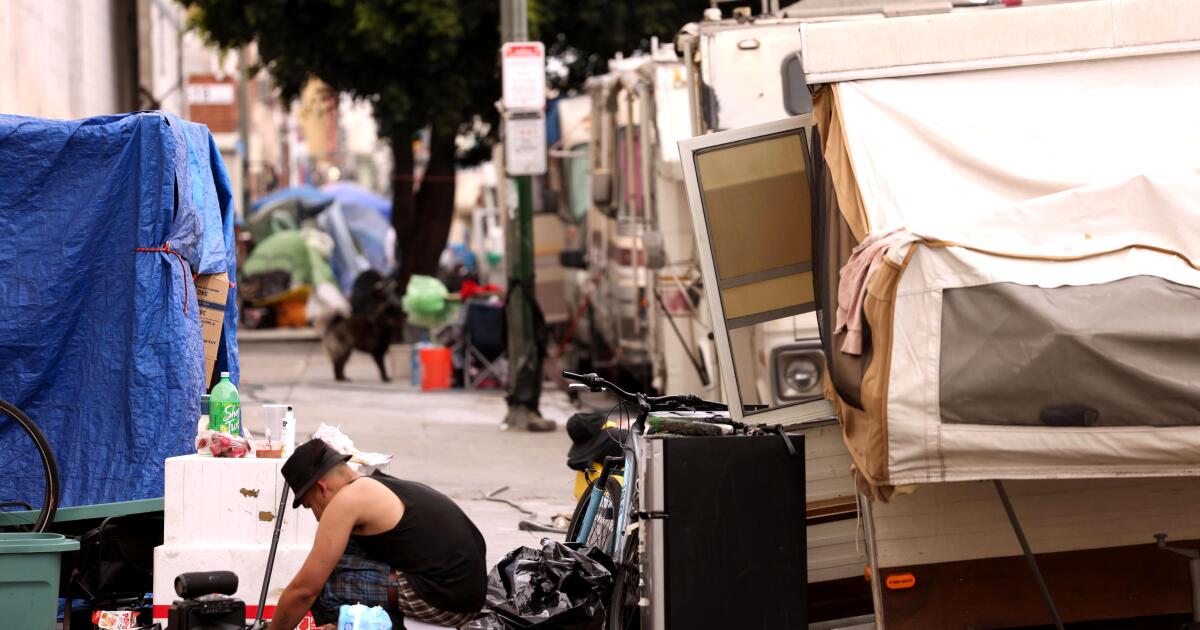
On my way through Skid Row to meet up with Estela Lopez, things looked pretty much as they did when I spent time there more than 20 years ago and first heard the promises that things would be better soon.
Tents lined some of the sidewalks, making them unpassable. Some people wore the damage of physical or mental disease, addiction, poverty, or all of the above. Outreach workers with ID lanyards strode through the trash-strewn landscape like lifeguards working against endless tides of fresh emergencies.
When I arrived at Lopez’s office in the 700 block of Crocker Street, where she runs a business improvement district on behalf of 600 or so beleaguered merchants, she had just completed a tour of the neighborhood with John McKinney, a candidate for city attorney.
She held a note card in her hand and shared some numbers, telling McKinney that by her latest count, 131 of the 702 streetlights in the district were out, 27 children were living on Skid Row, and 72 RVs were parked in the area.
“I came out here because I think this symbolizes the greatest failure in government,” McKinney said. “I think it’s the result of bad law and bad policy. I think it’s the result of a lack of leadership and indifference to the way people are living out here. To me, it’s completely untenable.”
But will anything ever change?
It’s a question two people in particular need to address, and I’ll get to that in a minute.
A lot of people I trust and admire work tirelessly to make a difference on Skid Row, and they’re always eager to share the success stories of those who move through and move on. (I’ve got a column on that coming up soon.)
The long-standing problem is that Skid Row is both a social service center and a mecca of drugs and other vices, with traps on every block. And so it’s a neighborhood at war with itself, with some viewing Skid Row as one of the largest recovery centers in the country while others see a snapshot of social collapse.
Estela Lopez has reached out to me several times over the years. About illegal dumping. Typhus. Calls to City Hall that don’t get answered. About the relentless plague of fires, overdoses and assaults.
“Can you imagine, in 24 years, how many people I’ve seen dead on these streets?” Lopez asked me near her office last week.
Estela Lopez runs a business improvement district on behalf of 600 or so beleaguered merchants.
(Genaro Molina / Los Angeles Times)
When the local post office closed recently in part because of security issues, Lopez told The Times’ Melissa Gomez that “we have reached a point in this city where we are unable to address criminal activity. … It’s surrender.”
We walked to the corner of 8th Street, where paramedics had just pulled away from a medical emergency. Cars and pedestrians stopped at tents for brief transactions, leaving little doubt as to the nature of the business being conducted.
We passed a caged dog and saw a puppy on a short leash being loaded into a vehicle. There’s a lot of talk about dogs being bred and sold, and Lopez said she’s seen evidence of animals being mistreated.
On 7th Street we passed the charred residue of a recent fire. A half block east, four men were slumped on the sidewalk, hitting pipes. Lopez gets calls from exasperated merchants dealing with vandalism and with people blocking their storefronts.
“I’ve never seen so many people overdose right here,” said Sergio Moreno, who runs a check-cashing business and said his family has been in business going back to the ‘70s. He said he’s seen paramedics use naloxone to revive opioid users, only to see the same people go down again just days later.
“How can you run a business?” asked Moreno, who chairs the board of the business improvement district Lopez runs. “This business is our life. This is how we got through school, this is how we put our kids through school.”
And yet despite paying city taxes and BID fees, Moreno said, problems persist and his customers fear for their safety.
Dr. Susan Partovi, a street medic for 22 years, has been advocating for more proactive intervention for those in obvious distress. Partovi told me she recently saw a man rise from a gutter, pull down his pants and defecate in front of her. She called to get help for him but said neither paramedics nor police determined him to be gravely disabled.

Lopez walks past residents of Skid Row last week. By her latest count, 131 of the 702 streetlights in the district were out, 27 children were living on Skid Row, and 72 RVs were parked in the area.
(Genaro Molina / Los Angeles Times)
“We have become complacent with having people lying in the gutter, having diarrhea, speaking nonsensically and putting their lives at risk,” said Partovi, whom I once accompanied as she administered long-acting anti-psychotic injections, arguing that people need clear heads to make better choices.
One sore point for Lopez is the Skid Row Care Campus in the 400 block of Crocker Street, which opened a little more than a year ago and offers all sorts of social services, meds that reduce drug cravings, and supplies that allow for safe use of drugs.
Lopez said she understands the theory of harm reduction: Engage people with a goal of getting them into treatment and back on track. But she wonders how successful such programs are, and argues that they become magnets for lawlessness.
As we talked, a young man approached and told Lopez he’d seen her airing her grievances on TV news.
“I’m wondering, what would be your solution?” he asked.
“I would hope that people could return to life in sobriety,” Lopez responded.
The man said he is “trying to elevate” himself, but that he’d been on a waiting list for housing for six months.
Lopez is tired of being on a waiting list, too.
“If something is working down here,” she told me, “you can’t prove it by me.”
Progress is undeniable, said Sieglinde von Deffner, a social worker and Skid Row coordinator for the Los Angeles County Department of Homeless Services and Housing. But given the “highly vulnerable” nature of the population, “the need is colossal,” she said.

A man stands among his belongings along 7th Street in Skid Row in downtown Los Angeles.
(Genaro Molina / Los Angeles Times)
“I have not yet met someone here who doesn’t want housing of some kind. We just don’t have enough affordable housing for everyone,” Von Deffner said, and long-term homelessness makes people harder to reach. “Now, if we could just stop the inflow.”
Dennis Culhane, a University of Pennsylvania professor who researches homelessness and served as an L.A. County consultant, said there are other ways to get people indoors than investing billions of dollars in new housing that takes years to build. Culhane said single adults who are not veterans, including the elderly and disabled, constitute a majority of the homeless population. But assistance is scarce.
“It’s like you have a famine, and you’ve only got food for 15% of the people,” Culhane said.
Rapid rehousing is critical for the newly homeless, he said. But it can take two years for them to qualify for Social Security disability, and once they do, the $1,000 a month “is completely deficient in the face of rising rents.”
Culhane recommends faster approval of SSI benefits and supplementing that income with additional sources of rental assistance. He believes there are enough vacancies at the low end of the housing market to make a sizable dent in homelessness without new construction.

Judy Mauricio, 65, who has been homeless for nine years, rests inside her tent next to her walker. She says her drug addiction has kept her on the street. She receives state disability funds and says she has cancer.
(Genaro Molina / Los Angeles Times)
As campaign season warms up, I’d like to know if Mayor Karen Bass and her challenger, Councilmember Nithya Raman, agree.
The mayor of L.A. is limited by a power split with the City Council, and the county oversees most addiction and mental health services. But Skid Row sits just a few blocks from the seat of city authority, and nobody has more power or responsibility to address the decades-long human catastrophe on Skid Row than the mayor.
Estela Lopez and the merchants deserve better. The people on the street deserve better. Thousands of housed residents deserve better.
Does Bass have a plan other than what’s currently in place? Does Raman have a better one?
If so, I’d like to hear the details, and I’m available.
steve.lopez@latimes.com
-
Business1 minute ago
Commentary: Trump wants to let companies make fewer disclosures, thus keeping investors in the dark
-
 Entertainment8 minutes ago
Justin Baldoni and wife break silence after ‘It Ends With Us’ legal battle with Blake Lively
-
 Lifestyle11 minutes ago
A meal with an animated Mona Lisa? Immersive dining goes high tech — but will L.A. eat it up?
-
Politics16 minutes ago
Nexstar launches its first digital subscription service with The Hill Insider, aimed at political junkies
-
 Science23 minutes ago
Not everyone is leaving California. A new commercial battery maker just landed in Sacramento
-
 Sports26 minutes ago
Mookie Betts’ eighth-inning single gives Dodgers the win over the Rockies
-
World38 minutes ago
From sewers to swimming sites: how Europe's cities reclaim their rivers
-

 News1 hour ago
Three more people charged with damaging Reflecting Pool after Trump’s multimillion-dollar restoration | CNN Politics


