Business
In-N-Out Burger outlets in Southern California hit by counterfeit bill scam

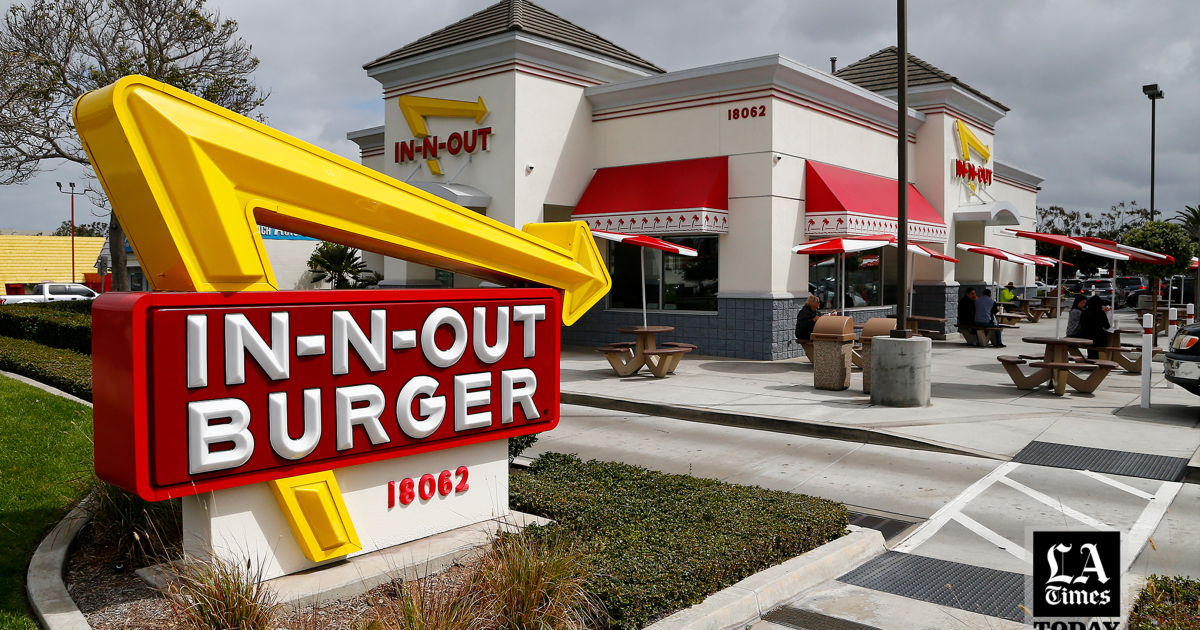
Two people allegedly used $100 counterfeit bills at dozens of In-N-Out Burger restaurants in Southern California in a wide-reaching scam.
Glendale Police officials said in a statement Friday that 26-year-old Tatiyanna Foster of Long Beach was taken into custody last month. Another suspect, 24-year-old Auriona Lewis, also of Long Beach, was arrested in October.
Police released images of $100 bills used to purchase a $2.53 order of fries and a $5.93 order of a Flying Dutchman.
The Los Angeles County District Attorney’s Office charged Lewis with felony counterfeiting and grand theft in November.
Elizabeth Megan Lashley-Haynes, Lewis’s public defender, didn’t immediately respond to a request for comment.
Glendale police said that Lewis was arrested in Palmdale in an operation involving the U.S. Marshals Task Force. Foster is expected in court later this month, officials said.
”Lewis was found to be in possession of counterfeit bills matching those used in the Glendale incident, along with numerous gift cards and transaction receipts believed to be connected to similar fraudulent activity,” according to a police statement.
A representative for In-N-Out Burger told KTLA-TV that restaurants in Riverside, San Bernardino and San Diego counties were also targeted by the alleged scam.
“Their dedication and expertise resulted in the identification and apprehension of the suspects, helping to protect our business and our communities,” In-N-Out’s Chief Operations Officer Denny Warnick said. “We greatly value the support of law enforcement and appreciate the vital role they play in making our communities stronger and safer places to live.”
The company, opened in 1948 in Baldwin Park, has restaurants in nine states.
An Oakland location closed in 2024, with the owner blaming crime and slow police response times.
Company chief executive Lynsi Snyder announced last year that she planned to relocate her family to Tennessee, although the burger chain’s headquarters will remain in California.


NEW YORK — Donald E. Newhouse, president of one of the largest family-controlled publishing companies in the nation and a former board chairman of the Associated Press, died Tuesday. He was 96 and died at his home in New Jersey, his family said.
During his career, Newhouse served as president of the Star-Ledger in Newark, N.J., and head of Advance Publications’ newspaper group, which he navigated into the internet age.
“You reveled in his company. He filled you with energy and humor when you felt doubtful and weak,” said Anna Wintour, the global editorial director of Vogue and Conde Nast’s chief content officer.
“He was scrupulous about not interfering in editorial business, but if you turned to him for counsel, he invariably offered judicious advice,” she said in an obituary released Tuesday night by the Newhouse family.
Newhouse, who lived in New York, spent nearly 50 years overseeing the 35 newspapers of Advance Publications, the media business started by his late father, Samuel Irving Newhouse Sr., in 1922. His older brother, S.I. Newhouse Jr., was chairman of the company and oversaw Conde Nast magazines. He died in 2017.
Louis D. Boccardi, retired president and chief executive of the AP, said Newhouse was an extraordinary chairman for the cooperative.
“His voice was never the loudest in the room, but it was often the wisest,” Boccardi said. Newhouse was instinctively private, but behind that, Boccardi said, was a generous man, at home anywhere and curious about everything.
“He could come across as self-effacing and deferential, but in Don’s skilled hands those were qualities that made him an enormously strong and effective leader,” Boccardi said. “You don’t often see the adjective ‘warm’ attached to a titan of industry, but it applied to him.”
A man who didn’t chase the spotlight
Newhouse, born in 1929, was known for staying out of the public eye. A reporter once asked him to list the biggest chances he took in his career. The answer: “Inviting your questions.”
The usually reserved Newhouse did step into the spotlight when he took on the role of chairman of the Newspaper Assn. of America from 1993 to 1994 and then chairman of the AP board of directors from 1997 to 2002. He had served on the AP board for nine years before becoming its chairman.
“He was a smart and shrewd businessman but as thoughtful and kind a man as you’ll find. Being in his presence was always a joy,” said Doug Clifton, editor of one of Newhouse’s papers, the Plain Dealer in Cleveland, from 1999 to 2007.
Newhouse attended Syracuse University but never graduated, heading into the family’s newspaper business instead. He would regularly visit his newspapers but left the ultimate authority of running them to his publishers.
“Each of our newspapers operates independently, with publishers who are strong, who set policy for their individual organizations and who have the authority and responsibility of carrying out the policies they set,” he said in 1993 when taking over as chairman of the newspaper association.
Newhouse was known for spending money to make sure that papers got the best stories. Jim Willse, editor of the Star-Ledger in Newark, N.J., from 1995 until 2010, said he would give “us all the resources we needed to make the Ledger really special.” Willse said Newhouse loved newspapers and newspaper people.
“He especially enjoyed it when we’d have a story about some politician caught with his hand in the cookie jar, or a spicy feature about stuffed shirts behaving badly,” Willse said.
Newhouse’s philosophy of spending money to produce quality coverage and a hands-off approach toward his editors led to many successes, including multiple Pulitzers.
Many of those newspapers were able to thrive and remain profitable because they dominated their market, but Newhouse said he was very much aware of what he called the “dramatically changing media landscape” and how people get their news.
“The 15th-century revolution was epitomized by the printing of the Gutenberg Bible; ours by Ted Turner’s cable news network and by web-based news sites — news in real time from anywhere to everywhere,” he said in 2004 at the rededication of a communications school named after his father at Syracuse University.
Three years later, he told one of his papers, the Post-Standard of Syracuse, N.Y., that newspapers can survive “by producing content that is relevant, interesting, accurate and entertaining for newspapers and the internet.”
He steered through financial struggles
Yet the papers did ultimately struggle financially.
Advance was known in the industry for a pledge that employees who weren’t in a union would have jobs regardless of economic downturns or technological advances. In 2009, the company announced that the pledge would be withdrawn.
The company also moved away from daily publishing of several papers. In 2012, it announced that the Post-Standard; the Times-Picayune in New Orleans; the Patriot-News in Harrisburg, Penn.; and the Birmingham News, the Press-Register of Mobile and the Huntsville Times, all in Alabama, would cease daily publication and would only offer print editions on Wednesdays, Fridays and Sundays. Those changes were accompanied by hundreds of layoffs.
“His conservative approach left both the papers and its employees somewhat unprepared for the realities of the internet,” said Thomas Maier, who wrote a 1994 biography of the family.
Newhouse’s eldest son, Steven, spearheaded the company’s growth on the internet and on mobile devices. Steven Newhouse is currently co-president of Advance Publications.
“My dad spent his life in the newspaper business and was devoted to it, built it up and enjoyed many good years. When it became more challenging, he was first in line to work through, finding solutions to keep the local journalism franchise going,” he said.
Newhouse is also survived by another son, Michael, daughter Katherine Mele and grandchildren. His wife, Susan, died in 2015.
Mayerowitz writes for the Associated Press.

Child safety advocates say the massively popular gaming platform Roblox could be bad for kids.
Fairplay and the National Center on Sexual Exploitation have requested the Federal Trade Commission to investigate if the games on Roblox are designed to make kids spend an unhealthy amount of time and money on their screens.
Roblox’s core users are young kids.
In a letter submitted to the FTC, the groups argue that Roblox’s engagement-maximizing design features, virtual currency system, and voice and text chat communication features are inappropriate for the platform’s user base and pose a substantial risk of harm.
“Alone and in combination, these three components capitalize on young users’ developmental vulnerabilities, exploit their desire for authentic self-expression, monetize their lack of impulse control, and turn in-game purchasing power into a form of social status,” the groups noted in the letter submitted Thursday to the FTC.
Roblox allows the purchase of virtual assets — clothing and dance moves, for example — which can only be purchased with the platform’s in-game currency, Robux. The platform obscures the exchange rate between dollars and the in-game currency, leaving young players to navigate a complex system of fluctuating conversion rates that increases the amount of real-world money players spend, according to the letter.
For instance, players can receive more Robux per dollar by purchasing larger bundles of currency or buying a “Roblox Premium” subscription, making it harder for children to perform financial calculations on how much they are spending on the platform.
The letter pointed to instances of unexpected Roblox charges, as one parent discovered that his daughter spent more than $5,000 on Roblox without understanding that she was spending real money.
The letter also outlined examples of “scarcity marketing” techniques that increase demand through limited-quantity assets and time-based reward to drive sales of virtual items, driving a false sense of urgency. Some see it as a strong-arm sales technique that should not be used on children:
“Items only available for a limited time encourage both rapid purchases and returning to the platform frequently — sometimes multiple times per day — to avoid missing out on items,” the letter said.
A Roblox spokesperson said that the company “strongly disputes these claims. Our platform is designed to provide a positive, healthy and enjoyable experience — we build for fun and connection, not short-term engagement. While no system can be perfect, we have a set of safeguards designed to support a safe and civil environment, and clear policies for game creators that require fair treatment of players.”
The groups pointed out that third-party games developed on Roblox are designed to profit from in-game purchases, and have “gambling-like” engagement mechanisms such as lootboxes, in which players cannot see what’s inside until after they have purchased it — and the items vary in value.
“We have clear policies prohibiting both actual and simulated gambling, and a set of rules governing how game creators can use gameplay mechanics like paid random items,” the Roblox spokesperson said. “Most games on Roblox are free to play and no one is required to purchase Robux. In the first quarter of 2026, only 1.4% of our 132 million daily active users were payers on the platform.”
The letter also alleged that the voice and text chat features on the platform expose children to sexual content, and argue that recent changes to age checks have not eliminated opportunities for adult-minor contact.

Everyone will know more, he told me, when Quantica signs a contract with a tech company to use the facility. That announcement could come by the end of the year.
Besides, Mr. Peterson said, much of the apprehension over the data center comes from people who are afraid of A.I. more broadly, as if “Big Brother is going to take over,” he said.
Those people, he added, “have no role in this conversation.”
What Mr. Peterson could tell me now, he said, was that the project would have minimal impact on the land and the people who live nearby. And residents wouldn’t have to pay a thing for it. He offered no guarantees, but said the project would bring its own power — at least some of it from solar and natural gas.
Despite what opponents have been saying, and despite the information gleaned from data centers around the world, Mr. Peterson said the Broadview site would need “not that terribly much” water.
It will bring jobs, he said. Thousands of temporary workers could descend on Broadview for the construction. The number of permanent jobs would be 30, 40, 100 — he doesn’t know for sure. But he described them as good-paying jobs that would not require specialized training or a college education. Jobs like janitors, maintenance workers or security guards.
He likened it to “being a miner, but not having to grab a drill.” Generations of families could stay in Broadview because people would not have to move to make a living, as many are doing now. They could say, “Oh my gosh, I could push a broom and come home to my home in Lavina that I love — and my kids can do that?”
For anyone who doesn’t like the idea of living next to a data center, he added, “there’s probably a county up the road that doesn’t have one.”
He said the eventual deal would include a “community benefits package,” which could help Broadview pay for things like its problematic wastewater lagoon. The Montana Department of Environmental Quality issued the town a violation in March for longstanding issues at the site, demanding compliance. Remediation could cost millions.
-

 Los Angeles, Ca1 hour ago
Inside Artesia’s Little India, a slice of South Asia in SoCal
-

 Detroit, MI1 hour ago
Cat rescued from side of Lodge Freeway
-

 San Francisco, CA2 hours ago
Two favorite SF festivals return to the streets this June.
-

 Dallas, TX2 hours ago
Why is George Pickens back in the news? Because Emmitt Smith made it so
-

 Miami, FL2 hours ago
TA Realty Buys Back Miami Warehouse Campus for $48M
-

 Boston, MA2 hours ago
Beloved MA Bakery Lands At Boston Logan Airport
-

 Denver, CO2 hours ago
Denver Broncos roster review: Wide receiver Mike Woods
-

 Seattle, WA2 hours ago
Where to Stay in Seattle If You Like to Eat

