Business
How Ted Sarandos became the ultimate Hollywood gate-crasher


Hollywood moguls once dismissed the outsize ambitions of Netflix’s executives.
“Is the Albanian army going to take over the world?” former Time Warner Chairman Jeff Bewkes asked a reporter 15 years ago. “I don’t think so.”
Think again. On Friday, Netflix co-Chief Executive Ted Sarandos pulled off an audacious $82-billion deal to buy much of Bewkes’ old haunts: the Warner Bros. film and TV studios in Burbank, and HBO and the HBO Max streaming service in Culver City.
“This is a rare opportunity,” Sarandos said in an investor call. “It’s going to help us achieve our mission to entertain the world and to bring people together through great stories. We’ve built a great business, and to do that, we’ve had to be bold and continue to evolve.”
If the takeover is approved — it could face a raft of legal and regulatory challenges — Netflix would gain ownership of such classics as “Casablanca” and “Goonies” and popular characters including Batman, Scooby-Doo, Dirty Harry and Harry Potter.
The acquisition represents a moment of triumph for the brash Sarandos, who has gone from Hollywood gate-crasher to the ultimate power broker.
“There seems to be no ceiling of opportunity for Ted Sarandos,” said Tom Nunan, a former studio and network executive. “He’s the king of Hollywood.”
Netflix’s victory in the auction for Warner Bros. stunned many in Hollywood who figured Paramount — whose bid was backed by the one of the world’s wealthiest men, Larry Ellison — had a lock on the prized Warner assets.
Even Netflix’s brass downplayed their merger ambitions as recently as two months ago. Co-Chief Executive Greg Peters shrugged off any interest at a Bloomberg conference, saying: “We come from a deep heritage of builders rather than buyers.”
But the streaming giant’s dominant market position and strong balance sheet allowed it to assemble a largely cash bid that wowed Warner Bros. Discovery’s board, which voted unanimously in favor. What’s more, Netflix agreed to absorb more than $10 billion of Warner Bros.’ debt, bringing the deal’s total value to $82.7 billion.
Warner shareholders and U.S. and foreign regulators still must approve Netflix’s takeover. Netflix — which is based in Los Gatos but has a large presence in Hollywood — said it expects the deal will close within a year to 18 months.
Netflix, however, already is facing stiff opposition from cinema chains, lawmakers, prominent creatives and labor unions. The Writers Guild of America said the deal should be blocked.
“The world’s largest streaming company swallowing one of its biggest competitors is what antitrust laws were designed to prevent,” the WGA said.
A career of defying convention
If it succeeds, the takeover would be a coup for Sarandos, the company’s often controversial co-CEO who has been responsible for Netflix’s content operations since 2000. Until recently, he was seen as a disruptor who upended the industry’s long-standing business models, especially its reliance on the big screen.
It’s a remarkable trajectory for the 61-year-old Phoenix native and movie buff, who once clerked in a strip mall video store, joining Netflix when it was a scrappy Silicon Valley startup distributing DVDs through the mail in red envelopes.
Company co-founder Reed Hastings was impressed by Sarandos after he struck a first-of-its-kind revenue-sharing deal with Warner Bros. as an executive at West Coast Video/Video City retail chain.
Sarandos has been in charge of Netflix’s content operations ever since.
One of five children, he’s the son of an electrician and a stay-at-home mom who left the TV on all day.
While working at the video store, Sarandos earned a reputation for giving great movie recommendations to customers based on what they liked to watch. In many ways, he was a human version of Netflix’s now famous recommendation algorithm.
Sarandos spent his first three years at Netflix working out of his bedroom in Los Angeles. Hastings and Sarandos’ enterprise was largely responsible for bankrupting the then-dominant video rental chain, Blockbuster.
His knack for knowing what audiences want was instrumental in Sarandos’ ascent at Netflix and Hollywood: Netflix now has more than 301 million subscribers, and it could grow even more.
Analysts estimate the acquisition could add an additional 100 million customers to the streaming service — a bounty that is expected to draw the attention of antitrust regulators.
Over time, the company shifted to streaming licensed TV and films, but as studios started to pull away from those deals, Netflix began its foray into original content.
Again, Netflix wasn’t taken too seriously at first. Sarandos would get TV show scripts with signs of rejection — coffee stains and smudged fingerprints — but his gamble on buying the rights to David Fincher’s political thriller, “House of Cards,” starring Kevin Spacey and Robin Wright, in 2011 changed that.
Sarandos walked into Fincher’s office and offered him a provocative deal: Netflix would commit to the first two seasons of “House of Cards” without seeing a pilot for $100 million.
“There were 100 reasons not to do this with Netflix,” Sarandos told The Times in 2013. “We had to give them one great reason to do it with Netflix.”
Sarandos has made a career out of defying convention.
Under his leadership, Netflix released episodes to shows all at once, allowing people to binge watch an entire season. The platform greenlighted full seasons of shows even before they began, and older series like “Friends” and “The Office” found new audiences years after they ended on network television.
He made bets on series that other traditional studios passed on, including the popular sci-fi show “Stranger Things,” which would become a global hit with its own universe of characters, like “Star Wars.”
Some studios were hesitant to give the show’s creators, Matt and Ross Duffer, first-time showrunners, the reins. Typically, Netflix and Sarandos thought differently.
“They read it, they got the project, and they wanted me and Ross to be involved as showrunners and to direct, and that completely changed our lives,” said Matt Duffer on stage at the L.A. premiere of the final season of “Stranger Things” in Hollywood this month.
“Ted made that decision all the way back then, 2015, and that’s why we’re here today,” he said.
Over time, Netflix became a place where talent wanted to pitch their shows.
“The goal is to become HBO faster than HBO can become us,” Sarandos told GQ in 2013.
Soon, Sarandos might be in charge of HBO.
Netflix expanded its reach globally, creating a production pipeline abroad. Its biggest international hits include 2021 Korean language series “Squid Game,” Netflix’s most popular show of all time, with its first season generating 265.2 million views in its first three months.
But as Netflix’s strategy changed the Hollywood landscape, it also angered theater owners and competitors who were upset that the streamer was playing by different rules that challenged long-standing practices in the entertainment industry.
Sarandos in particular has taken direct aim at the traditional practice of releasing movies in theaters first — and keeping them there for months before making them available for home viewing.
Netflix generally releases movies in theaters only for short periods in order to appeal to fans or qualify for awards. They appear on its platform shortly after they debut in theaters.
Sarandos was promoted from chief content officer to co-CEO in 2020, running the company with Hastings, who had previously served as Netflix’s CEO.
The duo faced their biggest challenge in 2022, when Netflix’s subscriber numbers plunged by 200,000 subscribers in its first quarter, the first decline in more than a decade.
Analysts feared that the streaming revolution was over and Netflix had reached a ceiling to its growth.
But Netflix was able to find new revenue streams by cracking down on password sharing and entering new areas of business it previously overlooked, including advertising and live events like sports, including NFL football.
In 2023, Hastings stepped down from his role to be executive chairman, and Peters, chief operating officer, was named to the co-CEO role.
Today, Netflix is widely heralded as the winner of the streaming wars years after many rivals tried to enter into the space, putting the company in an ideal position to make a significant cash and stock bid for the Warner Bros. Discovery assets it was seeking.
Unlike many of its competitors, Netflix is profitable — the company generated $2.5 billion in net income in the third quarter, up 8% from a year earlier.
Netflix has offered Warner Bros. Discovery shareholders $23.25 in cash and $4.50 of Netflix stock for each share. In September, before Paramount started the bidding, Warner Bros. was trading around $12.
“These assets are more valuable in our business model, and our business model is more valuable with these assets,” Sarandos said in a call with investors on Friday.
If the deal is approved, Netflix would be the third owner of Warner Bros. and HBO in a decade. On the call, Peters addressed his earlier critique that most big media mergers fail.
“We understand these assets that we’re buying,” Peters told investors on Friday. “Things that are critical in Warner Bros. are key businesses that we operate in, and we understand a lot of times, the acquiring company, it was a legacy, non-growth business that was looking for a lifeline. That doesn’t apply to us. We’ve got a healthy, growing business.”
Sarandos expressed confidence the deal would go through.
“This deal is pro-consumer, pro-innovation, pro-worker, pro-creator, pro-growth,” Sarandos told investors. “Our plans here are to work really closely with all the appropriate governments and regulators, but really confident that we’re going to get all the necessary approvals that we need.”
Sarandos is one of Hollywood’s most well-compensated CEOs, with a package that was valued at $61.9 million in 2024.
Long seen as friendly to talent, he has weathered some controversies over the years.
During dual strikes in 2023, writers and actors complained bitterly about how Netflix was compensating them for their work on streaming shows.
Sarandos was seen as one of the key Hollywood players in helping bridge the gap. One of the outcomes of the strikes was that studios, including Netflix, would release viewership data to the unions and give bonuses to talent based on certain viewership metrics.
In 2021, Sarandos faced internal backlash within Netflix when some employees organized a walkout over transphobic comments said on comedian Dave Chappelle’s special “The Closer.” Sarandos had stood by the comedian, saying in a staff memo that “content on screen doesn’t directly translate to real-world harm.” But days later he told Variety that “I screwed up that internal communication.”
“I should have led with a lot more humanity,” Sarandos said.
Despite its dominance in streaming, Netflix continues to face challenges from other forms of entertainment, including YouTube and social media sites like TikTok or gaming communities like Fortnite that all compete for eyeballs.
“In a world where people have more choices than ever how to spend their time, we can’t stand still,” Sarandos said Friday. “We need to keep innovating and investing in stories that matter most to audiences, and that’s what this deal is all about.”



MEXICO CITY — Mexico’s secretary of the economy, Marcelo Ebrard, urged “prudence” Friday in the aftermath of the U.S. Supreme Court ruling invalidating part of President Trump’s sweeping tariff regimen.
“We have to see where this is going,” Ebrard told reporters. “We have to see what measures [Washington] is going to take to figure out how it is going to affect our country. “
Amid widespread concern about tariffs in Mexico — the United States’ major commercial partner, with almost $1 trillion in annual two-way trade — Ebrard cautioned: “I tell you to put yourselves in zen mode. As tranquil as possible.”
Across the globe, nations were assessing how the high court’s ruling might affect them. Some world leaders expressed relief or satisfaction with Friday’s decision.
“The justices have shown that even a US president does not operate in a legal vacuum. Legal boundaries have been set, the era of unlimited, arbitrary tariffs may now be coming to an end,” Bernd Lange, chair of the European Parliament’s International Trade Committee, wrote on X.
Also writing on X, Canada’s trade minister, Dominic LeBlanc, referred to the International Emergency Economic Powers Act, which the Trump administration used to impose tariffs: “The United States Supreme Court’s decision reinforces Canada’s position that the IEEPA tariffs imposed by the United States are unjustified.”
Mexican President Claudia Sheinbaum, when asked about the tariffs, said, “We’ll review the resolution carefully and then gladly give our opinion.”
Ebrard said he plans to travel to the United States next week to clarify matters.
Last year, Ebrard noted, Mexico managed to stave off Trump’s threats to impose a 25% across-the-board levy on all Mexican imports.
However, Mexico has been pushing back against Trump administration tariffs on imports of vehicles, steel and aluminum, among other products.
Among other impacts, the Supreme Court voided so-called fentanyl tariffs on Mexico, China and Canada. The Trump administration said it imposed those levies to force the three nations to crack down on trafficking of the deadly synthetic opioid.
In the aftermath of Friday’s ruling, Trump said he planned to seek alternative legal avenues to impose now-stricken tariffs.
About 85% of Mexican exports to the United States are exempt from tariffs because of the United States-Mexico-Canada Agreement. The accord extended a mostly free-trade regimen among the three nations, replacing the North American Free Trade Agreement.
The three-way pact is scheduled for joint review starting July 1. That date marks six years since the agreement was signed during the first Trump presidential term.

SAN LEANDRO — A start-up recycling company has a message for its potential, environmentally conscious customers: Don’t send your problem garbage to the landfill; put it on your front porch.
The company is Ridwell, and if you drive the residential streets of the San Francisco Bay Area or Los Angeles, you’re likely to see the company’s signature white metal boxes on porches.
The boxes are for empty tortilla chip and plastic produce bags, used clothing, light bulbs and batteries. In some locations, polystyrene peanuts. All the things you’re not supposed to put in the blue recycle bin, but wish you could.
The Seattle-based waste service is geared toward people who worry their waste will end up in the landfill, or get exported to a developing country in Asia. They sort their waste into colorfully labeled canvas bags the company provides, and wait for a Ridwell pickup.
“Sorting is our special sauce,” said Gerrine Pan, the company’s vice president of partnerships. Part of the reason the company is successful at finding markets — or buyers — for its waste, she said, is that it’s sorted and pretty clean (unlike the food-contaminated jumble of waste that gets stuffed in many blue bins).
The company promises to distribute all that waste to specialty recyclers, manufacturers, even thrift shops.
Bagged recyclables sit in boxes at the Ridwell warehouse in San Leandro.
But critics say the boutique waste hauler is not accomplishing anything environmentally useful and is selling the public a myth: that these plastics — multilayer plastic film, plastic bags, polystyrene — can be taken care of responsibly. The service would be benign, they say, if it stuck to the delivery of materials, such as light bulbs and batteries, that can be recycled.
Most local waste haulers don’t accept batteries and light bulbs because they can pose a hazard to workers and equipment.
The base Ridwell membership is $20 a month. For that, a driver will come by every two weeks and take the presorted bags to a warehouse where they’re emptied, the contents stacked and collected, until there’s enough to deliver to a facility that will take it.

Sorted recyclable items await transport at the Ridwell central warehouse.
Company lore is that founder Ryan Metzger and his son were frustrated that so many things weren’t accepted by their local hauler for recycling. The two sat down and researched where to take the stuff, then decided to scale up and serve their neighbors.
The company has since expanded to Vancouver, Wash.; Portland, Ore.; San Francisco; Los Angeles; Denver; Austin, Texas; Minneapolis and Atlanta. It now boasts more than 130,000 customers nationwide.
Most of the waste is delivered locally. But some of it travels hundreds, if not thousands of miles.
For instance, multilayer plastic bags — those that hold snack chips, candy and coffee beans — are the scourge of municipal garbage haulers because they cannot be recycled, and if put in the blue bins, can damage mechanical sorting machines. Ridwell, however, found Hydroblox, a company that melts the multilayer films into hard, plastic bricks that can be used for drainage projects in landscaping and road construction.
But this arrangement highlights some of the limitations of the nascent industry. Hydroblox owner Ed Greiser said he can take only so many chip bags. The company is growing, but it’s still pretty small, and he’s typically maxed out on the bags.

Ridwell workers sift through recyclables.
“This article is going to be a nightmare for me,” he told a Times reporter, because it’s likely to attract a parade of unsolicited garbage trucks looking to dump their bags. “I’m not the solution.”
In addition, Greiser’s two facilities are in Pennsylvania, more than 2,700 miles from most West Coast pickup points, a steep transportation cost for a plastic bag that could instead go 20 miles to a local landfill.
Ridwell also has recently expanded to serve customers outside its pickup cities. It sends special plastic bags to these far-flung subscribers so they can sort their waste and ship it back.
Again, critics say the company’s decision to operate a service that is dependent on plastic bags and requires extensive transport undermines their environmental bona fides. And they worry that a narrative suggesting all waste can be dealt with responsibly is false and misleading. That misconception, they say, contributes to the glut of plastic piling up in our rivers and oceans, and inside our bodies.
“There is typically a reason why a given product isn’t being recycled through curbside collection, and it usually isn’t for lack of effort by cities and counties,” said Nick Lapis, director of advocacy for Californians Against Waste. “Most of the material being collected by boutique collection services like Ridwell are either very difficult to manage or lack strong recycling markets.”
Manufacturers of plastic packaging, not consumers, should pay for recycling products and packaging at the end of their life, he said. For regular people, “having to pay an extra fee to handle the unrecyclable plastic packaging that is thrust upon us every day is antithetical to every concept of producer responsibility.”
Earlier this month, the anti-plastic group Beyond Plastics published a disparaging report on boutique waste haulers, including Ridwell, accusing them of providing cover for plastic and packaging manufacturers who want people to believe their waste is being recycled.

A Ridwell employee inserts a bag of recyclables into a bailer at the San Leandro warehouse.
Ridwell offered a visitor a tour of its Bay Area warehouse in San Leandro. The spacious facility behind a Home Depot and Walmart was crowded with steel drums filled with alternating layers of batteries and fire-retardant pellets, boxes of light bulbs and piles of used clothes, all destined for recyclers, upcyclers and thrift stores.
While the public may think of recycling as a largely physical process, it’s actually a market: a function of how well a material can be profitably turned into something else.

Boxes of clothing await transport.
Metzger, Ridwell’s chief executive, said some of the material his company collects can be sold. Some of it is given away, “and some we pay to have responsibly processed.” The more technically challenging the plastic, the more likely Ridwell will have to pay to deal with it, he said.
He said the company vets all the places it sends its waste, giving preference to those that use items a second time over those that melt them down or shred them to make them into something else. It also gives preference to partners that are local.
He said his company is “careful not to present plastic recycling as a cure-all,” and it turns away some materials, for example vinyl shower curtains, “because we don’t have a downstream partner we can stand behind.”
And while Metzger agrees with many of Beyond Plastic’s concerns, he has observed that “when customers actively sort and see which items require special handling, it often increases their awareness of where plastic waste is coming from in their own lives … [leading] them to change purchasing habits and avoid certain packaging altogether.”
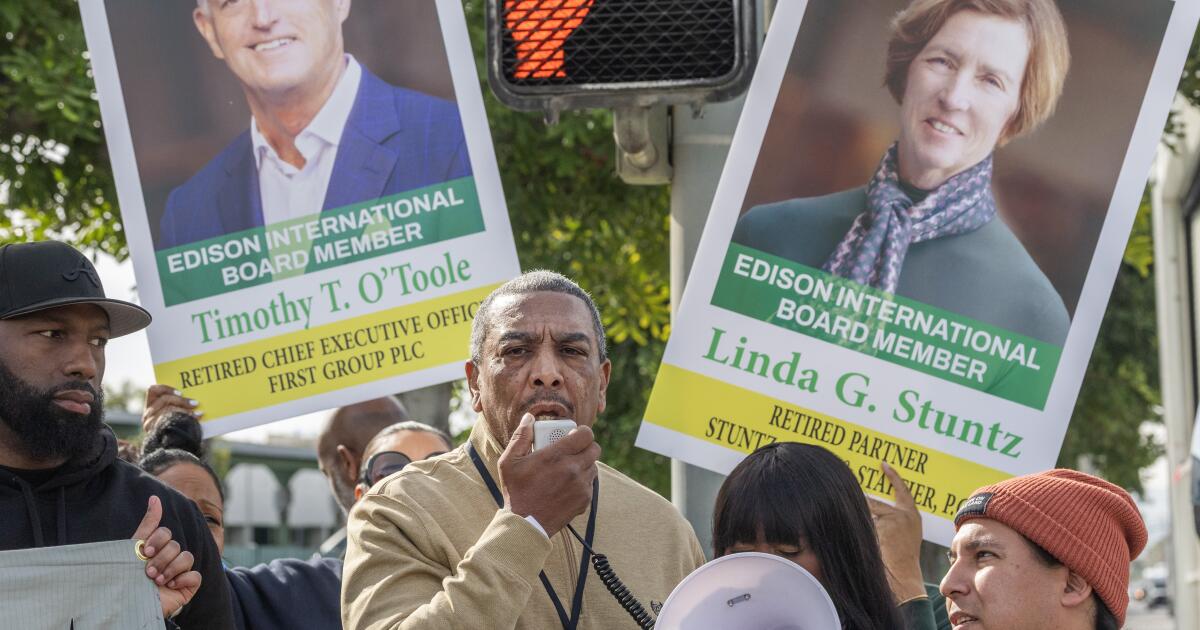
Outside a hall where Southern California Edison was celebrating Black History Month on Friday, a group of Altadena residents stood on the sidewalk, waving signs and talking of the homes and family members they lost in last year’s Eaton fire.
“They’re in there celebrating Black history and they’ve destroyed a Black town,” said Nicole Vasquez of My Tribe Rise, which helped organize the protest.
The Jan. 7, 2025 fire destroyed thousands of homes, including the majority of homes in west Altadena, a historically Black community. All but one of the 19 people who died were in west Altadena.
“If Edison’s tower did not ignite the fire, Altadena would still be there,” said Trevor Howard Kelley, who lost his 83-year-old mother, Erliene, in the fire.
Kelley, his daughter and two granddaughters had been living with his mother before her home was destroyed, he said.
The Black Altadena residents are part of a larger coalition that is asking Edison to advance each family who lost their home $200,000 in emergency housing assistance. They say that more than a year after the blaze many wildfire survivors are running out of the funds they had received from insurers.
The group protesting Friday also called for transparency from Edison. The company has said it believes it is likely its equipment caused the fire but has continued to deny it did anything wrong.
“We just want the truth,” said Felicia Ford, who lost her house in the fire. “What’s wrong with saying, ‘We got this wrong.’”
Scott Johnson, an Edison spokesperson, said Friday that the company continued to believe its voluntary compensation program was the best way to help victims of the fire. Edison has promised to quickly review each victim’s claim and pay it swiftly if approved.
Families who lost their homes can receive hundreds of thousands of dollars under the program, while those with damaged homes receive lesser amounts.
But many survivors say they don’t believe the offered amounts fully compensate their losses. And to receive the money, victims must agree not to sue — which many are not willing to do.
“We recognize the incredible struggles the community has faced,” Johnson said. “The intent of the program is to reach final settlements to allow the community to rebuild and move on.”
The investigation into the cause of the fire has not yet been released. Edison has said a leading theory is that its century-old transmission line in Eaton Canyon, which had not carried electricity for 50 years, somehow became reenergized and sparked the fire.
Company executives said they did not remove the old line because they believed it would be used in the future.
Tru Williams said he just wants to get his parents back home.
(Myung J. Chun / Los Angeles Times)
In December, state regulators ordered Edison to identify fire risks on its 355 miles of out-of service transmission lines located in areas of high fire risk and tell regulators how executives planned to use the lines in the future.
This week, Edison disclosed that the Los Angeles County district attorney was investigating whether Edison should be criminally prosecuted for its actions in the fire.
West Altadena became one of L.A.’s first middle-class Black neighborhoods in the 1960s, partly because discriminatory redlining practices for years kept Black homebuyers from settling east of Lake Avenue.
Heavenly Hughes, co-founder of My Tribe Rise, told the crowd she had lived in Altadena for 50 years.
“I was raised in a thriving working-class community and they have destroyed that community,” Hughes said, referring to Edison.
Added Ford, “The people making these decisions aren’t suffering at all. They’re still getting their paychecks, bonuses and stock options.”

Nothing couldn’t wait to show off the Phone 4A

North Korea’s Kim Jong Un re-elected as ruling party leader

Trump envoy rebukes Greenland leader for rejecting hospital ship proposal

Blood test could predict when Alzheimer’s symptoms will start years in advance

Team USA hockey stars keep America’s heroes top of mind after grabbing Olympic gold

Florida High School Football Rankings: Top 25 teams – Oct. 21

Cleary's 21 help Le Moyne down Central Connecticut State 69-64 in OT

How old is Bo Nix? What to know about Oregon quarterback ahead of 2024 NFL Draft

99th annual Pony Swim held in Virginia

Indiana Members Credit Union announced as new anchor tenant at Bottleworks District
Trump envoy rebukes Greenland leader for rejecting hospital ship proposal

Gulf countries back Kuwait’s sovereignty after Iraq draws new boundaries

Suspected gunman identified after being shot dead at Mar-a-Lago – US politics live

Video: Armed Man Is Shot and Killed at Mar-a-Lago, Authorities Say

Suspect identified after fatal shooting at Trump’s Mar-a-Lago estate: officials
-

 Montana3 days ago
2026 MHSA Montana Wrestling State Championship Brackets And Results – FloWrestling
-

 Oklahoma5 days ago
Wildfires rage in Oklahoma as thousands urged to evacuate a small city
-

 Culture1 week ago
Video: How Much Do You Know About Romance Books?
-

 Science1 week ago
What a Speech Reveals About Trump’s Plans for Nuclear Weapons
-

 Politics1 week ago
Schumer’s ‘E. coli’ burger photo resurfaces after another Dem’s grilling skills get torched: ‘What is that?’
-

 Technology2 days ago
YouTube TV billing scam emails are hitting inboxes
-

 Technology1 week ago
The DJI Romo robovac had security so poor, this man remotely accessed thousands of them
-
 Science1 week ago
Notoriously hazardous South L.A. oil wells finally plugged after decades of community pressure