Business
Frustrated with crowded resorts, more skiers risk avalanche hazards in backcountry

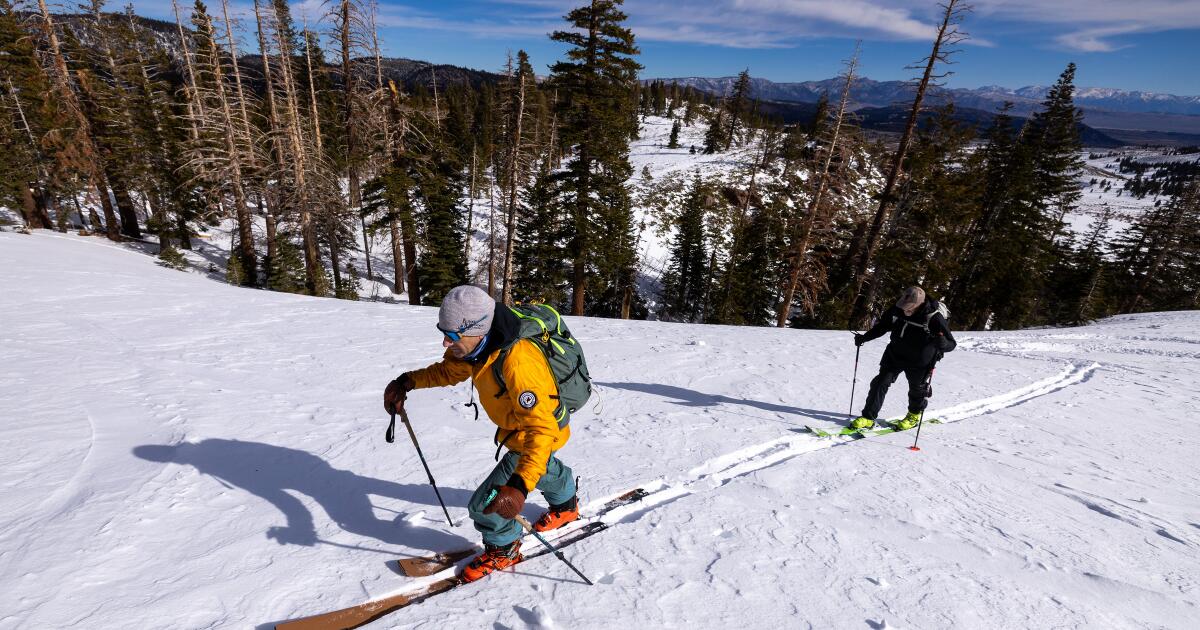
MAMMOTH LAKES, Calif. — On a clear, cold day in mid-February, we had spent hours on backcountry skis trudging up and across a remote mountainside in the eastern Sierra when we noticed that the trees directly above us were much smaller than the others we had passed along the way.
Still panting from the workout, I looked down the steep slope — something I had carefully avoided up to that point — and saw more suspiciously small trees stretching below us.
“Avalanche,” said my ski partner, Howie Schwartz, a veteran backcountry guide. “Huge one, back in the ’80s, reached all the way down to the valley.”
Schwartz demonstrates how to use probes designed to punch holes in avalanche debris to make contact with a buried ski partner.
(Brian van der Brug / Los Angeles Times)
To his trained eye, the nearly vertical strip of new growth was a telling sign that we were slogging across the high-alpine version of a bowling alley. On the wrong day, tons of snow piled on the ridge a thousand feet above could release without warning and crash down like a wave that, instead of washing over us, would bury us and quickly solidify into the consistency of concrete.
The odds were firmly in our favor that day: There had been no new snow recently or abrupt changes in the temperature. Still, it was best to not linger, Schwartz said, with a nod to make sure I followed him across to the taller trees.
Avalanches are an unavoidable fact of life in the mountains. Two days after our trip, following a storm that dumped 6 feet of snow in 36 hours, a pair of ski patrollers were caught in an avalanche at nearby Mammoth Mountain resort. One was extracted without serious injury; the other was hospitalized but did not survive.
On the same day, two small avalanches struck at Palisades Tahoe. Nobody was injured, but a year ago four people were trapped and one died in an avalanche at the resort.
As shocking and sad as those cases are, they happened on some of the most aggressively protected slopes in the world. Large commercial ski resorts such as Mammoth and Palisades employ patrol teams that go out every morning before the lifts open to test the stability of the snowpack.

A growing number of skiers are seeking out backcountry slopes, trading the relative safety of crowded resorts for the silence and solitude of untrammeled runs.
(Brian van der Brug / Los Angeles Times)
If anything looks suspicious, they deliberately trigger avalanches — using explosives for big stashes of snow, using their skis and body weight for smaller ones — in the hope that no unexpected slides will occur when paying customers are enjoying themselves downhill.
But if things can go wrong at carefully managed resorts, imagine how much risk there is in the backcountry where nobody patrols, cellphone signals are spotty and, even if you can make a call, help might take hours to reach you.
On Monday, a 46-year-old backcountry skier was killed in an avalanche just south of Lake Tahoe. Due to what deputies called “extremely hazardous” conditions, it took an El Dorado County search-and-rescue team more than 24 hours to retrieve the body. They had to use explosives to set off avalanches in the area before it was safe for them to go in, according to a sheriff’s department post on Facebook.
In the last decade, at least 245 people in the U.S. have been killed by avalanches — the vast majority in the backcountry, according to data compiled by the Colorado Avalanche Information Center and the U.S. Forest Service. Some victims were hikers and snowmobilers, but more than half were skiers.
That’s a shocking number given how small the community of hardcore backcountry skiers is. Seemingly everyone who makes the sport a significant part of their lives has lost at least one friend to an avalanche.
“I know of far, far too many who have died,” said Schwartz, 52, who has been guiding professionally for three decades and helped design the curriculum for the country’s most commonly taught avalanche training course. “The longer you do this, the more people you know who die, even professionals, even other guides.”

Schwartz, left, and Dolan install climbing skins, synthetic material that makes it possible to climb to the top of a run wearing backcountry skis.
(Brian van der Brug / Los Angeles Times)
Despite the obvious risks, there has been a steady rise in the number of people heading to the backcountry to “earn their turns” in recent years. There was a surge 2020 after ski resorts shut down due to COVID-19, said Steve Mace, director of the Eastern Sierra Avalanche Center, which publishes daily updates on the weather and avalanche risk in California’s high country.
But the number of backcountry skiers didn’t plummet after the pandemic emergency ended, Mace said. One reason is the eye-opening cost of lift tickets: A single day of skiing at Mammoth can cost as much as $219 this season. Another is the crowds: Despite the high cost, standing in a lift line on a holiday weekend can feel a lot like staring at taillights in rush hour on the 405 Freeway.
And then there is the resort vibe. When 19th century California naturalist John Muir famously said, “The mountains are calling and I must go,” he couldn’t possibly have imagined slushy parking lots crowded with Teslas and short tempers, or bars selling $15 beers.
The allure — some would say siren song — of the backcountry is the absence of everything resorts represent.
Even on the most hectic days within the boundaries of Mammoth Mountain, the untouched, unnamed slopes nearby offer precious silence and solitude. With no ski lifts you have to work a lot harder, but there’s something purifying in the effort it takes to climb hundreds of vertical feet to reach the top of a perfect line. The descent through unimaginably light, untracked powder is the reward.
On a good day — with a knowledgeable partner and the avalanche odds in your favor — all it costs is a few calories and a bit of sweat.

“The longer you do this, the more people you know who die, even professionals, even other guides,” Schwartz says of backcountry skiing.
(Brian van der Brug / Los Angeles Times)
With all of that in mind, Schwartz and I drove to the end of Old Mammoth Road on a recent weekday, where the gleaming vacation homes end and the landscape turns steeply up toward the Sierra crest.
We glued “skins” to the bottoms of our skis, synthetic material that allows the skis to glide forward through the snow but stops them from sliding backward, making uphill travel possible. We clicked into bindings that held only our toes in place for the uphill, and then, with a quick adjustment, locked our heels in place for the downhill run.
The temperature was well below freezing, but we left most of our layers in our backpacks, because the uphill portion would be an intense workout. We didn’t want to get soaked in sweat on the way up only to freeze on the way down.
Our safety gear included avalanche beacons, devices about the size of an old Blackberry that can send and receive electronic signals. We strapped them to our chests so that if one of us got buried in an avalanche, the other would, theoretically, be able to find the beacon.
We also had probes: long, thin sticks that unfold like tent poles and are designed to punch holes in avalanche debris to make contact with a buried partner. You hope you don’t poke someone in the eye, but if you’re using one, it’s a life-or-death emergency, so it’s no time to be squeamish. We also had collapsible shovels to help us dig if we were lucky enough to find our friend.
We pulled out all the gear and tested it at the bottom of the hill, an exercise that was more sobering than reassuring. Every step in the search-and-rescue process would take time, and someone buried in snow is likely to suffocate within minutes. It became obvious that the best way to stay safe in the backcountry would be to avoid having to use the emergency gear altogether.

Avalanche beacons transmit electronic signals that can help rescuers locate a skier buried in an avalanche.
(Brian van der Brug / Los Angeles Times)
That’s harder than it sounds. Predicting whether a snowy hillside might slide depends on a dizzying array of factors, most of which are not obvious to the naked eye. For example, avalanches usually occur on slopes with a 30-degree to 45-degree angle. I’ve been skiing, hiking and climbing for nearly four decades, and I can tell you if something is steep, but the mathematical degree of its slope? I have no idea.
Another crucial factor is the way snow is layered. Think of it like a cake. Some storms are warm and wet, like frosting; others are cold and dry, like crumbly pastry. If a firm layer is resting on top of a weak layer, that’s a recipe for disaster. But it’s difficult to know without encyclopedic knowledge of the season’s weather in that precise location, or digging a deep pit and carefully examining each striation — like performing a bit of impromptu archaeology before your workout.
“If I were going to tell you one thing that really gets my hackles up, it’s a persistent weak layer,” said Mace, the avalanche forecaster. All the other dangers are relatively short-lived. New snow from a storm settles pretty quickly, for example. But a weak layer buried underneath the surface can last for months.
That’s where the Eastern Sierra Avalanche Center website comes in. It provides a color-coded scale of the threat level that takes into account recent weather, the nature of the terrain and the likely consistency of the layers lurking beneath the surface.
Mace, 37, worked for years as a ski patroller and mountain guide before taking on the avalanche forecasting duties at the Eastern Sierra Avalanche Center. Despite the risks, he does almost all of his skiing in the backcountry.
“It brings me a lot of joy and peace. I love the uphill as much as the down,” he said. But Mace, too, said he has seen his share of tragedy. “I have been in this field a long time, and I have lost a lot of friends, people I loved.”
The most valuable lesson he has learned is patience. If he sees a particularly pretty line of snow carving down through some rocks, like an elegant white necklace, he doesn’t just throw on his skis, trudge up the hill and charge down, the way he did in his 20s.
These days, he studies the slope, like a gem cutter before lifting his saw. He watches the weather, assesses the layers and waits for the perfect dusting of powder. He accepts that it might take years for the stars to align.
“It’s a very harsh learning environment,” Mace said, with lots of unreliable “positive feedback.” You might ski something steep and wonderful, where nothing goes wrong, and think you’ve figured things out, he said.
“But there are a million reasons why an avalanche might not release” on any given day, Mace said. “It may not be that you made good choices; it may be that you just got lucky.”
Both Mace and Schwartz said it can be hard to find the right tone when offering advice to new backcountry skiers. They don’t want to underplay the dangers, but they also don’t want to discourage someone from pursuing what, for them, has become a passion.
“What you see more often than not,” Schwartz said, “is that people know what they’re doing is dangerous. They know there’s a mortal risk. But they do it anyway.”
I struggled, mightily, as Schwartz and I continued up and across the rugged slope. I’m a confident resort skier, but it was my first time in the backcountry and the unmanicured conditions proved tougher than I expected.
Wind had scoured away most of the powdery snow, and rain had left a slick, brittle crust. I grunted and cursed trying to get the unfamiliar skis to go where I pointed them. Schwartz smiled patiently and said the snow was “a little grabby,” anyone would struggle with it.
He didn’t, though.
When we finally approached the taller trees, the crunch-crunch of every stride grew steadily softer. There, sheltered beneath the branches of the towering pines, the snow was untouched, like a hillside covered in a foot and a half of down feathers.
Schwartz grinned and said, “This is it, man, this is why we’re here.”

With no ski lifts, backcountry skiers have to work a lot harder, often climbing hundreds of vertical feet to reach the top of a perfect line.
(Brian van der Brug / Los Angeles Times)
He reminded me to wait for him to get a good distance ahead. That way, if one of us kicked off an avalanche, we’d be far enough apart that it probably wouldn’t swallow us both, leaving one guy free to rescue the other.
And then he turned his skis parallel with the fall line, gathered some speed and started making effortless bouncy turns through the trees. The snow was so soft, he floated hundreds of feet to the valley floor in perfect silence.
Well, almost perfect. I could hear him laughing.


The luxury shopping center in Pacific Palisades will reopen next month after more than $100 million in renovations forced by the January 2025 wildfire that devastated the Los Angeles neighborhood.
Palisades Village will reopen Aug. 15, owner Rick Caruso announced Wednesday. The outdoor center survived the blaze that destroyed homes and other businesses but needed refurbishment to eliminate contaminants that the fire could have spread.
Crews are putting finishing touches on mall buildings after tearing them down to the studs, treating the wood and rebuilding the walls, Caruso said.
“Everybody’s working, and stores are moving their products in,” he said. “It’s a really cool feeling that people have really locked arms and are working together.”
An electrician installs lighting for a restaurant at Rick Caruso’s Palisades Village on Thursday. The shopping center is scheduled to reopen mid-August.
(Myung J. Chun / Los Angeles Times)
Pacific Palisades resident Allison Polhill, who is rebuilding the home of 30 years that her family lost in the blaze, said she is “thrilled” at the prospect of returning to the mall she used to frequent. Its comeback is a boost for the community, she said.
“Every single step that we make to reopen our commercial corridors is going to bring more people back into the Palisades,” said Polhill, who expects to move back into her home at the end of August.
A total of 6,822 structures were destroyed in the Palisades fire, including more than 5,500 residences and 100 commercial businesses, according to the California Department of Forestry and Fire Protection.
Caruso previously attributed the mall’s survival to the hard work of private firefighters and the fire-resistant materials used in the mall’s construction.
The $200-million shopping and dining center opened in 2018 with a movie theater and a roster of upmarket tenants, including Erewhon, which may be the only grocer in the heart of the fire-ravaged neighborhood when it opens.
Caruso’s company was able to fill the mall with tenants despite the long shutdown.
Palisades Village is 99% leased, with the majority of tenants returning, said Jackie Levy, chief financial and revenue officer. Nearly one-third of the shops and restaurants are new to the property.
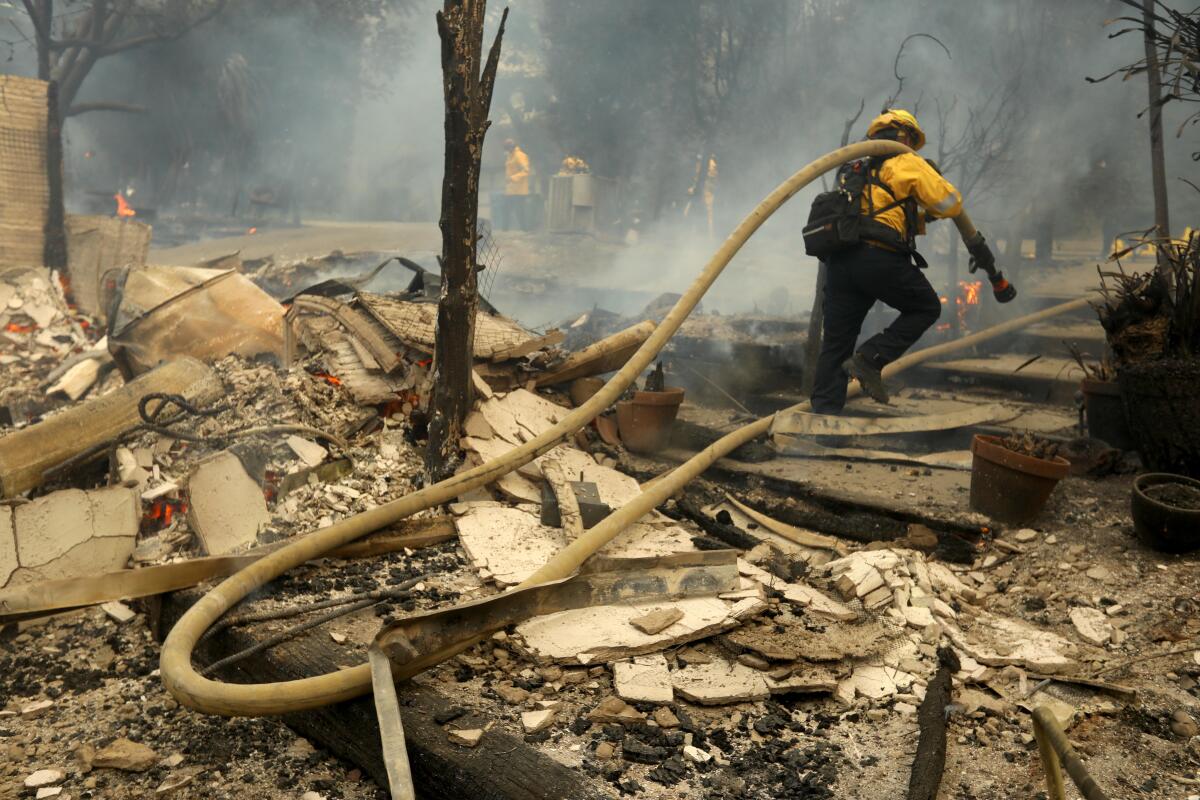
A firefighter carries a hose back to his rig while walking through a destroyed home from the Palisades fire in Pacific Palisades on Jan. 7, 2025.
(Genaro Molina / Los Angeles Times)
Last year, Pacific Palisades-based fashion designer Elyse Walker said she would reopen her eponymous store in Palisades Village after losing her 25-year flagship location on Antioch Street to the inferno.
Other neighborhood shops destroyed in the fire that are reopening at the mall include K Bakery and Loomey’s Toys, which caters to children up to age 12 and used to be across the street from Palisades Elementary Charter School.
“It’s been a journey and I’m excited because I wasn’t sure that there was going to be a place to come back to,” said toy store owner Amanda Rastegar. “Hopefully we can bring some of that magic back.”
Rastegar’s home in the Palisades survived but was damaged by the fire. The family returned about eight weeks ago. Her last memory of the fire was a burning supermarket.
“I just couldn’t wrap my brain around what was happening,” she said. “By the time I left, Gelson’s was on fire.”
Among the returning tenants is Angelini Ristorante & Bar. Well-known Los Angeles chef Gino Angelini said he will be in the kitchen next month for a return of the Italian restaurant.
“We won’t do a big celebrity open,” he said. “We want to have a very soft opening and see our customers come back.”

Construction takes place at Rick Caruso’s Palisades Village on Thursday. The shopping center is scheduled to reopen mid-August.
(Myung J. Chun / Los Angeles Times)
An elaborate celebration would not feel “correct for me,” Angelini said, because the devastation has been “very sad” for so many.
Other new tenants include local chef Nancy Silverton, who has agreed to move in with a new Italian steakhouse called Spacca Tutto. Women’s activewear retailer LESET will open its first West Coast location.
Caruso said he is optimistic that customers will return to the center, even though many Pacific Palisades residents are still dispersed. One tracking system estimated that about 30% of the Village’s customer base was impacted by the fire, he said.
“That means 70% did not get impacted, so there’s a lot of customers still left out there,” Caruso said. Historically, the center drew customers from as far away as Beverly Hills and Calabasas, as well as Malibu, Brentwood and Santa Monica.
He also hopes many will be inspired to visit the revived mall.
“I believe in the goodness of people and I believe that people are going to want to support the Palisades,” he said. “They’re going to want to be there and support the businesses that have had the courage and the heart to reopen.”

Walmart is rapidly expanding its network of electric vehicle chargers designed for customers to use while they shop.
The network could help fill gaps in EV infrastructure in states with greater need for chargers. Walmart, which has more than 5,000 locations in the U.S. and hundreds in California, says more than 90% of Americans live within 10 miles of one of its stores.
The chargers also offer an incentive for customers to choose Walmart — Walmart Plus members will receive a 10% discount off an average price of $0.46 per kilowatt-hour of energy at the company’s chargers.
Walmart chargers are already available at more than 75 locations in 17 states, with Texas boasting the most charging stations, followed by Florida and Arizona.
Matthew Nelson, Walmart’s director of energy policy, said last week on LinkedIn that the network will soon reach 29 states, including California.
“We are delivering on the promise of affordable, reliable and convenient charging,” Nelson said in his post.
According to Walmart’s website, six charging stations are coming to California soon, though the company did not offer a specific timeline.
The chargers will be installed at stores in Antelope, Brea, Fresno, Stockton, Suisun City and Vallejo.
Most charging sites in California will include eight to 16 fast-charging stalls, said Walmart spokesperson Kelsey Bohl.
The company first announced plans in April 2023 to install its own EV chargers at Walmart and Sam’s Club stores, with a goal of installing thousands of chargers by 2030. Partnering with ABB E-Mobility and Alpitronic, it added 25 new charging sites this past May and six more in June.
“Walmart is building a leading retail-integrated EV fast-charging network, focused on delivering an affordable, reliable and convenient charging experience where customers already shop,” Bohl said in an emailed statement. “Customers can charge while they shop, access stations through the Walmart app they already use, and benefit from affordable pricing.”
The charging stations already available include 612 individual charging stalls using 400-kilowatt chargers. Each stall has a dual charging cord with both Combined Charging System and North American Charging Standard connectors. The standard connectors, designed by Tesla, are smaller and lighter than the combined systems.
The primary way to pay for the chargers is through the Walmart app, but the company is also experimenting with built-in credit card readers to allow those without the app to use the stations.
Customers can check charger availability on the Walmart app. The company said the chargers will be available 24 hours a day.

Robotaxis could be turning into robocops.
A self-driving Waymo reported two teens to San Mateo, Calif., police on Monday after they were found drinking alcohol and shooting toy guns in the back of the vehicle.
According to a social media post from the San Mateo Police Department, officers detained two 15-year-olds after the Waymo they were riding in contacted the department and stopped in a parking lot until law enforcement arrived.
“Parents do you know where your teens are?” the San Mateo Police Department wrote on Facebook following the incident. “Waymo does!”
Officers removed both teens from the vehicle and determined they were using toy guns to shoot Orbeez out the windows. Orbeez are small, water-absorbing beads sold at toy stores.
“Toy guns, water guns, and BB guns all pose real dangers, especially to an untrained eye,” the Police Department said. “The simple handling of them can cause fear in [passersby].” “
A video posted on Facebook shows at least five officers and a police dog responding to the scene and approaching the Waymo with their weapons raised.
Waymo did not immediately respond to a request for comment.
Waymo vehicles have internal cameras and microphones that may be used in an emergency or to “promote safety and security,” according to Waymo’s online support page.
The cameras are also used to ensure the vehicles are clean and to help find lost items, according to the support page.
The company said it does not use facial recognition or other biometric identification technologies to identify individuals.
“In more urgent circumstances, support may access live video during a trip,” the Waymo page said.
The San Mateo Police Department’s Facebook post has garnered nearly 60 comments, with one user accusing Waymo of “snitching.”
“At least they got a designated driver?!” one user commented.
-

 News30 minutes ago
Three more people charged with damaging Reflecting Pool after Trump’s multimillion-dollar restoration | CNN Politics
-

 Los Angeles, Ca2 hours ago
Loved ones search for missing 34-year-old Southern California woman
-

 Detroit, MI2 hours ago
Chickens, geese found at vacant home after nonprofit reports them stolen
-

 San Francisco, CA2 hours ago
What’s next for San Francisco Giants as MLB trade deadline approaches?
-
 Dallas, TX2 hours ago
Dallas millionaire files lawsuit against groundwater district
-

 Miami, FL2 hours ago
7 more women arrested at southwest Miami-Dade massage parlors, accused of prostitution in undercover sting
-

 Boston, MA3 hours ago
‘They’re my buddies’: 96-year-old Back Bay woman befriends French soccer team
-

 Denver, CO3 hours ago
Denver officers cited for separate incidents, 1 fired

