Business
Column: Trump and Musk crippled our most important global aid agency. The consequences are grim


It’s probably too soon to claim Elon Musk has babies’ blood on his hands for effectively shuttering America’s most consequential foreign aid agency. But trust me: He will.
On Musk’s orders, the work of the United States Agency for International Development has come to a screeching halt. Thousands of its administrators, workers and contractors have been thrown out of work, its programs suspended for who-knows-how-long and its website no longer functioning.
“We’re shutting it down,” Musk said Monday. “You’ve got to basically get rid of the whole thing. It’s beyond repair.”
My guess is that Musk, the unelected, unappointed billionaire bureaucrat in charge of slashing federal spending, and his boss, President Trump, are betting that most Americans won’t care about stuff that goes on overseas. Voters were in an isolationist mood when they gave Trump a second term. And most of us have only a glancing knowledge of USAID, which delivers humanitarian aid to developing nations beleaguered by conflict, disease and natural disaster across the globe. With a budget of around $40 billion, USAID is also the world’s largest provider of food assistance — which, to put in terms even Musk might grok, means it saves the lives of malnourished babies.
But — surprise — Americans do care. On Wednesday, pro-USAID demonstrations took place at state capitols around the country. In Washington, D.C., where USAID is headquartered and many of its workers and contractors live, thousands turned out to protest Musk’s abrupt, potentially illegal move.
Detractors may wonder what the agency does, but a better question is what doesn’t it do?
Founded during the Kennedy administration to counter Soviet influence, USAID has helped Ukraine in its fight against Russia, worked to ensure that elections are free and fair and, collaborating with partners in 100 countries around the world, alleviated poverty, hunger, illness and desperation. It funds independent foreign media and civil society activists, advancing global freedom and security. And nearly all of that has abruptly stopped.
The New York Times reported that the Trump administration’s stop-work order to all USAID-funded organizations leaves thousands of people “with experimental drugs and devices in their bodies with no access to monitoring or care.”
Like any massive agency, USAID suffers from a degree of waste, fraud and abuse. The agency’s inspector general also recently laid out his concerns about a frustrating lack of United Nations cooperation with USAID and recommended changes.
But despite problems that should be addressed, USAID is the very embodiment of American soft power. It’s quite simply the most persuasive peaceful tool we have to improve people’s lives, spread democratic ideals and counter China’s growing influence in Africa and South America.
Which is why, as you can imagine, autocrats around the world are thrilled to see it dismantled.
“Wrapped into the billions the U.S. spends annually on foreign aid — more than any other nation — are hundreds of grants for grassroots groups dedicated to fighting for democracy in authoritarian countries around the world,” the Associated Press reported. Favorable reactions to the agency’s shuttering came from Venezuela, Nicaragua and Russia, the AP noted: “Former Russian President Dmitry Medvedev said on X that he hopes the ‘notorious Deep State doesn’t swallow’ Musk for pulling the plug on the agency.”
Project 2025, the Heritage Foundation blueprint for the second Trump administration, devotes a whole chapter to USAID, accusing the Biden administration of allowing the agency to promote “a radical ideology” and a “divisive political and cultural agenda that promotes abortion, climate extremism, gender radicalism, and interventions against perceived systematic racism.” And yet despite such absurd hyperbole, Project 2025 admits that the agency is crucial “to counter Communist China’s strategy of world domination.”
Musk called USAID an “evil” “criminal organization.” Trump chimed in that it’s run by “a bunch of radical lunatics.”
That is crazy. But it’s not surprising, because — with apologies to “Stranger Things” — we’re all living in the Upside Down right now.
“The idea that this is a criminal enterprise? Please,” said Peter Kerndt, a public health physician who recently spent five years in Mozambique working for a USAID contractor on a project to curb the spread of tuberculosis. His work involved tracing, identifying and treating those infected with the deadly disease. On Jan. 28, he was abruptly fired.
“It’s like a punch to the gut,” said Kerndt, who worked for the Los Angeles County Department of Public Health for 29 years before leaving for USAID. “My God, Musk doesn’t know the work that is being done. I think the richest man in the world has an agenda.”
Ya think?
Sen. Chris Murphy advanced a plausible theory Tuesday night in a video posted to Instagram. Musk, whose business relies on government contracts, is simply out to “pad his pockets,” the Connecticut Democrat said. He noted that Musk makes half his Teslas in China, which is also his biggest foreign market.
“He’s in a row right now with China because China is not allowing him to market his self-driving vehicle, and they are trying to give advantage to their domestic self-driving product,” Murphy said. “How do you get in quick favor with the Chinese government? You dismantle the agency that is the biggest thorn in the side of China.”
The USAID inspector general was also investigating how Musk’s SpaceX Starlink satellite terminals, purchased with agency funds, were used in Ukraine’s war with Russia, though details are sparse. Biographer Walter Isaacson wrote that Musk once cut off the Ukrainian military’s access to Starlink to thwart a submarine drone attack against Russia. That is simply too much power for one individual to wield.
MAGA Republicans can yelp all they want about “woke” agendas being exported by USAID, but the bottom line is the agency does incredibly important, lifesaving work.
I asked Dr. Kerndt why Americans should care about the work he does to prevent and cure tuberculosis, which is often fatal if untreated and for which there is no vaccine.
“Tuberculosis affects young, healthy people,” he told me. “It’s a catastrophic cost to those individuals, to the breadwinners, to the families. It sinks them further into poverty. It’s something we can prevent for pennies on the dollar. And it’s a source of immeasurable respect for the U.S.”
Throwing that good work away to appease a childish billionaire will leave a lasting moral stain on this country.
Bluesky: @rabcarian.bsky.social. Threads: @rabcarian


The luxury shopping center in Pacific Palisades will reopen next month after more than $100 million in renovations forced by the January 2025 wildfire that devastated the Los Angeles neighborhood.
Palisades Village will reopen Aug. 15, owner Rick Caruso announced Wednesday. The outdoor center survived the blaze that destroyed homes and other businesses but needed refurbishment to eliminate contaminants that the fire could have spread.
Crews are putting finishing touches on mall buildings after tearing them down to the studs, treating the wood and rebuilding the walls, Caruso said.
“Everybody’s working, and stores are moving their products in,” he said. “It’s a really cool feeling that people have really locked arms and are working together.”
An electrician installs lighting for a restaurant at Rick Caruso’s Palisades Village on Thursday. The shopping center is scheduled to reopen mid-August.
(Myung J. Chun / Los Angeles Times)
Pacific Palisades resident Allison Polhill, who is rebuilding the home of 30 years that her family lost in the blaze, said she is “thrilled” at the prospect of returning to the mall she used to frequent. Its comeback is a boost for the community, she said.
“Every single step that we make to reopen our commercial corridors is going to bring more people back into the Palisades,” said Polhill, who expects to move back into her home at the end of August.
A total of 6,822 structures were destroyed in the Palisades fire, including more than 5,500 residences and 100 commercial businesses, according to the California Department of Forestry and Fire Protection.
Caruso previously attributed the mall’s survival to the hard work of private firefighters and the fire-resistant materials used in the mall’s construction.
The $200-million shopping and dining center opened in 2018 with a movie theater and a roster of upmarket tenants, including Erewhon, which may be the only grocer in the heart of the fire-ravaged neighborhood when it opens.
Caruso’s company was able to fill the mall with tenants despite the long shutdown.
Palisades Village is 99% leased, with the majority of tenants returning, said Jackie Levy, chief financial and revenue officer. Nearly one-third of the shops and restaurants are new to the property.
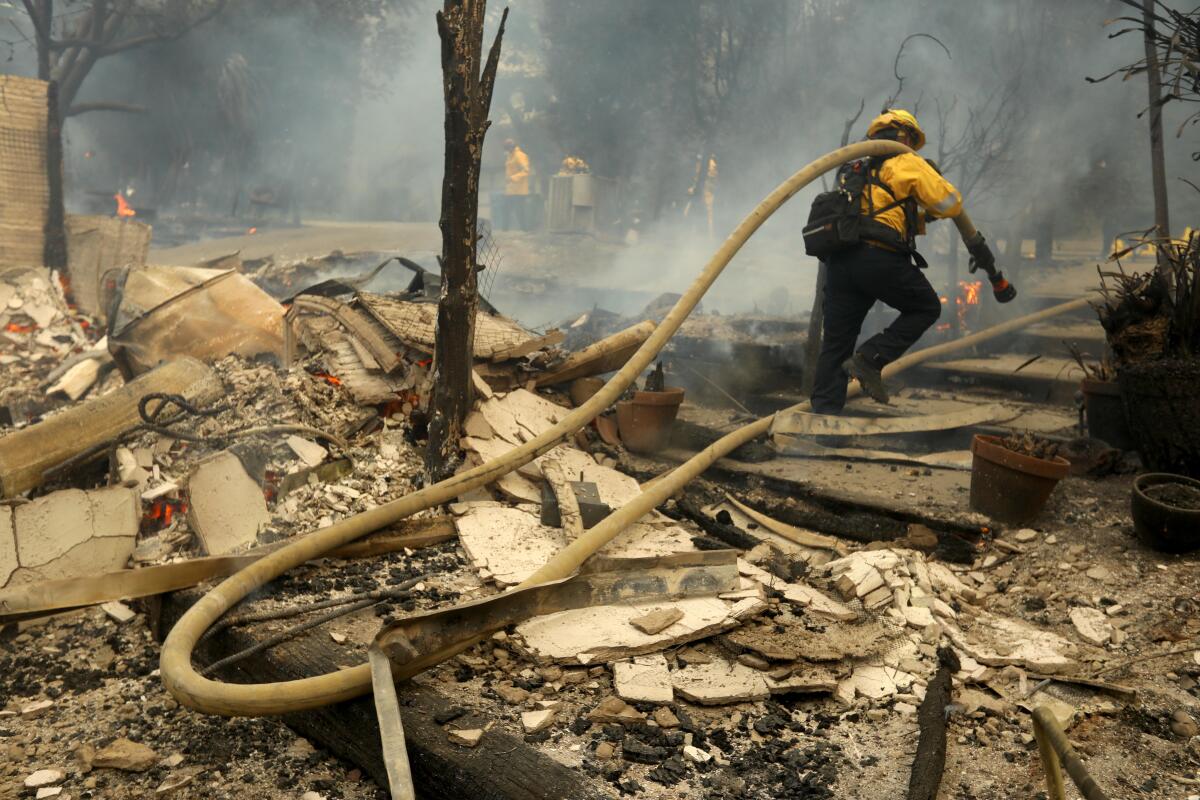
A firefighter carries a hose back to his rig while walking through a destroyed home from the Palisades fire in Pacific Palisades on Jan. 7, 2025.
(Genaro Molina / Los Angeles Times)
Last year, Pacific Palisades-based fashion designer Elyse Walker said she would reopen her eponymous store in Palisades Village after losing her 25-year flagship location on Antioch Street to the inferno.
Other neighborhood shops destroyed in the fire that are reopening at the mall include K Bakery and Loomey’s Toys, which caters to children up to age 12 and used to be across the street from Palisades Elementary Charter School.
“It’s been a journey and I’m excited because I wasn’t sure that there was going to be a place to come back to,” said toy store owner Amanda Rastegar. “Hopefully we can bring some of that magic back.”
Rastegar’s home in the Palisades survived but was damaged by the fire. The family returned about eight weeks ago. Her last memory of the fire was a burning supermarket.
“I just couldn’t wrap my brain around what was happening,” she said. “By the time I left, Gelson’s was on fire.”
Among the returning tenants is Angelini Ristorante & Bar. Well-known Los Angeles chef Gino Angelini said he will be in the kitchen next month for a return of the Italian restaurant.
“We won’t do a big celebrity open,” he said. “We want to have a very soft opening and see our customers come back.”

Construction takes place at Rick Caruso’s Palisades Village on Thursday. The shopping center is scheduled to reopen mid-August.
(Myung J. Chun / Los Angeles Times)
An elaborate celebration would not feel “correct for me,” Angelini said, because the devastation has been “very sad” for so many.
Other new tenants include local chef Nancy Silverton, who has agreed to move in with a new Italian steakhouse called Spacca Tutto. Women’s activewear retailer LESET will open its first West Coast location.
Caruso said he is optimistic that customers will return to the center, even though many Pacific Palisades residents are still dispersed. One tracking system estimated that about 30% of the Village’s customer base was impacted by the fire, he said.
“That means 70% did not get impacted, so there’s a lot of customers still left out there,” Caruso said. Historically, the center drew customers from as far away as Beverly Hills and Calabasas, as well as Malibu, Brentwood and Santa Monica.
He also hopes many will be inspired to visit the revived mall.
“I believe in the goodness of people and I believe that people are going to want to support the Palisades,” he said. “They’re going to want to be there and support the businesses that have had the courage and the heart to reopen.”

Walmart is rapidly expanding its network of electric vehicle chargers designed for customers to use while they shop.
The network could help fill gaps in EV infrastructure in states with greater need for chargers. Walmart, which has more than 5,000 locations in the U.S. and hundreds in California, says more than 90% of Americans live within 10 miles of one of its stores.
The chargers also offer an incentive for customers to choose Walmart — Walmart Plus members will receive a 10% discount off an average price of $0.46 per kilowatt-hour of energy at the company’s chargers.
Walmart chargers are already available at more than 75 locations in 17 states, with Texas boasting the most charging stations, followed by Florida and Arizona.
Matthew Nelson, Walmart’s director of energy policy, said last week on LinkedIn that the network will soon reach 29 states, including California.
“We are delivering on the promise of affordable, reliable and convenient charging,” Nelson said in his post.
According to Walmart’s website, six charging stations are coming to California soon, though the company did not offer a specific timeline.
The chargers will be installed at stores in Antelope, Brea, Fresno, Stockton, Suisun City and Vallejo.
Most charging sites in California will include eight to 16 fast-charging stalls, said Walmart spokesperson Kelsey Bohl.
The company first announced plans in April 2023 to install its own EV chargers at Walmart and Sam’s Club stores, with a goal of installing thousands of chargers by 2030. Partnering with ABB E-Mobility and Alpitronic, it added 25 new charging sites this past May and six more in June.
“Walmart is building a leading retail-integrated EV fast-charging network, focused on delivering an affordable, reliable and convenient charging experience where customers already shop,” Bohl said in an emailed statement. “Customers can charge while they shop, access stations through the Walmart app they already use, and benefit from affordable pricing.”
The charging stations already available include 612 individual charging stalls using 400-kilowatt chargers. Each stall has a dual charging cord with both Combined Charging System and North American Charging Standard connectors. The standard connectors, designed by Tesla, are smaller and lighter than the combined systems.
The primary way to pay for the chargers is through the Walmart app, but the company is also experimenting with built-in credit card readers to allow those without the app to use the stations.
Customers can check charger availability on the Walmart app. The company said the chargers will be available 24 hours a day.

Robotaxis could be turning into robocops.
A self-driving Waymo reported two teens to San Mateo, Calif., police on Monday after they were found drinking alcohol and shooting toy guns in the back of the vehicle.
According to a social media post from the San Mateo Police Department, officers detained two 15-year-olds after the Waymo they were riding in contacted the department and stopped in a parking lot until law enforcement arrived.
“Parents do you know where your teens are?” the San Mateo Police Department wrote on Facebook following the incident. “Waymo does!”
Officers removed both teens from the vehicle and determined they were using toy guns to shoot Orbeez out the windows. Orbeez are small, water-absorbing beads sold at toy stores.
“Toy guns, water guns, and BB guns all pose real dangers, especially to an untrained eye,” the Police Department said. “The simple handling of them can cause fear in [passersby].” “
A video posted on Facebook shows at least five officers and a police dog responding to the scene and approaching the Waymo with their weapons raised.
Waymo did not immediately respond to a request for comment.
Waymo vehicles have internal cameras and microphones that may be used in an emergency or to “promote safety and security,” according to Waymo’s online support page.
The cameras are also used to ensure the vehicles are clean and to help find lost items, according to the support page.
The company said it does not use facial recognition or other biometric identification technologies to identify individuals.
“In more urgent circumstances, support may access live video during a trip,” the Waymo page said.
The San Mateo Police Department’s Facebook post has garnered nearly 60 comments, with one user accusing Waymo of “snitching.”
“At least they got a designated driver?!” one user commented.
-

 Alaska6 minutes ago
Outmigration, inflation, choice schools: Alaska school closures likely to continue without changes
-
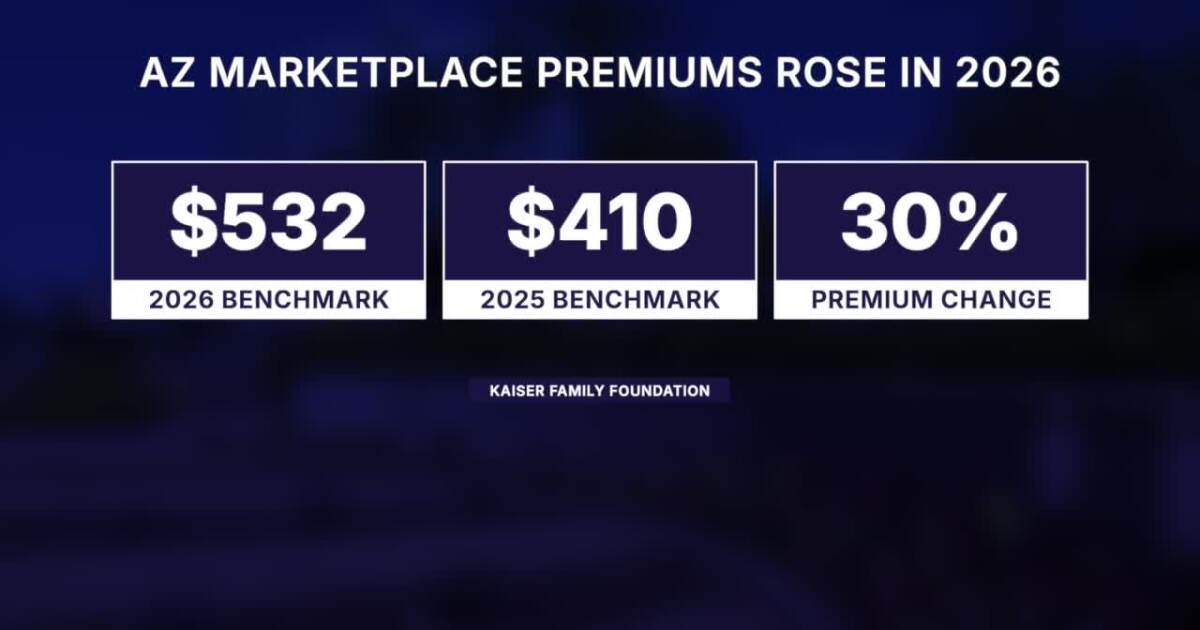 Arizona9 minutes ago
WATCH: Arizona’s health insurance marketplace is seeing dropping enrollment
-

 Arkansas14 minutes ago
ARKANSAS SIGHTSEEING: Randolph County can claim many firsts in Arkansas | Northwest Arkansas Democrat-Gazette
-

 California21 minutes ago
Toddler sustains brain injury in fall after California childcare worker threw him into the air, lawsuit says
-

 Colorado24 minutes ago
‘Saleabration’ comes back to Colorado Springs for third year
-

 Connecticut29 minutes ago
‘It’s a neighborhood effort’: Improvements made to Quinnipiac River Park
-

 Delaware36 minutes ago
Kids get hands-on learning during summer camp at Delaware County Technical School
-

 Florida39 minutes ago
Iranian drones in Cuba could threaten South Florida, officials warn

