Business
Column: Good riddance to the merger of grocers Albertsons and Kroger, which would have cost you money

The inside stories of messy marriage breakups have been an entertainment staple since even before Tolstoy observed that “every unhappy family is unhappy in its own way.” So let’s thank the supermarket giants Kroger and Albertsons, whose $24.6-billion merger has collapsed amid mutual recriminations, for their outstanding contribution to the genre.
The proximate cause of the breakup was the granting of a preliminary injunction against the deal by U.S. Judge Adrienne Nelson of Oregon. Nelson’s ruling, issued Tuesday, was a response to a motion by the Federal Trade Commission, the District of Columbia and eight states including California. (A state judge in Washington also ruled against the merger the same day.)
Although the two companies had fought the challenges to the merger seemingly hand in hand, their accord dissolved within 24 hours of Nelson’s ruling. Boise, Idaho-based Albertsons sued Kroger on Wednesday, citing the latter’s alleged “failure to exercise ‘best efforts’ and to take ‘any and all actions’ to secure regulatory approval” of the deal.
The overarching goals of antitrust law are not met by permitting an otherwise unlawful merger in order to permit firms to compete with an industry giant.
— Federal Judge Adrienne Nelson, blocking the Kroger/Albertsons merger
Kroger called Albertsons’ claims “baseless” and cited its would-be spouse’s “repeated intentional material breaches and interference throughout the merger process, which we will prove in court.”
Those of us who have followed the deal from its inception in 2022 can add this: “Good riddance.”
The collapse of the supermarket merger may stand as the final antitrust success of the Biden-era FTC, which has taken a hard line toward industry consolidations under Chair Lina Khan. Donald Trump is planning to nominate Andrew Ferguson, an FTC commissioner and conservative lawyer, as the agency’s chairman. Khan will be stepping down.
The two grocery chains maintained that they needed to merge in order to successfully compete with megastore chains such as Walmart and Costco, which have grown their grocery operations to the point that their sales approach those of Albertsons and Kroger or even exceed them.
The truth is, however, that the squalid nature of this transaction was always self-evident. As I wrote after the original announcement, the merger partners pitched it to the public as a boon to consumers. Merger partners always say this, but the consumer savings and service improvements generally prove elusive.
“We will take the learnings from each company to bring greater value and a better experience to more customers, more associates and more communities,” Kroger Chief Executive Rodney McMullen said then.
McMullen didn’t explicitly say that the deal would mean lower prices, but it would be a rare shopper who didn’t think that “greater value and a better experience” meant anything other than paying less at the checkout counter. Economists and antitrust experts predicted that the creation of a monopolistic supermarket giant would almost surely add inflationary pressure to food prices.
At the heart of the merger, as I further reported, was a $4-billion dividend to be paid to Albertsons stockholders. Six of the largest stockholders were corporate insiders, defined as holders of more than 5% of Albertsons shares each.
The biggest shareholder was the private equity firm Cerberus Capital Management, which owns more than 26% of the shares and has four nominees on the company’s board of directors. The other five are investment and real estate funds that hold a total of an additional three board seats.
The six investors control about 75% of Albertsons shares. In other words, they voted themselves a multibillion-dollar handout.
Albertsons had claimed that the dividend wasn’t connected to the merger but was “part of Albertsons’ long-term strategy for growth,” which was “determined well before Albertsons’ discussions with Kroger began.”
Yet the companies’ own merger announcement had stated explicitly that the $4-billion dividend was “part of the transaction.” They counted the dividend as part of the merger price, accounting for $6.85 per share of the $34.10 per share payable to Albertsons shareholders. The dividend was approved by the Albertsons board at the very same meeting at which it approved the merger deal itself.
It should go without saying that funneling $4 billion to insiders off the top wasn’t going to make it any easier to bring consumers lower prices at the checkout counter.
Then there was the issue of Albertsons’ corporate conduct. In October, Albertsons reached a $3.9-million settlement with the attorneys general of Los Angeles County and six other California counties as well as the FTC over accusations that the chain ripped off customers at hundreds of its Vons, Safeway and Albertsons stores in California. The company didn’t admit to liability in settling the case, but the terms of the final judgment suggest that the counties and the FTC had the goods — or at least had enough evidence that Albertsons thought it wise to make the case go away.
Albertsons says it has now implemented policies and employee training to ensure that its prices are accurate.
The principal issues raised by the FTC and the states concerned the prospects that the merger of America’s two biggest supermarket chains would allow them to dominate their markets as a monopoly or near-monopoly. That pointed to higher prices for customers and lower wages for workers, which are legitimate concerns for antitrust regulators.
Kroger, the largest chain, operates about 2,700 stores in 35 states and the District of Columbia, under brand names including Ralphs. Albertsons’ footprint encompasses about 2,300 stores under names such as Vons, Pavilions and Safeway. As Judge Nelson observed, the two chains have assiduously competed with each other for years, tracking each other’s prices in an effort to seize market share.
To meet the FTC’s objections, the merger partners proposed selling 579 stores to C&S Wholesale Grocers, a privately held supermarket supplier headquartered in New Hampshire that is a tiny fraction of the merger partners’ size — among other metrics, it has about 14,000 employees, compared with 430,000 employees at Kroger and 285,000 at Albertsons. The sale price was to be $2.9 billion.
Such divestitures are common features of merger deals that face regulatory challenge. But they don’t always meet their goal of preserving competition. A good example is the outcome of a divestiture scheme the FTC ordered in 2014, to mitigate the anticompetitive effects of Albertsons’ takeover of Safeway.
The FTC ordered the divestiture of 168 stores. More than 140 were acquired by Haggen Holdings, an 18-store chain in the Pacific Northwest. As it happened, Haggen was utterly ill-equipped to grow nearly tenfold overnight. Within months it was laying off workers, and before the year was out it had filed for bankruptcy.
Haggen put 100 of the stores back on the block, and 54 of them were reacquired by Albertsons as part of a deal to purchase Haggen outright. Even with the repurchases, the merger resulted in the elimination all competition in some communities.
That history gave Nelson pause when she assessed the new divestiture plan. C&S, she noted, didn’t have very happy experiences when it “dipped its toes into the grocery retail industry before.” The wholesaler bought 220 retail stores between 2001 and 2003, but had sold 190 of them by 2005. The company operates about 25 retail stores under the Piggly Wiggly and Grand Union brands; unlike Kroger and Albertsons, which incorporate pharmacies and gasoline stations into many of their locations, C&S operates only one pharmacy and no gas stations.
In short, Nelson observed, “there are serious concerns about C&S’ ability to run a large-scale retail grocery business that can successfully compete” with a merged Albertsons/Kroger. Among other issues, she wrote, C&S would have to re-brand about half the stores, a process that is “effectively the same as opening a new, unfamiliar grocery store in the eyes of consumers.” C&S didn’t respond to my request for a comment on Nelson’s take, though a spokeswoman told me by email that the firm is still committed to a “transformation strategy, which includes expansion into retail.”
As for the merger partners’ assertion that their deal was a defensive move against competitors such as Walmart and Costco, Nelson was unmoved. “The overarching goals of antitrust law are not met,” she wrote, “by permitting an otherwise unlawful merger in order to permit firms to compete with an industry giant.”
With the merger dead, the squabbling between the former partners is just beginning. Under their original deal, Albertsons is entitled to a $600-million breakup fee. But it says it will be seeking billions of dollars in costs, due in part to “the extended period of unnecessary limbo Albertsons endured as a result of Kroger’s actions.” Among other things, Albertsons’ asserted that Kroger dithered on divestiture deals that might have met the FTC’s objections.
In response, Kroger said it “went to extraordinary lengths to uphold the merger agreement throughout the entirety of the regulatory process and the facts will make that abundantly clear.”

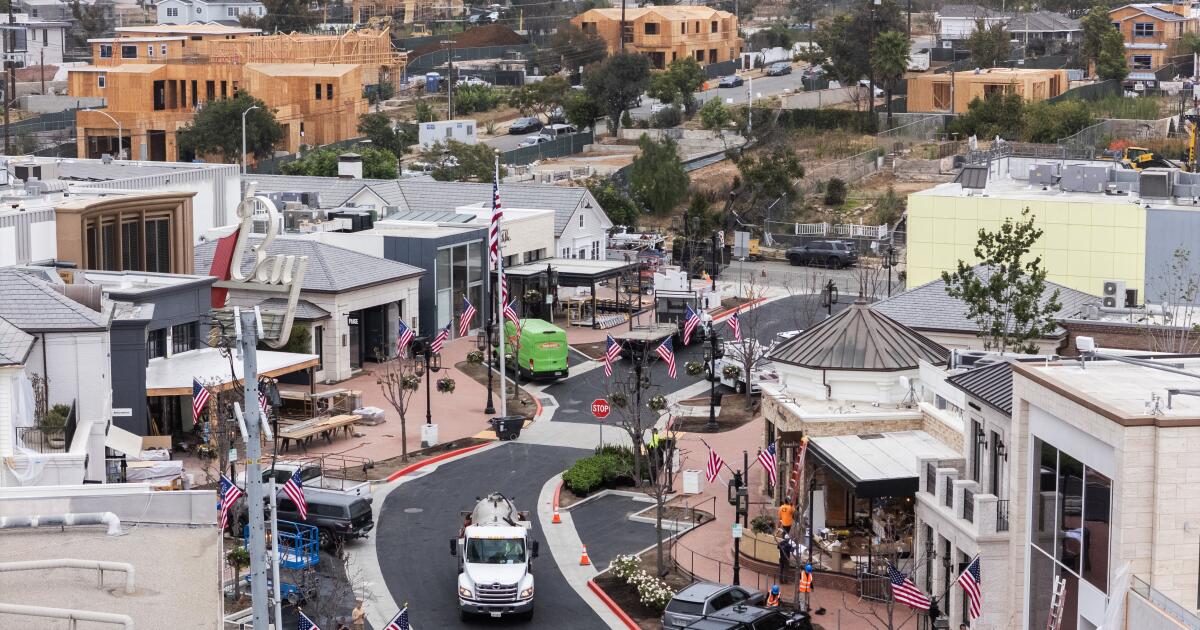
The luxury shopping center in Pacific Palisades will reopen next month after more than $100 million in renovations forced by the January 2025 wildfire that devastated the Los Angeles neighborhood.
Palisades Village will reopen Aug. 15, owner Rick Caruso announced Wednesday. The outdoor center survived the blaze that destroyed homes and other businesses but needed refurbishment to eliminate contaminants that the fire could have spread.
Crews are putting finishing touches on mall buildings after tearing them down to the studs, treating the wood and rebuilding the walls, Caruso said.
“Everybody’s working, and stores are moving their products in,” he said. “It’s a really cool feeling that people have really locked arms and are working together.”
An electrician installs lighting for a restaurant at Rick Caruso’s Palisades Village on Thursday. The shopping center is scheduled to reopen mid-August.
(Myung J. Chun / Los Angeles Times)
Pacific Palisades resident Allison Polhill, who is rebuilding the home of 30 years that her family lost in the blaze, said she is “thrilled” at the prospect of returning to the mall she used to frequent. Its comeback is a boost for the community, she said.
“Every single step that we make to reopen our commercial corridors is going to bring more people back into the Palisades,” said Polhill, who expects to move back into her home at the end of August.
A total of 6,822 structures were destroyed in the Palisades fire, including more than 5,500 residences and 100 commercial businesses, according to the California Department of Forestry and Fire Protection.
Caruso previously attributed the mall’s survival to the hard work of private firefighters and the fire-resistant materials used in the mall’s construction.
The $200-million shopping and dining center opened in 2018 with a movie theater and a roster of upmarket tenants, including Erewhon, which may be the only grocer in the heart of the fire-ravaged neighborhood when it opens.
Caruso’s company was able to fill the mall with tenants despite the long shutdown.
Palisades Village is 99% leased, with the majority of tenants returning, said Jackie Levy, chief financial and revenue officer. Nearly one-third of the shops and restaurants are new to the property.
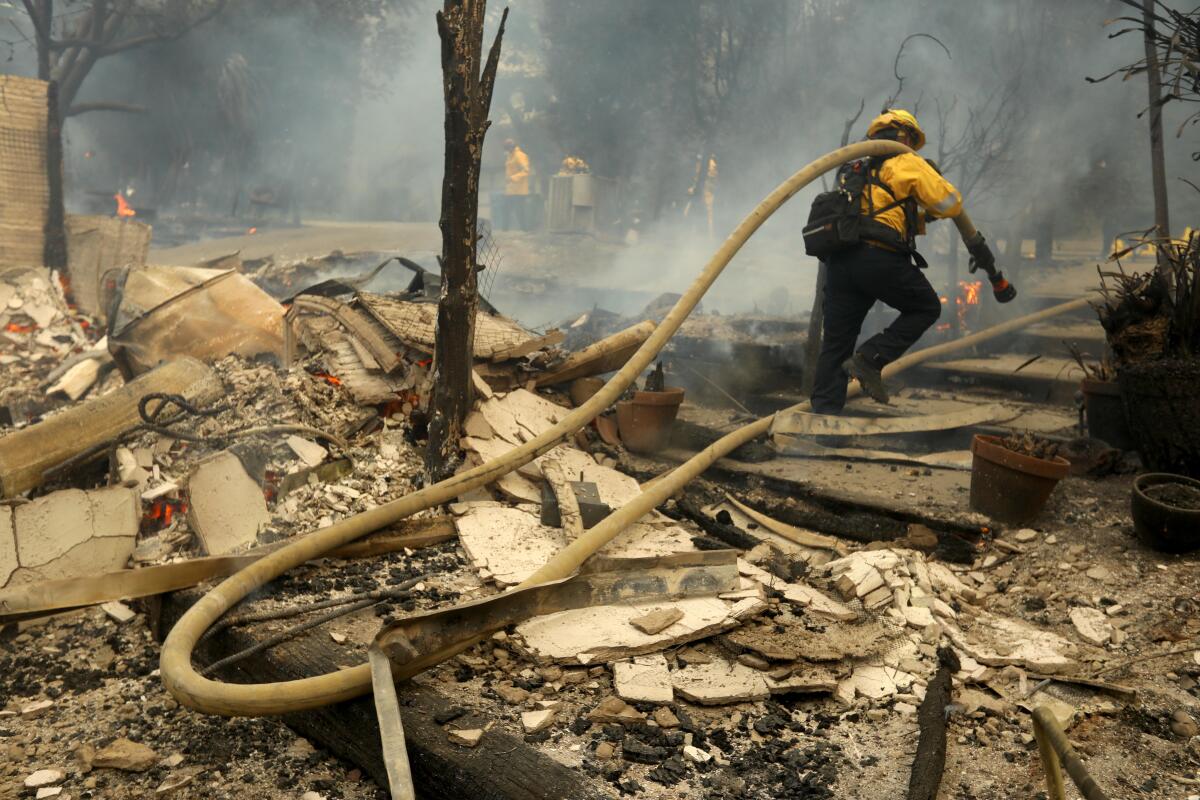
A firefighter carries a hose back to his rig while walking through a destroyed home from the Palisades fire in Pacific Palisades on Jan. 7, 2025.
(Genaro Molina / Los Angeles Times)
Last year, Pacific Palisades-based fashion designer Elyse Walker said she would reopen her eponymous store in Palisades Village after losing her 25-year flagship location on Antioch Street to the inferno.
Other neighborhood shops destroyed in the fire that are reopening at the mall include K Bakery and Loomey’s Toys, which caters to children up to age 12 and used to be across the street from Palisades Elementary Charter School.
“It’s been a journey and I’m excited because I wasn’t sure that there was going to be a place to come back to,” said toy store owner Amanda Rastegar. “Hopefully we can bring some of that magic back.”
Rastegar’s home in the Palisades survived but was damaged by the fire. The family returned about eight weeks ago. Her last memory of the fire was a burning supermarket.
“I just couldn’t wrap my brain around what was happening,” she said. “By the time I left, Gelson’s was on fire.”
Among the returning tenants is Angelini Ristorante & Bar. Well-known Los Angeles chef Gino Angelini said he will be in the kitchen next month for a return of the Italian restaurant.
“We won’t do a big celebrity open,” he said. “We want to have a very soft opening and see our customers come back.”

Construction takes place at Rick Caruso’s Palisades Village on Thursday. The shopping center is scheduled to reopen mid-August.
(Myung J. Chun / Los Angeles Times)
An elaborate celebration would not feel “correct for me,” Angelini said, because the devastation has been “very sad” for so many.
Other new tenants include local chef Nancy Silverton, who has agreed to move in with a new Italian steakhouse called Spacca Tutto. Women’s activewear retailer LESET will open its first West Coast location.
Caruso said he is optimistic that customers will return to the center, even though many Pacific Palisades residents are still dispersed. One tracking system estimated that about 30% of the Village’s customer base was impacted by the fire, he said.
“That means 70% did not get impacted, so there’s a lot of customers still left out there,” Caruso said. Historically, the center drew customers from as far away as Beverly Hills and Calabasas, as well as Malibu, Brentwood and Santa Monica.
He also hopes many will be inspired to visit the revived mall.
“I believe in the goodness of people and I believe that people are going to want to support the Palisades,” he said. “They’re going to want to be there and support the businesses that have had the courage and the heart to reopen.”

Walmart is rapidly expanding its network of electric vehicle chargers designed for customers to use while they shop.
The network could help fill gaps in EV infrastructure in states with greater need for chargers. Walmart, which has more than 5,000 locations in the U.S. and hundreds in California, says more than 90% of Americans live within 10 miles of one of its stores.
The chargers also offer an incentive for customers to choose Walmart — Walmart Plus members will receive a 10% discount off an average price of $0.46 per kilowatt-hour of energy at the company’s chargers.
Walmart chargers are already available at more than 75 locations in 17 states, with Texas boasting the most charging stations, followed by Florida and Arizona.
Matthew Nelson, Walmart’s director of energy policy, said last week on LinkedIn that the network will soon reach 29 states, including California.
“We are delivering on the promise of affordable, reliable and convenient charging,” Nelson said in his post.
According to Walmart’s website, six charging stations are coming to California soon, though the company did not offer a specific timeline.
The chargers will be installed at stores in Antelope, Brea, Fresno, Stockton, Suisun City and Vallejo.
Most charging sites in California will include eight to 16 fast-charging stalls, said Walmart spokesperson Kelsey Bohl.
The company first announced plans in April 2023 to install its own EV chargers at Walmart and Sam’s Club stores, with a goal of installing thousands of chargers by 2030. Partnering with ABB E-Mobility and Alpitronic, it added 25 new charging sites this past May and six more in June.
“Walmart is building a leading retail-integrated EV fast-charging network, focused on delivering an affordable, reliable and convenient charging experience where customers already shop,” Bohl said in an emailed statement. “Customers can charge while they shop, access stations through the Walmart app they already use, and benefit from affordable pricing.”
The charging stations already available include 612 individual charging stalls using 400-kilowatt chargers. Each stall has a dual charging cord with both Combined Charging System and North American Charging Standard connectors. The standard connectors, designed by Tesla, are smaller and lighter than the combined systems.
The primary way to pay for the chargers is through the Walmart app, but the company is also experimenting with built-in credit card readers to allow those without the app to use the stations.
Customers can check charger availability on the Walmart app. The company said the chargers will be available 24 hours a day.

Robotaxis could be turning into robocops.
A self-driving Waymo reported two teens to San Mateo, Calif., police on Monday after they were found drinking alcohol and shooting toy guns in the back of the vehicle.
According to a social media post from the San Mateo Police Department, officers detained two 15-year-olds after the Waymo they were riding in contacted the department and stopped in a parking lot until law enforcement arrived.
“Parents do you know where your teens are?” the San Mateo Police Department wrote on Facebook following the incident. “Waymo does!”
Officers removed both teens from the vehicle and determined they were using toy guns to shoot Orbeez out the windows. Orbeez are small, water-absorbing beads sold at toy stores.
“Toy guns, water guns, and BB guns all pose real dangers, especially to an untrained eye,” the Police Department said. “The simple handling of them can cause fear in [passersby].” “
A video posted on Facebook shows at least five officers and a police dog responding to the scene and approaching the Waymo with their weapons raised.
Waymo did not immediately respond to a request for comment.
Waymo vehicles have internal cameras and microphones that may be used in an emergency or to “promote safety and security,” according to Waymo’s online support page.
The cameras are also used to ensure the vehicles are clean and to help find lost items, according to the support page.
The company said it does not use facial recognition or other biometric identification technologies to identify individuals.
“In more urgent circumstances, support may access live video during a trip,” the Waymo page said.
The San Mateo Police Department’s Facebook post has garnered nearly 60 comments, with one user accusing Waymo of “snitching.”
“At least they got a designated driver?!” one user commented.
-

 Los Angeles, Ca1 hour ago
Loved ones search for missing 34-year-old Southern California woman
-

 Detroit, MI2 hours ago
Chickens, geese found at vacant home after nonprofit reports them stolen
-

 San Francisco, CA2 hours ago
What’s next for San Francisco Giants as MLB trade deadline approaches?
-
 Dallas, TX2 hours ago
Dallas millionaire files lawsuit against groundwater district
-

 Miami, FL2 hours ago
7 more women arrested at southwest Miami-Dade massage parlors, accused of prostitution in undercover sting
-

 Boston, MA2 hours ago
‘They’re my buddies’: 96-year-old Back Bay woman befriends French soccer team
-

 Denver, CO2 hours ago
Denver officers cited for separate incidents, 1 fired
-

 Seattle, WA2 hours ago
Study finds dangerous chemicals in the breast milk of Seattle moms

