News
Thousands in US to join ‘no school, no work, no shopping’ May Day protest in economic blackout


Thousands are set to join an economic blackout for International Workers’ Day on Friday, as part of 3,500 “May Day Strong” events across the country. Organizers are calling for “no school, no work, no shopping” with walkouts, marches, block parties and other gatherings planned into the evening.
May Day has long been an annual day of protest for the labor movement, and this year, many active movements are converging to fight for “a nation that puts workers over billionaires”. Demanding no ICE, no war, and taxing the rich, the May Day Strong coalition includes labor unions, immigrants rights groups, political organizations such as the Democratic Socialists of America, and the organizers behind the No Kings protests. Friday’s economic disruption builds on a similar coordinated effort out of Minnesota in January, when tens of thousands of Twin Cities residents took off from school and work to flood the streets in protest of federal immigration agents storming the city.
Neidi Dominguez, founding executive director of Organized Power in Numbers and an executive team member of May Day Strong, said that they expect more than twice the number of May Day events than last year.
Leah Greenberg of Indivisible, one of the main organizations behind No Kings, described the May Day economic blackout as a “structure test” for the movement.
“We are asking people to take a step into further exerting their power in all aspects of their lives – as workers, as students, as members of local organizing hubs,” she said. “It’s important as it builds muscles towards greater non-cooperation.”
Teachers’ unions and students are an active part of the fight, a continuation of their months of organizing against ICE. At least 15 school districts in North Carolina have given teachers the day off to join a statewide May Day “Kids Over Corporations” rally for public education funding. In Chicago, Illinois, the Chicago Teachers Union fought and won to have May Day made a “day of civic action”.
“As educators, we feel a very real accountability to the young people in the families that we serve,” Stacy Davis Gates, president of the Chicago Teachers Union and Illinois Federation of Teachers, said earlier this week. “We want to connect people not just to the affordability crisis but the crisis of our institutions being marginalized in this moment and the impact on our young people.”
Sanshray Kukutla, a student at Purdue University in West Lafayette, Indiana, and organizer with the campus’s Sunrise Movement chapter, is helping coordinate a local walkout for students, teachers, workers and residents. “We’re taking collective action to send a message to the billionaire class: it’s our labor, our spending, and our participation that keeps the whole system running, and if we don’t work, they don’t have profits,” said Kukutla.
Organizers say the day of action is an effort to build toward a general strike, which was essentially outlawed through the 1946 Taft-Hartley Act and hasn’t happened in the US since. As a workaround, Shawn Fain, president of the United Auto Workers (UAW), has called for unions to work toward a general strike on 1 May 2028, by having existing union contracts expire in unison.

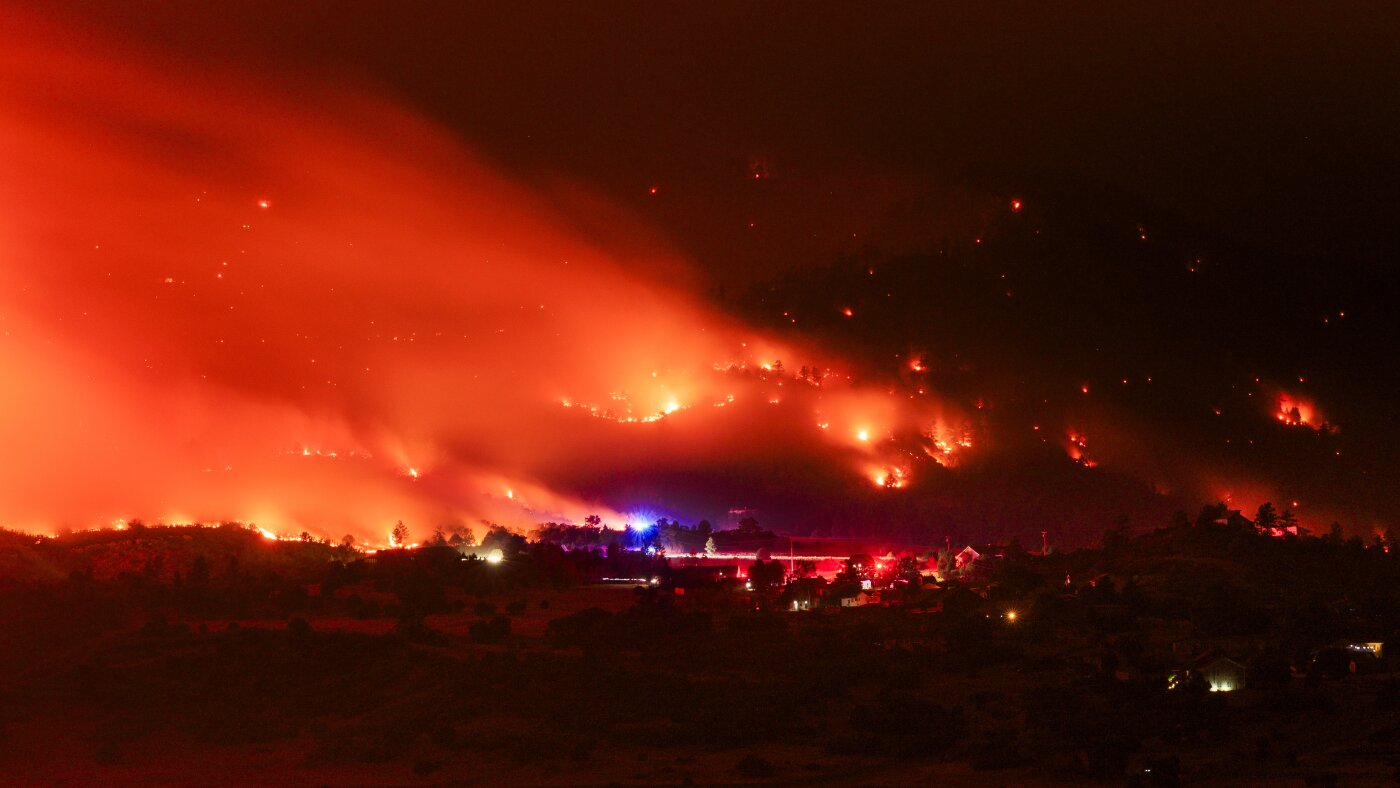
The Aspen Acres Fire burns on Friday in Rye, Colo.
Michael Ciaglo/Getty Images
hide caption
toggle caption
Michael Ciaglo/Getty Images
Thunderstorms with high winds on Sunday could hamper efforts to contain a massive wildfire that has scorched parts of southern Colorado.
The Aspen Acres Fire, which is burning south of Colorado Springs across Pueblo and Custer counties, has grown to more than 86,000 acres. It began nearly a week ago and is 13% contained, officials said on Sunday morning.

Authorities have ordered people to evacuate or to prepare to evacuate across counties including Custer, Pueblo, Huerfano and Fremont.
Scattered showers and thunderstorms could hit south central and southwest Colorado on Sunday, according to the National Weather Service.
Officials and forecasters say the rain could be beneficial for firefighting but are concerned it could lead to road damage in burned areas and cause flash flooding.
“The main threats from storms will be gusty outflow winds up to 50 mph and lightning,” the NWS office in Pueblo said.
Red flag warnings and air quality alerts have also been issued across the state, with the Colorado Department of Public Health and Environment on Sunday warning residents to limit time outdoors because of heavy smoke.
Other wildfires are burning in the state, including the Ferris Fire in southwest Colorado that has grown to more than 42,000 acres and is 7% contained as of Sunday afternoon. The Gold Mountain Fire, which is also in the southwest portion of the state, has grown to more than 25,000 acres and is 0% contained as of Sunday.
A memorial service was held on Sunday for three firefighters who were killed battling wildfires on the Colorado-Utah border on June 27: Emily Barker, Sydney Watson and Nick Hutcherson.
The firefighters, along with two others, were involved in a “burnover incident,” which happens when firefighters are overtaken and have to shelter as best they can while a fire passes directly over them, according to the Department of Interior. Two firefighters survived and were treated for burns.
Colorado Gov. Jared Polis ordered flags to fly half-staff in honor of the deceased firefighters.

“These three brave heroes ran towards the flames, put themselves in harm’s way, and gave the ultimate sacrifice to protect Coloradans, our communities and our families,” Polis said in a social media post on Sunday.
Another fire across the border in southern Utah, the Babylon Fire, has grown to more than 90,000 acres and is O% contained as of Sunday afternoon. It is expected to be hot and dry through Monday, with very little humidity, officials said, making conditions challenging for containment.

At least about two dozen people have died amid the perilous climate crisis-driven heatwave that has scorched swaths of the US with record temperatures.
As a huge heat dome sits over the county’s eastern half, extreme heat gripped millions of people in the days leading up to the US’s semiquincentennial on Saturday – and beyond it. More than 20 states experienced have reported stifling temperatures more than 100F (38C), marring celebrations. And more than 140 million people remained under active heat alerts across the US on Sunday.
Officials in New Jersey believe the extreme heat was a factor in the deaths of 22 people across 10 counties there, mostly in central and northern parts of the state. Many of the individuals were found in homes with no air conditioning, outside their residences, on the street and in parked cars, according to officials.
The first of those deaths occurred on Thursday, and the ages of the deceased in question mostly range from their mid-30s to their 80s. Preliminary findings cause investigators to believe the deaths are heat-related, though the chief state medical examiner for New Jersey would later determine the exact cause of death for each.
“This is not a typical summer heatwave,” the New Jersey department of public health said in a statement. “This type of heat can quickly become life-threatening to humans and to animals of all ages.”
The National Weather Service (NWS) has said cool air from the north in the coming days is going to lower some of the most extreme temperatures in the region, including New Jersey. The Fifa World Cup final is scheduled to be held in the New Jersey city of East Rutherford on 19 July.
Elsewhere, a heat-related death was reported in Cook county, Illinois, Natalia Derevyanny, a government spokesperson, told NBC News. The cause of that death was recorded as organic cardiovascular disease – with heat stress as a contributing factor.
Hinds county in Mississippi reported the death of 74-year-old Mitchell Ray Cooley due to heat exposure on Thursday, state officials said. Cooley had been reported missing, and his body was found the next day behind a gas station, the county coroner said in a statement.
“Mr Cooley suffered from a medical condition that impaired his judgment,” the coroner’s office said. “Based on the investigative findings, scene examination, and subsequent evaluation, the cause of death has been determined to be weather-related heat exposure. At this time, there is no indication of foul play.”
Meanwhile, on 27 June, Martha Irene Van Egmond, 83, died in Bolton, Mississippi, after falling in her garden. When her husband, Rick, tried to help her up, he fell too. The couple were unable to get up and spent hours in the heat.
Rick Van Egmond said he and his wife called out for help, and eventually two men from a nearby apartment complex came – but it was too late for Martha. She died surrounded by flowers, doing what she loved, he said to local news outlet WAPT.
Jeramiah Howard, Hinds county’s chief death investigator, attributed her death to the heat combined with her age, WAPT reported.
after newsletter promotion
As Donald Trump spoke during rain-dampened celebrations in Washington DC on Saturday, emergency services there had treated 51 people with heat-related issues as of 8pm ET, with 12 taken to nearby hospitals, according to local emergency response officials.
Other events scheduled for Saturday – including the Independence Day parade in DC – were cancelled amid the blistering heat. Among other weather-related disruptions, Trump’s so-called Great American State Fair on the National Mall also temporarily closed down on Friday after reports that 44 visitors had been treated for heat-related illnesses.
The worst of the heat started moving out of the US’s north-east and midwest regions by Sunday, shifting farther south into the mid-Atlantic and south-eastern parts of the country.
But scientists warn that heatwaves with extreme temperatures are indications that the world must lower the greenhouse gas pollution driving the global climate crisis.
The NWS is urging the public to avoid heat sickness by drinking plenty of fluids as well as staying out of the sun and in air-conditioned environments. Officials have also asked people to check on relatives and neighbors.

Rep. Nancy Pelosi, D-Calif., and her husband Paul arrive at the funeral services for Clive Davis at Central Synagogue in New York, Monday, June 29, 2026.
Adam Gray/AP
hide caption
toggle caption
Adam Gray/AP
LOS ANGELES — The husband of former House Speaker Nancy Pelosi was involved in a hit-and-run in California that left a parked car with “major” damage authorities said Saturday, and he could face misdemeanor charges.
Paul Pelosi was driving his brown convertible Friday in Yountville, a town in the heart of wine country, when he struck a legally parked car on the side of the road, briefly stopped and then drove away, the Napa County Sheriff’s Office said in a statement. No injuries were reported.

A witness saw the collision and called 911. Shortly afterward sheriff’s deputies found Pelosi with damage to the front of his car on a road roughly a quarter of a mile away. He reportedly told officers he knew he hit something but was not sure when or what caused the damage.
Pelosi, 86, did not have any alcohol in his system, according to the statement. The sheriff’s office referred him to the Department of Motor Vehicles for a process to determine whether he may continue to drive — something that officials say is common for older drivers.
Pelosi was not arrested, and because no one was injured, the sheriff’s office recommended a misdemeanor charge for fleeing the scene of an accident.
A staffer for Nancy Pelosi did not immediately respond to an email seeking comment.
Paul Pelosi pleaded guilty in 2022 to misdemeanor charges of driving under the influence in Napa County and was sentenced to five days in jail and three years of probation. However, he served only two days in jail and received good conduct credit for two other days, leaving just one day to serve in a work program at the courthouse.
As part of his probation, Pelosi was required to attend a three-month drinking driver class and install an ignition interlock device, which forces drivers to provide a breath sample to prove sobriety before the engine will start. He also was ordered to pay about $5,000 in victim restitution for medical bills and lost wages, along with nearly $2,000 in fines.
That same year he was attacked and severely beaten with a hammer at the couple’s San Francisco home.
-

 Michigan5 minutes ago
J Batt still heading to Kentucky, which owes $5M buyout with Guskiewicz staying at MSU
-

 Massachusetts7 minutes ago
Another shark species off Massachusetts is taking striped bass from fishermen
-

 Minnesota12 minutes ago
1 arrested after shooting injures 32-year-old man in Oakdale
-

 Mississippi20 minutes ago
Mississippi Bar wants Jody Owens suspended from law after guilty plea
-

 Missouri22 minutes ago
Missouri cannabis workers notch union wins as organizing spreads
-

 Montana28 minutes ago
Flathead River to close temporarily for Sportsman’s Bridge beam work
-

 Nebraska35 minutes ago
Four former Nebraska men’s basketball players set for 2026 NBA Summer League
-

 Nevada37 minutes ago
U. Nevada Reno department merger will study social life via ‘intersectional, decolonial, humanistic’ lens | The College Fix

