News
Judge halts Trump effort requiring colleges to show they don’t consider race in admissions

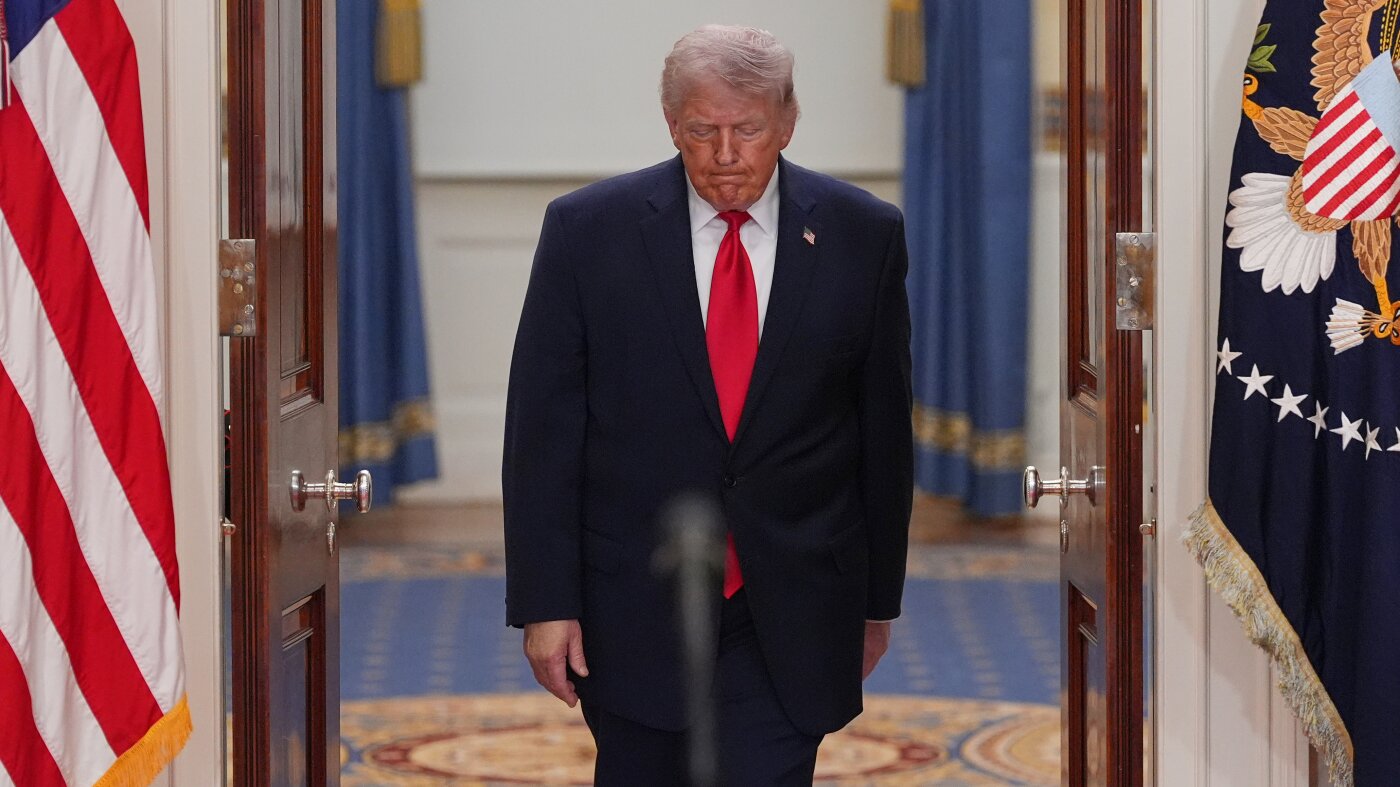
President Donald Trump arrives to speak about the Iran war from the Cross Hall of the White House on Wednesday, April 1, 2026, in Washington. (AP Photo/Alex Brandon, Pool)
Alex Brandon/AP Pool
hide caption
toggle caption
Alex Brandon/AP Pool
BOSTON — A federal judge has halted efforts by the Trump administration to collect data that proves higher education institutions aren’t considering race in admissions.

The ruling from U.S. District Court Judge F. Dennis Saylor IV in Boston on Friday granting the preliminary injunction follows a lawsuit filed earlier this month by a coalition of 17 Democratic state attorneys general. It will only apply to public universities in plaintiffs
The federal judge said the federal government likely has the authority to collect the data, but the demand was rolled out to universities in a “rushed and chaotic” manner.
“The 120-day deadline imposed by the President led directly to the failure of NCES (National Center for Education Statistics) to engage meaningfully with the institutions during the notice-and-comment process to address the multitude of problems presented by the new requirements,” Saylor wrote.
President Donald Trump ordered the data collection in August after he raised concerns that colleges and universities were using personal statements and other proxies to consider race, which he views as illegal discrimination.

In 2023, the Supreme Court ruled against the use of affirmative action in admissions but said colleges could still consider how race has shaped students’ lives if applicants share that information in their admissions essays.
The states argue the data collection risks invading student privacy and leading to baseless investigations of colleges and universities. They also argued that universities have not been given enough time to collect the data.
“The data has been sought in such a hasty and irresponsible way that it will create problems for universities,” a lawyer for the plaintiffs, Michelle Pascucci, told the court, adding that the effort seem was aimed at uncovering unlawful practices.
The Education Department has defended the effort, arguing taxpayers deserve transparency on how money is spent at institutions that receive federal funding.
The administration’s policy echoes settlement agreements the government negotiated with Brown University and Columbia University, restoring their federal research money. The universities agreed to give the government data on the race, grade-point average and standardized test scores of applicants, admitted students and enrolled students. The schools also agreed to be audited by the government and to release admissions statistics to the public.
The National Center for Education Statistics is to collect the new data, including the race and sex of colleges’ applicants, admitted students and enrolled students. Education Secretary Linda McMahon has said the data, which was originally due by March 18, must be disaggregated by race and sex and retroactively reported for the past seven years.
If colleges fail to submit timely, complete and accurate data, the administration has said McMahon can take action under Title IV of the Higher Education Act of 1965, which outlines requirements for colleges receiving federal financial aid for students.
The Trump administration separately has sued Harvard University over similar data, saying it refused to provide admissions records the Justice Department demanded to ensure the school stopped using affirmative action. Harvard has said the university has been responding to the government’s requests and is in compliance with the high court ruling against affirmative action. On Monday, the Education Department’s Office for Civil Rights directed Harvard to comply with the data requests within 20 days for face referral to the U.S. Justice Department.


Gov. Gavin Newsom declared a State of Emergency Saturday night as plumes of black smoke continue to rise from the Lineage Logistics warehouse fire, still burning on the 1400 block of South Los Palos Street in Boyle Heights.
The fire started inside a freezer area at the cold storage facility Wednesday afternoon and was initially extinguished before reigniting on Thursday, according to officials.
Newsom’s declaration allows the state to use additional funding for firefighting efforts, public health services and disaster recovery as Los Angeles continues to deal with the emergency.
“California is mobilizing to support Los Angeles as firefighters and emergency personnel continue their work to contain this fire and protect surrounding communities,” Newsom said in a statement Saturday. “While local officials continue to lead this response, the State of California is prepared to help safeguard public health, support emergency operations, and assist impacted residents. We are coordinating closely with our local partners, deploying specialized expertise, and pre-positioning critical supplies so communities have the support they need both now and throughout recovery.”
Although local officials have not asked for additional state resources at this time, Newsom preemptively made the declaration to provide the region with resources as soon as they are needed, California Governor’s Office of Emergency Services Director Caroline Thomas Jacobs said.
“Cal OES is working side-by-side with the City and County of Los Angeles and our regional partners to ensure they have the resources, information, and support necessary to respond to this incident,” Jacobs said. “The State of Emergency allows us to further streamline coordination efforts and leverage additional state capabilities as needed. Our focus remains on protecting communities and supporting locally led response operations.”
-
Smoke from Boyle Heights warehouse fire continues to blow over downtown Los Angeles on Saturday, June 20, 2026. (KTLA) -
A massive plume of toxic smoke is seen rising from a Boyle Heights cold storage facility fire on Wednesday, June 17, 2026. (KTLA) -
Crews work a warehouse fire in the Boyle Heights section of Los Angeles on Wednesday, June 17, 2026. (AP Photo/Jae C. Hong)


Resources available to Los Angeles following the declaration include:
- 5.5 million N95 respirator masks available for distribution to impacted communities.
- Commercial-grade air purifiers available for deployment to evacuation centers, community facilities, and other public spaces.
- Bottled water and other emergency supplies available through the state’s logistics network.
- Enhanced air quality monitoring and technical support resources.
Cal OES Fire and Rescue Branch leaders with specialized technical expertise are also available to consult L.A. fire officials on how to deal with the warehouse fire, if necessary. The state provided similar expertise to officials during the chemical tank failure in Garden Grove.
Air quality remains unhealthy in parts of Los Angeles due to the large amount of smoke produced by the fire.
“The warehouse fire has produced significant smoke and particulate matter that may affect air quality in surrounding neighborhoods,” the governor’s office stated. “To support public health monitoring efforts, the California Air Resources Board is coordinating with local and regional partners to ensure access to air quality information and technical expertise. State agencies continue to monitor conditions and stand ready to deploy additional monitoring resources if requested.”

The exterior of the Robert F. Kennedy Department of Justice building is pictured on May 4, 2021, in Washington, D.C.
Patrick Semansky/AP
hide caption
toggle caption
Patrick Semansky/AP
The Justice Department released a memo this week that quietly calls into question decades of civil rights protections for Americans with disabilities and stirred fear and anger among advocates and families.
The memo, an opinion from the Office of Legal Counsel, argues that states do not have to provide in-home or community-based care to people with disabilities who need support. These services allow many disabled Americans to continue to live, learn and work at home or in their own communities, among family and friends.
“It is now the position of the United States government that people with disabilities don’t have a right to be part of their communities,” says Alison Barkoff, a health law and policy professor at George Washington University who led disability law and policy efforts during both the Obama and Biden administrations. “I can’t overstate how significant this change in position is.“
Without the federal government requiring that states provide these services – to help disabled people integrate into their communities – advocates and legal experts warn that cash-strapped states could cut them and return to what was once common practice: de facto segregation of Americans with disabilities in nursing homes and large institutions.
Pushback from the disability community was swift.
“As America prepares to celebrate 250 years of independence, [this memo] threatens to drag our nation back to a dark and shameful era of ignorance and cruelty,” said the American Association of People with Disabilities. “This interpretation will open the doors for states to revert to warehousing people with disabilities out of sight and out of mind in institutions.”
“This opinion is a direct threat to decades of progress toward community living for people with disabilities,” said Shira Wakschlag of The Arc of the United States, a nonprofit disability advocacy group. “People with disabilities shouldn’t be forced into institutions because a state refuses to provide services in the community.”
The Justice Department did not respond to an NPR request that it explain its position as well as why it is changing course after decades of legal and bipartisan support for community services.
What the law says
This new memo calls into question what legal experts say has been settled law for decades.
Both Section 504 of the Rehabilitation Act and Title II of the Americans with Disabilities Act have long been interpreted to require that states provide services to Americans with disabilities in the most integrated setting appropriate. In short: Institutionalization should be a last resort.
In 1999, a case testing these protections made it to the U.S. Supreme Court. In Olmstead v. L.C., two women with mental disabilities sued Georgia, arguing that the state had failed its obligation to provide services that would allow them to return to their communities and that it had continued to institutionalize the women instead, thus violating their civil rights.
The court agreed that states have a legal responsibility to provide support that integrates disabled Americans into their communities, and for nearly three decades, courts across the country have embraced that interpretation.
By 2023, 8.4 million Americans were receiving home- and community-based services through Medicaid.
The new memo, written by Lanora Pettit, principal deputy assistant attorney general in the Office of Legal Counsel, argues that, while federal law prohibits discrimination on the basis of disability, it does not impose an “integration mandate” on states to provide these community services.
What’s more, the memo argues, the Supreme Court’s Olmstead decision “held only that a state cannot institutionalize such patients without justification.”
But, the memo adds: “What counts as adequate justification remains an open question.”
At one point, Pettit acknowledges the novelty of this reading: “We recognize that this view of Olmstead‘s import is out of step with the common understanding of that decision within the federal courts.”
Why it matters
“The United States government since 1977 has taken the position that [federal law] includes an integration mandate that requires services to be provided in the most integrated setting appropriate,” says professor Barkoff, who worked in the Obama Justice Department leading its Olmstead enforcement efforts.
For decades, Barkoff adds, both Republican and Democratic administrations, including the first Trump administration, proactively enforced federal disability law and repeatedly brought actions against states that relied too heavily on care in large, segregated settings that the law says should be a last resort.
The courts and Congress decided institutionalization should be a last resort because people’s personal liberty is at stake, says Jennifer Mathis of the Bazelon Center for Mental Health Law: “Who you can see, when you can go out, when you eat, what you eat. Who your roommate is, who you talk to, what your environment is. And for so many people who are institutionalized, their life is literally a hallway. I have been on those hallways with people. It is deadening.“
This memo signifies a dramatic change in the U.S. government’s official position.
“We are incredibly concerned that the message coming from the federal government in this memo is, ‘It’s fine to go back to the days that people were placed in institutions,’ even though they can be served in the community, even though they want to be and even though it’s more cost-effective,” Barkoff says.
The timing matters too. The memo arrives as a new case, Texas v. Kennedy, is making its way through the courts. The case, brought by Texas and several other states, is essentially a fresh challenge to the integration mandate on states.
With this memo, the federal government is aligning itself with the plaintiffs in the case. Though Mathis cautions: “It’s important to understand that [this memo] is not the law, that the Justice Department can’t change the law. Congress makes laws, not agencies.“
For now, it’s not clear what the immediate impact of the memo will be, though it seems the Justice Department will stop its enforcement efforts around Olmstead.
Why now?
The Justice Department memo appears to be the latest salvo in a broader effort that began on July 24, 2025, when President Trump issued an executive order intended to make it easier for state and local governments to police homelessness.
“Endemic vagrancy, disorderly behavior, sudden confrontations, and violent attacks have made our cities unsafe,” the order argues, going on to claim that “the overwhelming majority of these individuals are addicted to drugs, have a mental health condition, or both.”
The administration’s solution: Involuntary institutionalization. “Shifting homeless individuals into long-term institutional settings for humane treatment through the appropriate use of civil commitment will restore public order,” the order reads.
In a 2023 campaign video, President Trump himself pledged: “For those who are severely mentally ill and deeply disturbed, we will bring them back to mental institutions, where they belong.”
A conservative Texas think tank, the Cicero Institute, has been a driving force behind recent efforts to forcefully combat homelessness, including through institutionalization.
One serious obstacle to large-scale institutionalization of the unhoused is federal disability law that has long required home- or community-based services instead, when appropriate. A footnote in the Justice Department’s new memo appears to suggest these laws have contributed to the rise in chronic homelessness.
To the contrary, Barkoff says, the Olmstead decision “has been one of the most effective tools in providing services and stable housing to people who are homeless.”
NPR has previously reported that the Trump administration’s push for institutionalization faces another big obstacle: An acute shortage of beds at these specialized facilities.
The memo arrives as Republicans have also passed deep cuts to Medicaid, which is the primary source of funding for community-based services many disabled Americans rely on.
Multiple legal experts tell NPR that, in response to last year’s One Big Beautiful Bill Act, states must now make deep cuts to a whole range of services previously funded by Medicaid. The Trump administration’s memo, they add, essentially gives states permission to cut these localized supports and, instead, rely on institutionalization – even though research shows the latter is considerably more expensive for states to provide.
This comes as disability advocates were already pushing back against the Trump administration’s announcement on Tuesday that it would move federal administration of special education programs out of the Department of Education and into the Department of Health and Human Services – a change that, as with the new Justice Department memo, raised fears of a rollback of the enforcement of longstanding civil rights protections.

new video loaded: The Sacred Catholic Site Where Trump Wants a Border Wall

The Trump administration is trying to seize the land around Mount Cristo Rey, a sacred site of Catholic pilgrimages, in order to build a border wall on it. The Times reporter Reis Thebault takes us up the mountain to see the 30-foot statue of Jesus at the top, and the border wall below.
By Reis Thebault, Christina Shaman, Jon Miller, June Kim and Melanie Bencosme
June 20, 2026
-

 Health2 minutes ago
Poison centers link growing Benadryl abuse among teens to dangerous social media trends
-

 Sports9 minutes ago
Bryce Harper hits for cycle, Kyle Schwarber blasts three homers in Phillies blowout win over Mets
-

 Technology11 minutes ago
Meta offers paid training for AI data center jobs
-
 Business17 minutes ago
‘I got crushed’: AI giants are funding ad wars in races across the country
-
 Entertainment24 minutes ago
A fake mountain and real magic transform Paris’ oldest bridge
-
Lifestyle26 minutes ago
Day 1,578 of WW3: The UN Security Council will meet on Monday to address Russia's latest strikes on cultural and religious sites, including the attack on Kyiv-Pechersk Lavra. ANGH, of course. This is your Saturday Ukraine discussion
-
 Politics32 minutes ago
Can a new commission remedy California’s public defender crisis?
-
Sports42 minutes ago
2026 World Cup guide: Full TV schedule, game previews, results and standings


