Movie Reviews
5 takeaways from an Oscars night that spread the love

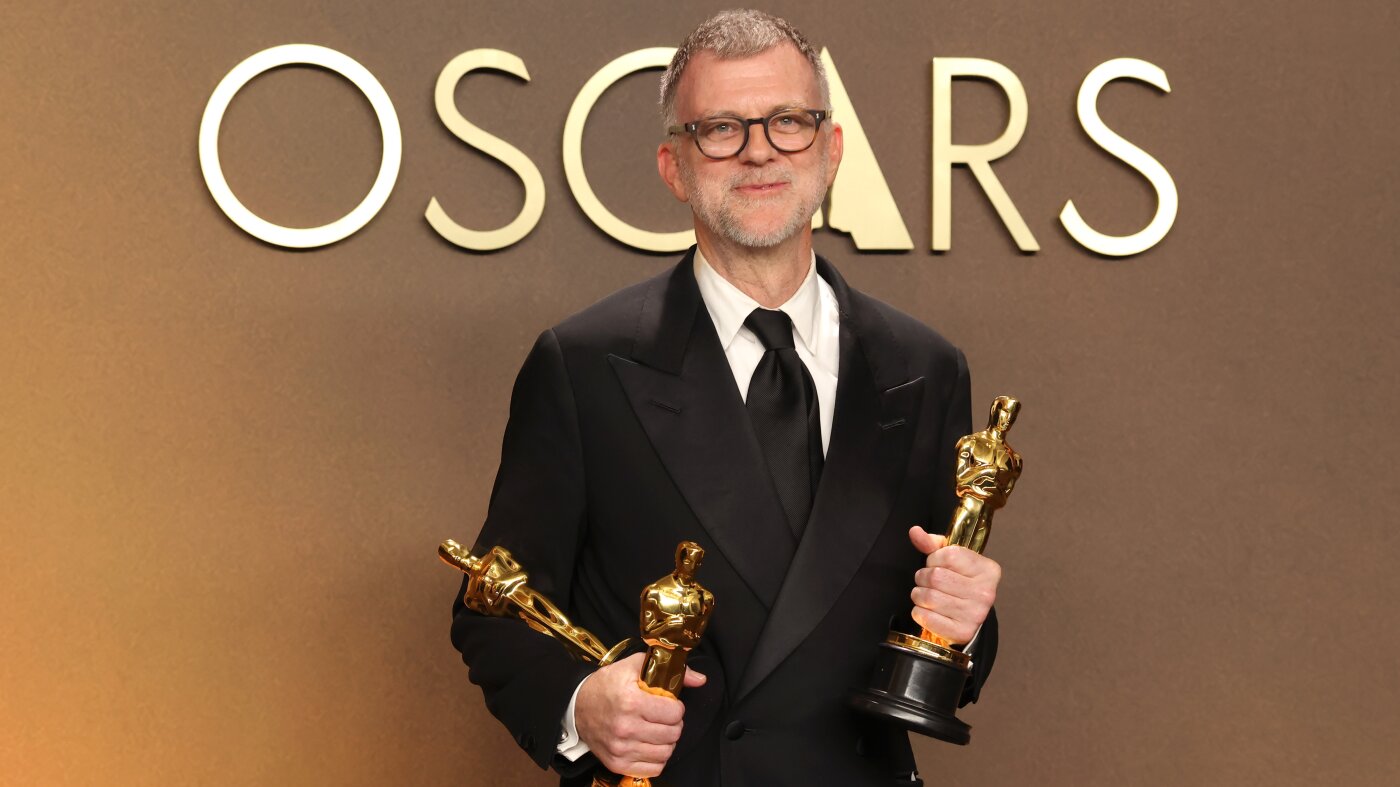
Paul Thomas Anderson holds his Oscars for best adapted screenplay, best director and best picture for One Battle After Another.
Mike Coppola/Getty Images
hide caption
toggle caption
Mike Coppola/Getty Images
As Sunday’s Oscars ceremony approached, it seemed to be shaping up to be a showdown between the vampires and the revolutionaries, between Sinners and One Battle After Another. In the end, One Battle After Another won both best picture and best director, but it was a very good night for Sinners, too, including an original screenplay award for writer and director Ryan Coogler.

There were some surprises over the course of the evening, including a rare tie in the live action short category, a remembrance of Robert Redford that included Barbra Streisand singing a bit of “The Way We Were,” and Jimmy Kimmel stepping in just long enough to make some pointed comments about media censorship. But let’s go over some of the major takeaways.
A celebrated director gets his Oscar.

Paul Thomas Anderson won best director for One Battle After Another after three previous nominations for There Will Be Blood, Phantom Thread and Licorice Pizza. Anderson had already won several major Oscar precursor awards this year, including top directing prizes at the BAFTAs and from the Directors Guild of America, so he was the odds-on favorite. The other nominees in the category were relative newcomers: Ryan Coogler, Josh Safdie and Joachim Trier were all first-time directing nominees; Chloé Zhao was nominated (and won) for Nomadland at the ceremony in 2021.
Michael B. Jordan won a rare acting award for a genre movie.

Michael B. Jordan won best actor for his portrayal of twin brothers in Sinners.
Brianna Bryson/Getty Images
hide caption
toggle caption
Brianna Bryson/Getty Images
Sinners is a drama, but it’s also very much a genre film. It’s horror. It’s vampires. Those are not the kinds of films that most often win Oscars for actors. But Jordan, with his first nomination, won over performers from much more traditionally awards-friendly films. Three of those actors (Leonardo DiCaprio, Timothée Chalamet and Ethan Hawke) already had multiple acting nominations before this year.

The last actor to win for a genre film might have been Joaquin Phoenix for Joker, since that was technically a comic-book movie, but that one did away with most of its genre trappings and pressed itself into a dramatic mold, which Sinners emphatically does not. Before that, while definitions of genre aren’t bright lines, you might have to go all the way back to … Anthony Hopkins in The Silence of the Lambs, if you consider that horror? Maybe even further? At any rate, it’s a great win for an actor who has been beloved at least since The Wire almost 25 years ago, who’s been doing rich and varied work ever since. His victory is also a win for his lengthy and fruitful collaboration with Ryan Coogler in Sinners, but also in Fruitvale Station, Creed and Black Panther.
Amy Madigan, the award-winning straight-up monster.

Amy Madigan won best supporting actress for her performance in Weapons.
Arturo Holmes/Getty Images
hide caption
toggle caption
Arturo Holmes/Getty Images
(We don’t mean Amy Madigan the person, of course.) Madigan won best supporting actress for her deeply unsettling and entirely singular performance as Aunt Gladys in Weapons, which is even more fully a horror movie than Sinners. While the nominated cast members from Sinners — Jordan, Delroy Lindo and Wunmi Mosaku — play regular people who are swept into an unreal situation, Madigan is playing, essentially, the boogeyman (boogeywoman?). It’s thrilling to see the Academy recognize a performance that is as weird and funny and scary as just the last few minutes of what Madigan does in Zach Cregger’s terrifying story of a town that sees a whole classroom full of its children disappear.
The casting Oscar makes its debut.

Cassandra Kulukundis won the Academy’s first award for achievement in casting for her work on One Battle After Another.
Frazer Harrison/Getty Images
hide caption
toggle caption
Frazer Harrison/Getty Images
This was the first year that there was an Oscar for casting, which is very much overdue — there have been casting Emmys for ages. It was easy to argue for any of the nominated casting directors. Marty Supreme and The Secret Agent both deploy nontraditional actors in some roles, Sinners and One Battle both use a wide variety of well-known and well-regarded stars in interesting ways, and Hamnet places most of the weight of an enormously heavy story on the shoulders of just a couple of performers, including best actress winner Jessie Buckley.

Cassandra Kulukundis, who won for One Battle After Another, not only has been working with Paul Thomas Anderson for ages, but she also worked on casting (get this) for both The Brutalist and Harold & Kumar Go To White Castle. But all the nominees have tremendous resumes. Francine Maisler, who was nominated for Sinners, was the credited casting director for Arrival, Creed, Baby Driver, Widows, and Challengers! Honestly, the biggest problem in the category was that everybody couldn’t win.
A first in the cinematography category.

Autumn Durald Arkapaw accepts the award for best cinematography for Sinners.
Patrick T. Fallon/AFP via Getty Images
hide caption
toggle caption
Patrick T. Fallon/AFP via Getty Images
Autumn Durald Arkapaw, who won best cinematography for her work on Sinners, was only the fourth woman, and the first woman of color, to be nominated in the category. She becomes the first woman to win. Sinners is a sumptuously, inventively, beautifully shot film, and the cinematography is one of the core crafts that makes it so effective.



Rose of Nevada is a genuinely poetic movie that pushes the boundaries of the Groundhog Day-style time-travel narrative while carving out an identity completely its own. Rather than relying on the familiar mechanics that audiences have come to expect from the genre, the film approaches the concept through a more reflective and emotional lens. The result is a movie that feels thoughtful, ambitious, and surprisingly moving.
It makes a huge on-screen presence felt through its cast, particularly George MacKay and Callum Turner, who both deliver performances that elevate the material beyond a simple science-fiction premise. Combined with breathtaking visuals and a strong directorial vision, Rose of Nevada becomes something far more memorable than many of its genre contemporaries.
George MacKay continues to prove why he is one of the most compelling actors working today. Following his acclaimed work in 1917, he once again demonstrates an ability to carry a film through sheer presence and emotional authenticity.
Every scene feels grounded because of his performance, even when the story ventures into more abstract territory. Alongside him, Callum Turner delivers what could easily be viewed as a breakout performance. The chemistry between the two leads helps anchor the film, allowing audiences to connect with the characters even as the narrative challenges conventional storytelling expectations.
One of the film’s greatest strengths is its visual presentation. The cinematography is nothing short of earth-shattering. Nearly every frame looks like a carefully crafted painting, capturing both the beauty and mystery of the world these characters inhabit. There is a dreamlike quality to the imagery that perfectly complements the film’s themes of time, memory, and destiny.
The camera lingers on landscapes just long enough to allow viewers to soak in their beauty without ever slowing the pace. It’s the kind of cinematography that demands to be appreciated on the largest screen possible.
Director Mark Jenkin continues to establish himself as one of the most distinctive voices in modern British cinema. Following the atmospheric and haunting Enys Men, Jenkin once again crafts a story that feels deeply connected to folklore and place.
The British backdrop becomes a character in itself, with rugged coastlines, open landscapes, and isolated locations contributing to the film’s unique atmosphere. His direction never feels showy or excessive; instead, he trusts the audience to absorb the experience and interpret its deeper meanings.
What makes Rose of Nevada especially fascinating is how it recalls classic time-travel films without simply copying them. There are moments that evoke the spirit of The Final Countdown, particularly in the sense of wonder and uncertainty surrounding the temporal elements.
Yet the film remains firmly rooted in its own identity, focusing more on emotion and introspection than spectacle. It invites viewers to engage with its ideas rather than simply consume them.
This is also one of those rare films that benefits from reflection after the credits roll. It is not a movie designed to provide easy answers. Instead, it lingers in the mind, encouraging discussion and interpretation. The more time you spend thinking about it, the more rewarding it becomes. Much like a fine wine, Rose of Nevada continues to improve with age, revealing new layers and details upon reflection.
Overall, Rose of Nevada is a beautiful, ambitious, and visually stunning piece of filmmaking that deserves to be experienced on the big screen. Powered by exceptional performances, remarkable cinematography, and confident direction, it stands as one of the more unique takes on time travel in recent memory.
Overall Grade: 4/5 Stars

James Gunn isn’t exactly crushing it.
Named co-chairman and chief executive officer of the newly formed DC Studios in 2022, the “Guardians of the Galaxy” filmmaker wrote and directed the division of Warner Bros. Discovery’s largely disappointing “Superman,” released last year.
This week, DC Studios’ second big-screen affair, “Supergirl,” lands in theaters with similarly underwhelming results.
‘Superman’ review: James Gunn gets DCU off to rocky, overstuffed start
Starring Milly Alcock as the movie’s namesake Kryptonian heroine — who also goes by Kara Zor-El and is the cousin of David Corenswet’s Superman/Clark Kent/Kal-El — “Supergirl” isn’t distractingly zany the way its 2025 sister film was. Instead, it’s tonally boring, a chore of a movie chock full of thinly drawn characters and increasingly bombastic and violent.
To be clear, Gunn isn’t at the helm for “Supergirl.” Instead, it’s the typically dependable Craig Gillespie (“I, Tonya,” “Cruella”), working from a script by Ana Nogueira, making her less-than-impressive feature-writing debut.
This planet-hopping adventure in the new DC Universe isn’t a complete space wreck, however, thanks largely to the spunky performance by Aussie Alcock, best known for portraying the younger Rhaenyra Targaryen in the early episodes of HBO’s “House of the Dragon.”
When we catch up with Kara, she’s basically as we left her late in “Superman”: a super-sized mess. She’s out with her beloved, rambunctious dog, Krypto — the peppy and powerful pup having already been a major player in “Superman” — and enjoying a 23rd-birthday pub crawl among planets under a red sun. (Quick reminder: Supergirl, like Superman, draws her incredible powers from a yellow sun, like Earth’s, so she’s at least vaguely normal under a red sun and, importantly, can become intoxicated. The color of suns is a major factor throughout “Supergirl,” and it’s the movie’s most inventive narrative element.)
It is on such a world where a drunken Kara encounters 13-year-old Ruthye Marye Knoll of the Danastia Clan (Eve Ridley), whose family has just been brutally slain by the ruthless Krem of the Yellow Hills (Matthias Schoenaerts). Understandably, Ruthye wants revenge against Krem — leader of the Brigants, a band of male pirates and traffickers — and can think of little else.
She’s offering anyone who will help a sword made by her family of skilled weapons makers. The beyond-buzzed Kara isn’t interested, but she gets involved when a scumbag type tries to take the sword. She continues to do her best to fend off Ruthye’s subsequent pleas for assistance in her quest to kill Krem, but when the baddie — in the process of stealing her floating RV of a spaceship — shoots a charging Krypto with a poison dart, Kara has designs on punishing him, too. In fact, she needs to retrieve the specific antidote Krem carries with him to save her four-legged bud.
And so the gals are off to other worlds, initially traveling via the space equivalent of a beat-up Greyhound bus, on which they run into a trio of pillaging Sklarian Raiders. The sequence in which Kara retrieves stolen possessions and extracts information from them is as zany as “Supergirl” gets.
As their trek through the stars warps on, Kara and Ruthye encounter Lobo (Jason Momoa, seemingly leaving his Aquaman character back in the defunct DC Extended Universe), a rough-and-tumble, motorcycle-riding bounty hunter. They team up — sort of, eventually — but their alliance of convenience is one of the flick’s myriad plot threads that fail to tie into a sturdy knot.
The screenplay by Nogueira — an actor who’s penned a pair of plays — attempts to explore why Kara is so jaded by taking us back to her childhood in the Kryptonian city Argo, protected by her father’s tech after the planet’s demise. Of course, that protection proved to be temporary, or she wouldn’t have eventually been sent to Earth like her cousin before her. It’s lukewarm fare, with Kara eventually learning the familiar Spider-Man lesson — with great power comes great responsibility.
Gillespie adds a few nice touches from the director’s chair throughout the movie, but they’re too little to elevate the proceedings.
Again, Alcock — whose credits also include the recent Netflix limited series “Sirens” — does what she can with the material. It’s a demanding role, as she is on screen for most of the movie, and is spirited in it.
Unfortunately, the lesser-known Ridley — making her feature debut following a few television appearances — is given even less to work with. We never learn much about the one-note Ruthye beyond that her family was killed in her presence and that she is really upset about it.
If you’re expecting the always-lively Momoa to save the day, he brings his larger-than-life presence to Lobo, but the demon-like figure isn’t very interesting. A mix between Aquaman and his Khal Drogo from “Game of Thrones,” the longtime DC Comics character isn’t anything you wouldn’t expect here.

If there’s another bright spot in the cast, it’s Schoenaerts (“Rust and Bone,” “The Old Guard”), who brings a touch of nuance to the villainous Krem. You may have expected a bigger name to play the big bad in this second DC Universe big-screen effort, but some of the acting choices the Belgian makes keep things vaguely engaging when he’s within the frame.

Sadly, vaguely engaging is the best “Supergirl” can manage.
We’ll see if Gunn can turn things around, starting with the HBO series “Lanterns” in August and the horror-tinged film “Clayface” in October, before he returns to direct Corenswet, Alcock and the rest of the “Superman” gang in “Man of Tomorrow,” arriving a little more than a year from now.
We’re hoping for super results, but, at this point, it’s tough to say we’re expecting them.
‘Supergirl’
Where: Theaters.
When: June 26.
Rated: PG-13 for sequences of strong violence, action, language, and smoking.
Runtime: 1 hour, 48 minutes.
Stars (of four): 2.

In the Hand of Dante, 2025.
Directed by Julian Schnabel.
Starring Oscar Isaac, Gal Gadot, Gerard Butler, John Malkovich, Louis Cancelmi, Sabrina Impacciatore, Benjamin Clementine, Martin Scorsese, Al Pacino, Franco Nero, Jason Momoa.
SYNOPSIS:
A handwritten manuscript of Dante Alighieri’s poem “The Divine Comedy” makes its way from a priest to a mob boss in New York City, where it is taken by Nick Tosches after he’s asked to verify its authenticity.

Outrageously ambitious with an absurd narrative that veers between slick scuzzy fun and philosophically snoozy, the key issue with co-writer/director Julian Schnabel’s excessively long In the Hand of Dante is that it’s more engaging as a dopey early 2000s crime thriller about mobsters employing the services of novelist Nick Tosches (also the writer of the novel the film is based on, inserting himself into it as a fictional character, here played by Oscar Isaac in the adaptation by Schnabel and Louise Kugelberg) and Dante Alighieri specialist to steal the recently unearthed original manuscript of his 14th-century masterwork The Divine Comedy from Italian priests than it does as its other side to that coin, a flashback story about the creation of that story complete with actors portraying secondary characters to eventually get at some points about reincarnation.
This means that the film mostly begins with Oscar Isaac entangled in a web of crime alongside slur-slinging, trigger-finger-happy Louie (in what might be the best performance of Gerard Butler’s career, despite the steep drop in quality in the second half), John Malkovich as a mob boss seeing nothing but dollar signs if they can get a hold of the original manuscript, authenticate it, and sell it on the black market, and even Al Pacino popping up for a scene and stealing it set during Nick’s childhood following a violent incident that is so bonkers readers might not believe it even if I typed it out here, to something close enough to a mess culminating in a confrontation between the excellent Oscar Isaac and the shudderingly bad Gal Gadot and Jason Momoa in important roles, the former a lover placed in danger to the mob by her proximity to Nick, and the latter a greedy killer in a relationship with literary historian Dr. Susanna Pulice (Sabrina Impacciatore).

Martin Scorsese also appears in the 14th-century section (for someone who loves to assert what real cinema is vs cinematic theme park rides, he has now appeared in 3 mediocre-to-terrible movies this year), offering sage-like advice to Dante (also Oscar Isaac) in a hilariously over-the-top beard piece. Much of this is a mental journey, but also has something to do with Pope Boniface VIII (also Gerard Butler) placing the Mark of Cain on Dante following a falling out, the writer’s inability to find inspiration in his current lover Gemma Donati (also Gal Gadot) compared to his first love Beatrice, executed in stark contrast from the much more accessible and palatable modern day crime story. A blunter way to put it is that any time the film shifts to these flashbacks, it’s quite boring and never finds a sense of rhythm, drive, or purpose.
Unquestionably, some of this is by design and baked into other elements of the presentation, which includes flashbacks only receiving color as a means of implying that they were more enriching days for artistic freedom and integrity, compared to the black-and-white 2000s material that further homes in on greed and only financial gain for a manuscript no one even knows how to price if it turns out to be authenticated. Expanding on that thought, there are certainly no qualms to be had with the striking cinematography from Roman Vasyanov.

The other encroaching thought here is that, for as carefully considered as the film looks and as captivating as about half the performances are (we truly do not need to talk anymore about Gal Gadot and Jason Momoa, neither of whom can deliver convincing accents without eliciting laughs), it’s not going anywhere interesting, especially once the mobsters exit the narrative. Technically, they are replaced by a hitman, although a lengthy amount of time is spent watching Nick fly around the world for different aspects of the identification process, sometimes involving technology that even he doesn’t understand and tunes out of. In the novel, there appears to be a greater emphasis on Nick’s inner thoughts about the current state of the art world and on finding flaws in classic works or restrictive prose, which is alluded to here but not interrogated enough to emerge as a compelling element. It’s enough to make one wonder what else was lost in translation from the book.
The filmmakers seem to think the romantic subplot will sustain intrigue for the second half, but it’s devoid of emotion and comes across as aimless in the 14th-century portion. At a certain point, one simply longs for a more focused movie about mobsters stealing recently discovered historic manuscripts for profit; it’s far more fun and amusing than the rest of the sluggish, artfully tedious In the Hand of Dante. No one here seems to realize that this should be a comedic crime caper, and it works that way until it takes itself far too seriously, with flashbacks that bore rather than provide insight or meaningful context.
Flickering Myth Rating – Film: ★ ★ / Movie: ★ ★ ★
Robert Kojder
https://www.youtube.com/watch?v=embed/playlist
-

 Los Angeles, Ca1 hour ago
Boyle Heights warehouse cleanup begins as crews face 85 million pounds of spoiled food
-

 Detroit, MI1 hour ago
Would Detroit Lions Salary Cap Be Wrecked If Terrion Arnold Gets Cut?
-

 San Francisco, CA2 hours ago
Two more Presidio Heights homes reach $10M range as luxury supply dwindles
-

 Dallas, TX2 hours ago
One Dallas Cowboys Contract That Will Age Poorly in 2026
-

 Miami, FL2 hours ago
Live updates: Today’s South Florida News
-
 Boston, MA2 hours ago
A federal judge in Boston has blocked parts of Trump’s order to limit voting by mail
-
 Denver, CO2 hours ago
Denver Transplant Games sets Guinness World Record for most living donors, recipients in one place at one time
-

 Seattle, WA2 hours ago
17-year-old boy shot in High Point, multiple suspects seen running from crashed car

