West
Iran-born winemaker ‘thrilled’ to be in US after fleeing country where alcohol is outlawed

NEWYou can now listen to Fox News articles!
FIRST ON FOX — As scrutiny of Iran’s leadership intensifies amid renewed attention, an Iranian-born Oregon winemaker told Fox News Digital his homeland “could progress” if the regime falls.
Moe Momtazi, founder of Maysara Winery in Oregon’s Willamette Valley, fled Iran in 1982. Today, as an American citizen, he runs one of the world’s top-ranked vineyards.
Alcohol is banned in modern Iran under Islamic law, but Momtazi has built a globally recognized wine business in the United States.
Maysara Winery means “house of wine” in Farsi. It currently ranks No. 23 worldwide.
“If this regime is gone, we could progress and be the pride of the Middle East,” said Momtazi, 74.
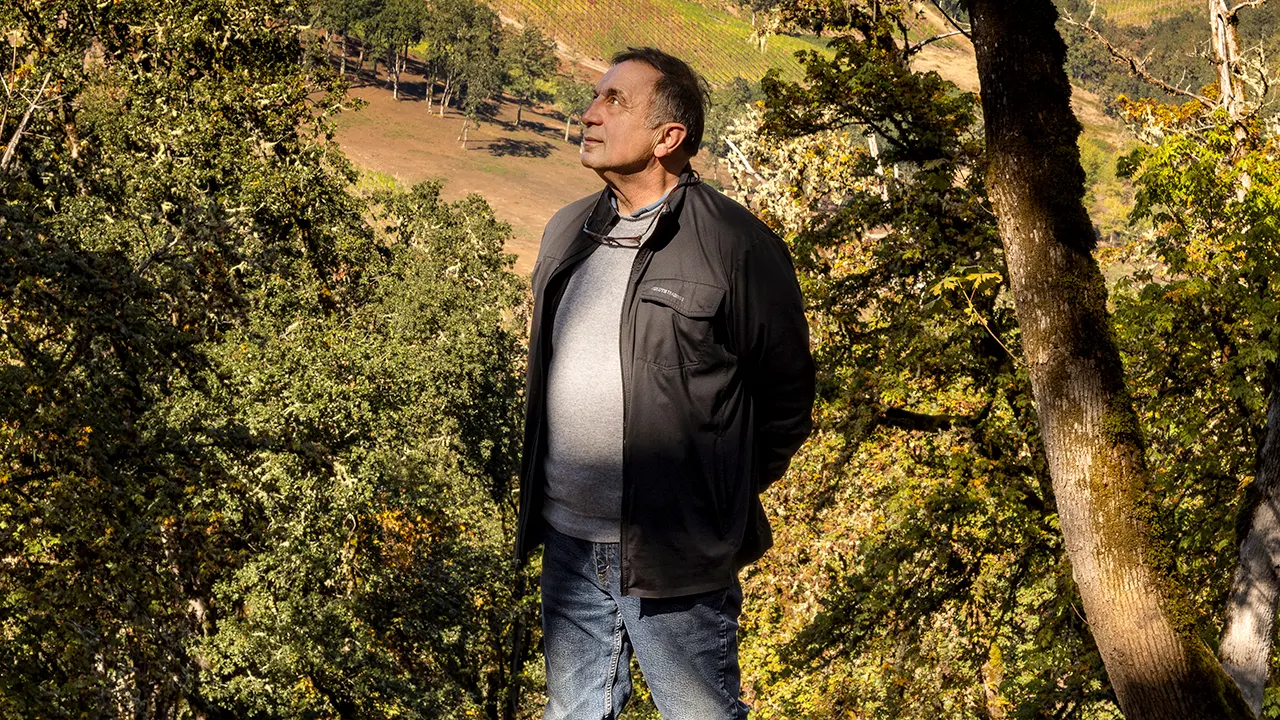
Moe Momtazi was born in Iran and later became a United States citizen. He owns Maysara Winery in Oregon, home of one of the world’s top vineyards. (Direct Wines Inc.)
Iran’s restrictions on alcohol date back to the Islamic Revolution in 1979, when religious authorities outlawed production and sale for most citizens.
“In Persian culture, wine has been and still is a very key component of society,” Momtazi said.
TEXAS WINERY BEATS NAPA ELITES WITH SMALL-TOWN SAVVY AND TOP-NOTCH TASTE
He, his wife and their three daughters see the family business as a continuation of that legacy, thousands of miles from their ancestral homeland.
Momtazi’s 98-year-old mother still lives in Tehran, as do two of his brothers.
Momtazi, center, poses for a photograph with his wife, second from left, and the couple’s three daughters at the family’s Oregon vineyard. (Karissa Williams Photography)
His middle daughter, Naseem Momtazi Bachinsky, told Fox News Digital she’s communicated with her mother’s relatives in Iran — and they’re all safe.
Momtazi left Iran with his wife, Flora, who was eight months pregnant at the time with their oldest daughter, in 1982. Tahmiene Momtazi was born later that year in Spain.
“We had a really hard journey to get to the United States, but I’m really thrilled and happy that we did leave from there because, even then, life was unbearable for us,” he recalled.
NAVY VET-TURNED-WINEMAKER INFUSES MILITARY GRIT INTO POWERHOUSE POURS
It would be more than two decades before he returned to visit family.
Despite the distance, the Momtazi family’s success in America is something their relatives back home celebrate.
“They’re very proud of us, which makes me proud that they’re proud of what we’re doing and what we’ve created,” said Momtazi Bachinsky, who is also president of sales.
Moe and Flora Momtazi are pictured in their native Iran before they got married and settled in the United States. (Momtazi Family)
Wine, they pointed out, is part of a cultural heritage that stretches back thousands of years — one that predates modern political divides. Persian poets wrote about wine as a symbol of joy, reflection and even spiritual connection, Momtazi said.
For the Momtazi family, producing wine in America is both an expression of gratitude and a nod to history.
“We’re just really lucky and thrilled to be in this country.”
“The United States is not second to any other country, and we’re just really lucky and thrilled to be in this country,” Momtazi said.
Momtazi Bachinsky, who was born in the U.S., said her parents raised her with a simple principle.
“Add value to where you are and who you are,” she said.
Naseem Momtazi Bachinsky, left, told Fox News Digital her mother and father, shown at right, raised her with the following principle: “Add value to where you are and who you are.” (Fox News Digital)
That mindset shaped the winery — and their outlook on Iran’s future.
“I want freedom … for the people to be able to make their own choices and to be able to do what they want,” Momtazi Bachinsky said.
CLICK HERE FOR MORE LIFESTYLE STORIES
She remembers first visiting Iran and being upset that she was forced to wear a hijab while she was there.
Moe and Flora Momtazi share a dance on their wedding day, Aug. 2, 1981, in Iran. (Momtazi Family)
“I want women and girls to be able to make that choice without a fear,” she said.
CLICK HERE TO DOWNLOAD THE FOX NEWS APP
She’s also hopeful that Iran will become a country that is welcoming to all religions.
Pictured in his vineyard, Momtazi hopes for a better future for his native land as he feels “lucky and thrilled” to be able to pursue the American dream in Oregon with his family. (Direct Wines Inc.)
“I’m personally not Islamic. I don’t have ties to the religion, but it’s not the religion that [is] making people bad,” she said.
“There are certain leaders [who] are using the religious aspect as a power mechanism. And that is what has been bad for the root of that country.”
TEST YOURSELF WITH OUR LATEST LIFESTYLE QUIZ
Noted Moe Momtazi about what’s happened in Iran amid Operation Epic Fury, “I couldn’t be happier that the head guy has been put out, because finally somebody had the guts to interfere. … We’ve gone through so many things over 40-some years.”
As Maysara Winery celebrates American opportunity, the Momtazi family said it hopes the Iranian people can soon raise a glass in the name of freedom.
Related Article

Read the full article from Here



Oregon Attorney General Dan Rayfield and attorneys general from 11 other states filed a lawsuit Monday seeking to block Paramount Skydance Corp.’s proposed $110 billion acquisition of Warner Bros. Discovery, arguing the merger would reduce competition and ultimately raise costs for consumers.
The lawsuit, filed in the U.S. District Court for the Northern District of California, alleges the merger violates the Clayton Act by substantially lessening competition in the film and television industries.
California, Arizona, Colorado, Connecticut, Massachusetts, Minnesota, Nevada, New Jersey, New Mexico, New York and Washington are the other states involved in the lawsuit.
The coalition said it is prepared to seek a temporary restraining order if the companies do not pause the deal as the case moves forward.
“If this massive corporate merger is allowed to go through, Oregonians will pay the price – through higher bills, fewer jobs, less choice at the box office, and fewer editorial voices,” Rayfield said in a press release on Monday. “Despite the federal regulators rubber-stamping this bad deal, we’re stepping up to protect families, small businesses, and Oregon’s film industry.”
READ ALSO | Warner Bros shareholders back $81B Paramount takeover in preliminary vote
According to the lawsuit, the combined company would control nearly one-third of U.S. theatrical film distribution and basic cable programming. The states argue the merger would eliminate competition between two of Hollywood’s five major film distributors and two of the nation’s five largest basic cable companies.
The complaint alleges the merger would reduce competition in theatrical film distribution, blockbuster movie releases and licensing basic cable television channels.
The filing follows Oregon’s investigation into the proposed merger. In early July, Rayfield asked a Multnomah County judge to compel Paramount to produce records the state said it had sought since June, including documents related to the company’s lobbying of the White House and U.S. Department of Justice.
“Paramount has already shown that they think they’re above the law by refusing to comply with Oregon’s investigation,” Rayfield said. “This litigation is the next step to protect Oregonians before irreparable harm is done.”
The U.S. Justice Department isn’t challenging the deal — and instead released an unusually lengthy statement in support, maintaining a Paramount-Warner combo would “increase competition across the media and entertainment ecosystem, with benefits for American consumers and workers,” according to a report from the Associated Press.
In a statement sent out on Monday, Paramount said the lawsuit “distorts settled antitrust law” and maintained its merger would create a “stronger competitor against dominant streaming and technology platforms who have harmed the market for theatrical exhibition and jobs in the entertainment industry.” Paramount went on to say it will “vigorously defend” the transaction.

This story was adapted from a radio broadcast script using artificial intelligence. Every story, including those adapted with AI, is reviewed by a human editor before publication to ensure that KSL’s editorial standards are upheld.
SALT LAKE CITY — As Utah looks for ways to meet growing electricity demand from data centers, artificial intelligence, manufacturing and population growth, nuclear energy has become part of the state’s energy conversation.
Gov. Spencer Cox has said Utah must embrace nuclear energy if it wants to meet surging electricity demand and remain competitive in the global economy.
“And as I’ve said many times, if you are serious about energy abundance, you have to be serious about nuclear energy,” Cox said.
Much of that demand is being driven by artificial intelligence data centers, which require enormous and reliable power supplies. Proponents say small modular reactors are the answer — offering stable, carbon-free electricity that traditional renewables struggle to match.
Critics, including downwinders and environmental advocates, said Utah’s history with radiation exposure should make state leaders more cautious.
Listen to parts one and two of the nuclear energy reporting on KSL News Daily below.
Advocates tout nuclear reliability and clean air benefits
John Kotek, senior vice president of policy and public affairs at the Nuclear Energy Institute, said nuclear power’s fuel cycle gives it an edge over fossil fuels.
“Once you fuel a nuclear reactor, it’ll run between 18 and 24 months before you have to shut it down and put new fuel in it,” Kotek said. “So you’re not dependent on shipments of coal or gas in a pipeline or what have you.”
Kotek added that nuclear energy produces no carbon emissions or air pollutants, saying it has “a real role to play in cleaning up air quality in the West.”
Dr. Tatjana Jevremovic, director of the nuclear lab at the University of Utah, said the math also favors uranium.
“The amount of energy you get out of a kilogram of uranium is about 10,000 times the amount of energy you get out of a kilogram of coal or petroleum,” Goodell said. “And also it is an energy source that has basically zero carbon emissions along with it.”
Environmental, health groups raise alarms
Not everyone is convinced the benefits outweigh the risks. Carmen Valdez, a senior policy associate at Heal Utah, said co-locating reactors with data centers creates compounding dangers.
“If something were to catch on fire, if something were to fail, you are now accumulating a lot of issues as well as creating toxic spaces,” Valdez said. “If we’re concerned about the cancers coming from data centers, what is the concern about a data center with a nuclear reactor, with spent fuel, on site?”
Valdez urged state lawmakers to invest instead in resources Utah already has in abundance.
“We are extremely equipped for solar. Maybe we should start looking at rooftop solar for our large communities and consumers,” Valdez said. “We have battery storage. We have so many opportunities.”
Waste disposal remains unresolved
Even nuclear supporters acknowledge one lingering challenge: the United States has no permanent disposal facility for radioactive waste.
“The very good part about spent nuclear fuel is that it’s very easy to manage. You put it in pools for a few years, you put it in these concrete and steel containers, and you can leave it on site,” Kotek said. “The challenge is, of course, it is radioactive, so it needs a long-term place to be stored and ultimately disposed.”
The Nuclear Regulatory Commission is an independent federal agency that licenses and regulates the civilian use of nuclear energy. Kotek said the commission has helped to significantly improve plant safety over decades of operation.
“We’ve been operating commercial nuclear power plants in the United States for more than 60 years,” Kotek said. “And when you do something that long, you learn a lot about it. You get good at it.”
Utah’s Downwinders say history demands caution
Between 1951 and 1962, the U.S. government conducted above-ground nuclear testing at what was then called the Nevada Test Site. As a result, the wind carried radioactive debris to thousands of people in Utah, Idaho, Nevada, Arizona and New Mexico.
The people subjected to that fallout are known as Downwinders. For Mary Dickson, a Downwinder and thyroid cancer survivor, the push for nuclear energy carries a deeply personal weight. Dickson advocates for Utahns harmed by radiation exposure from nuclear weapons testing, and she said the state’s history should give leaders pause.
Mary Dickson, a Downwinder and cancer survivor who grew up in Salt Lake City in the path of radioactive fallout during the Cold War, pauses while on a walk with her 3-year-old husky in the foothills in Salt Lake City on Saturday, May 2, 2026. (Tess Crowley, Deseret News)
“The idea that they would be so cavalier and just welcome nuclear energy and everything that goes with it, including nuclear waste, into our state makes us expendable,” Dickson said. “And you’d think with our legacy, we would be far, far more cautious and just say ‘no.’”
Dickson said the concern extends beyond reactors themselves.
“They’re pushing for the facilities for every step — to develop uranium for reactors, to mine it, mill it, fabricate it, enrich it, all of that,” Dickson said. “And they’re looking at these throughout the state.”
Modern reactors designed to contain worst-case scenarios
Goodell said residents worried about safety should consider the track record of communities that already live near nuclear plants. He said modern facilities are engineered with multiple layers of protection.
“We don’t just design them to prevent accidents. We design them to contain accidents, so that even in a worst-case scenario for a nuclear power plant, all of the nasty radioactive material will stay at the plant,” Goodell said.

Graphic accessed from the Downwinders.info website. It indicates which counties in Arizona, Idaho, Nevada, New Mexico, and Utah experienced fallout from nuclear testing.
Dickson acknowledged that newer technology is safer than past designs but said no system is foolproof. She called on Utahns to demand answers from government leaders and push for regulations that protect public health and safety.
Contributing | Simone Seikaly

See what a ‘super’ El Niño could bring
USA TODAY Network reporter Brandi D. Addison breaks down what a strong El Niño could mean for weather patterns across the country.
It may be the middle of July, but the Old Farmer’s Almanac is already looking ahead to the fall with cooler temperatures ahead.
The Almanac, which has been one of the most trusted weather prediction sources for more than two centuries, recently released its fall forecast, showing a wide range of weather throughout the United States.
But what about in the Washington DC region? Here’s what the Almanac says.
What is the fall weather forecast in the Washington DC area?
DC sits along the Almanac’s Atlantic Corridor, and that region should expect a “cool, dry” fall, according to the forecast.
“Expect cooler and wetter conditions than usual this fall,” the Old Farmer’s Almanac says. “Below average temperatures are forecast, along with an uptick in precipitation over traditional averages.”
Last year, DC received 6.53 inches of rain during September, October and November — significantly lower than the city’s 30-year average of 10.50 inches, according to the National Weather Service.
September’s average temperature was 72.2 degrees, with October at 60.3 and November at 49.9 degrees. The season had an average temperature of 60.8 degrees, slightly below the 30-year average of 61.0 degrees.
What does the Farmer’s Almanac say about winter in Washington DC?
In its long-range forecast, the Almanac forecasts above average temperatures this winter in DC with snowfall below normal.
“The coldest periods will occur in mid- to late-December and early and late January,” it says. “The snowiest periods will be in late December, early January, and late February.”
The Old Farmer’s Almanac says it is 80% accurate, but a 2017 University of Illinois study found it to be just 52% accurate.
-

 Oklahoma6 minutes ago
OKFB pleased with newly proposed settlement in long-running State of Oklahoma poultry case | Oklahoma Farm Bureau
-

 Oregon12 minutes ago
Oregon joins multistate lawsuit seeking to block Warner Bros.-Paramount merger
-

 Pennsylvania18 minutes ago
Governor Josh Shapiro signs overdue Pennsylvania state budget with bipartisan support
-

 Rhode Island24 minutes ago
Rhode Island Foundation is offering three composers $30,000 grants — applications due Aug. 10 – What’s Up Newp
-

 South-Carolina30 minutes ago
LIVE: South Carolina governor to announce new appointment after Sen. Graham’s sudden death
-

 South Dakota36 minutes ago
South Dakota ends 2026 fiscal year with $69 million surplus
-

 Tennessee42 minutes ago
Everything Tennessee Basketball Assistant Coach Gregg Polinsky Said During Summer Practice | Rocky Top Insider
-

 Texas48 minutes ago
Talarico, Paxton campaigning in Texas this week. See events

