
Connect with us

West

Fentanyl exposure scare forces courtroom evacuation during active trial

Published

on

Fentanyl exposure scare forces courtroom evacuation during active trial

NEWYou can now listen to Fox News articles!

Nearly two dozen people were evacuated from a Washington state courtroom Thursday after a piece of drug evidence containing fentanyl residue was opened during trial proceedings, triggering a hazmat response.

The incident unfolded around 11:55 a.m. inside a second-floor courtroom at the Snohomish County Courthouse in Everett, according to the Everett Fire Department.

An evidence envelope, initially reported as a bag containing a scale, was handled and opened in court. The scale later tested positive for fentanyl residue. It remains unclear why the envelope was opened during the proceedings.

“One person thought that they saw a small powder that kind of came off the scale,” Rachael Doniger of Everett Fire told KOMO.

Advertisement

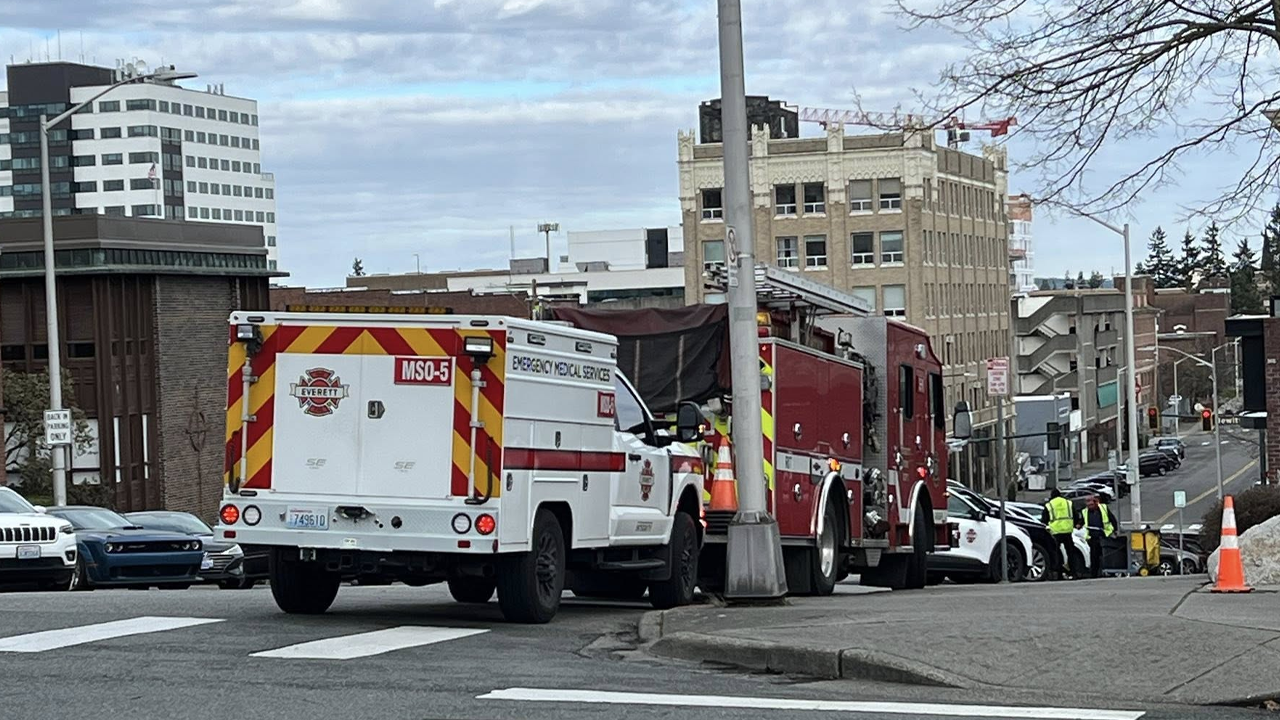
Everett Fire Department crews responded to the Snohomish County Courthouse after fentanyl residue was exposed inside a courtroom during an active trial. (Everett Fire Department Facebook)

Out of an abundance of caution, everyone in the courtroom was relocated to the courthouse’s fourth floor for medical evaluation. Crews checked vitals and blood pressure and monitored for potential overdose symptoms, including unconsciousness or difficulty breathing, officials said.

“No one showed any symptoms or was taken to the hospital,” Doniger said, adding that all individuals were released to go home.

The second-floor courtroom was shut down by the Snohomish County Sheriff’s Office while a specialized hazmat team cleaned and secured the area.

UTAH CHILDREN’S AUTHOR KOURI RICHINS SAYS STATE THREATENED WITNESSES AHEAD OF TRIAL IN HUSBAND’S POISONING

Advertisement

A courtroom was evacuated and evaluated for fentanyl exposure, prompting a hazmat response from Everett Fire. (Everett Fire Department Facebook)

The unusual incident raised questions about how drug evidence is handled inside courtrooms.

Mark Lindquist, the former district attorney for Pierce County and a former trial chief of the Pierce County Drug Unit, told KOMO he had never heard of a courtroom being cleared over potential drug exposure.

“Either somebody dropped the ball here or a rule needs to be changed,” Lindquist said.

DHS ISSUES WARNING ABOUT TREND OF DOMESTIC PARTNERS POISONING LOVED ONES

Advertisement

Authorities closed a second-floor courtroom at the Snohomish County Courthouse while a hazmat team cleaned the area after suspected fentanyl exposure. (Everett Fire Department Facebook)

He added that drug paraphernalia should be securely stored in an evidence room and questioned why photographs were not used during the Snohomish County trial instead of the physical scale.

“This is the first time I’ve ever heard of a courtroom being cleared because of potential exposure to drugs,” Lindquist said. “And it highlights why prosecutors use pictures rather than the actual drug.”

When asked whether an investigation was underway, the Superior Court told KOMO it is looking into all the circumstances and reviewing policies and procedures to prevent something similar from happening again.

CLICK HERE TO DOWNLOAD THE FOX NEWS APP

Advertisement

“We take all matters impacting staff and court users very seriously, especially with regard to the spaces in which the public frequently occupies,” a statement from the court said. “We are committed to taking all steps necessary to make sure events like this don’t happen again, including examining policies and procedures and working collaboratively with stakeholders.”

Officials said the exact quantity of fentanyl residue involved remains unknown. There was no visible plume or indication of a significant airborne release.

Stepheny Price covers crime, including missing persons, homicides and migrant crime. Send story tips to stepheny.price@fox.com.

Related Article

Children’s book author Kouri Richins says scandal and notoriety poisoned her murder trial

Read the full article from Here

Advertisement

Alaska

Why Juneau should be on every Alaska traveler’s bucket list

Published

on

Why Juneau should be on every Alaska traveler’s bucket list


Juneau blends towering glaciers, the Tongass National Forest and rich Indigenous culture.

play

Juneau, Alaska, is the only U.S. state capital not accessible by road — a remoteness that adds to its magic and appeal.

Nestled between mountains, rainforest, and the waters of the Inside Passage, Juneau combines Alaska Native heritage, Gold Rush history, and some of the state’s most spectacular scenery.

Visitors can watch humpback whales surface offshore, ride a tram above downtown, stand face-to-face with or even on Mendenhall Glacier, a river of ice flowing from the vast Juneau Icefield. Surrounded by the Tongass National Forest — the world’s largest temperate rainforest — Juneau offers a quintessential Alaska experience where nature feels immense, and adventure begins just minutes from the cruise dock.

Why Juneau matters

Long before prospectors arrived in search of gold, the area now known as Juneau was home to the Áak’w Kwáan, whose name for this place — Áakʼw, often translated as “little lake” — reflects a deep connection to the surrounding land and water.

Advertisement

Russia later expanded into Alaska through the fur trade, bringing Orthodox missionaries, new trade networks, and profound cultural change to Indigenous communities across the region. Though Juneau rose to prominence during the Gold Rush and became the territorial capital after the United States purchased Alaska in 1867, the city still bears traces of both worlds.

As the nation approaches its 250th anniversary, Juneau offers visitors a richer understanding of America’s layered history — one that’s shaped by Native stewardship, Russian influence, and the enduring resilience of southeast Alaska’s Indigenous peoples.

What to see today

The star attraction is Mendenhall Glacier, a 13.6-mile-long glacier that descends from the Juneau Icefield into a turquoise lake.

Easy trails lead to roaring Nugget Falls, while boardwalks along Steep Creek offer chances to spot spawning salmon and black bears. Back downtown, colorful floatplanes skim the harbor and the Mount Roberts Tramway lifts visitors above the city for sweeping views of Gastineau Channel and the surrounding mountains.  

Advertisement

Ask a local

One of Juneau’s most whimsical attractions is Glacier Gardens Rainforest Adventure, tucked into the Tongass rainforest just outside downtown.

Locals and visitors alike love the upside-down trees known as “Flower Towers” — massive spruce trunks planted root-side up, bursting with colorful blooms. The display is a unique (and accidental) creation of master gardener Steve Bowhay.

It’s an eccentric sight that feels uniquely Alaskan, blending lush rainforest scenery with a touch of horticultural imagination.  

Advertisement

Plan your visit


Source link

Continue Reading

Arizona

Arizona’s mountain rollercoasters are open for season. How to ride

Published

on

Arizona’s mountain rollercoasters are open for season. How to ride


play

Advertisement
  • Arizona is home to several roller coaster attractions, including two mountain coasters.
  • The Canyon Coaster Adventure Park is located in Williams, Arizona.
  • The Sunrise Apache Alpine Coaster is at Sunrise Park Resort near Greer.

Despite its desert reputation, Arizona has several exciting roller coaster attractions that make it a fun destination for thrill seekers. One of the best-known rides is the Desert Storm coaster at Castles N’ Coasters in Phoenix.

Arizona is also home to two popular mountain coasters located in the cooler mountain regions of the state.

Mountain coasters are gravity-powered rides built along hillsides or mountains. Riders sit in individual carts attached to a track and control their own speed using hand brakes. Unlike traditional roller coasters, mountain coasters often wind through forests and natural scenery, creating a mix of adventure ride and scenic experiences.

And Arizona is lucky enough to have two mountain coasters. Here’s how to visit.

What roller coaster is in the mountains in Arizona?

There are two mountain coasters in Arizona: the Canyon Coaster Adventure Park in Williams and the Sunrise Apache Alpine Coaster at Sunrise ski resort.

Advertisement

Canyon Coaster Adventure Park in Williams AZ

Canyon Coaster Adventure Park features the Canyon Coaster, which spans 1 mile with a scenic mountain backdrop. It has a peak height of 35 feet and is integrated into the natural curves of the landscape. The 13-acre park also offers tubing across 400 feet of track in summer and snow-covered slopes in winter, facilitated by two conveyor lifts. There’s also a restaurant and bar.

Where: 700 E. Route 66, Williams, Arizona.

When: 10 a.m.-4 p.m. Monday-Thursday, 10 a.m.-7p.m. Fridays-Saturday, 10 a.m.-5 p.m. Sunday year-round.

Advertisement

Admission: The Canyon Coaster costs $20 per person per ride. Riders must be over 4 feet, 5 inches tall. Children who are at least 3 years old and 38-54 inches tall ride for $10 with a driver who is 18 or older. Visit the website for other attractions and pricing.

Details: 928-707-7729, canyoncoasteradventurepark.com.

Sunrise Apache Alpine Coaster at Sunrise ski resort

Spanning over half a mile with 3,287 feet of track, the coaster’s carts can reach up to 25 mph. Hand brakes let you choose a mellow or zippy ride. Sunrise Park has skiing and other snow activities in winter, plus mountain biking, scenic chair lift rides and more in summer. Dining options include a restaurant and pub.

Where: Sunrise Park Resort, 200 State Route 273, on the Fort Apache Reservation near Greer.

When: 10 a.m.-6 p.m. Friday-Sunday, closed Monday-Thursday. Open every day starting June 2026.

Advertisement

Admission: $19 per ride or buy two rides for $38 and get a third ride free. Tickets are available in person. See the Sunrise Park website for other seasonal activities and prices.

Details: 928-735-7669, sunrise.ski/apache-coaster.

Got a story you want to share? Reach out at Tiffany.Acosta@gannett.com. Follow @tiffsario on Instagram.

Looking for the best things to do in Arizona? Sign up for our newsletter.


Source link

Advertisement
Continue Reading

California

Opinion | California will make less money from greenhouse gas emission auctions

Published

on

Opinion | California will make less money from greenhouse gas emission auctions


By Dan Walters, CalMatters

The Phillips 66 refinery in Wilmington, on Sept. 30, 2025. Photo by Stella Kalinina for CalMatters

This commentary was originally published by CalMatters. Sign up for their newsletters.

Two decades ago, when California got serious about reducing or even eliminating carbon dioxide and other greenhouse gases, its political leaders weighed two potential tactics about industrial emissions.

Advertisement

The state could impose direct facility-by-facility limits, generally favored by climate change advocates. Or it could set overall emission reduction goals that would gradually decrease and auction off emission allowances, assuming their costs would encourage reductions.

The latter, known as cap-and-trade, was favored by corporate interests as being less onerous and was adopted, finally taking effect in 2012.

Since then, the California Air Resources Board has conducted quarterly auctions of emission allowances, collecting a total of $35 billion dollars so far, which, in theory, is being spent on projects that would reduce emissions.

The revenues have varied from year to year, but they have generally increased as the emission caps have declined. Since reaching a peak of $8.1 billion in the 2023-24 fiscal year, however, auction proceeds have been declining.

Roughly half of the money has been given to utilities to minimize cap-and-trade’s impact on consumer costs. However, the program has been widely criticized as a de facto tax on gasoline and other fuels, which were already among the most expensive of any state.

Advertisement

The remaining revenues have been deposited into a Greenhouse Gas Reduction Fund that governors and legislators have tapped for various purposes, not all of them connected to emission reductions. In a sense, it’s been a slush fund.

Last year Gov. Gavin Newsom and the Legislature overhauled the program in two bills, Senate Bill 840 and Assembly Bill 1207. The program was extended, it was renamed as cap-and-invest and new priorities for spending auction proceeds were set.

Notably, the state’s cash-strapped and long-stalled bullet train project would get a flat $1 billion a year, rather than the 25% share it had been getting. Project managers hope that lenders will advance enough money to complete its first leg in the San Joacim Valley; the plan is to repay the loans from the $1 billion annual cap-and-invest allocation.

Early this year, the Air Resources Board released new regulations to implement the legislative changes but faced criticism that they would increase consumer costs. That led to a revision in April that softens the rules’ impact — most obviously on refiners who have been threatening to leave California — but environmental groups are very critical.

The April version would also sharply reduce net revenues from emission auctions, according to the Legislative Analyst’s Office, providing barely enough for the $1 billion allocation to the bullet train and another $1 billion for the governor and Legislature to spend. Other programs that have been receiving cap-and-invest support, such as wildfire protection and housing, would probably get nothing.

Advertisement

The program has been tapped in recent years to backfill programs that a deficit-ridden state budget could not cover, so the projected revenue drop would exacerbate efforts by Newsom and legislators to close the state budget’s yawning gap.

“The (Greenhouse Gas Reduction Fund) is a relatively small portion of the overall state budget, but it has been a noteworthy source of funding for environmental and other programs in recent years,” the state Assembly’s budget advisor, Jason Sisney, says in an email. “Collapse of its revenues would change the state budget process noticeably. The state’s cost-pressured general fund seemingly would be unable to make up much, if any, of a significant (Greenhouse Gas Reduction Fund) revenue decline at this time.”

When Newsom presents his revised budget this week, he may reveal how he intends to cover the cap-and-invest program’s shortfall, particularly whether he will maintain the $1 billion bullet train commitment that project leaders say is vital to continuing construction of its Merced-to-Bakersfield segment.

It could boil down to bullet train vs. wildfire protection.

This article was originally published on CalMatters and was republished under the Creative Commons Attribution-NonCommercial-NoDerivatives license.

Advertisement


Source link

Continue Reading
Advertisement

Trending
