Politics
Trump envoy rebukes Greenland leader for rejecting hospital ship proposal


NEWYou can now listen to Fox News articles!
Greenland’s rejection of President Donald Trump sending a U.S. military hospital ship has touched off a private-public healthcare debate amid ongoing diplomatic talks about Arctic security.
Greenland’s Prime Minister Jens-Frederik Nielsen on Sunday turned down Trump’s offer, and now Trump special envoy to Greenland, Louisiana Gov. Jeff Landry, has weighed in.
“Shame on Prime Minister Jens-Frederik Nielsen!” Landry wrote in response to a Fox News report on Nielsen’s objection. “President Donald J. Trump and America care. After speaking to many Greenlanders about the day to day problems they face, one issue stood out — healthcare.”
Greenland has sought more self-governance from Denmark under the Self Government Act in 2009 to take more local authority under home rule, but Danish officials’ instant rejection of Trump’s offer is aligned with Greenland’s own rejection that came later Sunday.
CANADA AND FRANCE OPENING NEW CONSULATES IN GREENLAND’S CAPITAL AMID TRUMP PRESSURE
Greenland has rejected the Trump administration’s push to take over the Danish territory. (Thomas Traasdahl/Ritzau Scanpix / AFP via Getty Images; Al Drago/Bloomberg via Getty Images)
“President Trump’s idea of sending an American hospital ship here to Greenland has been noted,” Nielsen wrote in a translated Facebook post. “But we have a public healthcare system where treatment is free for citizens.
“It is a deliberate choice.”
Greenland remains open to dialogue and cooperation with the U.S., with a caveat, according to Nielsen.
“But talk to us instead of just making more or less random outbursts on social media,” Nielsen said in his own public Facebook protestation.
TRUMP KEEPS MACRON UNDER SPOTLIGHT AS GREENLAND TALKS GRIND FORWARD FROM DAVOS
Louisiana GOP Gov. Jeff Landry speaks during a meeting with President Donald Trump last year. (Scott Olson/Getty Images)
Greenland’s “free for citizens” care is not sufficient, Landry argued in his Facebook response posted to his campaign’s page.
“Many villages and small towns lack basic services that Americans often take for granted,” Landry’s post continued. “Small settlements are without permanent doctors, diagnostic tools, or specialist care – forcing residents to travel great distances for vital treatments that should be available at home.”
The healthcare issue underlies the overreaching Trump hopes to annex Greenland to secure the strategic Arctic region from Russian and Chinese designs, calling it a vital issue for “national security” for both the U.S. and the NATO alliance.
“A healthy Greenland is vital for America’s national security,” Landry’s post concluded. “America is committed to defending Greenland, and that begins by ensuring its people are defended against basic illnesses and ailments.
“These missions matter because health is inseparable from security. America’s commitment to defending Greenland must begin with ensuring its people are healthy.”
The recent dust-up came after Denmark’s Joint Arctic Command evacuated a crew member who required urgent medical treatment from a U.S. submarine in Greenlandic waters, seven nautical miles outside of Greenland’s capital of Nuuk.
“Working with the fantastic Governor of Louisiana, Jeff Landry, we are going to send a great hospital boat to Greenland to take care of the many people who are sick, and not being taken care of there,” Trump wrote Saturday night on Truth Social. “It’s on the way!!!”
That post sparked objection from both Danish Defense Minister Troels Lund Poulsen and Danish Prime Minister Mette Frederiksen on Sunday.
“The Greenlandic population receives the healthcare it needs,” Poulsen told Danish broadcaster DR, according to Reuters. “They receive it either in Greenland, or, if they require specialized treatment, they receive it in Denmark.
VANCE: US SHOULD GET ‘SOME BENEFIT’ FROM GREENLAND IF IT’S GOING TO BE ‘ON THE HOOK’ FOR PROTECTING TERRITORY
“So it’s not as if there’s a need for a special healthcare initiative in Greenland.”
Danish Prime Minister Mette Frederiksen is rejecting President Donald Trump’s offer to send a U.S. military hospital ship to Greenland, suggesting Denmark’s public healthcare system is sufficient. (Anna Moneymaker/Getty Images; Kirsty Wigglesworth – WPA Pool/Getty Images)
Frederiksen spun the Trump offer into a political debate on public healthcare.
“Am happy to live in a country where there is free and equal access to health for all,” Frederiksen wrote in a translated post, sharing a Democrat attack point on Trump’s Republican Party’s struggles to reform what Trump has rebuked as a “failure” of Obamacare. “Where it’s not insurances and wealth that determine whether you get proper treatment. You have the same approach in Greenland.”
CLICK HERE TO DOWNLOAD THE FOX NEWS APP
The U.S. Navy has two hospital ships, the Mercy and the Comfort. Both were last docked in Alabama for repairs, according to Reuters.



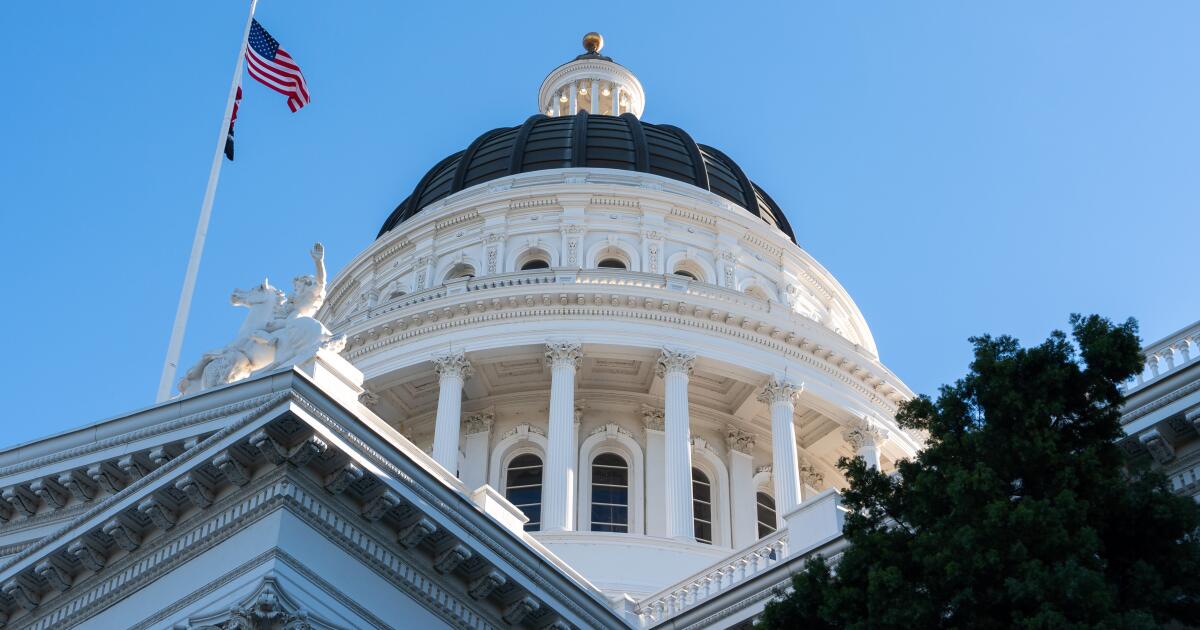
SACRAMENTO — Gov. Gavin Newsom and Democratic leaders of the California Legislature plan to approve a proposed constitutional amendment this week that would ask voters to give them more flexibility over state spending and allow them to save money that could otherwise go back to taxpayers.
The proposal seeks to exempt deposits into state savings accounts from a spending limit that voters adopted through a series of ballot measures dating back to the late 1970s and to increase the share of tax revenue that can be put into the rainy day fund.
“Putting money aside to protect ourselves from future uncertainties isn’t just good government; it’s common sense,” Newsom said in a statement. “California is strong and resilient, but we’re not immune to economic headwinds. At a time when our essential services are under pressure, we have a responsibility to safeguard the programs and investments that Californians rely on.”
Assembly Constitutional Amendment 20, which Democrats are calling the “Save for California’s Future Act,” could receive push back from taxpayer advocates.
Under an existing state appropriations restraint, also known as the Gann limit, lawmakers cannot spend more than an amount determined by a formula that takes into consideration annual tax proceeds and changes to the population and cost of living. Tax revenue above the limit must be divided between schools and refunds to taxpayers.
With few exceptions, the limit applies to most appropriations of tax revenue, including money that lawmakers tuck away into the rainy day fund and other reserves. California voters have also capped the amount of money lawmakers can set aside in the rainy day fund to 10% of general fund proceeds in a given year.
Since taking office, Newsom has argued that it doesn’t make sense for savings to count as spending under state law.
State budget revenue is subject to dramatic swings from year to year based on stock market activity. The law, Newsom has said, prevents the state from saving more money in good years to stave off cuts to programs in bad years.
The proposed changes would exempt deposits into the rainy day fund and a short term reserve, called the “Projected Surplus Temporary Holding Account,” from the state appropriations limit. The cap on the rainy day fund would grow from 10% of general fund tax revenue to 20%.
“Californians live by a simple, bipartisan truth: set money aside when times are good so you’re ready when they’re not,” Assembly Speaker Robert Rivas (D-Hollister) said in a statement. “The Save For California’s Future Act is what responsible leadership looks like — and future taxpayers will thank us for it.”
The measure could incentivize Democrats to save more money because funds tucked away in the rainy day fund would no longer be considered expenditures counted toward the spending limit. By allowing lawmakers to set aside more money that is not subjected to state spending limits, it could also allow them to hold onto money that would be returned to taxpayers under current law.
The measure is slated for a vote Thursday. If approved by two-thirds of lawmakers, voters will consider the proposal on the November ballot.
Politics
Social media erupts over Mamdani’s silence after Brooklyn coffee shop bans Jewish congressman

Socialists push progressive agenda in NYC primaries
Fox News national correspondent Bryan Llenas reports on the New York City primary, highlighting the influence of socialists. Candidates backed by Zohran Mamdani advocate for abolishing ICE and all deportations, even for convicted murderers.
NEWYou can now listen to Fox News articles!
New York City Mayor Zohran Mamdani is facing swift backlash after declining to condemn a local coffee chain that told a Jewish congressman with pro-Israel views that he was not welcome.
Mamdani has remained silent after the Williamsburg, Brooklyn-based Poetica coffee shop posted — and later deleted — a message on social media telling Rep. Dan Goldman, D-N.Y., not to return after he stopped by the shop with his daughter Monday. The mayor declined to comment through a spokesman when contacted by The New York Times on Monday.
“Shameful,” Fox News Radio analyst Josh Kraushaar wrote on social media in response to a section of The Times story detailing that Mamdani declined to comment.
“Well folks, we’ve reached the stage of antisemitism where Jews are being publicly barred from businesses,” the CEO and co-founder of the antisemitism-focused nonprofit Boundless Israel said on X. “A coffee shop in Mamdani’s New York City told Jewish Congressman Dan Goldman he wasn’t welcome in their store.”
Zohran Mamdani announces new members of his team at the Brooklyn Public Library Greenpoint Branch in Brooklyn on Dec. 17, 2025. (Shawn Inglima/New York Daily News/Tribune News Service via Getty Images)
MAMDANI SKIPS ISRAEL DAY PARADE DESPITE JOINING OTHER CULTURAL CELEBRATIONS
“The café is implementing Mamdani’s wishes,” journalist Melissa Braunstein said.
Fox News Digital reached out to Mamdani’s office for comment but did not immediately hear back.
In a since-deleted social media post, Poetica Coffee said it would have declined to serve Goldman had staff recognized him in the store. Goldman has notably declined to characterize Israel’s war in Gaza as a genocide and has received financial contributions from the pro-Israel lobby AIPAC, drawing criticism from some on the progressive left.
“Hey Congressman Dan Goldman, we see that you stopped by our shop today for a coffee. Do you see how it doesn’t taste like genocide juice? Or are you still having a hard time telling the difference?” the post said.
“See, here at Poetica, we don’t serve racists, fascists, homophobes, genocide enablers, or anyone in between,” the post continued. “Too bad we didn’t recognize you right away, or we would have turned you away. We issued you a refund—we don’t need your money (it’s probably coming from AIPAC anyways). Enjoy your loss on Tuesday. Don’t ever come to Poetica.”
The coffee chain has since deleted its Instagram page amid social media backlash.
Mamdani’s silence comes as he is working to unseat Goldman, despite the incumbent lawmaker being a leading Trump critic and embracing an array of leftist legislative proposals. Goldman notably did not endorse Mamdani’s mayoral campaign, citing concerns about how his administration would approach Jewish New Yorkers.
A Brooklyn, N.Y., coffee shop refunded a purchase made by Rep. Dan Goldman, D-N.Y., over the weekend over his support for Israel, saying the company doesn’t serve “genocide enablers.” (Getty Images; Google Maps)
The mayor publicly backed former New York City Comptroller Brad Lander to represent Goldman’s district, which spans Lower Manhattan and deep-blue, wealthy pockets of Brooklyn.
Democratic voters will decide whether to hand Goldman a third House term during the Empire State’s primary elections on Tuesday.
NY DEM WOULDN’T BACK MAMDANI FOR MAYOR — NOW MAMDANI IS BACKING HIS CHALLENGER
Since both men largely hold the same policy stances, the bruising primary battle has revolved around support for Israel — with Lander vowing to elevate the Palestinian cause if elected to the House.
Goldman has notably supported military aid to Israel following Hamas’ Oct. 7, 2023, attacks and distanced himself from inflammatory rhetoric used by some on the left to criticize Israel.
Goldman offered a tempered response after the coffee chain effectively banned him from their storefronts.
“I’m sorry to see this post,” he said. “The barista could not have been nicer to my 7-year-old daughter and me—allowing her to use the bathroom even though we had not purchased anything. I made sure to buy a coffee in return for her kindness. I hope you at least make sure she gets the tip that she deserved.”
New York City Mayor Zohran Mamdani speaks in support of Brad Lander, Democratic candidate for Congress in New York’s 10th Congressional District, in Carroll Park in the Carroll Gardens neighborhood of Brooklyn on June 14, 2026. (Shuran Huang/For The Washington Post via Getty Images)
CLICK HERE TO DOWNLOAD THE FOX NEWS APP
Assistant Attorney General for Civil Rights Harmeet Dhillon said Tuesday her office has opened an investigation into the matter.
“Federal law prohibits public accommodations such as coffee shops from discriminating against patrons based on their race, religion, or national origin,” Dhillon wrote. “These actions are not only reprehensible, they’re potentially illegal.”

Attorneys general in seventeen states are suing California over its landmark single-use plastic law, which went into effect on June 1.
The lawsuit comes after a coalition of environmental groups sued the state over the same law this month, arguing the new final regulations create loopholes so large they gut the law.
The states are led by Nebraska Atty. Gen. Mike Hilgers, and the plaintiffs include the National Assn. of Wholesaler-Distributors. The coalition is asking the court to block enforcement of the law immediately.
“Once again, California is trying to enact a policy that negatively impacts the rest of the country,” said Hilgers in a news release. “If California goes unchecked, consumers will be forced to pay more for basic necessities.”
The other states in the coalition are Alabama, Florida, Georgia, Idaho, Indiana, Iowa, Louisiana, Missouri, Montana, North Dakota, Oklahoma, South Carolina, South Dakota, Texas, Utah and West Virginia. The lawsuit was filed in the U.S. District Court of Eastern California in Sacramento on Monday.
State Senate Bill 54, the Plastic Pollution Prevention and Packaging Producer Responsibility Act, was signed by Gov. Gavin Newsom in 2022. It was considered landmark legislation because it requires plastic and packaging companies to use less single-use plastic and ensure by 2032 that all food packaging is either recyclable or compostable.
Accumulating plastic waste is overwhelming waterways and oceans, sickening marine life and threatening human health.
The intent was not only to reduce single=use plastic, but also to put the onus and cost of dealing with it on packaging producers and manufacturers, not consumers and local governments. It was supposed to incentivize companies to consider the fate of their products and spur innovation in material redesign.
Plastic bottles of dishwashing liquid at Compton’s Market in Sacramento on June 17, 2022.
(Rich Pedroncelli/AP)
According to one state analysis, 2.9 million tons of single-use plastic and 171.4 billion single-use plastic components were sold, offered for sale or distributed during 2023 in California.
The single-use plastic law is what is known as a producer responsibility law. It emphasizes the idea of a “circular economy” in which the producer of a material must consider its fate — making sure it can be reused or recycled, or at least reduced.
In California, all producers of single-use packaging and plastic foodware (plates, knives, spoons, etc.) join a private entity known as a producer responsibility organization. Only one such organization has been approved in California: the Circular Action Alliance.
The states and the National Assn. of Wholesaler-Distributors say the plastic law discriminates against businesses selling into the state in two ways: by making them change or alter their plastic packaging and by conferring government authority upon the alliance, enabling a private entity to regulate and impose taxes and fees on businesses selling into California.
“California is not entitled to pronounce nationwide policies,” Eric Hoplin, president and chief executive of the wholesalers group, said in a statement. “Because the Act extends California’s regulatory reach far beyond its borders and brings within its sweep conduct wholly unconnected to California, the Act violates principles of federalism, the horizontal separation of powers, and due process.”
In addition, the attorneys general say the law suppresses their free speech by compelling companies to join and fund the speech of an organization with which they may disagree.
Hoplin and his organization filed a similar suit in Oregon in February. Oregon has a comparable single-use plastic law. A federal judge blocked enforcement of that law. A trial begins on July 13.
Heidi Sanborn, executive director and CEO of the National Stewardship Action Council, which advocates for the producer responsibility laws and a more circular economy, said in May that both SB 54 and the Oregon law are public policies that were “passed by legislatures and implemented with government oversight.”
She said the laws create clear and consistent rules so all producers contribute fairly to the cost of recycling and waste management.
Meanwhile, environmental groups are also unhappy.
On June 2, Oceana, the Natural Resources Defense Council and Californians Against Waste Foundation filed a lawsuit in San Francisco Superior Court.
They allege that the final regulations for the law, drafted and approved by the state’s waste agency, include exclusions for large categories of plastic packaging that companies could use indefinitely. In addition, they say, the regulations also allow for recycling technologies that pollute, such as chemical recycling, which the law as originally drafted forbids.
“While SB 54 remains a monumental achievement as the nation’s strongest single-use plastic reduction law, some of the final regulations implementing the statute undermine the law’s ambitions,” Christy Leavitt, Oceana’s senior campaign director, said in a statement.
-
 Lifestyle6 minutes ago
‘Worth every penny’: This is how much fans spent to attend the World Cup in L.A.
-
Politics9 minutes ago
Democrats want California voters to give them more flexibility over spending
-
 Sports24 minutes ago
Dodgers game to start 30 minutes late; give updates on Kyle Tucker and Dalton Rushing
-

 World36 minutes ago
Iceland kills first whales since 2023, resuming whaling
-

 News59 minutes ago
ODNI under Pulte fires 6 staff, sends 45 back to home agencies
-

 Los Angeles, Ca2 hours ago
Air quality concerns remain as the Boyle Heights warehouse fire continues to burn
-

 Detroit, MI3 hours ago
Wenceel Pérez returns home, but when will he return to Detroit Tigers?
-

 San Francisco, CA3 hours ago
San Francisco Supervisor Jackie Fielder to return following mental health leave

