Midwest
Tyrese Haliburton makes last-second 3 to complete Pacers' wild comeback, take surprising 2-0 lead over Cavs

NEWYou can now listen to Fox News articles!
Advantage, Indiana Pacers.
The Pacers, fourth in the Eastern Conference, entered their second-round series against the top-seeded Cleveland Cavaliers as heavy underdogs. But suddenly, the ball is in their court.
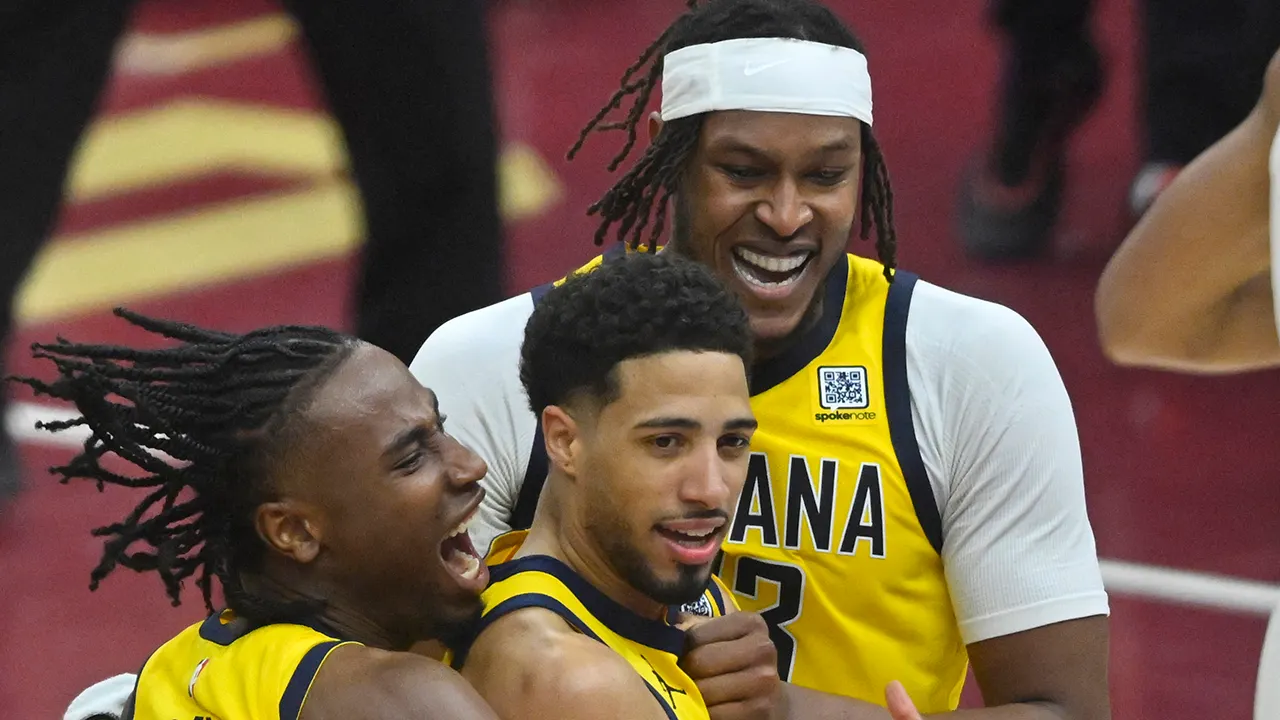
After upsetting Cleveland Game 1, they overcame a 20-point deficit thanks to Tyrese Haliburton to take a commanding 2-0 lead, winning both games on the road.
The Indiana Pacers celebrate their last-second win as Cleveland Cavaliers center Jarrett Allen (31) walks off the court after game two of the second round of the 2025 NBA Playoffs at Rocket Arena. (David Richard-Imagn Images)
Indiana had slowly chipped away, but Cleveland looked like they were going to go on the road evening up the series, as they led by seven with less than 50 seconds to go.
But Aaron Nesmith threw down a dunk, and Donovan Mitchell was called for an offensive foul two seconds later. Pascal Siakam hit a layup with 27.1 seconds, making it a three-point game.
The Cavs called a timeout, but it did nothing, as they turned the ball over on the inbound. They then fouled Haliburton, who made just one of two, but Haliburton got his own rebound. He then hoisted up and cashed a stepback three to go up 120-119, which would turn out to be the final score, with 1.1 seconds left.
It was a crusher for Cleveland, whose best player in Mitchell dropped 48 points in a losing effort.
Tyrese Haliburton #0 of the Indiana Pacers makes the game winning 3 point basket during the game against the Cleveland Cavaliers during Round Two Game Two of the 2025 NBA Playoffs on May 6, 2025 at Rocket Arena in Cleveland, Ohio. (David Liam Kyle/NBAE via Getty Images)
Haliburton scored 11 of his 19 points in the final 12 minutes.
It’s the first time the Pacers won the first two games of a playoff series on the road since 1994 against Orlando.
The Cavs were missing three key players: NBA Defensive Player of the Year Evan Mobley (left ankle) and key reserve De’Andre Hunter (right thumb) were injured in Game 1, while Darius Garland (left big toe) missed his fourth straight postseason game.
Tyrese Haliburton #0 of the Indiana Pacers celebrates after the game against the Cleveland Cavaliers during Round 2 Game 2 of the 2025 NBA Playoffs on May 6, 2025 at Rocket Arena in Cleveland, Ohio. (Joe Murphy/NBAE via Getty Images)
Game 3 is at Indiana on Friday night, as Indiana looks for a second consecutive appearance in the Eastern Conference Finals.
The Associated Press contributed to this report.
Follow Fox News Digital’s sports coverage on X, and subscribe to the Fox News Sports Huddle newsletter.
Read the full article from Here


Editor’s note: This story is part of the Monitor’s summerlong series following old U.S. Route 66 from Chicago to Santa Monica, California.
Just a few blocks from the Old Joliet Prison, Johnny Williams is standing outside a tire shop, waiting for a repair.
He’s a lifelong resident of the Joliet area, a father of six and grandfather of 10, and he remembers back in the day when the prison was part of the economic engine that made Joliet run.
Why We Wrote This
Route 66 courses through American cities that once flourished before their economies faded or were forced to change. The story of Joliet, Illinois, reflects the high times, the hardships and the reinvention found along the century-old road.
“I remember when people used to sit out there visiting their people — on the buses, you know?” Mr. Williams says. “I have plenty of people whose parents and uncles worked there.” He gestures toward the 25-foot limestone walls, still topped with razor wire. “And as a child, I would always wonder — what’s behind that wall?”
So, he still marvels at how the once imposing former state penitentiary has been transformed over the past decade. Today, the people walking through its front gate are not prisoners or staff, but tourists and Americana-lovers there to have fun and celebrate the centennial of Route 66. The iconic roadway, noted in hundreds of anthems about America, passed right by the prison until 1940, when it was rerouted a few blocks away.
The prison once housed such infamous criminals as Richard Speck, James Earl Ray, and John Wayne Gacy. But since its closing in 2002, it has become a site for concerts, film viewings, and today, an event dubbed “The Big House Ballgame.”
People wondered about the prison for decades, said Quinn Adamowski, board president of the Joliet Area Historical Museum, which now runs the prison, before the game. “This site defined Joliet in many ways.”
After the prison closed, it was largely abandoned, becoming a liability, Mr. Adamowski said, especially in this neighborhood. “In 2017, 160 years after the first inmates arrived, we had the opportunity to wonder what this site could be,” he added. “It was our time – Joliet’s time – to define the prison.”
The Big House Ballgame on April 30, which is the 100th anniversary of the naming of Route 66, featured the Joliet Slammers, a Frontier League baseball team co-owned by actor Bill Murray. It was one of the featured events of an official five-city kickoff of events commemorating America’s “Mother Road.”
Baseball was also part of the prison’s history. In the early 20th century, inmates formed teams and played games against one another and against outside clubs, part of a broader effort to impose order and routine within the prison. The Big House Ballgame today is, in part, an attempt to revive that history — to connect the present moment to something that had once taken place on the same ground.
What happened to Joliet over the past century and a half happened, in some version, to nearly every city and town along Route 66. The collapse of jobs, travel routes, and movement west – and then a slow, uncertain reinvention.
The roadway passed through working America, and then through America after the work was gone. The centennial is, among other things, a celebration of the survival of places that kept going when the economies that made them no longer existed.
***
Curt Herron, like Mr. Williams, has lived in this part of Will County his whole life, growing up in Lockport, a small city just north of Joliet, before spending 45 years as a sports reporter covering high schools, the Slammers, and nearly every sporting event in between. Today, he’s an assistant at the historical museum.

Harry Bruinius/The Christian Science Monitor
“Joliet was always a real working-class city,” he says, pausing in the shadow of a guard tower as a group of tourists photographs the cellblock windows above him. “The second biggest steel city in the country after Pittsburgh. And then, on top of that, a prison city — two prisons within a few miles of each other, running simultaneously for 75 years. Almost nowhere in America can say that,” he says, noting that the area’s other prison, Stateville Correctional Center in Crest Hill, is still in operation.
The steel came first. In 1869, the Joliet Iron and Steel Works opened along the Des Plaines River, drawing on the region’s coal deposits and its limestone – the same blue-gray stone that built the prison walls, the same stone quarried from just beneath the city’s surface – to become one of the great industrial enterprises of the Gilded Age. At its height, it employed thousands of men and produced the railroad rails that stitched together the American West.
Joliet drew immigrant workers in successive waves: first, the Irish who dug the Illinois and Michigan Canal in the 1840s; then Poles, Lithuanians, and Eastern Europeans; then African Americans and Mexican migrants during the First World War. Joliet became, in the language of the era, a city of stone and steel – proud of its grit and defined by its labor, built on the conviction that hard work in a hard place was its own kind of American story.
Then, the steel left. By the early 1980s, the mill was gone, and the unemployment rate in Joliet climbed to 26% – among the highest of any city in the United States at the time. The limestone ruins of the ironworks sat empty along the river for decades, overgrown with vegetation, before the Forest Preserve District turned them into a heritage trail.
A wound, converted in time into a park.
“We were known for being a hardscrabble place,” Mr. Herron says. “Because of the prisons and the steel industry and a lot of working-class people. But that’s not a bad thing. It’s also led to a real competitive area – a lot of great athletes have come from here, a lot of people who’ve gone on to do remarkable things.” These include actors Nick Offerman and Melissa McCarthy, two Super Bowl-winning football players, and a WNBA champion.
But transportation has been, and remains, a major driver of Joliet’s economic engine. The Illinois and Michigan Canal and the railroads that followed in the 19th and 20th centuries once spurred its growth. Today, vast inland port complexes make Joliet one of the major freight hubs in North America.
And then, Route 66, which ran directly through downtown, across the Des Plaines River at the Ruby Street Bridge, helped make Joliet a destination for travelers.
The state is betting that Route 66 travel will continue to help the local economy, said Catie Sheehan, the Illinois deputy director of tourism and a Route 66 Centennial commissioner. “Joliet is one of nearly 100 communities along the Illinois stretch of the Mother Road. These towns bring Route 66 to life in so many different ways.”
Her tourism office has funded a suite of new roadside attractions for the centennial: a 20-foot “Tire Tower” for Joliet’s Chicagoland Speedway, a 12-foot penny for Lincoln, Illinois, and a 14-foot statue of Abraham Lincoln for Granite City.
“A lot of Midwestern industrial towns have fallen by the wayside and haven’t recovered,” Mr. Herron says. “Transportation saved the day – it’s always been about roads and waterways here.”
***
Dan Goedert is sitting in the stands at The Big House Ballgame, dressed as a prisoner with a black and white striped shirt.
Harry Bruinius/The Christian Science Monitor
A retired emergency room nurse, Mr. Goedert has posed for a few pictures already. “I just read about this yesterday,” he says. “So, I just came to have a little fun today.”
The group Billy Branch and the Sons of Blues have been playing in the old prison yard, along with local blues singer Sheryl Youngblood. They do a spirited version of “(Get Your Kicks on) Route 66.”
But the old prison, like Route 66, has a legendary pop cultural connection. “We like history, and we’re old, so we remember the ‘Blues Brothers,’” says Sue Bradley, a special education teacher sitting on the grass before the game with her husband John, who works in finance. She gestures toward people wearing fedoras and black suits and ties. “You’ll see people dressed like them everywhere here today. This is the prison they got out of at the beginning of the movie.”
It’s a movie that few people in Chicago have forgotten. In the opening scene of the 1980 film, a paroled convict played by the late Chicago native John Belushi – “Joliet” Jake Blues – walks out of the same prison gate here to meet his brother Elwood, also a small-time criminal, played by Dan Aykroyd.
Jake and Elwood set off on a road trip that is, at its heart, a story about the open road as salvation. It made the prison famous in a way that, at the time, 144 years of incarcerating murderers and gangsters had not.
And it made Route 66 — the road that once passed this gate and ran all the way to the Pacific – feel, to generations of viewers and travelers alike, like a road of freedom.

Northwestern baseball’s cherished tradition of playing at Wrigley Field filled the dugout and the stands with joy and humility. But it did not deliver a win this year, as Indiana (21-25, 7-15 B1G) used two offensive spurts and stifling pitching to outlast the Wildcats (17-25-1, 5-17 B1G) 9-2 on Friday night.
The fourth annual ‘Cats Classic unfolded under a fading sunset on a brisk 43-degree evening. The chilly weather did not deter fans from making the trip to Wrigleyville. A flurry of spectators dressed in purple sweaters and beanies lined the third-base side, while the Hoosiers countered with supporters of their own bearing red attire along the first-base line.
Advertisement
Ryan Weaver got the start for Northwestern, pitching five innings where he ceded six hits and five runs while striking out six. Sam Hliboki pitched two scoreless innings in relief.
Meanwhile, Indiana’s starter Tony Neubeck pitched a six-inning shutout, walking four ‘Cats while striking out seven.
The Hoosiers’ offense jumped on Weaver early. Indiana’s Hogan Denny knocked a leadoff double in the top of the first before Jake Hanley singled to right field, where Jackson Freeman played the ball cleanly to hold Denny at third.
With runners at the corners and nobody out, a sacrifice fly from Owen ten Oever brought Denny home for the game’s first run. Weaver buckled down afterwards, securing a strikeout and flyout to hold Indiana’s lead at 1-0.
Advertisement
NU’s lone baserunner in the bottom of the first was Ryan Kucherak, who reached on a throwing error by shortstop Cooper Malamazian. Aside from that, the ‘Cats went quietly.
In the top half of the second frame, the leadoff runner again reached base off Weaver and advanced to third on two sacrifice groundouts. Weaver recorded a clutch strikeout to strand Landen Fry at third.
With two outs and nobody on in the second inning, Freeman recorded NU’s first hit of the game and de Groot drew a walk to put Freeman in scoring position. The inning ended with a whimper as Shane Hofstadler grounded out to third.
The third inning was marked by several self-inclifted errors for the Wildcats and Indiana made them pay for each one. Weaver induced a swinging strike three, but a passed ball put Hogan on first, making it three straight innings in which Indiana’s leadoff runner reached base. Two wild pitches then moved Hogan all the way to third.
Advertisement
The Hoosiers immediately took advantage, as Jake Hanley singled to right field to score Hogan and ten Oever followed by mashing a double into the left-center gap and off the green ivy to bring home Hanley and make it 3-0 Indiana.
Indiana’s offense didn’t stop there. Weaver hit a batter to put a second runner on and Landen Fry plated them both on a single to center field. The Northwestern left-hander got two-straight groundouts to strand Fry on base, but the damage was done. The ‘Cats found themselves in an early 5-0 hole after a four-run inning from IU.
Meanwhile, Neubeck continued to shut down Northwestern’s offense, pitching a scoreless inning around a leadoff walk to Owen McElfatrick.
Weaver and the defense turned in their cleanest inning in the fourth. The graduate student opened with a strikeout and though Denny reached on a single, Hofstadler caught him trying to steal second on a ball in the dirt. Weaver then recorded his second strikeout of the inning to keep the score at 5-0.
Advertisement
In the bottom half, NU stretched its reached base streak to four consecutive innings as Jake Yang poked a single to left field. With two outs, de Groot moved Yang into scoring position with a single, but Hofstadler lifted a high foul popout that was caught near the Wildcats’ dugout, leaving them empty handed through four frames.
Weaver tossed a scoreless frame in his final inning of work, capped off by a nice defensive play for the ‘Cats where McElfatrick laid out to snag a sharply hit ball and tossed a one-hopper to first for Nick Barron to scoop out of the dirt for the final out.
NU loaded two runners on base in the bottom of the fifth via a McElfatrick single and a Kucherak walk, but again, the ‘Cats were unable to capitalize, leaving its seventh and eighth runners on base.
Sam Hliboki took the mound for NU in the top of the sixth, plunking the first batter he saw. He appeared to hit the second as well, but after review, the umpires ruled that Moore interfered by bending his knee into the pitch, leading to IU head coach Jeff Mercer’s ejection. Hliboki induced a groundout and flyout to end the inning.
Advertisement
The Wildcats’ batters continued to be silenced in the bottom half of the sixth by Neubeck, eclipsing 100 pitches on a strikeout of Hofstadler. The theme of untimely hitting persisted for NU, as it stranded a runner in scoring position for the fourth time.
The Hoosiers threatened to grow their lead in the seventh, loading the bases with one out. Hliboki held firm, striking out both Fry and Cal Gates to keep the ‘Cats in it.
NU’s offense finally got on the board in the seventh inning, teeing off Neubeck’s replacement in Jacob Vogel. McElfatrick continued his strong night with a second base hit and Kucherak’s double moved him to third. For the first time on Friday night, the Wildcats had a runner on third.
Noah Ruiz plated both McElfatrick and Kucherak on a two-run RBI single to make it a 5-2 game.
After a sharp Barron lineout, Indiana’s second reliever of the night, Reagan Rivera, struck out Yang to end the inning.
Advertisement
The Hoosiers found their biggest rally of the night in the eighth against Tommy Bridges. A leadoff walk from Moore and a pair of singles by Denny and Hanley loaded the bases for IU. Bridges then hit ten Oever to plate a runner, Malamazian hit a sacrifice fly and Cole Decker launched a dagger of a triple into right center that cleared the bases, making it a 9-2 Indiana cushion.
Rivera slammed the door for the Hoosiers, striking out the final five batters he faced to secure the save and a 9-2 victory for Indiana in game one of the weekend tilt.
The Wildcats head back to Rocky and Berenice Miller Park for the remaining two games of their series against the Hoosiers. The games in Evanston are slated for Saturday, May 2nd at 2 p.m. CT and Sunday, May 3rd at 1 p.m. CT.

The five candidates vying for the Republican Party nomination for governor each went before conservative activists in the Des Moines area Friday night to ask for their support in the upcoming primary election.
The fundraiser for the Iowa Faith and Freedom Coalition, an influential evangelical political group, was the first event of the campaign season where all five candidates were present in person.
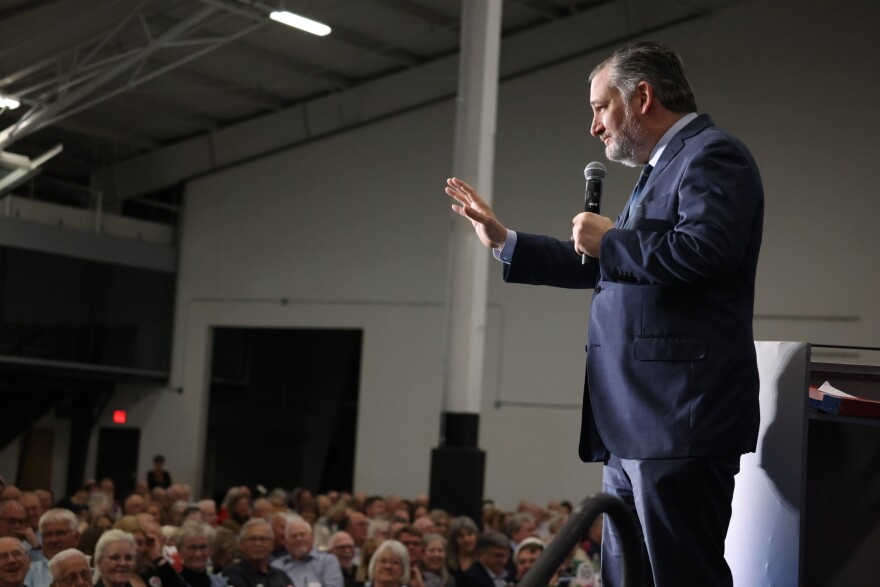
More than 1,000 people attended the fundraiser at an event center in Clive where Gov. Kim Reynolds and Sen. Ted Cruz, R-Texas, also looked to unify support for Republicans in the upcoming midterms.
Lucius Pham/Iowa Public Radio
Feenstra and rivals appeal to conservative activists
The candidates took turns answering questions from Republican Party of Iowa Chair Jeff Kaufmann, who prompted them to share their views on key conservative issues: abortion, eminent domain, school choice and religious freedom.
All five candidates oppose abortion rights. Adam Steen, former director of the Iowa Department of Administrative Services, said as governor he would push for restrictions beyond the state’s current law — which bans most abortions at about six weeks of pregnancy.
“We have to be pro-life. We have to be life at conception. It’s fundamental,” Steen said. “And I’ll say this right now — with those abortion pills that are being sent into the state of Iowa right now, we have to stop those first and foremost. Get those out of there and ensure that life is protected at conception.”
The Iowa House passed a bill Friday that includes a measure requiring medial providers to only dispense abortion-inducing drugs directly to the patient in a health care setting. It is not clear whether the bill has enough support to pass in the state Senate.
Also on Friday, a panel of the New Orleans-based 5th U.S. Circuit Court of Appeals issued a ruling temporarily blocking the mailing of the abortion pill mifepristone, requiring that it be distributed only in person in medical settings. The ruling is expected to be appealed to the Supreme Court.

Lucius Pham/Iowa Public Radio
Businessman Zach Lahn of Belle Plaine said the conservative movement should look beyond abortion. For instance, Lahn said, conservatives should advocate to reverse declines in life expectancy.
“We have to make sure that we are fighting for healthy food, for less medication, for our children, for clean water, for cancer,” said Lahn, who was endorsed by MAHA Action, an advocacy group related to the Make America Healthy Again movement.
Reynolds vetoed a measure that would have put some limits on eminent domain, but the candidates all said they oppose the use of eminent domain for private-sector projects.
Fourth District Rep. Randy Feenstra said he would protect landowners’ property rights.
“The property belongs to the American farmer, the Iowa farmer, belongs to each of us and not anything else,” Feenstra said. “And if somebody wants to run a pipeline, or whatever it might be, then it’s negotiated between the private property owner and the business. And if the private property owner says, ‘no,’ that’s it.”
Former state Rep. Brad Sherman agreed.
“A private company who’s not a common carrier for a product that’s not a public utility should never, ever get to use eminent domain,” Sherman said. “It’s just that simple.”
The GOP candidates for governor are supporters of school choice measures passed in recent years. That includes Iowa’s education savings accounts (ESAs) program, which this year gave around $8,000 in public funding per student to help families pay for tuition at private schools.
Steen called the ESA law “one of the greatest pieces of legislation” passed under Republican control in the Legislature. Current state Rep. Eddie Andrews, R-Johnston, said he would like to see the state expand school choice.
“It didn’t just start with ESAs. I led the push for just regular district-to-district school choice. Then we added public charter school choice,” Andrews said. “I understood that parents need to be in charge of their kids’ education.”
If no candidate wins at least 35% of the primary vote on June 2, the nomination will be decided at a party convention.
Lucius Pham
/
Iowa Public Radio
Reynolds says election will affect GOP achievements
Reynolds told activists at the fundraiser she plans to be on the campaign trail supporting the person chosen as the GOP nominee for governor. She said the results of the election in November will have implications for landmark conservative policies put in place under her leadership.
Reynolds listed what she considers some of Republicans’ greatest accomplishments in the Statehouse in her time as governor, including cuts to income tax rates, a broad state government reorganization and one of the most restrictive abortion laws in the United States.
“I would put our record up against anyone,” Reynolds said. “It’s what’s driven more Iowa voters to register as Republicans. In 2018, Republicans held just a 10,800 voter registration advantage. Today, we have an advantage of over 198,000.”
But Republicans should not take their advantage among active registered voters for granted, Reynolds said. Democrats, she said, are united, well-funded and motivated to win back the governor’s office.
“We have the record. We have the numbers,” Reynolds said. “So the only way that we see a Rob Sand win is if we don’t show up. If we show up, we win.”
-

 Idaho6 minutes ago
Today in History: May 2, carbon monoxide from Idaho mine fire kills 91
-

 Illinois12 minutes ago
Where Route 66 begins: A tale of boom, bust, baseball, and a ‘big house’
-

 Indiana18 minutes ago
Rapid Reaction: Indiana stomps Northwestern 9-2 at Wrigley Field
-
Iowa24 minutes ago
Republicans running for governor lay out conservative credentials
-

 Kansas30 minutes ago
Kansas State freshman Jack Fleischaker, 19, dies after falling from fraternity house window
-

 Kentucky36 minutes ago
How much does a Kentucky Derby jockey make? Highest paid, average salary and more to know
-

 Louisiana42 minutes ago
Thoroughbred season has opened at Louisiana Downs
-

 Maine48 minutes ago
‘I’m proud of my record’: Sen. Collins says she’s looking forward to Senate race