Entertainment
For beloved conductor Michael Tilson Thomas, a final bow from the podium


San Francisco — San Francisco Mayor Daniel Lurie had declared it Michael Tilson Thomas Day. City Hall glowed MTT’s trademark blue. Davies Symphony Hall, where Tilson Thomas presided over the San Francisco Symphony for an influential quarter century, was festooned with giant blue balloons.
For Tilson Thomas, it all was the culmination of what he declared in February: “We all get to say the old show business expression, ‘It’s a wrap.’”
Despite starting treatment for an aggressive form of brain cancer in summer 2021, Tilson Thomas astonishingly continued to conduct throughout the U.S. and even in Europe for the next three and a half years. But in February he learned that the tumor had returned, and the conductor declared last Saturday night’s San Francisco Symphony gala, billed as an 80th tribute to this native Angeleno, would be his last public appearance.
He was led to the podium by his husband, Joshua Robison, who remained seated on stage, keeping a watchful eye. Tilson Thomas started with Benjamin Britten’s Variations and Fugue on a Theme by Purcell, better known as “The Young Person’s Guide to the Orchestra.” After various tributes and performances in his honor, MTT, ever the great showman, went out with a bang, leading a triumphant and mystical and stunningly glorious performance of Respighi’s splashy “Roman Festivals.”
A song from Leonard Bernstein’s “On the Town” — including the line “Where has the time all gone to?” — followed as an encore, sung by guest singers and the San Francisco Symphony Chorus, just before balloons joyfully fell from above.
For six decades, beginning with his undergraduate years at USC — where he attracted the attention of Igor Stravinsky, Aaron Copland, Jascha Heifetz, Gregor Piatigorsky and the odd rock ‘n’ roll musician about town — Tilson Thomas has been a joy-making key figure in American music.
To pin MTT down is an unreasonable task. He saw a bigger picture than any great American conductor before him — his mentor and champion, Bernstein, included. With a pioneering sense of eclecticism, he connected the dots between John Cage and James Brown, between Mahler and MTT’s famous grandfather, Boris Thomashefsky, a star of the New York Yiddish theater.
Tilson Thomas has nurtured generations of young musicians and given voice to outsiders greatly responsible for American music becoming what it is. He treated mavericks as icons — Meredith Monk and Lou Harrison among them.
The San Francisco concert could touch on little of this, but it did reveal something of what makes MTT tick. In “Young Person’s Guide,” for instance, Tilson Thomas demonstrated an undying love of every aspect of the orchestra as well as his lifelong devotion to education. As a 25-year-old Boston Symphony assistant conductor, he was speaking to audiences, sharing enthusiasm that not all uptight Bostonians were quite ready for.
Not long after, he succeeded Bernstein in the New York Philharmonic Young People’s Concerts. He made television and radio documentaries. In 1987, he founded the New World Symphony in Miami Beach, training orchestra musicians. Alumni are now busy reinventing American orchestral life. In L.A., former New World violinist Shalini Vijayan curates the imaginative Koreatown new music series Tuesdays @ Monk Space.
With the young conductor Teddy Abrams at his side turning pages, Tilson Thomas treated “Young Person’s Guide” more as a seasoned player’s guide to the orchestra. A hallmark of Tilson Thomas’ tenure in San Francisco had been to encourage a degree of free expression typically stifled in ensemble playing. Britten’s score is a riot of solos, and this time around they all seemed to be saying, in so many notes: “This is for you Michael.”
Michael Tilson Thomas conduct’s Britten’s ‘Variations and Fugue on a Theme of Purcell’ to open his gala concert with the San Francisco Symphony at Davies Symphony Hall.
(Stefan Cohen / San Francisco Symphony)
This is for you, Michael, as was all else that followed. While Tilson Thomas sat in a chair at the front of the stage looking at the orchestra, Abrams — music director of the Louisville Orchestra and a Berkeley native who began studying at age 9 with Tilson Thomas — led the rousing overture to Joseph Rumshinsky’s Yiddish theater comedy, “Khantshe in Amerike.” Bessie Thomashefsky, Tilson Thomas’ grandmother, was the original Khantshe in 1915.
Throughout his career Tilson Thomas has been an active composer, but only in recent years had he finally began more actively releasing his pensive and wistful songs that served as informal entrees in a private journal. Mezzo soprano Sasha Cooke led off with “Immer Wieder” to a poem by Rilke. Frederica von Stade, still vibrant-sounding at 79, joined her for “Not Everyone Thinks I’m Beautiful.”
The two songs tenor Ben Jones turned to, “Drift Off to Sleep” and “Answered Prayers,” were moving odes to melancholy. The Broadway singer Jessica Vosk — whose career in show business was launched when Tilson Thomas picked her out of the San Francisco Symphony Chorus to be a soloist in “West Side Story” — lifted spirits with “Take Back Your Mink” from “Guys and Dolls,” but then reminded us why we were all there with Tilson Thomas’ “Sentimental Again.”
Cooke sang “Grace,” which Tilson Thomas wrote for Bernstein’s 70th birthday but which here took on a brave new meaning in its final stanza: “Make us grateful whatever comes next / In this life on earth we’re sharing / For the truth is / Life is good.”
Edwin Outwater, who got his start as an assistant conductor to Tilson Thomas in San Francisco, led the inspirational finale of Bernstein’s “Chichester Psalms” before Tilson Thomas returned to raise the roof with “Roman Festivals.”
Respighi’s evocations of gladiators at the Circus Maximus, of early Christian pilgrims and other scenes of ancient Roman life, seem a surprisingly odd epilogue to an all-American conductor’s storied career. But Tilson Thomas has always been an arresting programmer, even in his 20s when he served as music director of the Ojai festival. “Roman Festivals” has long been a Tilson Thomas favorite. He recorded it with the L.A. Phil in 1978, relishing the details of ancient Rome in all its intricate and realistic complexity.
This last time, Tilson Thomas offered an epic, yet longing, look back. Trumpets blared with startlingly loud majesty. Pilgrims were lost in stunning meditative refinement. In the last of the four festivals, “The Epiphany,” grace and grandeur merged as one, with final, firm orchestral punctuation massively powerful. It was as if Tilson Thomas was saying to the audience, “This one is for you. And I’m still here saying it.”
Tilson Thomas has made a practice of musing about what happens when the music stops. What is left? How long does the music stay with us, somewhere inside? Can it change us? Does it matter?
From the instant Tilson Thomas became music director of the San Francisco Symphony in 1995, he treated the orchestra as an essential component of San Francisco life. His successor, Esa-Pekka Salonen, has taken that to heart with the kind of innovatory spirit that he had brought to the L.A. Phil. The orchestra’s management has not, however, provided needed support, and Salonen is leaving in June. Musicians stood outside Davies handing out fliers to the audience demanding that the orchestra pursue Tilson Thomas’ mission.
The San Francisco Symphony has reached a turning point. Respighi wrote of “The Epiphany” that he wanted frantic clamor and intoxicating noise, expressing the popular feeling “We are Romans, let us pass!” Tilson Thomas beat out those three emphatic staccato orchestral chords — Let! Us! Pass! — as though meant to ring and ring and ring, as lasting as centuries-old Roman monuments.

Entertainment
Justin Baldoni and wife break silence after ‘It Ends With Us’ legal battle with Blake Lively

Justin Baldoni has broken his silence after reaching a settlement in a lengthy and highly publicized legal dispute with Blake Lively.
Baldoni and his wife, Emily Baldoni, presented a united front in an Instagram video the couple shared Wednesday that began, “So we have not spoken publicly for the better part of the last two years, and it’s not because we haven’t had anything to say, because Lord knows we have.”
The “It Ends With Us” actor and director said that although they’d wanted to address the debacle that involved dueling lawsuits with Lively, nearly two years of tit-for-tat fodder and culminated in a confidential settlement, “something was telling us not to.”
The couple said they prayed about when to make a public statement. “This feels like the moment,” Emily said.
“What does feel important,” she continued, “is that we can genuinely say that we are sitting here today feeling immense gratitude for so many things and so many people and so many things that have happened to us.”
“Gratitude has saved us,” Justin added.
“I also feel that it’s important as we say that — in that gratitude — it doesn’t negate the injustice and the pain that we have also felt in the last few years, and we’ve had to wrestle with so many things and try to understand so many things,” Emily said. “How could something like this even happen? Let alone disguised as a fight for women. So much to unpack. And the truth is, reality is, is that there’s been a lot of trauma for us to move through as a family, which also makes it hard to speak.”
“We don’t even know this is the right thing to say, but we just know we need to share something,” Justin said. “What I will say is that there have been so many painful things that have been spoken into existence — “
“Untruthful,” Emily broke in.
“We didn’t want to add to the noise, so we just wanted to let the justice system run its course,” he said.
“And the truth and the facts have spoken for themselves,” Emily said.
The couple’s statement comes a year and a half after Lively filed a bombshell lawsuit against Baldoni alleging sexual harassment, retaliation and several other charges on the heels of a messy “It Ends With Us” summer release and press tour that fueled rumors of on-set turmoil.
Less than a month after the allegations against Baldoni rallied Hollywood against him, he countersued Lively, her publicist Leslie Sloane and her husband, Ryan Reynolds, for $400 million in damages, claiming they’d smeared his name in the press and wrestled away his control of the film. His suit was later dismissed.
In May, two weeks ahead of the trial, Lively and Baldoni reached an agreement to resolve their legal dispute, bringing an abrupt end to the contentious battle.
“The parties in the Blake Lively and Wayfarer Studios litigation have reached an agreement to resolve the matters,” lawyers for both sides said in a joint statement.
“The end product — the movie ‘It Ends With Us’ — is a source of pride to all of us who worked to bring it to life. Raising awareness, and making a meaningful impact in the lives of domestic violence survivors — and all survivors — is a goal that we stand behind. We acknowledge the process presented challenges and recognize concerns raised by Ms. Lively deserved to be heard. We remain firmly committed to workplaces free of improprieties and unproductive environments. It is our sincere hope that this brings closure and allows all involved to move forward constructively and in peace, including a respectful environment online.”
In June, a federal judge ordered Baldoni and his production company to pay Lively’s attorney fees related to his unsuccessful defamation lawsuit against her, but rejected her bid for additional damages.
“So, how are we doing?” the filmmaker said in the Instagram video. “We are healing, and if you’ve ever been through something traumatic, you know that healing isn’t linear. It lives different every day, and we have had to rethink for ourselves what is real. What matters, and it’s this. It’s our family. It’s our friends. It’s our community. It’s our faith.”
Times staff writer Josh Rottenberg contributed to this report.
Movie Reviews
‘The Guest’ Review: Trine Dyrholm Gives a Scorcher of a Performance in a Gutsy Danish Party-Gone-Wrong Drama

A family and friends gather for a naming-day ceremony at a Danish seaside hotel, but an unexpected appearance by one uninvited attendee (Trine Dyrholm) ruptures the veil of bland, happy-clappy familial unity in director Mads Mengel’s gutsy, well-wrought debut feature, The Guest.
The most audacious move here may be Mengel and co-screenwriter Christian Bengtson’s choice to write something that will inevitably invite comparisons with Festen (The Celebration), arguably the most notorious Danish-language film of the last 30 years, which similarly revolved around a bougie gathering disrupted by angry revelations. But there’s a savvy 2026 vibe about the way the film refuses to create florid melodrama out of quotidian crisis, and instead observes with generosity as the characters grope awkwardly toward emotional détente and mutual forgiveness.
The Guest
The Bottom Line When wetting the baby’s head goes too far.
Venue: Karlovy Vary Film Festival
Cast: Simon Bennebjerg, Trine Dyrholm, Josephine Park, Peter Gantzler, Petrine Agger, Mette Klakstein Wiberg, Kristine Kujath Thorp, Buster Lund Luscher
Director: Mads Mengel
Screenwriter: Christian Bengtson, Mads Mengel
1 hour 40 minutes
Festen-alumnus Dyrholm, having a bit of a career moment with outstanding performances both here and in the recent The Girl With the Needle among others, leads a uniformly excellent cast in a work that deserves celebration on the festival circuit and beyond.
Dyrholm’s Vibeke is technically the first person we meet, although she’s seen only in shadow at first as she smokes and drives while her unattached seatbelt, caught outside by a closed door, clatters on the road. This is the kind of unsafe driving her son Karl (Simon Bennebjerg) so deplores, a point of contention later on in the story when he will steal her car keys in interest of her own safety and that of others.
But well before we get to that flashpoint, the film introduces Karl, effectively the film’s protagonist, as he arrives at the swanky resort with his wife Emilie (Mette Klakstein Wiberg) and their infant son Elliot (Buster Lund Luscher). The young family, who’ve chosen this new, secular tradition instead of a christening to welcome their child to the world, are there a day before the ceremony to meet up with core family members.
As this advance party settles down for dinner, a table that includes Karl’s sister Rikke (Josephine Park) and Emilie’s parents Frank (Peter Gantzler) and Kirsten (Petrine Agger), there’s a surprise: Vibeke is coming, courtesy of Rikke’s invitation. Karl is quietly furious and seems determined to turn her away, even when she shows up minutes later. Poor Frank and Kirsten look on confused, determinedly polite in their insistence that all family members should be welcome.
Bengtson and Mengel’s economical script carefully dripfeeds backstory as the film unfolds to explain that Karl hasn’t spoken to his mother in years, that Rikke has taken over all the daily mom management and that she’s very worn out by it. Even so, she insists Vibeke is regularly taking her medication and isn’t a problem these days, although to Karl every weird anecdote and moment of emotional intensity is an augur of impending chaos. Rikke counters that their mother is just “big, that’s her personality not her condition.”
Interestingly, that specific condition is never named throughout, although armchair diagnosticians might spot many of the signs of bipolar disorder. But the film’s emotional focus on the person and her actions rather than the label is also very contemporary, reflecting a more holistic, inclusive mindset and approach to dealing with mental health issues.
Which is all fine and dandy, until Vibeke duly does skip a dosage and starts getting manic. One of the first signs of chemical imbalance arrives during the ceremony on the beach, when Vibeke carries little Elliot much further away from the shore than anyone wants, creating a panic. From there it just gets worse as Vibeke picks up on the censorious feeling emerging from the other party guests, who had found her so charming the night before when she’d led everyone to the casino to play roulette and diverted a bunch of partying teenagers from the room next to Karl and Emilie so they could get some sleep. When the toasts at the formal dinner begin, Vibeke’s mood darkens much further, and if we’ve all learned one thing from Festen, it’s be very afraid when a Dane gets up to make a toast.
Cinematographer David Bauer’s nimble-footed lensing and use of natural light does indeed hark back considerably to the look of those Dogme 95 movies back in the day, as does the naturalistic editing style deployed by Louis Emil Ramm Seeberg. But there are plenty of sins against the rules of cinematic chastity that marked that movement, such as the ample space made for Lasse Aagaard’s affecting, low-key score that amps up the anxiety as Vibeke starts to spiral.
That said, Mengel keeps things simple in sonic terms when it really counts, letting the musicality of Dyrholm’s deep, sonorous voice ring out on its own in the big monologue scenes. She is, as ever, utterly mesmerizing but the performance is made even more powerful by the muted, expressive reactions of the rest of the cast as they look on, frozen like deer in the headlights of the car crash of pseudo-christening. Moments of levity puncture the gloom, but the final feeling is one of numbed sorrow and pity for all these kind, fallible people, just trying to do their best.
Entertainment
Rhea Seehorn celebrates her ‘Pluribus’ Emmy nomination as she waits to hear about Carol and the atom bomb
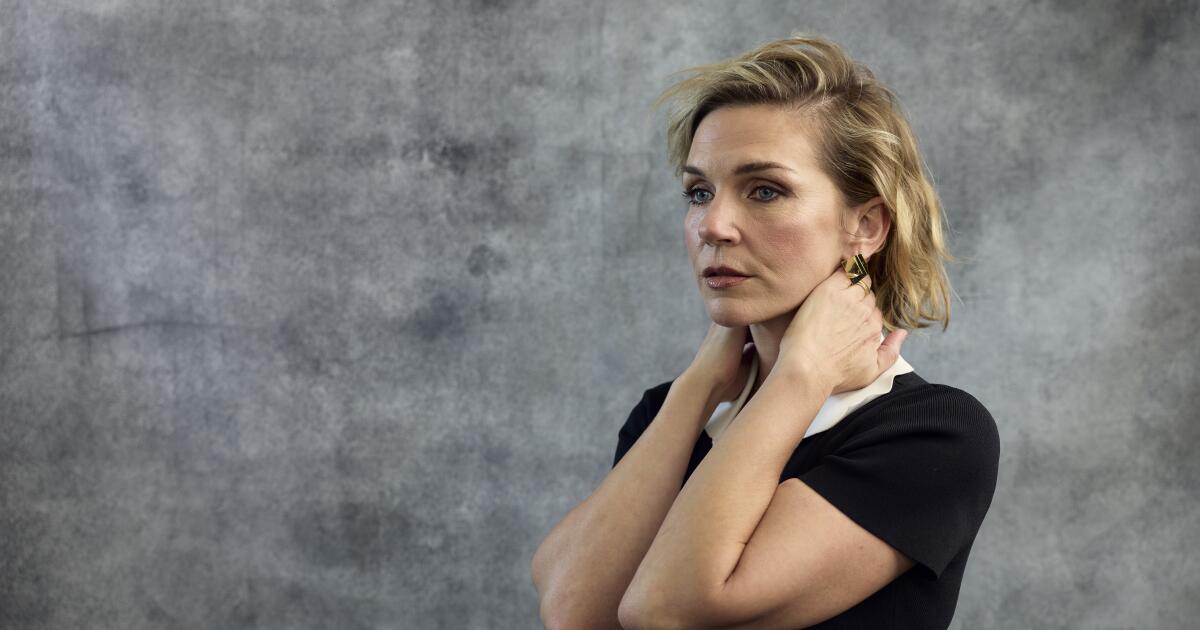
Rhea Seehorn was nervous about whether “Pluribus” would be recognized by Emmy voters Wednesday when nominations were announced. So she was jubilant when she and the surreal sci-series on Apple TV scored 18 nominations, the most for a first-year drama.
“I’m just so grateful,” the actor said in a phone interview. “People were like, ‘Why were you nervous?’ Honestly, you never actually know. I’m just so thrilled for the show, my co-stars, the production design, the editing, the writing, the music, the sound. I haven’t moved from my couch since they first announced everything because I’m still trying to call everybody on the show.”
Seehorn received a nomination for lead actress in a drama series for her portrayal of cynical Carol Sturka, a fantasy romance author who finds herself in a mystifying situation after a virus seems to have wiped out most of Earth’s population. The series was created by Vince Gilligan, who created the acclaimed series “Breaking Bad” and co-created its spinoff “Better Call Saul,” which also featured Seehorn.
The actor compared her experience of being nominated for “Pluribus” to “Better Call Saul,” which earned her two supporting actress nominations: “ ‘Better Call Saul’ was such a family that supported and cheered each other on, and I’m so grateful I have that environment again. People could not be happier for each other, and we get to celebrate the show together.”
She added, “The only part that feels different is that it’s my first nomination as a lead. It’s the process of Vince writing this for me and seeing the mountain which he wanted me to climb and going through that process. The whole thing has been its own journey, so ending up with awards and nominations, and being so well received by critics and fans is not lost on me.”
The series has been applauded for its mix of drama, comedy and strangeness in its portrait of a woman coming to terms to what seems like an impossible dilemma.
“I love the storytelling, how much Vince and I would drill down on making this as authentic as we could in terms of an everyman who has to deal with an insane situation,” Seehorn said. “Most of us are just not heroic or leaping off the couch to go save the world. And Carol is dealing with immense grief and confusion in an utter dystopian crisis. I love the humor and the drama that comes out of us being as realistic as we can with her amidst an unrealistic event.”
Fans of “Pluribus” have been relentlessly curious since the finale in December about when the second season will launch.
“I don’t know anything about that,” Seehorn said. “I don’t have to keep secrets because I’m not great at keeping them, and I know nothing. I don’t know what I’m doing with an atom bomb in the driveway. I can’t wait to find out. The writers want to have the same quality and reward the intelligence of the fans and never phone a single thing in. So their process is their process.”
-
Entertainment2 minutes ago
Justin Baldoni and wife break silence after ‘It Ends With Us’ legal battle with Blake Lively
-
 Lifestyle4 minutes ago
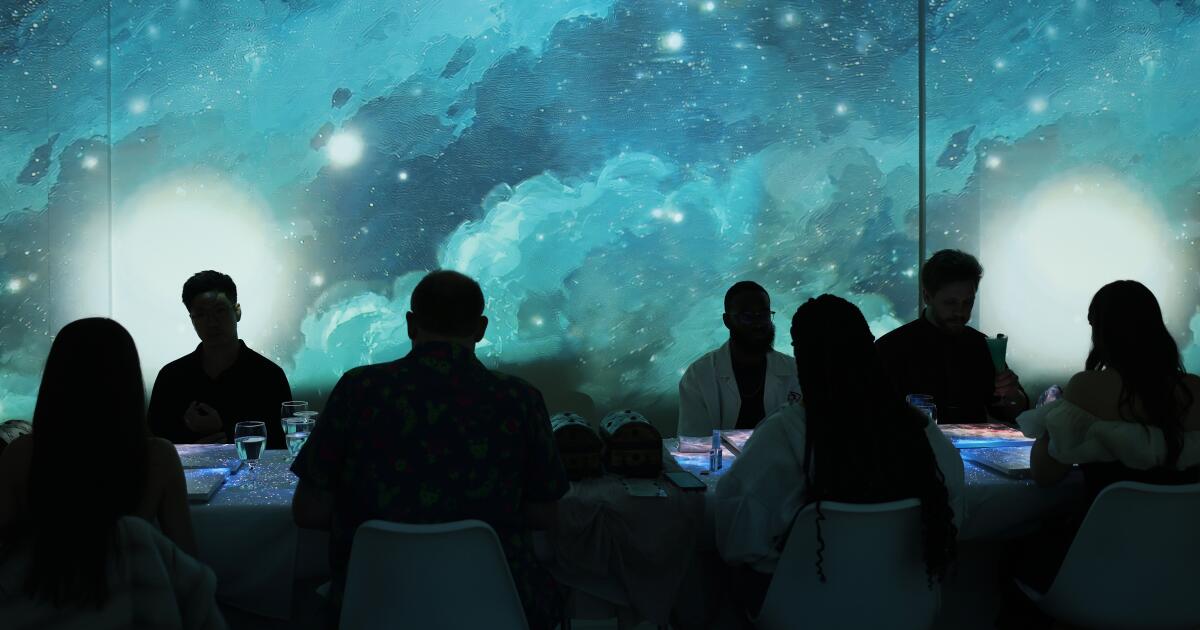
A meal with an animated Mona Lisa? Immersive dining goes high tech — but will L.A. eat it up?
-
 Politics10 minutes ago
Nexstar launches its first digital subscription service with The Hill Insider, aimed at political junkies
-
 Science17 minutes ago
Not everyone is leaving California. A new commercial battery maker just landed in Sacramento
-
 Sports20 minutes ago
Mookie Betts’ eighth-inning single gives Dodgers the win over the Rockies
-
World32 minutes ago
From sewers to swimming sites: how Europe's cities reclaim their rivers
-

 News1 hour ago
Three more people charged with damaging Reflecting Pool after Trump’s multimillion-dollar restoration | CNN Politics
-

 Los Angeles, Ca2 hours ago
Loved ones search for missing 34-year-old Southern California woman

