Northeast
Karen Read appeals double jeopardy ruling to US Supreme Court

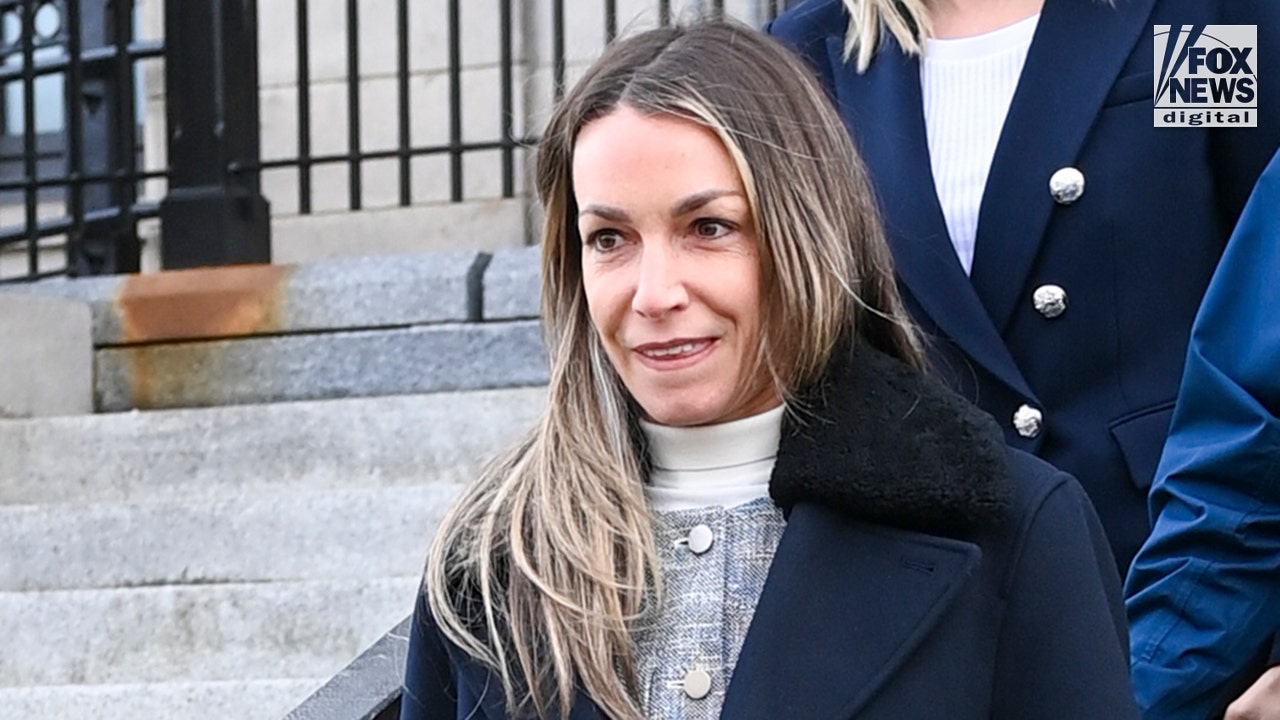
With jury selection underway for her second murder trial in the death of Boston Police Officer John O’Keefe, attorneys for Karen Read are appealing a lower court’s ruling that she is not facing double jeopardy to the U.S. Supreme Court.
Read’s first trial ended with a mistrial last year, but her lawyers have argued that the jury agreed unanimously that she was not guilty of two of the three charges, including the most serious of murder, and that keeping those on the books for her second trial is unconstitutionally placing her on trial twice for the same crime.
This agreement was unannounced at trial, however.
PROBE OF TOWN POLICE IN KAREN READ CASE FINDS NO SIGN OF ‘CONSPIRACY TO FRAME’ SLAIN OFFICER’S GIRLFRIEND
Karen Read exits Norfolk Superior Court in Dedham, Massachusetts, on Wednesday, April 2, 2025. (Dario Alequin for Fox News Digital)
According to the 149-page filing, Read’s lawyers are presenting the high court with two questions:
- Whether a final and unanimous, but unannounced, decision by a jury following trial that the prosecution failed to prove a defendant guilty of a charged offense constitutes an acquittal precluding retrial under the Double Jeopardy Clause.
- Whether a defendant who produces credible evidence of such a final, unanimous, and unannounced acquittal is entitled to a post-trial hearing to substantiate the fact of such acquittal.
KAREN READ AND JOHN O’KEEFE: INSIDE EVOLUTION OF BOSTON MURDER MYSTERY SINCE JULY MISTRIAL
Officer John O’Keefe poses for his official headshot. O’Keefe’s girlfriend, Karen Reed, is currently on trial for murder after he was found dead outside a Massachusetts home in January 2022. (Boston Police Department)
The Fifth Amendment guarantees constitutional protection from facing double jeopardy – trial or punishment for the same offense twice.
After a mistrial, a retrial can normally proceed – but Read’s lawyers argue the unique circumstances in her case place her under double jeopardy on the two charges jurors agreed on but did not announce.
GO HERE FOR FULL COVERAGE OF THE 2ND KAREN READ TRIAL
Karen Read and John O’Keefe pose in an undated photo. (Karen Read)
Over days of stalled deliberations, jurors repeatedly sent notes to the court explaining they were at an impasse, and Judge Beverly Cannone instructed them to keep trying. Deliberations began on June 25, 2024. By July 1, with jurors still deadlocked, the judge declared a mistrial.
In their appeal, Read’s lawyers said the judge did not give counsel for either side the opportunity to speak and dismissed the jury without asking them if they were locked on all charges or any charges individually.
KAREN READ JURY SELECTION: DOZENS IN POOL ALREADY HAVE AN OPINION ON THE CASE
Karen Read sits in court during jury selection at Norfolk County Superior Court on Thursday, April 18, 2024 in Dedham, Massachusetts, for her first trial. (David McGlynn/New York Post via AP, Pool)
The next day, a juror identified as Juror A contacted Read’s attorney, Alan Jackson, and told him that the panel had “unanimously agreed that Karen Read is not guilty of Count 1 (second-degree murder),” according to the lawsuit.
Text messages purportedly sent from Juror B expressed similar claims, according to the lawsuit. Jurors C and D also reached out to Read’s team with similar versions of events, according to the filing.
Additionally, at least one juror said it in a voicemail for prosecutors.
FOLLOW THE FOX TRUE CRIME TEAM ON X
Karen Read smiles as defense attorney David Yannetti speaks to reporters in front of Norfolk Superior Court after the judge declared a mistrial after jurors were unable to reach a verdict following a two-month trial on Monday, July 1, 2024 in Dedham, Massachusetts. (AP Photo/Steven Senne)
“It was not guilty on second degree,” Juror B wrote in a text shared with another Read attorney, David Yannetti. “And split in half for the second charge…I thought the prosecution didn’t prove the case. No one thought she hit him on purpose or even thought she hit him on purpose.”
In a phone conversation, Read’s lawyers claim Juror B clarified the second sentence of that text, saying it should have read, “No one thought she hit him on purpose or even knew that she had hit him.”
SIGN UP TO GET TRUE CRIME NEWSLETTER
Judge Beverly Cannone looks over the verdict slip the jurors have to fill out when they reach a verdict in Karen Read’s murder trial on Wednesday, June 26, 2024 at Norfolk Superior Court in Dedham, Massachusetts. (Greg Derr/The Patriot Ledger via AP, Pool)
The murder charge was “off the table,” according to the filing, and Juror A also said jurors agreed that Read was not guilty of leaving the scene.
Read was arrested on charges of drunken driving, manslaughter and leaving the scene of an accident, and later indicted for the additional charge of second-degree murder after she allegedly backed into O’Keefe outside a party and drove away, leaving him to die on the ground in a snowstorm.
If her appeal is successful, she would just face the manslaughter charge.
Karen Read appears with her attorneys, Alan Jackson and David Yannetti, during the first day of jury selection at Norfolk Superior Court on Tuesday, April 1, 2025 in Dedham, Massachusetts. (Nancy Lane/The Boston Herald via AP, Pool)
Appellate courts in Massachusetts have already denied her request, finding that because no verdict had been read in court, she was not acquitted of any charges and is not facing double jeopardy. Her legal team turned to the nation’s highest court this week, asking them to review a lower court’s decision and for a post-trial hearing on the matter.
Read could face life in prison if convicted of second-degree murder at her second trial, which began Tuesday. She has pleaded not guilty and denied involvement in O’Keefe’s death, with her defense presenting her as a scapegoat being framed by the alleged true killers.
Read the full article from Here


Watch CBS News
Pittsburg, PA
Trash pickup schedules adjusted in Pittsburgh-area communities due to impending heat wave

Several communities in the Pittsburgh area have adjusted their trash pickup times as the region is bracing for a heat wave with temperatures and heat indexes expected to be near 100 degrees this week.
The hottest temperatures of 2026 are expected this week and by Tuesday afternoon, temperatures are anticipated to reach into the 90s. This, coupled with extremely high humidity levels, means the heat index — also known as the “feels like” temperature — will flirt with triple digits.
In Mt. Lebanon, trash and recycling pickup routes will begin earlier than normal to help keep workers safe amid the extreme heat.
“All trash and recycling should be placed at the curb the night before your scheduled collection day, as collection times may occur earlier than usual,” a notice posted on municipality’s Facebook page said.
Shaler Township said that it received an update from County Hauling that collection crews will begin their routes earlier than normal this week as well.
“Please place all trash and recycling at the curb the night before your scheduled collection day,” the township said.
In Robinson Township, trash collection will begin at 5 a.m. on Tuesday, one hour earlier than normal.
People are being asked to have their trash and recycling at the curb at least one hour prior to their normal pickup time.
Pleasant Hills Borough said it had adjusted its trash pickup schedule for earlier in the day on Friday to “help reduce employee exposure to hazardous temperatures.”
“This temporary adjustment is being made in the interest of employee health and safety,” the borough said. “We kindly ask that you help notify your residents that all trash and/or recycling should be placed at the curb the night before their scheduled collection day, as collection times may occur earlier than usual.”
In Brentwood Borough, Noble Environmental will begin earlier collection on pickup routes as well.
People are being asked to place their trash and recycling at the curb the night before their scheduled collection day.
The borough added that collection days are not changing, only the start time of the pickup routes.
“Thank you for your cooperation as crews work safely during this week’s heat wave,” the borough said.
The Library Volunteer Fire Company said that trash pickup in South Park Township is being moved earlier on Thursday.
“We kindly ask Township residents to place trash and recycling at the curb the night before Thursday, July 2nd pickup, as collection times may occur earlier than usual,” the notice said.
Connecticut
New Haven asks for retrial after jury awards Connecticut man $38M in wrongful conviction lawsuit

NEW HAVEN, Conn. — The City of New Haven is asking for a retrial after a jury awarded a Connecticut man $38 million in May for being wrongfully convicted of murder and imprisoned for 21 years.
Stefon Morant was allegedly wrongfully convicted of a double homicide in 1994. According to the New York-based law firm of Neufeld Scheck Brustin Hoffmann & Freudenberger, LLP, the jury ruled New Haven police officers and the City of New Haven were liable for his wrongful imprisonment.
The jury found that New Haven police detectives made up false evidence to frame Morant and that the city was liable for suppressing evidence favorable to criminal defendants.
A judge has issued a temporary stay, pausing any payments until the motion is resolved.
-

 Detroit, MI19 minutes ago
18 New Kid-Friendly Places That Opened in Metro Detroit in 2026 (So Far!)
-

 San Francisco, CA34 minutes ago
Anza expedition celebrates 250th anniversary in San Francisco
-

 Dallas, TX37 minutes ago
Preston Hollow residents oppose proposed $800 million mixed-use development in Dallas, survey reveals
-

 Miami, FL42 minutes ago
Bradley Beal to Miami Heat rumors draw skepticism
-

 Boston, MA49 minutes ago
Boston Pops surprise travelers at Logan Airport with July 4th preview performance
-

 Denver, CO50 minutes ago
Denver Broncos Crack Top 10 in NFL Uniform Rankings
-

 Seattle, WA57 minutes ago
PHOTOS: Visiting all 12 stops during this year’s West Seattle Garden Tour
-

 Milwaukee, WI1 hour ago
Milwaukee Barbecue: A Legacy of Smoke

