Kansas
Bishop McKnight tapped to follow Naumann as archbishop of Kansas City, Kansas


Vatican City, Apr 8, 2025 /
10:10 am
The Vatican on Tuesday announced Pope Francis’ choice of Bishop Shawn McKnight of Jefferson City, Missouri, as the next archbishop of Kansas City in Kansas, following the resignation of Archbishop Joseph Naumann.
Naumann is retiring after turning 75 in June 2024 and after 20 years at the helm of the Archdiocese of Kansas City, Kansas, which has over 180,000 Catholics and a total population of nearly 1.4 million. Pope Francis accepted Naumann’s resignation on April 8 after the Kansas City archbishop submitted his letter last year as required by canon law.
Originally from St. Louis, Naumann was appointed coadjutor archbishop of Kansas City in January 2004 and assumed the role of archbishop one year later when his predecessor retired. Prior to that, he served for nearly seven years as an auxiliary bishop of St. Louis, the archdiocese in which he had been ordained a priest in 1975.
From 2018-2021, Naumann was chairman of the pro-life committee of the U.S. Conference of Catholic Bishops (USCCB), for which he now serves as a consultant.
For the 56-year-old McKnight, the appointment marks a return to his home state — and a move just 150 miles to the west — after seven years in Missouri’s capital city.
The archbishop-designate, who will be installed in the Archdiocese of Kansas City, Kansas, on May 27, said in an April 8 statement that he was grateful for his seven years leading the Catholics of the Diocese of Jefferson City, his “first flock as a bishop.”
Kansas City, Kansas, on the border with the state of Missouri, is part of the greater metropolitan area of Kansas City, which also includes the separately incorporated city of Kansas City, Missouri (part of the Catholic Diocese of Kansas City-St. Joseph).
Prior to his nomination as bishop of Jefferson City, McKnight, one of seven children, was a priest of the Diocese of Wichita, Kansas, where he was ordained in 1994.
The bishop has a bachelor’s degree in biochemistry from the University of Dallas and both a licentiate and a doctorate in sacred theology from the Pontifical Athenaeum of St. Anselm in Rome. His dissertation was on the permanent diaconate.
McKnight was an adjunct professor of theology and visiting scholar in the Bishop Gerber Institute of Catholic Studies at Newman University in Wichita from 2000-2001. He also served as a university chaplain.
From 2003-2008, McKnight taught liturgy and homiletics, and held several administrative roles, including dean of students at the Pontifical College Josephinum, a seminary in Columbus, Ohio.
He spent six years in Washington, D.C., serving as executive director of the Secretariat for Clergy, Consecrated Life, and Vocations of the USCCB before returning to serve in a parish in Wichita.
Pope Francis named him the fourth bishop of Jefferson City in early 2018.

Hannah Brockhaus is Catholic News Agency’s senior Vatican correspondent. After growing up in Omaha, Nebraska, she earned a degree in English from Truman State University in Missouri. In 2016, she moved to Rome, Italy, where in her spare time she enjoys reading and going on adventures with her husband and son.



Editor’s note: The video above aired in May.
WICHITA, Kan. (KSNW) — Voters in a southwest Kansas County have decided to remove their sheriff from office.
On Tuesday, Morton County residents voted 311-206 to recall Sheriff Thad Earls.
The sheriff came under heavy criticism from the Board of County Commissioners and the county attorney, who accused him of everything from mishandling evidence to falsifying employee time sheets.
In a letter posted on Facebook, the commissioners said 12 grams of methamphetamine went missing “under Mr. Earls’ watch.”
The sheriff denied any wrongdoing. He said that the officer who mishandled the meth was fired and that all county departments have incorrect time sheets, which are “revised all the time.”
Last month, the Kansas Bureau of Investigation told KSN that it was looking into the allegations.
The results of the election will be certified on Monday. Earls will leave his office the next day, under state law.
For more Kansas news, click here. Keep up with the latest breaking news by downloading our mobile app and signing up for our news email alerts. Sign up for our Storm Track 3 Weather app by clicking here. To watch our shows live on our website, click here.

KSHB 41 anchor/reporter Daniela Leon covers transportation-related issues in Kansas City. Share your story idea with Daniela.
—
The first express toll lanes in Kansas are seeing slow but steady growth as most drivers along U.S. 69 continue to use the free lanes.
As part of our effort to capture a range of commuter perspectives, we spoke with drivers who regularly travel the corridor. Opinions were split.
First-of-its-kind 69Express lanes see rising but limited use
Amanda says the 69Express lanes have made a noticeable difference in her commute.
“I use it every day when I go to work, especially if there’s traffic. It really helps when I’m in a rush,” she said.
KSHB 41
But others, like Andrew, avoid the express toll lanes altogether.
“I moved here from a small town, so this construction was new to me. I’m glad it’s over,” Andrew said. “I never take the express lanes. I don’t think there’s a purpose for them.”
KSHB 41

Some drivers fall somewhere in between.
“The express lanes are there for you to use,” Larry said. “If you want to use it, use it. If you don’t, then don’t. Quit worrying about it.”
KSHB 41

The Kansas Department of Transportation says roughly 90,000 vehicles travel U.S. 69 every day.
In March, about 51,000 drivers used the express lanes — in total for the month, not per day. That number climbed to 64,000 in April, indicating growing interest in the new pay-to-drive option.
But when you compare monthly express lane usage to the total traffic on the highway, only about 1% to 2.5% of drivers are choosing the express toll lanes. The rest are sticking with the free lanes.
KSHB 41
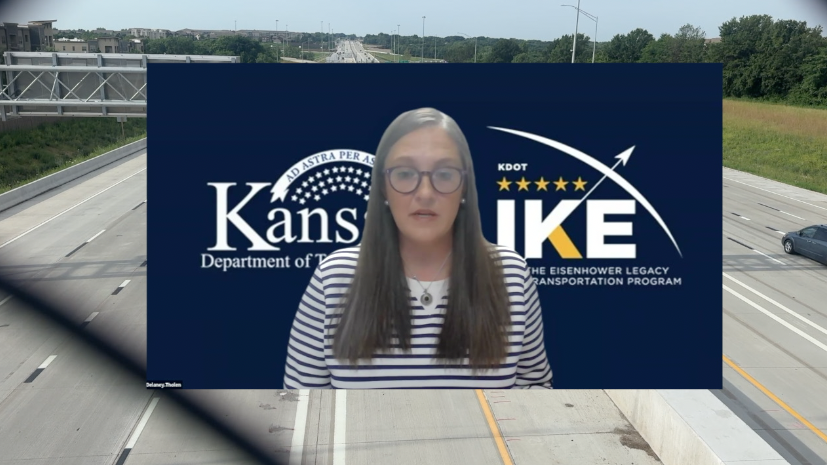
“As construction has been wrapping up and the express lanes opened in February, we anticipated that there would be a time period of folks getting used to the express lanes. And we also knew that because of some of the interchange improvements and other work that was part of the 69Express project that congestion would be relieved on its own without people having to choose to use those lanes,” said KDOT spokesperson Delaney Tholen. “As we look down the road into the future, we see that there will be more people living in the area, more people traveling through the corridor, and we expect that more people will be choosing on a daily basis to utilize the express lanes.”
The 69Express lanes stretch from 103rd Street to 151st Street. Toll prices vary depending on the direction of travel, time of day, traffic congestion and whether drivers are paying with KTAG.
According to KDOT, the lanes generated more than $43,000 in revenue in March. Figures for April have not yet been released.
Daniela Leon 
“Funding for this project came from state, local and federal sources,” Tholen said. “The city of Overland Park also committed money to the project, and that money will be repaid through revenue collected from the express lane tolls.”
KDOT has not yet calculated exactly how much time drivers are saving by using the lanes.
A reminder: express toll lanes follow the same speed limit as other lanes. In May, Overland Park police reported issuing 42 warnings and 20 citations for lane violations on U.S. 69.
This story was reported on-air by a journalist and has been converted to this platform with the assistance of AI. Our editorial team verifies all reporting on all platforms for fairness and accuracy.
—

WICHITA, Kan. (KSNW) — A day after the Kansas Department of Health and Environment issued a public health advisory for blue-green algae in Kansas lakes, a fisherman found hundreds of dead fish in Clearwater’s Chisholm Ridge ponds.
He said what he found surprised him.
“I was kind of in shock,” Ryder Frickey said. “It started out by I just saw one, and I looked more down the bank, and I just saw hundreds of them. Didn’t really know what to say or do.”
According to the KDHE, blooms of blue-green algae can impact how much oxygen is in the water, and low oxygen can result in fish mortality.
Walter Dodds, a professor of biology at Kansas State, said warm temperatures also help blue-green algae grow and spread.
“So, it’s just kind of a one-two whammy of making the algae grow more, but there’s less oxygen in the water,” Dodds said.
This is not uncommon. Dodds said several lakes in Kansas have routine blooms.
Although the cause of the spread is unclear, Dodds speculates that fertilizer runoff could be a factor, which helps algae grow.
“We did get those spring rains, pretty hard spring rains,” Dodds said. “And so, it’s possible that people fertilized and then just shot it all in there and just dumped a whole bunch of fertilizer into the system.”
Clearwater is cleaning up the fish in both ponds on Tuesday, but, for now, there is not much to do other than let the algae take its course and wait a couple of weeks.
For more Kansas news, click here. Keep up with the latest breaking news by downloading our mobile app and signing up for our news email alerts. Sign up for our Storm Track 3 Weather app by clicking here. To watch our shows live on our website, click here.
-

 Tennessee3 minutes ago
Comparing Tennessee’s Neyland Entertainment District to others in college sports
-

 Texas6 minutes ago
Where to watch Texas Rangers vs Kansas City Royals: TV channel, start time, streaming for June 10
-

 Utah11 minutes ago
New NBA Draft Intel: AJ Dybantsa, Darryn Peterson and Utah
-

 Vermont18 minutes ago
Vermont Green FC plays Canada’s national soccer team in World Cup tuneup – VTDigger
-

 Virginia21 minutes ago
Navy sailor sentenced to 44 years for killing fellow service member Angelina Resendiz in his Virginia barracks room
-
Washington26 minutes ago
Where to watch Washington Nationals vs San Francisco Giants: TV channel, start time, streaming for June 10
-

 Wisconsin33 minutes ago
Chris Borland heads back to Wisconsin as Hall of Fame inductee
-

 West Virginia36 minutes ago
West Virginia Democrats re-elect Mike Pushkin, elect new leadership team – The Real WV

