Kansas
Bishop McKnight tapped to follow Naumann as archbishop of Kansas City, Kansas


Vatican City, Apr 8, 2025 /
10:10 am
The Vatican on Tuesday announced Pope Francis’ choice of Bishop Shawn McKnight of Jefferson City, Missouri, as the next archbishop of Kansas City in Kansas, following the resignation of Archbishop Joseph Naumann.
Naumann is retiring after turning 75 in June 2024 and after 20 years at the helm of the Archdiocese of Kansas City, Kansas, which has over 180,000 Catholics and a total population of nearly 1.4 million. Pope Francis accepted Naumann’s resignation on April 8 after the Kansas City archbishop submitted his letter last year as required by canon law.
Originally from St. Louis, Naumann was appointed coadjutor archbishop of Kansas City in January 2004 and assumed the role of archbishop one year later when his predecessor retired. Prior to that, he served for nearly seven years as an auxiliary bishop of St. Louis, the archdiocese in which he had been ordained a priest in 1975.
From 2018-2021, Naumann was chairman of the pro-life committee of the U.S. Conference of Catholic Bishops (USCCB), for which he now serves as a consultant.
For the 56-year-old McKnight, the appointment marks a return to his home state — and a move just 150 miles to the west — after seven years in Missouri’s capital city.
The archbishop-designate, who will be installed in the Archdiocese of Kansas City, Kansas, on May 27, said in an April 8 statement that he was grateful for his seven years leading the Catholics of the Diocese of Jefferson City, his “first flock as a bishop.”
Kansas City, Kansas, on the border with the state of Missouri, is part of the greater metropolitan area of Kansas City, which also includes the separately incorporated city of Kansas City, Missouri (part of the Catholic Diocese of Kansas City-St. Joseph).
Prior to his nomination as bishop of Jefferson City, McKnight, one of seven children, was a priest of the Diocese of Wichita, Kansas, where he was ordained in 1994.
The bishop has a bachelor’s degree in biochemistry from the University of Dallas and both a licentiate and a doctorate in sacred theology from the Pontifical Athenaeum of St. Anselm in Rome. His dissertation was on the permanent diaconate.
McKnight was an adjunct professor of theology and visiting scholar in the Bishop Gerber Institute of Catholic Studies at Newman University in Wichita from 2000-2001. He also served as a university chaplain.
From 2003-2008, McKnight taught liturgy and homiletics, and held several administrative roles, including dean of students at the Pontifical College Josephinum, a seminary in Columbus, Ohio.
He spent six years in Washington, D.C., serving as executive director of the Secretariat for Clergy, Consecrated Life, and Vocations of the USCCB before returning to serve in a parish in Wichita.
Pope Francis named him the fourth bishop of Jefferson City in early 2018.

Hannah Brockhaus is Catholic News Agency’s senior Vatican correspondent. After growing up in Omaha, Nebraska, she earned a degree in English from Truman State University in Missouri. In 2016, she moved to Rome, Italy, where in her spare time she enjoys reading and going on adventures with her husband and son.



KANSAS CITY, Mo. (KCTV) – A house fire broke out early Tuesday morning in the 3300 block of Bales Avenue in Kansas City.
Firefighters arrived to find heavy smoke and flames coming from a two-story home and two people stranded on the roof. Both were brought safely to the ground.
The fire was under control within about 18 minutes after crews arrived. No injuries were reported.

The cause of the fire is under investigation.
Copyright 2026 KCTV. All rights reserved.

KSHB 41 reporter Rachel Henderson covers neighborhoods in Wyandotte and Leavenworth counties. Share your story idea with Rachel.
—
I first told you two weeks ago about the Love Lot at 3306 Main St., in Kansas City, Missouri.
Some of the food trucks there are still capitalizing on World Cup traffic as others move in to capture new business for their trucks.
Tameisha Martin, the owner of Love Is Key, has been welcoming vendors to the space.
Al Miller/KSHB 41
“We’re calling it the Love Lot,” Martin said on June 10. “Come show these different food trucks some love.”
With month-to-month agreements in place, there are already some new trucks on the lot.
One of them is Pancake Dreams, a brand founded in Kansas City, Kansas, by Julia Abuoun and her 10-year-old daughter, Amirah.
The two created the concept about two years ago, and Monday was their first day at the Love Lot.
Abuoun spent more than 20 years in the restaurant industry before launching the food truck.
Rachel Henderson/KSHB 41
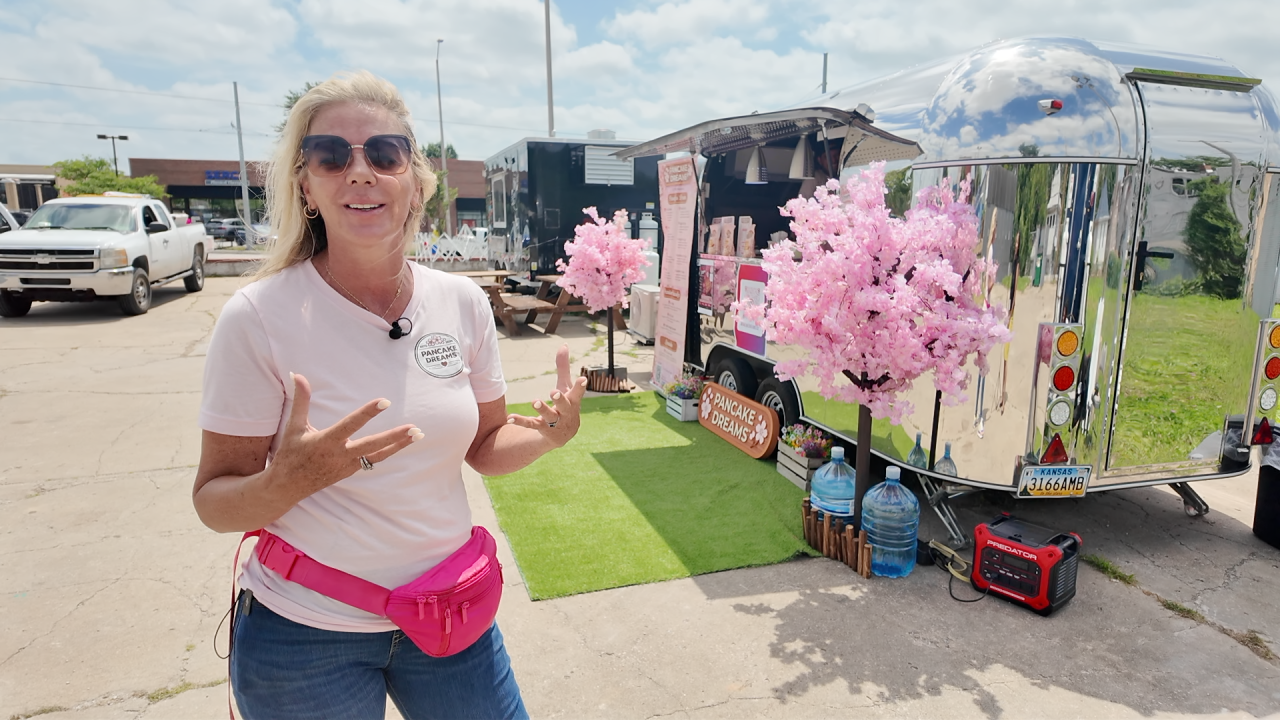
“Pancake Dreams was created based on love and family,” Abuoun said.
She said the goal was to stand out from traditional breakfast spots.
“We wanted to create something that was different than the mundane, regular breakfast restaurants, so that’s where we came up with Pancake Dreams,” Abuoun said.
The FIFA World Cup 26 in Kansas City made the Love Lot feel like the right fit.
“I was like ‘that’s the perfect fit for Pancake Dreams’ because you know the Love Lot, Pancake Dreams with the World Cup in town everybody with all the excitement going on, and we’re right here by the trolley stop, so hopefully that will get us some exposure,” Abuoun said.
Abuoun said the timing was intentional.
“Kansas City’s got a lot of excitement going on right now, so we wanted to get in on that excitement out there and get our name out there while we were up in with the World Cup and everything that’s going on,” Abuoun said.
The transition from a traditional restaurant building to a food truck has come with adjustments, especially the extreme heat their opening week.
“I’m used to being in a restaurant that has four walls and an air conditioner, so this is something new that we’re learning, but I mean hey, it is what it is and if you love what you do, then it doesn’t really affect you,” Abuoun said.
In addition to the Love Lot, Abuoun says Pancake Dreams is rolling out pancake batter this week at World Fresh Market at West 103rd Street and Metcalf Avenue.
The Abuouns hope to open a brick-and-mortar location in 2027.
Amirah handled the truck’s design, which features cherry blossoms.

Rachel Henderson/KSHB 41
She said one of the brand’s messages reflects the spirit behind it.
“One of these messages is, ‘A Dream in Every Bite,”’ Amirah said.
For Amirah, the venture means more than just business.
“Beauty, and it means memories, and these will always be memories to me and my mom,” Amirah said.
She also shared what she hopes visitors take away from the experience.
“I’m hoping that they can really see that we worked hard on this and that they enjoy,” Amirah said.
Pancake Dreams is not the only truck cooking up dreams at the Love Lot.
Jims Desauguste, the founder of Creole KC, is also set up on the lot.
It is the truck’s second week there.
Desauguste, who is from Haiti, said he asked about a spot after driving by the lot and seeing the trucks there.
Rachel Henderson/KSHB 41

“I’ve been dreaming about it, and then the opportunity came, and we just make that happen,” Desauguste said. “Cooking is my passion. I love cooking, I love doing it and just giving back to the community the Haiti cuisine flavor.”
I met Desauguste a week ago at his restaurant, Black Garlic, where he shared his disappointment over the lack of World Cup traffic there.
That prompted him to remove the 18% gratuity he charged during the World Cup.
“It did not happen for us very well,” Desauguste said on Tuesday.
His new truck has since seen its fair share of traffic, especially on weekends.
Creole KC is open Monday through Thursday from 11 a.m. to 10 p.m., and Friday and Saturday until 2 a.m. — or later, depending on the crowd.
Desauguste said he is also looking forward to more events, including the Reggae Fest.
While the World Cup brought energy to the lot, Desauguste said his long-term focus is closer to home.
“Definitely, we’re going to get some more business after the World Cup,” Desauguste said. “We’re not banking on that, no. But I’m banking on local Kansas Citians.”
His truck’s bright exterior is hard to miss.
“Right on the Main Street, you can see the bright-colored truck,” Desauguste said.
Martin says the list of trucks may change in July with the month-to-month agreements, but that the list should be updated by July at loveiskeykc.com.
This story was reported on-air by a journalist and has been converted to this platform with the assistance of AI. Our editorial team verifies all reporting on all platforms for fairness and accuracy.
—

KANSAS CITY, Kan. (KATV) — A few members of Little Rock Police’s Mounted Patrol Unit had a field trip this past month, traveling to Kansas City to assist with public safety during FIFA World Cup matches.
In a statement, police said these officers “provided high-visibility patrol, supported crowd management, and engaged with fans from around the world.”
They posted these pictures to their Facebook page:
Little Rock mounted police assist with public safety at Kansas City World Cup matches (Photo LRPD via Facebook)
Little Rock mounted police assist with public safety at Kansas City World Cup matches (Photo LRPD via Facebook)
Little Rock mounted police assist with public safety at Kansas City World Cup matches (Photo LRPD via Facebook)
“We are proud of our Mounted Patrol Unit for representing the Little Rock Police Department with professionalism, dedication, and excellence while helping provide a safe and welcoming environment for everyone attending this world-class event,” the Department said.
-
 Lifestyle2 minutes ago
‘Dead but Dreaming of Electric Sheep’ is full of beautifully written grotesqueries
-

 Technology10 minutes ago
Google’s NotebookLM can sum up your research in a TikTok-style clip
-

 World17 minutes ago
Trump admin backs Bolivia state of emergency as leftist ex-leader’s loyalists fracture nation
-

 Politics20 minutes ago
Congress eyes rare bipartisan housing win with or without Trump’s help
-

 Health25 minutes ago
America’s national parks could add years to your life — here’s how they boost health
-

 Sports32 minutes ago
LeBron James Next Team Odds: Warriors, Cavaliers, Heat In Mix
-

 Technology35 minutes ago
The trick to smoother streaming at home and on the road
-
 Business40 minutes ago
Downtown L.A. World Trade Center to become affordable apartments

