
Connect with us

South

Wildfires scorch the Carolinas, SC Governor McMaster declares state of emergency

Published

on

Wildfires scorch the Carolinas, SC Governor McMaster declares state of emergency


South Carolina Gov. Henry McMaster on Sunday declared a state of emergency as firefighters battle hundreds of wildfires across the Carolinas.

“I have declared a State of Emergency to further support wildfire response efforts across the state and ensure our first responders continue to have the resources they need,” McMaster wrote in a post on X. “A statewide outdoor burning ban remains in effect—violators will be prosecuted. Please stay informed.”

Nearly 5,000 acres have burned in the Palmetto State, with 170 fires reported, according to the South Carolina Forestry Commission (SCFC).

Ignitions were caused by very low relative humidity, coupled with drying fuels resulting from the lack of significant rain. High winds led the fires to grow and spread rapidly.

Advertisement

WOMAN ACCUSED OF LOOTING FROM HOME IN PALISADES FIRE AREA WHILE WEARING ‘PALISADES STRONG’ SHIRT

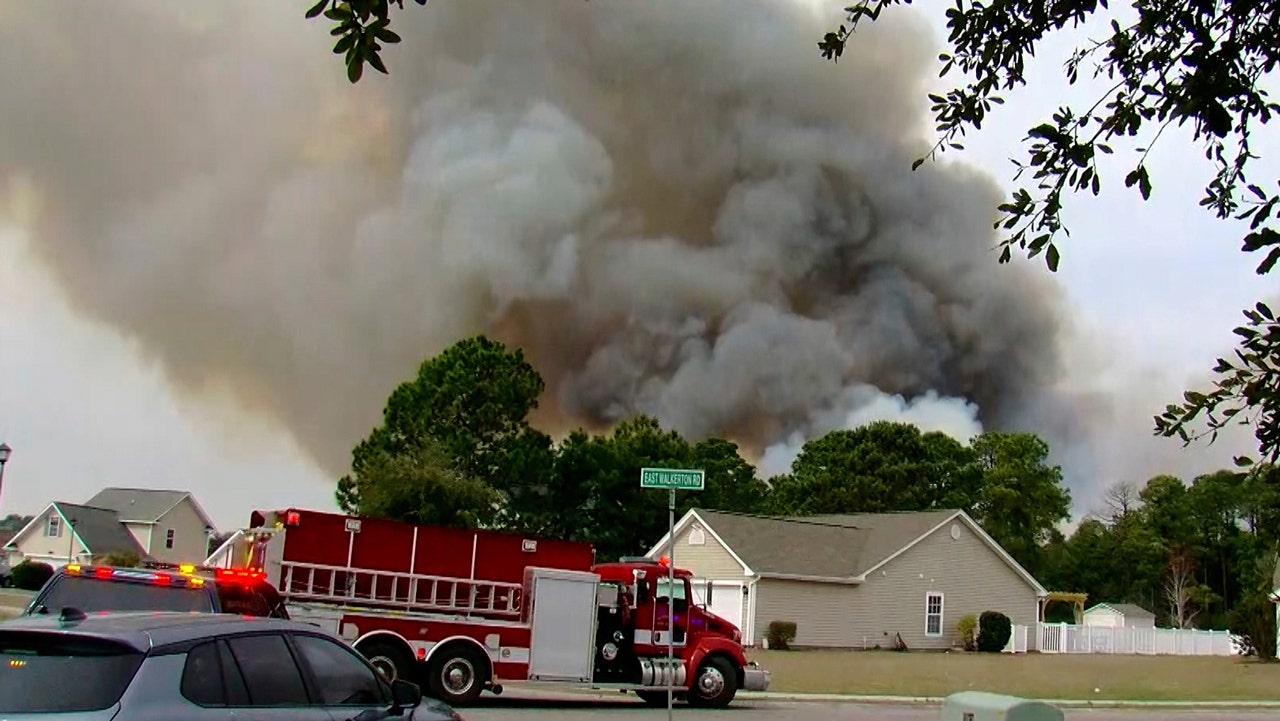
Crews work to contain a fire in the Carolina Forest area west of the coastal resort city of Myrtle Beach, S.C., Sunday, March 2, 2025, where residents were ordered to evacuate several neighborhoods. (WMBF-TV via AP)

The largest of the fires is in Carolina Forest, a community 10 miles west of Myrtle Beach in Horry County.

As of Sunday afternoon, the wildfire incinerated 1,200 acres and was 0% contained, according to the SCFC.

Multiple forest fires in the area have caused evacuations along the South Carolina coast. (Sean Rayford/Getty Images)

Advertisement

SEN. SCHIFF URGES TRUMP ADMIN TO EXCLUDE FIREFIGHTERS FROM FEDERAL HIRING FREEZE

More than 400 firefighters are battling the blaze with at least 127 fire apparatus, according to the Horry County Fire Department. 

No structures have been lost, and no injuries have been reported, as of Sunday morning.

U.S. Army Soldiers with Company A, 111th General Support Aviation Battalion, 59 Aviation Troop Command, South Carolina Army National Guard prepared two Blackhawk Helicopters to assist the South Carolina Forestry Commission and the South Carolina Department of Natural Resources with wildfire containment in Horry County, South Carolina, March 2, 2025. (U.S. Army Photo by Sgt. Elizabeth A. Schneider, South Carolina National Guard)

The South Carolina Army National Guard sent two Black Hawk helicopters on Sunday to assist the SCFC and the South Carolina Department of Natural Resources with wildfire containment.

Advertisement

The Black Hawk water buckets can carry approximately 600 gallons of water, according to the guard. 

The SCFC also issued a State Forester’s Burning Ban for all counties, which prohibits all outdoor burning, including yard debris burning, prescribed burning and campfires in all unincorporated areas of the state. 

A Black Hawk helicopter scoops up water to help fight fires in Horry County, South Carolina, March 2, 2025. (U.S. Army Photo by Sgt. Elizabeth A. Schneider, South Carolina National Guard)

The ban, which will send anyone who sets a fire to jail, will stay in effect until further notice.

Meanwhile, the North Carolina Forest Service estimates a brush fire in the Blue Ridge Mountains, about 40 miles south of Asheville, is between 400 and 500 acres and is 0% contained, as of Sunday afternoon.

Advertisement

The military helicopters aided in fighting the wildfires. (U.S. Army Photo by Sgt. Elizabeth A. Schneider, South Carolina National Guard)

The Melrose Fire, burning in the Saluda and Tryon communities, was caused by a downed power line, according to Saluda Fire & Rescue. The fire rapidly spread up the mountain, threatening multiple structures.

CLICK HERE TO GET THE FOX NEWS APP

North Carolina Emergency Management said there are ongoing air operations to battle the fire.

Advertisement


Source link

Arkansas

HUNTING: Turkey hunters have more success | Arkansas Democrat Gazette

Published

on

HUNTING: Turkey hunters have more success | Arkansas Democrat Gazette


As of Monday, with six days left in the season, hunters checked 12,666 wild turkeys in Arkansas.

That’s a increase of 1,334 gobblers, approximately 12%, checked during the 2025 spring season. The 2025 official tally of 11,332 gobblers was a 24% increase over 2024.

These stats are noteworthy because they illustrate a consistent uptick in hunter success, which should represent corresponding growth in the statewide turkey population. The growth trend also rebuts complaints that Arkansas intentionally suppresses hunter success by opening its spring turkey season too late, after gobblers are reputably less vocal.

Advertisement

Anecdotal observations are situational and specific to a particular time and location. They are not scientific, but field reports are all we have to evaluate turkey behavior in the field. Two hunters in northern Grant County told us on Tuesday that they worked vocal gobblers on the last week of the season in turkey management zone 2. One of the hunters, Alan Thomas of Conway, said that a strutting gobbler, with a subordinate in tow, hung up about 75 yards away.

“I had my gun up for 27 minutes,” Thomas said. “I needed him to come about 12 or 15 more steps, but he wouldn’t do it, and I wasn’t going to shoot that far.”

Thomas said he might have considered taking the shot with tungsten super shot loads. Nevertheless, he said he was satisfied with the experience because he gets more satisfaction from working a bird in close than merely tagging a bird.

Thomas said he hunted in a small section of hardwoods where the open ground story created very long sight lines.

“Turkeys love it,” Thomas said. “That kind of habitat is great for turkeys, but it’s not great for hunting. They can see a long way.”

Advertisement

Thomas’s hunting companion worked a different gobbler that bellowed for a very long time. The companion abandoned the effort after the bird went silent. He gathered his gear and found the gobbler strutting in the middle of a nearby road.

Our point is that for every hunter who is disgruntled over what they believe to be unfair season dates, there are at least 12,666 other hunters who are happy. Others, like Thomas, worked birds that they didn’t kill.

Still, it’s easy to see why some hunters resent our spring turkey season structure. Before our season opens, many Arkansans hunt in states that have more liberal seasons. They hire guides and kill three gobblers in Texas in March. They have success in Mississippi and Alabama in March. March is the peak of breeding season, when it is easiest to work a gobbler.

Then they come home and get humbled.

The spring season in south Arkansas opens April 13. It opens April 20 in north Arkansas. That is after the peak of the breeding season. Arkansas doesn’t have as many turkeys as other southern states. That combination makes Arkansas a harder place to kill turkeys. Many hunters are proud of that because killing a turkey here is quite an achievement.

Advertisement

Missouri, the gold standard for turkey hunting, opened its spring season April 20, on a Monday. That is the standard to which Arkansas aspires. It is achievable on a smaller scale because we are a smaller state with a fraction of the turkey habitat that Missouri has.

I wish I could make sense of turkey gobbling behavior. I have had some epic hunts with very vocal gobblers late in the season, including on the closing day. I’ve had them slip in silently on opening day, and I’ve had them walk up so loudly crunching sticks and leaves that I was initially alarmed that another hunter was stalking my calls.

Once, at a camp in southeast Arkansas, Sheffield Nelson and I watched a gobbler stroll through the middle of camp gobbling non-stop in the middle of a hot day. Mostly, my experience in Arkansas involved one or two gobblers traveling apart from hens. They are generally not loquacious birds, and they only gobbled after I provoked them with aggressive calling.

That frustrates hunters who are accustomed to working multiple gobblers in other states. Some feel entitled to that degree of activity.

For turkey hunting, Arkansas is the big leagues. The birds themselves are a big reason for that, but our late season structure contributes to the difficulty level.

Advertisement

I haven’t killed a gobbler this season, but I tip my cap to the many others that did.


Source link

Advertisement
Continue Reading

Delaware

Bill to create film tax credit clears Delaware House committee

Published

on

Bill to create film tax credit clears Delaware House committee


play

A Delaware bill creating a film production tax credit cleared its first hurdle May 6, advancing out of the House Revenue & Finance Committee.

Several states offer film and television production tax credits and other incentives to lure projects, often to boost jobs, tourism and visibility.

Advertisement

Delaware does not – at least for now.

The proposal mirrors a recommendation in Delaware’s 5% operational spending growth and accompanying revenue plan, released alongside Gov. Matt Meyer’s proposed fiscal year 2027 budget, and would put the state in line with most of the country.

What does the bill do? 

Backed by House Majority Leader Kerri Evelyn Harris, this House bill would create a new film production tax credit for the First State.  

Delaware remains one of a few states that does not already have a film tax credit or a similar incentive in place, according to the Dover Democrat.  

Advertisement

This means that spending in these sectors – from hotel stays to equipment rentals – is going to other states.  

And while other revenue streams have served and continue to serve Delaware well, Harris said, it is also crucial to ensure the state is positioned “for the next generation of economic growth.” 

The bill would offer eligible productions – including films, TV shows and video games — a nonrefundable tax credit equal to 30% of qualified expenses, usable against personal income and corporate taxes.

Advertisement

To qualify, companies must show their activities resulted in expenditures more than $500,000 during any consecutive 12-month period. They must also present opportunities to Delawareans to come onboard projects as interns.  

Companies must also obtain “an independent audit” out of their own pockets, authenticating eligible expenses. These expenses can include any cost tied back to production, pre-production or post-production that took place within state lines.  

These credits would also be transferrable – so long as they are approved by the state Division of Small Business – and can be extended for upwards of five years.  

This bill mirrors a similar proposal included in a presented 5% operational spending growth and adjoining revenue plan.  

Advertisement

The plan set aside up to $10 million in new revenue for a film tax credit to spur Delaware’s creative economy, though the actual cost would depend on how many productions apply.

Should this bill become law, the state will have a similar cap at $10 million every year, according to Harris.  

This isn’t the first time lawmakers have seen this legislation.  

In the hours before last year’s session ended, state Rep. Michael Smith backed a bill that would also establish a film tax credit for Delaware.    

Advertisement

Also known as the Delaware Entertainment Job Act, the bill would have also established a 30%, “transferable tax credit for an investment in the state” for qualified productions.    

Like its legislative relative, the bill would have required productions to bring First State residents as interns to qualify for this credit, as well as produce an audit of expenditures once production has wrapped.    

Doing this, the bill argued, would spur job creation, artistic ventures and investment in the media industry.    

The bill was also assigned to the House Revenue & Finance Committee, but did not advance. Smith signed on as a co-prime sponsor of this latest bill, according to Harris. 

Advertisement

Former Rep. Valerie Longhurst introduced a near-verbatim measure to Smith’s bill back in 2022, but it did not make it all the way through the House. 

What do lawmakers, Delawareans think? 

For the most part, committee members were receptive to the bill.  

Rep. Kendra Johnson was enthusiastic about the bill, asking to come on board as a co-signer of the bill.   

She pointed to the HBO crime drama series “Task,” whose entire second season is scheduled to be filmed entirely in southeastern Pennsylvania, starting July 6. 

Advertisement

Delaware’s neighbor state was reportedly investing $49.8 million into the project – the largest tax credit bestowed by the state to a single production, as reported by WHYY last year.  

The projection is also set to create 3,700 jobs and infuse $194.1 million back into its economy.  

Pennsylvania’s current tax credit program offers a 25% to 30% credit to productions that spend no lesser than 60% of their total funds within state lines.  

“Imagine the economic growth that is happening there, that could be happening here,” Johnson told the panel.  

Advertisement

Others have thrown their support behind bringing a film tax credit to Delaware.  

Meyer is one such advocate. He mentioned during his State of the State address that Delaware not offering film tax credits made no sense, considering the latest Superman movie is “literally set” in the First State.     

“They should be shooting here,” he said. “We’re just going to let so many other neighboring states soak up all of that Hollywood money?”  

Other groups, including the Delaware Arts Alliance and the Delaware Hotel & Lodging Association, have also thrown their support behind the bill, Harris said.

Advertisement

What happens now? 

The bill will continue to move through the House.  

If signed into law, it would take effect starting July 1, the first day of the new fiscal year.

But lawmakers will need to move quickly – they only have until June 30 to have it passed in both chambers. Otherwise, they’ll need to start all over again come next session.  

Olivia Montes covers state government and community impact for Delaware Online/The News Journal. If you have a tip or a story idea, reach out to her at omontes@delawareonline.com.    


Source link

Advertisement
Continue Reading

Florida

Are lovebugs coming back to Central Florida!?

Published

on

Are lovebugs coming back to Central Florida!?


ORLANDO, Fla. – Over the past couple of years, experts have noticed a heavy decrease in lovebugs across Central Florida.

However, that trend may have just been reversed.

Lovebugs are known for flying through the air while getting “stuck” together during their explosive breeding seasons, causing plenty of splatters on the front of people’s cars.

A Disney Cruise Line bus covered in lovebugs. (Image courtesy: Omar Izquierdo)

But in recent years, Florida natives have noticed a stark drop in the number of these pests flitting about.

Advertisement

During a 2024 conversation with Dr. Norman Leppla — a professor at the University of Florida specializing in pest management — he explained that lovebugs’ disappearance was part of a larger trend.

“I really don’t know why, but we’re having a crisis globally with the loss of insect species and all kinds of other organisms just plain disappearing. And we’re quite worried about it,” he said at the time.

[ Where did all the lovebugs go?]

But this week, News 6 reached out for a follow-up after several members in the newsroom noticed more lovebugs in the air this year.

“Your newsroom members are correct in noticing more lovebugs than last year,” Leppla wrote. “I have seen some in North Central Florida during the past couple of weeks where there were none last year. They certainly aren’t abundant, however.”

Advertisement

According to Leppla, the number of lovebugs you see flying around depends on the survival of larvae, which in turn depend on continuous moisture to feed and develop.

Female lovebugs can lay hundreds of eggs, but if the environment is too dry or submerged for too long, the larvae end up dying — resulting in fewer lovebugs.

Swarm of lovebugs, Plecia nearctica Hardy, on flowers. (Photo: James Castner, University of Florida)

Typically, lovebug season pops up twice per year in Florida: in April to May, and August to September.

Per Leppla, lovebugs actually reached nuisance levels last month down south in places ranging from the Florida Keys up through Ft. Myers.

“They probably occurred in swarms along the lower east coast, as well,” he continued. “They will continue to be relatively abundant in local habitats where larvae can develop. Lovebugs will exist as far north as the climate will enable the larvae to survive.

Advertisement
Lovebugs

However, lovebugs aren’t originally from Florida.

They actually hail from the Yucatán in Mexico, having traveled into the Gulf Coast through Texas during the early-to-mid 1900s. In the Sunshine State, they weren’t seen until around 1950.

That means that even if lovebugs really did disappear from Florida, it doesn’t necessarily mean they’re gone for good.

“They live in that tropical habitat, and they came here as our habitat became more conducive to lovebugs,” Leppla previously explained. “That’s usually what happens. And so they spread, and they can certainly just recede right back to the tropics.”

[ Don’t touch these fuzzy Florida bugs!]

Advertisement

But that begs the question: what are the impacts of lovebugs possibly disappearing from Florida?

The short answer? Not much.

In fact, lovebug guts reportedly contain an enzyme that can eat through the clearcoat of a vehicle, which can damage the vehicle’s paint. As such, it could be good news for drivers.

“It’s not going to cause a lot of issues for the folks here in Florida,” Leppla stated. “Only the car wash people.”

Leppla gave News 6 a few tips to keep the pesky insects away. Here’s what you should know:

Advertisement
  • Lovebugs are attracted to light colors, so you can avoid wearing light-colored clothing and being near light-colored walls to not draw them in

  • They are also bad flyers, so you can use a fan to blow them away

  • Lastly, lovebugs don’t fly at night and take a break around noon, so if you limit outdoor exposure during the morning and afternoon times you may be able to avoid them

Copyright 2026 by WKMG ClickOrlando – All rights reserved.


Source link

Continue Reading
Advertisement

Trending