Lifestyle
NBA Stars Like Jalen Brunson Enlist Social Media Surrogates to Expand Reach in China


Jalen Brunson first experienced the fervor of the N.B.A.’s biggest international market in 2018 when, as a rookie, he traveled with the Dallas Mavericks to China for a pair of preseason games. The trip itself was brief, but the reception that Mr. Brunson and his teammates received left a lasting impression.
“The fandom that basketball brought to that country, I thought it was really cool and interesting and something I wanted to be a part of,” Mr. Brunson said in a recent interview.
Now a star for the New York Knicks, Mr. Brunson, 28, took a crucial step toward that goal before the current N.B.A. season when his representatives at Creative Arts Agency enlisted a digital management company, East Goes Global, to create and run Chinese social media accounts for him. In the months since, Mr. Brunson has gained more than 400,000 followers across five of the country’s major apps: Bilibili, Douyin, RedNote, Weibo and WeChat.
Mr. Brunson is one of several N.B.A. players looking to establish an online presence in China, where millions of people follow the league closely. But given the language barrier and differing societal norms and trends — not to mention an insular Chinese internet where popular western platforms such as YouTube, Instagram and X are blocked and content is reviewed by the government — most have sought help from companies with specific expertise in navigating the digital landscape.
“I think it’s important to understand your audience, and I think a lot of smart people understand what they know and what they don’t know,” Mr. Brunson said. “It was key for me to let someone else do it, because they understand more than me. Even though I am the face of it, they really run it.”
Founded in 2018 by Andrew Spalter, a former music manager who lives in Austin, Texas, East Goes Global is not alone in providing such a service. Coral Lu, a former ESPN reporter, handles the Chinese social media accounts for Kawhi Leonard of the Los Angeles Clippers and Paul George of the Philadelphia 76ers. The IMG-owned company Mailman, based in Shanghai, manages 30 accounts for 14 active players.
“For the player, some people are really motivated by engaging with their global audience, and in cultures where basketball is huge,” said Matthew Spalter, the chief operating officer of East Goes Global, who is Andrew’s brother. “There’s also the business perspective: ‘During my basketball career, how can I scale my business? And, post-career, how can I make sure I’m not gone forever?’”
The player-led push is coming at an important time for relations between the N.B.A. and China. In October 2019, a year after Mr. Brunson’s trip, a pro-Hong Kong social media post from Daryl Morey, then the general manager of the Houston Rockets, led to China pulling N.B.A. games off national television and ending the N.B.A. China Games, which had been played annually since 2012.
The freeze from Mr. Morey’s post, however, has significantly thawed, and the league is planning to play two exhibition games next October in the Chinese territory of Macau. With help from groups like East Goes Global, some players will be ahead of others should the relationship between the league and China return to its previous heights.
The work of the groups typically begins by reaching out to the various platforms to verify the player’s accounts — and often, as with Mr. Brunson, creating them in the first place. But further measures can be required, as when the team at Mailman helped an N.B.A. All-Star client recover his page on Douyin, China’s equivalent of TikTok, after it had been taken over by a mysterious third party that was posting spam content.
Next comes the process of creating content for a Chinese audience. Success, according to the people involved, goes beyond simply using the native language in captions and adding trending background music.
“Mirroring the same content on your Chinese channels as your western ones really isn’t diving deeper into that Chinese culture,” said Michael Lin, a vice president of digital at Mailman who oversees its U.S. sports operation. “Athletes do a lot better when they’re creating personalized content that’s speaking to the Chinese fans.”
For Mr. Brunson, this has meant meeting periodically with East Goes Global staff members to film exclusive videos for his Chinese accounts, including a marathon two-hour session heading into last month’s Chinese New Year during which he sampled Chinese snacks and wrote his name in Chinese characters.
“I thought that was really cool,” he said.
There are numerous business possibilities for N.B.A. players in China. Some have gone on huge tours across the country. Others have signed endorsement deals with Chinese shoe companies. James Harden, a star for the Clippers, sold 10,000 bottles of wine in five seconds during a Douyin livestream.
But Mr. Lin has noticed a particular uptick in requests from players who cite another source of motivation: getting fan votes for the All-Star Game.
The ideal playbook, in that regard, was laid out last season, when Tyrese Haliburton of the Indiana Pacers rode a wave of Chinese social media support to lead Eastern Conference guards in fan voting, earning a surprising spot as a starter for the 2024 All-Star Game.
“I know people see a player in Indiana and don’t expect that,” Mr. Haliburton said at the media day for that game, “but the love I’ve received from my fans in China has been amazing.”
According to Matthew Spalter, Mr. Brunson’s team at C.A.A. similarly approached East Goes Global about executing a “massive All-Star push” for this year’s game. The results? Even though Mr. Brunson finished third among Eastern Conference guards on fan ballots, he was named a starter under the league’s weighted voting formula, which also incorporated votes from the news media and the players.
“I think it helped a lot, and I’m really appreciative of it,” Mr. Brunson said in February of the help from Chinese fans, adding that he planned to post a message of gratitude after the All-Star break.
Sure enough, a week or so later, a 44-second video was uploaded to Mr. Brunson’s account on Bilibili, China’s equivalent of YouTube. The video features behind-the-scenes footage from his trip to the game in San Francisco.
“Thanks to my friends at Bilibili for voting and supporting me,” the caption read — in Chinese characters, of course.



Lifestyle
‘Office Romance’ stars J.Lo as a CEO with a bad case of Brett Goldstein : Pop Culture Happy Hour

Jennifer Lopez and Brett Goldstein in Office Romance.
Ana Carballosa/Netflix
hide caption
toggle caption
Ana Carballosa/Netflix
The new Netflix film Office Romance pairs rom-com veteran Jennifer Lopez with Brett Goldstein in a story about the hazards of falling for your boss. But is the on-screen chemistry there? And how does it fit into J.Lo’s rom-com history? Directed by Ol Parker (Mamma Mia! Here We Go Again), the film was written by Goldstein and Joe Kelly, one of the writers he worked with on Ted Lasso.
If you need another Jennifer Lopez fix, check out these episodes:
Can Jennifer Lopez’s ‘This Is Me… Now’ say anything new?
A silly ‘Shotgun Wedding’ sends J.Lo on an adventure
Connect with Pop Culture Happy Hour:
Letterboxd / Facebook
Our weekly newsletter
Support Pop Culture Happy Hour+
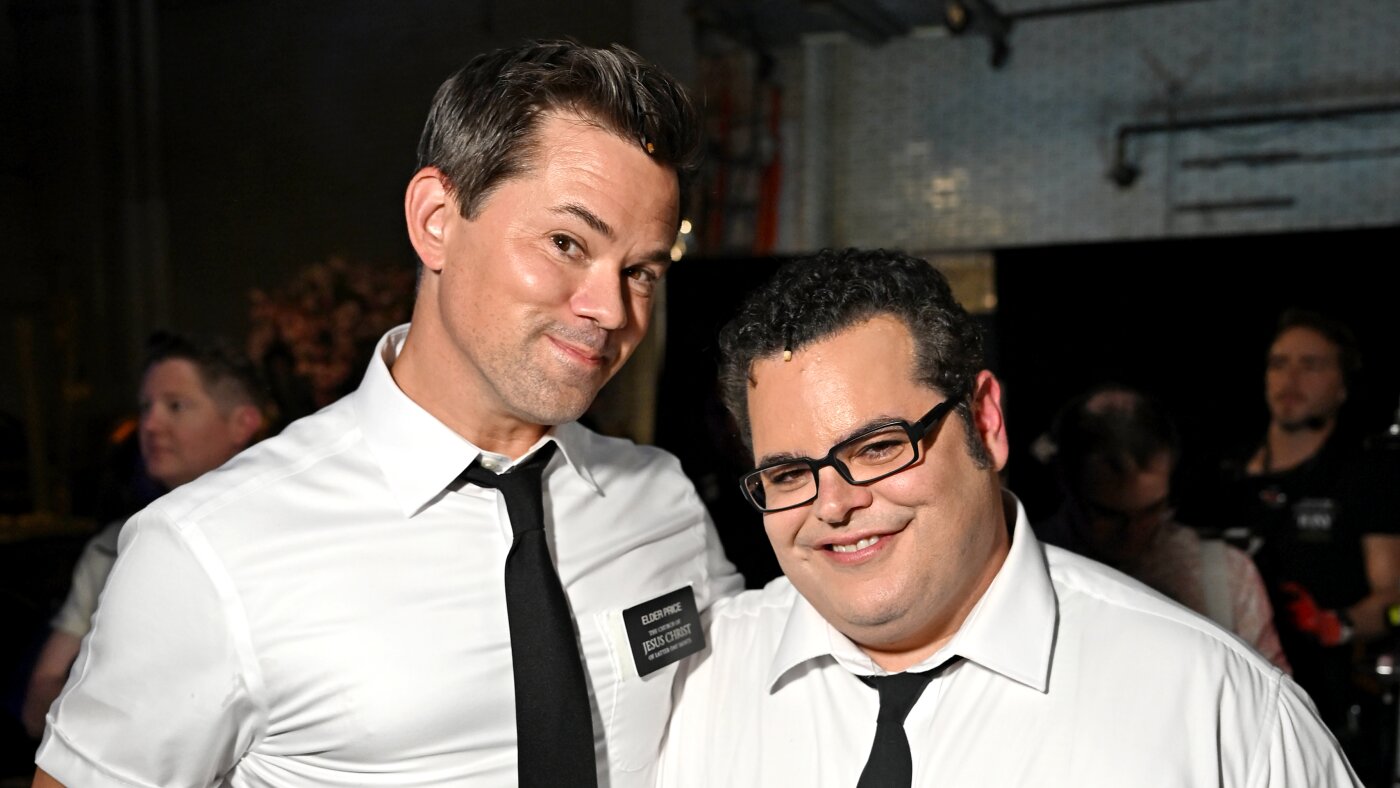
Andrew Rannells and Josh Gad performed at the Tony Awards at Radio City Music Hall on June 7, 2026 in New York City.
Jenny Anderson/Getty Images North America
hide caption
toggle caption
Jenny Anderson/Getty Images North America
Fifteen years after The Book of Mormon made its Broadway debut, original cast members Andrew Rannells and Josh Gad once again took the stage as Mormon missionaries — this time at the 2026 Tony Awards.
Created and written by Trey Parker and Matt Stone (the duo behind South Park), along with veteran Broadway composer Robert Lopez, The Book of Mormon follows two young missionaries sent to try and bring Mormonism to a Ugandan village that’s struggling with the AIDS epidemic, war and famine. The musical is a satirical — sometimes affectionate, sometimes offensive — look at Mormonism and youthful naïveté. It was clear from the very first number — “Hello!” — that the show would cause a stir when it debuted in 2011.

Gad, who played Elder Cunningham in the original Broadway cast, remembers “laugh[ing] my butt off” when he first heard “Hello!” Then Gad listened to “Hasa Diga Eebowai,” a song in which the Ugandan villagers curse God, and he called his agent.
“I said, ‘I don’t think I can do this show,’” Gad recalls. “And he said, ‘Why?’ And I said, ‘Because I don’t want to get killed.’”
Meanwhile, Rannells, who played Elder Price, wasn’t phased by the material: “I heard the humor in it and I felt very confident that people were going to think it was funny,” Rannells says. “I certainly didn’t think it would be still running on Broadway after 15 years and would have toured to Salt Lake City. I didn’t think that they would have done that, but it did.”

The Book of Mormon received nine Tony Awards in 2011, including best musical and best score. To celebrate its Broadway anniversary, Gad and Rannells will be making cameo appearances in every show this week — along with the show’s creators and several other original cast members. Gad says that behind the satire, The Book of Mormon is actually a “very pro-faith show.”
“If you stick with the craziness and chaos … the end is very uplifting,” he says. “It’s actually quite emotional and soaring. And so you get this sense that there is something positive to come out of this hellscape that the show depicts.”

Andrew Rannells and Josh Gad starred in The Book of Mormon when it premiered on Broadway in 2011.
Joan Marcus
hide caption
toggle caption
Joan Marcus
Interview highlights
On connecting with Mormon missionaries in New York City while in rehearsal for The Book of Mormon
Rannells: When we were in rehearsals for the workshop, I decided that I should be a good little actor, and I should go to the Mormon temple and I should meet with some Mormon missionaries. So I got myself ensnared in a very strange relationship with these two young men, who I met with a handful of times and they were so excited that someone wanted to talk to them and that I solicited them. We met twice, like out near Lincoln Center where there is the big Mormon church. And then they said, “Can we come to your home?” …
So these two Mormon missionaries came over and immediately there’s a picture of my boyfriend and I like on the mantel and so I had to explain to them that I was like, I’m actually in a musical about the Mormon church and they were sort of shocked. But then they really … opened up to me about how scary and disappointing it was to be a missionary at times, and especially being a missionary in New York City. They were like, “No one will speak to us. People are very mean to us.” And then I was like, “Well, where are you hanging out?” And they’re like, “They send us to Times Square,” and I was like, “You’ve got to get out of Times Square. You cannot be hanging out in Times Square, boys. You should go someplace else. Don’t try to talk to people there. It’s not safe for you.”
YouTube
On how their voices have changed in the past 15 years
Gad: I was insulted yesterday when our producer came up to me and said “You sound so much better than you did back when you first did it.” I was like what did I really not sound good when I first did it?
Rannells: No you sounded great. … I think you sound the same. I mean, look, our voices are different. Fifteen years, there’s a lot of wear and tear. But some of it is muscle memory, I would say, some of it comes back. I got to perform this number, “I Believe,” on Stephen Colbert’s show. That was the number that I sang on the Tony Awards… It was still somewhere like lodged in my voice.
Gad: When I found out I was doing this I played the album in the car, and I started to sing along, and some of those high notes, I just was like, “Oh my god I can’t! How am I gonna hit these?” And I actually asked them to lower it, and they laughed and said no, and then I started to sort of do it on my feet. And just like you said, something clicks. It’s like riding a bike. It’s just sort of in there somewhere
Rannells: Now the physical side of it, Terry, is a little different. Physically doing some of these numbers, that’s where the aging process really catches up to you. … I can’t dance as much as I used to. The singing part is a little easier to control. The physical, the knees, the getting up and down off the ground, that’s all a little bit different.
On losing his voice during a show
Rannells: That happened many times.. … Over the course of my career, that’s something that happens, not just in The Book of Mormon, but in other shows. You learn to sing through sickness. I think there are nights where there are certain notes missing in your voice all of a sudden, and you don’t find out until you’re on stage in front of 1,200 people, and you’re like, “Oh boy.” And you just have to figure out a way to sing around it. After previews, after opening, after the Tony Awards, I hadn’t missed any performances. And I started my career as a replacement, as an understudy. I was not accustomed to the idea that I could call out of a show. I probably shouldn’t have done the show that night, but I remember it was like a couple weeks after the Tony Awards and I sang this duet that that Josh and I sing called “You and Me (But Mostly Me)” and it was kind of a disaster, but I just continue with the show and I was like, I’m gonna try to make this work.
Gad: It was actually remarkable to watch.
Rannells: I got through “I Believe,” somehow and sang the whole thing and I amazed myself that I could do it. And then I got to another song that’s called “Orlando,” I’m not sure if you remember this Josh, and it’s supposed to end with a little falsetto thing … and instead I went [low] … and the curtain flew up and all the missionaries come out and everyone was laughing and it was not great. But after the bows that night, I walked off stage and I remember Karen Moore, our stage manager, was standing there and I burst into tears, and I said, “I have to miss a show.” And she said, “You’re allowed to miss a show.” And I just cried and cried about it. It had never occurred to me.
On the songs in The Book of Mormon being a tribute to musical theater, influenced by Wicked, The King and I, The Lion King and The Music Man

Gad: The influences of each of these songs [come] from a place of absolute weird devotion to musical theater on the part of Trey Parker and Matt Stone. Obviously Bobby Lopez comes from that world. But when you look at Trey and Matt, the first thing you think of is not necessarily, like, musical theater acumen. And these are two guys that people forget when they wrote South Park: Bigger, Longer & Uncut, the feature film adaptation of the Comedy Central show, they got a letter from Stephen Sondheim, who’s probably the most acclaimed composer and lyricist of the 20th century. And he basically said this is one of the top 10 most brilliantly realized musicals he’s ever seen.
And I really do think that part of the reason this show endures is because each one of these songs is instantaneously hummable. … Each one of these songs reminds you of something, but it’s never pastiche. It’s never sort of making fun of a genre. It is fully embracing it and earning its space. So you have an 11 o’clock number in “I Believe” that is as powerful, potent, and as mesmerizing and memorable as an 11 o’clock number from Guys and Dolls.
Rannells: Well, I think, and a lot of people would come to see The Book of Mormon and say, “Ah, I don’t really like musicals, but I do like this one.” Which is always funny to me, because every number was — I don’t wanna say a ripoff — but was a tribute.
On making the decision to leave the show and later regretting it
Rannells: We did leave at the same time. Josh and I both had this very unique experience where we opened The Book of Mormon, we were both nominated for Tony Awards, we both lost those Tony Awards. … We then went out to Los Angeles. … We had a bunch of meetings in LA. We were very popular. These two guys from the biggest Broadway hit, everyone wanted to meet with us. We both got TV shows for NBC. Josh’s was called 1600 Penn. Mine was called The New Normal. They both aired the same week. We went to the up fronts together. They were both canceled.
Gad: Same week. … I was definitely, I think, more done than Andrew was by that point. … I had checked out at that point, and I felt like I was doing a disservice to myself and the audience.
Rannells: You didn’t seem like you were checked out.
Gad: No, but I started forgetting lines on stage. I wasn’t present. … I had also been doing it for so long, from its origin. I wanted to try new things. When I sort of do the same thing again and again, I start to get bored. … I look back at that now with a lot of regret. Because I don’t think I appreciated this incredible moment until I was able to reflect on it, actually, years later. Because when you’re in it, when you are in the eye of the hurricane there’s a lot going on that you can’t stop and settle yourself and go, oh my God, this is a moment that I’ll never have again. This is so unbelievably unique. …
Rannells: I wish that I had stayed longer.
Gad: I wish we had done another year.
Susan Nyakundi and John Sheehan produced and edited this interview for broadcast. Bridget Bentz, Molly Seavy-Nesper and Beth Novey adapted it for the web.
Lifestyle
L.A. Affairs: I’m a black woman. He’s a white guy with a pickup truck. Here’s what happened

“That guy over there.”
I was talking to my friend, Kim, as we sipped cocktails at a bar in Hollywood. She followed my gaze. “The … bald … white guy?” she asked, her face scrunched up in disbelief. I nodded. She raised an eyebrow and slurped on her vodka cranberry.

Classic stories from the Los Angeles Times’ 143-year archive
Some background might be helpful here. I’m black and my friend Kim is white, as was the guy in question. He also shaved his head and, apparently, that threw my friend for a loop. I knew why.
Since I’d known her I’d mostly dated black guys. The real estate agent I’d met at the LACMA summer jazz series. The actor who’d given me his head shot as soon as he learned I was a TV writer. The musician who serenaded me at the Dresden between Marty and Elayne’s sets. All black. And the one or two white guys in the mix had hair.

Two weeks later, I climbed in the passenger seat of the bald white guy’s truck when he picked me up from my apartment in Miracle Mile. Hmm … he drove a pickup truck. And I knew from talking to him on the phone that he was from the South.
I smiled as he told me he’d made a reservation at Ammo. So far, so good. I liked that place. As we drove along, I surreptitiously glanced at him — he was wearing a nice suit, having come straight from his office to get me.
He had mentioned he was a lawyer, so I’d already mentally checked the box for gainfully employed. But something else was on my mind.
Here’s the truth: Race is still a thing.
No matter how advanced a society we think we are, the idea that we’re post-racial is laughable. Over the years working in numerous writers rooms as the only black writer, I’d become a pro at deciphering comments white guys made:
Interracial relationships aren’t a big deal nowadays.
Translation: I’d never do it but I think Halle Berry’s pretty.
I have a lot of friends in interracial relationships.
Translation: Some of my friends date Asian women.
Today, kids don’t care about race.
Translation: My kid listens to hip-hop.
This guy was from Georgia. “The heart of Klan activity,” one of my friends felt compelled to tell me. To be fair, I’m from the South. Raised in Florida, I know about chewing tobacco, gator farms, 2 Live Crew, y’all, and the Confederate flag. For that reason, I started getting nervous about this guy.
What if I were part of some Dixieland fantasy of his? After we were seated I asked him how many black girls he’d dated. “Why?” he asked. “Because maybe black girls are your thing,” I said. “I don’t want to be part of your chocolate fantasy.”
“Uh … I just think you’re hot,” he said.
We continued dating, and soon we were exclusive. This didn’t come without challenges.
Whenever we went somewhere with a lot of black people in attendance, I got the side eye from some of them. I understood. My dating outside the race was seen as a betrayal. Their thought bubble hovered, clear as day: “After everything they’ve done to us, you’re going to date one of them?”
And some days, it was tough because I felt guilty for not completing the picture of the strong black couple. Another time, my boyfriend got a call from his ex-girlfriend. “I heard you’re dating a black girl.” Yep. Word had spread through the Caucasian grapevine.
I was working on a sitcom at the time. When I told the writers on the show I was dating a white guy from the South who drove a pickup truck, I could tell they were skeptical.
The kicker was when we went to the wedding of one of his friends in Cape Girardeau, Mo. I’m not exaggerating when I say white people stared at us as we walked down the street.
See? Race is a thing.
The more serious the relationship got, the more I started thinking about kids.
If we had them, they would be “multiethnic” or “biracial” or “mixed heritage.” All terms that annoyed me. But I was getting ahead of myself, right? Was I in this or not? Was I ready to be committed to a guy whose family owned shotguns and went to the Waffle House?
My parents were both college professors. His parents hadn’t gone to college. My parents were Baha’is who didn’t celebrate Christmas. His dad played Santa Claus in various malls below the Mason-Dixon line during the yuletide season. My boyfriend listened to emo rock, for God’s sake!
This was bound to be a disaster.
But I didn’t break up with him.
I grew to love him more.
I loved that he shared a house off Sunset with a gay, Pakistani performance artist. I loved that he’d had the same Rottweiler for a pet since high school. I loved that he was a plaintiff’s attorney, helping clients who’d been discriminated against in the workplace.
I didn’t love his pickup truck — it was cramped and always had dog hair on the seat.
But no relationship’s perfect.
Fourteen years and two kids later, race is still a thing, in a growing list of things, that defines us.
Maisha Closson is a TV writer living in Los Angeles. She’s on Instagram as @maisha_closson
L.A. Affairs chronicles the current dating scene in and around Los Angeles. If you have comments or a true story to tell, email us at LAAffairs@latimes.com.
-

 Minneapolis, MN2 minutes ago
Minneapolis standoff: Deputies fired at while serving arrest warrant
-

 Indianapolis, IN9 minutes ago
Very humid through Thursday night with more storms on the way
-

 Pittsburg, PA12 minutes ago
Pirates Place Top Prospect on Taxi Squad
-

 Augusta, GA17 minutes ago
New system launches in Augusta, offering noninvasive brain tumor treatment
-

 Washington, D.C24 minutes ago
Trayon White censured and fined for missing financial disclosure deadlines
-

 Cleveland, OH27 minutes ago
New York Yankees vs. Cleveland Guardians prediction, pick for Tuesday 6/9/26
-
 Austin, TX32 minutes ago
Texas rule targeting smokable hemp is back in effect
-

 Alabama39 minutes ago
Alabama Football Recruiting Update: Crimson Tide Picks Up Second RB Commit

