Business
California loves Dungeness crab. But concerns over whale safety have put the industry in peril


BODEGA BAY, Calif. — It was a calm January morning, the waters off Bodega Bay unusually smooth, but crab fisherman Dick Ogg couldn’t shake a grim feeling that the day wouldn’t go his way.
The Dungeness crab season had opened just a few weeks earlier — two months behind schedule — and was off to a slow start. “We’re working very hard to basically get nothing,” said Ogg.
The anemic hauls so early in the season mark the latest setback for California’s commercial Dungeness crab fishery, a roughly $45-million-a-year industry that delivers one of the state’s most iconic culinary delights.
Dick Ogg navigates his boat out of Bodega Bay in the predawn hours of a January morning, setting off for a 16-hour day of crab fishing.
The industry’s future has been complicated by another celebrated sea creature: Each year, a number of humpback whales migrating through California’s waters to and from tropical breeding grounds get entangled in commercial crab fishing gear, encounters that often end in mutilation or death. State regulators are intent on lowering the chances of whales coming into contact with the gear.
There’s reason to be concerned.
Since 1970, when the federal government listed humpback whales as “endangered” after they were hunted to near extinction, the population has made a fragile comeback. Whales along the West Coast have recovered at an estimated annual rate of 8.2% since the 1980s, according to the National Oceanic and Atmospheric Administration, with more than 4,500 humpback whales now feeding off California’s coast.
The state Department of Fish and Wildlife has imposed sharp restrictions on the crab industry over the last decade in an effort to protect that progress, as well as to safeguard populations of blue whales, gray whales and the critically endangered leatherback sea turtle.
The annual crab season — which historically ran from late fall to midsummer — has been repeatedly truncated, due to both whale safety concerns and elevated levels of domoic acid, a toxin that builds up in shellfish. This year’s season opened after New Year’s and is likely to end in spring. The shortened timeline gives whales more time to migrate without risk of entanglement, but has cut California’s commercial crabbers out of the lucrative Thanksgiving, Christmas and New Year’s markets, devastating the fleet’s income expectations.

Fisherman Dick Ogg, right, gives instructions to crew members Bradlee Titus, left, and Axel Bjorklund during a disappointing day of crab fishing.
In addition, most of the California crab fleet is under a mandatory order this year to use 50% less gear, meaning the fleet has fewer weeks to fish and can use just a fraction of its traps. And the weeks that are open to crabbing pose some of the most dangerous wind and weather conditions of the season.
“We’ve had times we shouldn’t be out,” said Ogg, 71. “We have to go. We don’t have a choice.”
After making what feels like one concession after the next, he wonders whether the fishery can survive any more changes.
And now the crabs aren’t biting.

“We’ve adjusted almost as much as we possibly can,” Ogg says of the tighter whale safety regulations California has imposed on the crab fishery.
Early on a Thursday in late January, Ogg readied his 54-foot fiberglass boat, the Karen Jeanne, for a 16-hour day of hauling 200 crab pots. It was barely 4:30 a.m. at the Spud Point Marina, and Ogg’s crew, Bradlee Titus, 34, and Axel Bjorklund, 22, both multi-generational fishermen, prepared the deck by washing equipment, filling water buckets and packing jars with bait — a stinky, oily mashup of mackerel and squid. At the helm, Ogg tracked water currents and the weather forecast as he moved the boat out of Bodega Bay, past Point Reyes toward the Farallon Islands and San Francisco skyline.
Ogg was adopted from Japan, and has lived most of his life near Bodega Bay, a fishing town on the Sonoma County coast. He didn’t start out in commercial fishing, but eased into it about 25 years ago, after more than three decades working as an electrician at Sonoma State University.
He is lean and fit from years of diving and martial arts training. As a captain, he is regimented, but also gentle with his crew. He pays them 17% off the top after every trip, no matter how much, or little, crab is brought in. He’ll make a batch of pizza bread before fishing trips and keeps the boat stocked with snacks. On overnight trips, he gives Titus and Bjorklund the cabin below deck, while he sleeps on the floor of the wheelhouse with his three rescue dogs.

This year’s California crabbing season, already truncated, has gotten off to an anemic start.
He bought the Karen Jeanne about 11 years ago. He extended the vessel by 8 feet, adding a new motor and a big tank for the bundles of crab and massive salmon he dreamed of catching — but never eating. Ogg has been vegetarian for more than 40 years.
“For me, it’s about providing that resource,” Ogg said. “The public can’t get out here.”
Crab pots sit on the ocean floor, with more than 200 feet of rope attaching them to buoys at the surface. A bait jar inside the pot tempts the crab into a one-way entrance.
Titus and Bjorklund move in a choreographed dance to haul in the crabs using a process that takes about one minute and 30 seconds per pot: Grab the buoy and attach the rope to a crab hauler; raise the 100-pound pot out of the water; empty the crabs into a holding tank; replace the old bait with a fresh jar; toss the female and small crabs back overboard; and throw the larger males into the tank. Then they push the empty pot back into the water and begin the process again.
1

2

3

1. Titus, left, and Bjorklund sort Dungeness crabs, throwing back female and undersized crabs. 2. Bjorklund sizes crabs aboard the Karen Jeanne. 3. Ogg, right, and Titus place boxes of bait into a freezer.
The cycle repeats itself hour after hour, a meditation in back-breaking labor, as Ogg navigates through his lines of crab pots. On this day, each pot would yield eight to 12 crabs, a small harvest compared with the dozens of crabs the pots are built to hold. After throwing out the “shorts” and females, they’re lucky to keep two. The team stays focused, but it’s easy to see the disappointment.
“We’re going backwards,” Bjorklund yelled at one point.
Ogg, at the wheel, shook his head. “On this particular trip, I won’t make any money,” he said. The bait alone tallies around $1,200 each trip, on top of fuel costs and upkeep. The one bright spot was that the fleet had negotiated a relatively high price of $7.25 per pound with buyers, meaning even for a low-volume trip he might break even.
Ogg has come to accept the shortened season. He’s cut the number of pots he puts in the water in compliance with state rules. He’s bracing to spend up to $20,000 on fishing lines next season in preparation for new state rules requiring the fishery to use a specific color of rope, in an effort to better identify what gear is entangling the whales.
“We’ve adjusted almost as much as we possibly can,” he said.
He serves on a dozen state and regional committees focused on the Dungeness crab industry. This year, he hopes to be added to a new federal task force set up to find solutions to whale entanglement. Crabbers hope the federal government will relax some regulations, but there’s a chance the task force just adds more.

Seagulls gather off the aft of the fishing boat Karen Jeanne.
Ogg emphasized his respect for whales. “I don’t want to have any problems with these” whales, he said. “I love these animals.”
But he likened fishing to driving a car. You can put on your seat belt and drive slower, but there will still be accidents.
“They want zero entanglements. And zero is not an achievable number.”
There were 34 whale entanglements, including 29 humpbacks, recorded off the Pacific Coast in 2024, a six-year high, according to preliminary data from the National Oceanic and Atmospheric Administration.
Twenty-seven whales were reported entangled in 2023 and 30 whales in 2022, which environmental groups say is probably an undercount. It’s an improvement from years past; in 2016, 71 whale entanglements were reported off the coasts of Washington, Oregon and California, prompting conservationists to file a lawsuit against California. The settlement agreement led to many of the current regulations.
The humpback whales are divided into subgroups: one that travels to Mexico for the winter, listed as “threatened” under the federal Endangered Species Act; and a smaller group that breeds off the coast of Central America, which is listed in the more urgent “endangered” category. Because it’s nearly impossible to distinguish one group from the other, any entanglement is treated as a deadly risk to the endangered population.
“Sometimes they’re able to free themselves. Often they’re not,” said Ryan Bartling, senior environmental scientist at the state Department of Fish and Wildlife.

“They want zero entanglements,” Ogg says of the push for tighter whale protections. “And zero is not an achievable number.”
Here’s where things get complicated. Wildlife groups, the state and fishery leaders disagree on what number of entanglements is “acceptable,” meaning what would constitute a “negligible impact” on the whale population. Federal and state guidance isn’t always clear, often leaving conservationists and crews confused.
Either way, commercial Dungeness crab gear has contributed to an annual average of 5.2 humpback entanglements since 2014, according to national and state data, more than double what federal rules allow.
Nancy Black, a marine biologist and owner of Monterey Bay Whale Watch, is in the camp that wants to see the number of entanglements cut to zero. “I don’t think any of them should be entangled at all,” she said.
Black has seen a steady increase in the humpback whale population in recent decades, and wants to see even greater efforts to reduce run-ins with the crab fishery. She partners with other scientists to report whale entanglements, so rescue teams can be dispatched to save the animals.
“It’s really distressing,” she said. “Especially if you see one that has had it on for a long time, or it’s cutting through its body or it’s wrapped around its mouth.”
1

2

1. Bjorklund throws crab buoys into the sea. 2. Bjorklund stacks crab pots.
Sarah Bates, who commercially fishes salmon, also wants to protect the whales. Commercial fishers are invested in the ocean ecosystem, she said. But there’s a growing concern that the state has prioritized whale safety at the expense of the fishery, even as the whale population increases.
California’s fishery was already struggling from the cancellation of the 2023 and 2024 salmon seasons; salmon counts had plummeted, a crisis attributed to drought and the state’s overtaxed river systems, and the hope was that a reprieve would help their numbers rebound. Now, given restrictions on the crab fleet combined with a low-volume season, “we’re belly-up,” Bates said.

“We’re putting our California fishermen out of business, while we sit and eat Scottish salmon,” says Lisa Damrosch, executive director of the Pacific Coast Federation of Fishermen’s Assns.
Lisa Damrosch, executive director of the Pacific Coast Federation of Fishermen’s Assns., noted that the industry is inherently unpredictable.
“The weather, a wild, natural product that you’re not planting or watering or controlling,” said Damrosch, whose family has fished out of Half Moon Bay for over 100 years. “Now we’re adding whales, which are also unpredictable and not something we can control as human beings.”
As the California fishery becomes increasingly regulated, she said, it creates a market of opportunity for someone else.
“We’re putting our California fishermen out of business, while we sit and eat Scottish salmon,” Damrosch said, “and look out at the oceans and feel so good about ourselves.”
In a few weeks, whales could return to California waters, potentially bringing the crab season to a halt.
But Stephen Melz will still be fishing.
Melz lives in Half Moon Bay, and has been commercially fishing for nearly four decades. For the last two years, he’s participated in a pilot program testing pop-up crab gear.
While traditional crab gear uses vertical lines to connect the pots to buoys at the surface, pop-up gear keeps the rope and a flotation device on the ocean floor with the trap. To retrieve the pot, Melz uses an app on his phone that sends an acoustic signal to the trap that releases the rope and buoy, sending them back to the surface.
“It sounded like science fiction to me, but this stuff actually works,” said Geoff Shester, California campaign director and senior scientist at Oceana.
Shester promotes pop-up gear as an alternative to vertical ropes, a shift he believes could protect whales and still establish some stability for crab fishers. The pop-up gear helped bring in 229,000 pounds of crab during the 2024 spring fishery, according to Oceana, “worth $1.5 million, with high reliability and minimal gear loss.”
Many fishermen, including Ogg, remain skeptical. They’ve invested tens of thousands of dollars in their traditional equipment, and don’t trust the pop-up gear success rates touted by environmental organizations.
Melz agrees that traditional gear is far easier to use at the start of the season, when fleets are navigating choppy waters. But in spring, when conditions are more favorable, the pop-up gear is a great option, he said.
“We’d all like to be able to use our traditional gear, absolutely,” he said. “But if we come to a point where the powers that be decide that the whale presence is too much to use traditional gear, and my option is either to use pop-up gear that works excellently, or to be sitting on the dock not working, you can see what answer I’m going to take.”
The morning after Ogg’s long day of pulling pots, he takes the Karen Jeanne to the Tides Wharf, a seafood wholesaler in Bodega Bay, to offload his crabs.
“This might be the smallest load I’ve ever brought in,” Ogg said. “If we have 1,000 pounds, I’d just go nuts.”
“I’m guessing we have 750,” Titus responded.
Titus and Bjorklund shoveled mounds of ice over the crabs, putting them in a hibernating state to make it easier to transfer them into containers to be weighed.

Amid heavier crabbing regulations, Ogg, left, wonders whether there is a future for the young fishermen who serve as his crew members.
As they worked, Ogg flipped through his iPad, pulling up photos from prior seasons. At the start of the 2017 season, the boat’s tank nearly overflowed with crab, netting about $30,000 from one day on the water, even at a wholesale price significantly lower than $7.25 per pound.
He’d like to keep fishing for another 10 years. But it’s getting harder. “I’m still physically capable, but my body is not happy,” he said. And at this rate, he wonders, is there any future left for young fishermen like Titus and Bjorklund?
“It’s going to look completely different,” he said. “There’s going to be regulations that control us. So how do we adapt to make that work?”
The crabs were lifted off the boat and weighed: 855 pounds of fresh crab meat to be transformed into sauteed crab cakes, a Louie salad or thrown into some cioppino.
Gross earnings: $6,200. After paying the crew and the costs of fuel and bait, Ogg would net about $2,000.
Worse than usual. Better than expected. The best part was he didn’t see any whales.

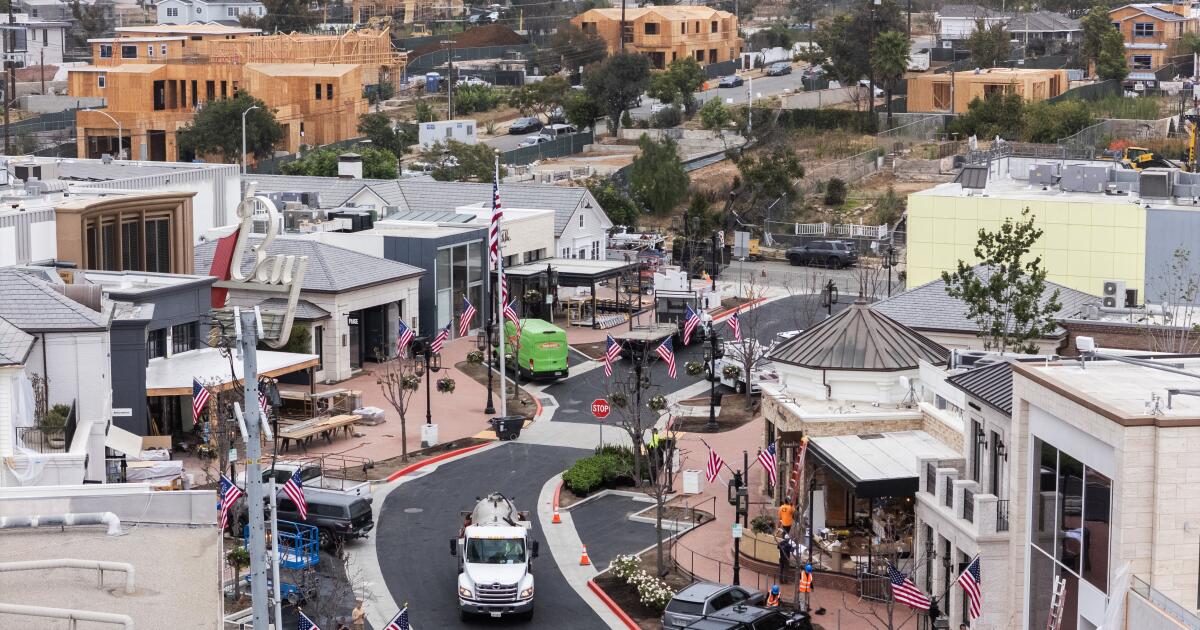
The luxury shopping center in Pacific Palisades will reopen next month after more than $100 million in renovations forced by the January 2025 wildfire that devastated the Los Angeles neighborhood.
Palisades Village will reopen Aug. 15, owner Rick Caruso announced Wednesday. The outdoor center survived the blaze that destroyed homes and other businesses but needed refurbishment to eliminate contaminants that the fire could have spread.
Crews are putting finishing touches on mall buildings after tearing them down to the studs, treating the wood and rebuilding the walls, Caruso said.
“Everybody’s working, and stores are moving their products in,” he said. “It’s a really cool feeling that people have really locked arms and are working together.”
An electrician installs lighting for a restaurant at Rick Caruso’s Palisades Village on Thursday. The shopping center is scheduled to reopen mid-August.
(Myung J. Chun / Los Angeles Times)
Pacific Palisades resident Allison Polhill, who is rebuilding the home of 30 years that her family lost in the blaze, said she is “thrilled” at the prospect of returning to the mall she used to frequent. Its comeback is a boost for the community, she said.
“Every single step that we make to reopen our commercial corridors is going to bring more people back into the Palisades,” said Polhill, who expects to move back into her home at the end of August.
A total of 6,822 structures were destroyed in the Palisades fire, including more than 5,500 residences and 100 commercial businesses, according to the California Department of Forestry and Fire Protection.
Caruso previously attributed the mall’s survival to the hard work of private firefighters and the fire-resistant materials used in the mall’s construction.
The $200-million shopping and dining center opened in 2018 with a movie theater and a roster of upmarket tenants, including Erewhon, which may be the only grocer in the heart of the fire-ravaged neighborhood when it opens.
Caruso’s company was able to fill the mall with tenants despite the long shutdown.
Palisades Village is 99% leased, with the majority of tenants returning, said Jackie Levy, chief financial and revenue officer. Nearly one-third of the shops and restaurants are new to the property.
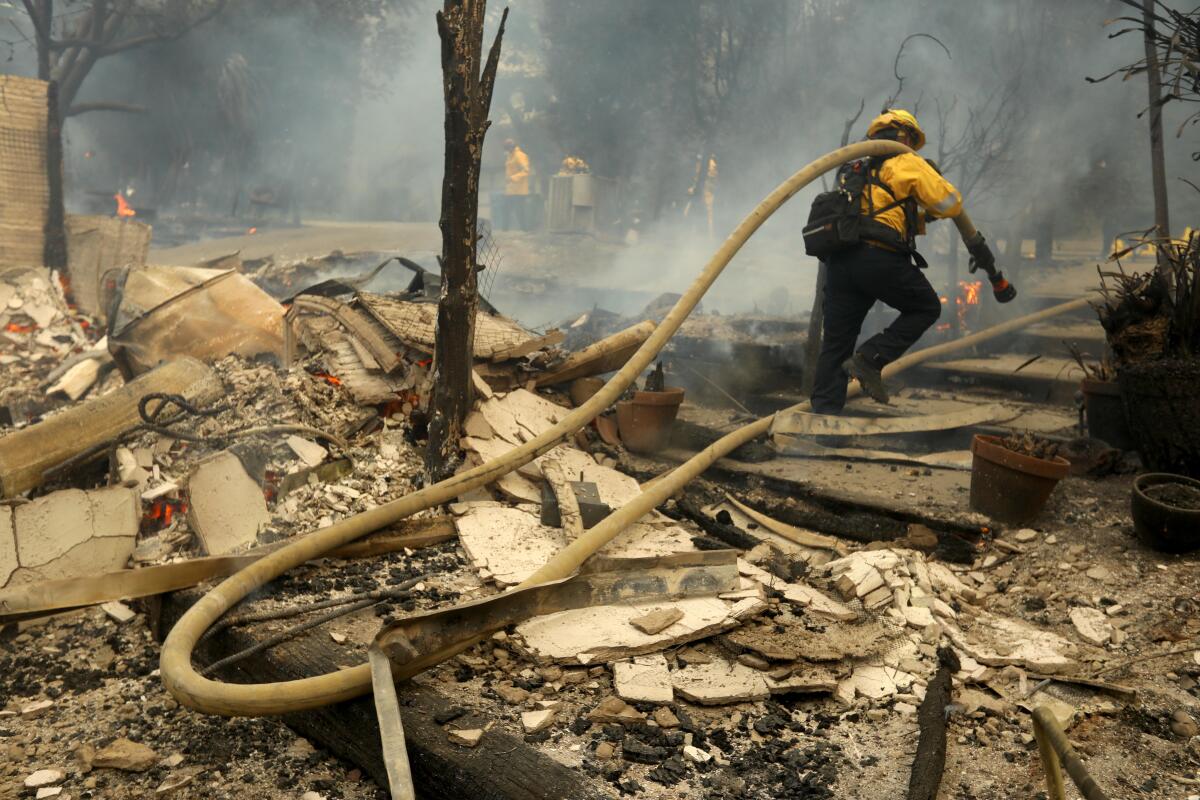
A firefighter carries a hose back to his rig while walking through a destroyed home from the Palisades fire in Pacific Palisades on Jan. 7, 2025.
(Genaro Molina / Los Angeles Times)
Last year, Pacific Palisades-based fashion designer Elyse Walker said she would reopen her eponymous store in Palisades Village after losing her 25-year flagship location on Antioch Street to the inferno.
Other neighborhood shops destroyed in the fire that are reopening at the mall include K Bakery and Loomey’s Toys, which caters to children up to age 12 and used to be across the street from Palisades Elementary Charter School.
“It’s been a journey and I’m excited because I wasn’t sure that there was going to be a place to come back to,” said toy store owner Amanda Rastegar. “Hopefully we can bring some of that magic back.”
Rastegar’s home in the Palisades survived but was damaged by the fire. The family returned about eight weeks ago. Her last memory of the fire was a burning supermarket.
“I just couldn’t wrap my brain around what was happening,” she said. “By the time I left, Gelson’s was on fire.”
Among the returning tenants is Angelini Ristorante & Bar. Well-known Los Angeles chef Gino Angelini said he will be in the kitchen next month for a return of the Italian restaurant.
“We won’t do a big celebrity open,” he said. “We want to have a very soft opening and see our customers come back.”

Construction takes place at Rick Caruso’s Palisades Village on Thursday. The shopping center is scheduled to reopen mid-August.
(Myung J. Chun / Los Angeles Times)
An elaborate celebration would not feel “correct for me,” Angelini said, because the devastation has been “very sad” for so many.
Other new tenants include local chef Nancy Silverton, who has agreed to move in with a new Italian steakhouse called Spacca Tutto. Women’s activewear retailer LESET will open its first West Coast location.
Caruso said he is optimistic that customers will return to the center, even though many Pacific Palisades residents are still dispersed. One tracking system estimated that about 30% of the Village’s customer base was impacted by the fire, he said.
“That means 70% did not get impacted, so there’s a lot of customers still left out there,” Caruso said. Historically, the center drew customers from as far away as Beverly Hills and Calabasas, as well as Malibu, Brentwood and Santa Monica.
He also hopes many will be inspired to visit the revived mall.
“I believe in the goodness of people and I believe that people are going to want to support the Palisades,” he said. “They’re going to want to be there and support the businesses that have had the courage and the heart to reopen.”

Walmart is rapidly expanding its network of electric vehicle chargers designed for customers to use while they shop.
The network could help fill gaps in EV infrastructure in states with greater need for chargers. Walmart, which has more than 5,000 locations in the U.S. and hundreds in California, says more than 90% of Americans live within 10 miles of one of its stores.
The chargers also offer an incentive for customers to choose Walmart — Walmart Plus members will receive a 10% discount off an average price of $0.46 per kilowatt-hour of energy at the company’s chargers.
Walmart chargers are already available at more than 75 locations in 17 states, with Texas boasting the most charging stations, followed by Florida and Arizona.
Matthew Nelson, Walmart’s director of energy policy, said last week on LinkedIn that the network will soon reach 29 states, including California.
“We are delivering on the promise of affordable, reliable and convenient charging,” Nelson said in his post.
According to Walmart’s website, six charging stations are coming to California soon, though the company did not offer a specific timeline.
The chargers will be installed at stores in Antelope, Brea, Fresno, Stockton, Suisun City and Vallejo.
Most charging sites in California will include eight to 16 fast-charging stalls, said Walmart spokesperson Kelsey Bohl.
The company first announced plans in April 2023 to install its own EV chargers at Walmart and Sam’s Club stores, with a goal of installing thousands of chargers by 2030. Partnering with ABB E-Mobility and Alpitronic, it added 25 new charging sites this past May and six more in June.
“Walmart is building a leading retail-integrated EV fast-charging network, focused on delivering an affordable, reliable and convenient charging experience where customers already shop,” Bohl said in an emailed statement. “Customers can charge while they shop, access stations through the Walmart app they already use, and benefit from affordable pricing.”
The charging stations already available include 612 individual charging stalls using 400-kilowatt chargers. Each stall has a dual charging cord with both Combined Charging System and North American Charging Standard connectors. The standard connectors, designed by Tesla, are smaller and lighter than the combined systems.
The primary way to pay for the chargers is through the Walmart app, but the company is also experimenting with built-in credit card readers to allow those without the app to use the stations.
Customers can check charger availability on the Walmart app. The company said the chargers will be available 24 hours a day.

Robotaxis could be turning into robocops.
A self-driving Waymo reported two teens to San Mateo, Calif., police on Monday after they were found drinking alcohol and shooting toy guns in the back of the vehicle.
According to a social media post from the San Mateo Police Department, officers detained two 15-year-olds after the Waymo they were riding in contacted the department and stopped in a parking lot until law enforcement arrived.
“Parents do you know where your teens are?” the San Mateo Police Department wrote on Facebook following the incident. “Waymo does!”
Officers removed both teens from the vehicle and determined they were using toy guns to shoot Orbeez out the windows. Orbeez are small, water-absorbing beads sold at toy stores.
“Toy guns, water guns, and BB guns all pose real dangers, especially to an untrained eye,” the Police Department said. “The simple handling of them can cause fear in [passersby].” “
A video posted on Facebook shows at least five officers and a police dog responding to the scene and approaching the Waymo with their weapons raised.
Waymo did not immediately respond to a request for comment.
Waymo vehicles have internal cameras and microphones that may be used in an emergency or to “promote safety and security,” according to Waymo’s online support page.
The cameras are also used to ensure the vehicles are clean and to help find lost items, according to the support page.
The company said it does not use facial recognition or other biometric identification technologies to identify individuals.
“In more urgent circumstances, support may access live video during a trip,” the Waymo page said.
The San Mateo Police Department’s Facebook post has garnered nearly 60 comments, with one user accusing Waymo of “snitching.”
“At least they got a designated driver?!” one user commented.
-

 Los Angeles, Ca24 minutes ago
Loved ones search for missing 34-year-old Southern California woman
-

 Detroit, MI44 minutes ago
Chickens, geese found at vacant home after nonprofit reports them stolen
-

 San Francisco, CA54 minutes ago
What’s next for San Francisco Giants as MLB trade deadline approaches?
-
 Dallas, TX59 minutes ago
Dallas millionaire files lawsuit against groundwater district
-

 Miami, FL1 hour ago
7 more women arrested at southwest Miami-Dade massage parlors, accused of prostitution in undercover sting
-

 Boston, MA1 hour ago
‘They’re my buddies’: 96-year-old Back Bay woman befriends French soccer team
-

 Denver, CO1 hour ago
Denver officers cited for separate incidents, 1 fired
-

 Seattle, WA1 hour ago
Study finds dangerous chemicals in the breast milk of Seattle moms

