Washington
Figure skaters onboard Washington plane crash


U.S. figure skaters, their coaches and family members were passengers on an American Airlines jet that collided with an Army helicopter near Ronald Reagan National Airport in Washington, D.C., and crashed into the Potomac River on Wednesday, U.S. Figure Skating said.
The figure skaters were returning from a development camp that followed the U.S. Figure Skating Championships in Wichita, Kansas.
“U.S. Figure Skating can confirm that several members of our skating community were sadly aboard American Airlines Flight 5342, which collided with a helicopter yesterday evening in Washington, D.C.,” U.S. Figure Skating said in a statement. “We are devastated by this unspeakable tragedy and hold the victims’ families closely in our hearts.”
U.S. Figure Skating did not identify any of the members of its team that were onboard the flight.
The flight carried 60 passengers and four crew members. The airplane collided with the helicopter while attempting to land, prompting a large search-and-rescue operation in the Potomac River.
There were multiple fatalities, a person familiar with the matter told The Associated Press, but the precise number of victims was unclear as rescue crews hunted for any survivors.
Three soldiers were onboard the helicopter, an Army official said.
Russian media also reported that two Russian figure skaters were on board the flight, and a presidential spokesman expressed condolences to the families and friends of those killed in the plane crash.
“There were other of our fellow citizens there. Bad news from Washington today,” Russian presidential spokesman Dmitry Peskov said Thursday morning.
Russia’s figure skating federation expressed its condolences to those who had lost loved ones in the crash but said it was unable to comment further.
There was no immediate word on the cause of the collision, but all takeoffs and landings at the airport were halted as dive teams scoured the site and helicopters from law enforcement agencies across the region flew over the scene in methodical search for bodies.
“We are going to recover our fellow citizens,” Washington, D.C., Mayor Muriel Bowser said at a somber news conference at the airport Thursday morning in which she declined to say how many bodies had been recovered.
President Donald Trump said he had been “fully briefed on this terrible accident” and, referring to the passengers, added, “may God bless their souls.”
The Federal Aviation Administration said the midair crash occurred before 9 p.m. ET when a regional jet that had departed from Wichita collided with a military helicopter on a training flight while on approach to an airport runway.
The crash occurred in some of the most tightly controlled and monitored airspace in the world, just over three miles south of the White House and the Capitol.
Investigators will try to piece together the aircrafts’ final moments before their collision, including contact with air traffic controllers and the loss of altitude by the passenger jet.
Less than 30 seconds before the crash, an air traffic controller asked the helicopter if it had the arriving plane in sight. The controller made another radio call to the helicopter moments later: “PAT 25 pass behind the CRJ.” Seconds after that, the two aircraft collided.
Some 300 first responders were on scene. Inflatable rescue boats were launched into the Potomac River from a point along the George Washington Parkway, just north of the airport, and first responders set up light towers from the shore to illuminate the area near the collision site. At least a half-dozen boats were scanning the water using searchlights.
“It’s a highly complex operation,” D.C. fire chief John Donnelly said. “The conditions out there are extremely rough for the responders.”
The last fatal crash involving a U.S. commercial airline occurred in 2009 near Buffalo, New York. Everyone aboard the Bombardier DHC-8 propeller plane was killed, including 45 passengers, 2 pilots and 2 flight attendants. Another person on the ground also died, bringing the total death toll to 50.
Wednesday’s collision recalled the crash of an Air Florida flight that plummeted into the Potomac on Jan. 13, 1982, that killed 78 people. That crash was attributed to bad weather.
Reuters contributed to this report.


Bagel shop manager Fernando Mejia was arrested by federal agents just over a year ago in the Port Washington store’s parking lot. Since then, including Monday evening, members of the Port Washington community have kept a weekly vigil to honor Mejia, who they consider one of their own, and bring attention to how his abrupt arrest, and ultimate deportation, left a void in his family, at his workplace and among anyone in town who knew him.
For 52 consecutive Mondays, they have flocked to the Main Street side of the Port Washington Long Island Rail Road station as a tribute to Mejia and their other immigrant neighbors who have been arrested by U.S. Immigration and Customs Enforcement agents and never returned home. The weekly 7 p.m. effort, dubbed the “Port Shines a Light in a Sea of Darkness” vigil by organizers, began a few weeks after Mejia’s June 12 arrest and has continued, even after he agreed to self deport and return to family in his native El Salvador.
Vigil co-organizer Jeff Seigel, 68, told the crowd of about 75 people — many toting handwritten protest signs — that Mejia was “doing well, although well is a relative term.”
Mejia is unable come back to Port Washington to see his teenage daughter, who stood in the crowd Monday evening and who Seigel said flies to El Salvador for visits.
Fernando Mejia was arrested by federal agents on June 12, 2025 outside the Port Washington bagel shop he managed. Credit: Courtesy: Lauren Wax
“He came here when he was about 20 years old, and here in the United States is where he became a man,” Seigel, 68, said. “He worked very hard, always. And it is here in the United States where he became a father. … After five months in detention, he could no longer wait to see if the immigration court would rule in his favor.”
Mejia, the former manager of Schmear Bagel & Cafe on Main Street, one block west of where each vigil is held, was one of about 3,000 Long Islanders arrested by federal immigration agents through March 10 as part of President Donald Trump’s ramped-up deportation push since his return to power, Newsday previously reported.
Mejia had just started his car in the bagel shop’s parking lot about 6:30 a.m. on June 12 to make a delivery when federal agents converged and placed him under arrest. Over the months that followed, Mejia bounced from facility-to-facility — first in Manhattan, then in Newark, Louisiana and Miami. He does not have a criminal record, his attorney, Bryan Richard Pu-Folkes, previously told Newsday. Pu-Folkes said at the time Mejia was likely detained due to a January 2006 deportation order from the Executive Office for Immigration Review for unlawful presence in the country.
Pu-Folkes did not immediately return a phone message Monday seeking comment. Mejia could not be immediately reached for comment.
The weekly efforts help community organizers raise awareness and funds for legal fees and even food for immigrants in the community. Another goal, said Stan Lacy, also a vigil organizer, is distributing whistles throughout the community. As Lacy and other members of Port Washington’s Rapid Response Network drive around Port Washington and encounter ICE agents, they blow whistles to alert immigrants of their presence.
After a trio of arrests “a little over a month ago,” ICE’s presence has been “relatively quiet,” he said.
Fellow organizer Stacey Mellus told Newsday the weekly vigils sometimes draw immigrants thankful for the community support, but not so much “when more ICE activity is in the area, when the climate gets a little more hot.”
“I witnessed one of those abductions here, you’re never going to get over something like that,” Mellus, 50, of Port Washington, said. “I’m never going to get over seeing people separated from their families, people yelling ‘don’t take my husband.’ “
Washington
Supreme Court rules states can count late-arriving mailed ballots, rejecting Trump-led challenge

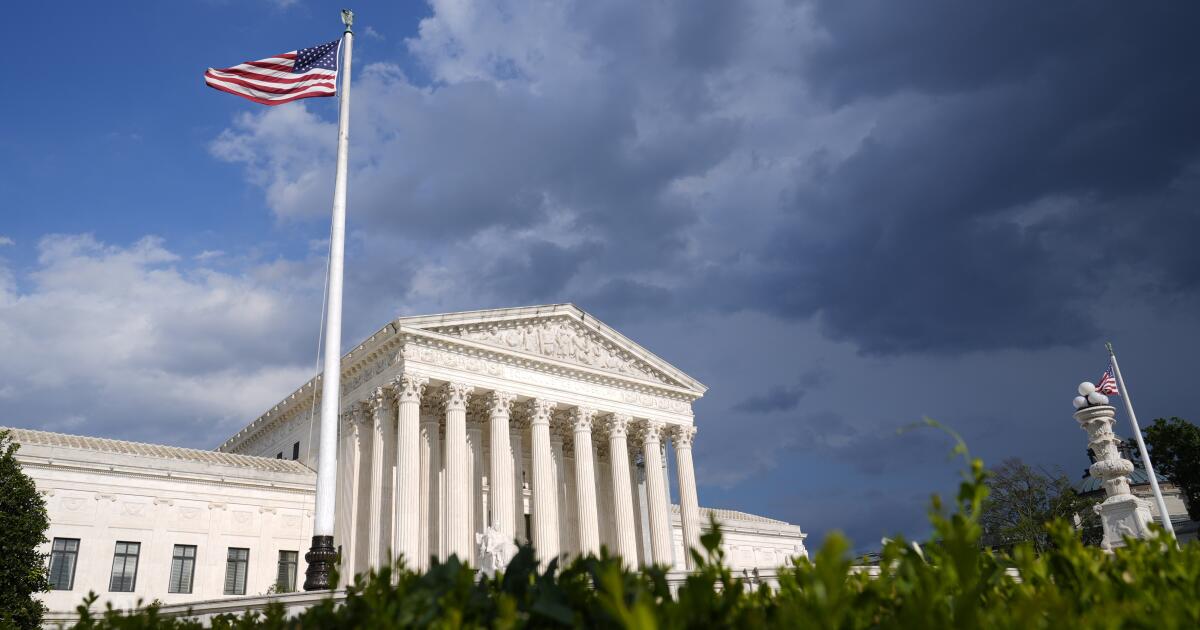
The Supreme Court ruled Monday that states should be allowed to count ballots that are mailed on time but arrive after Election Day.
In a 5-4 decision, the high court rejected a Republican-led attack on laws in more than half the states and the District of Columbia that permit mailed ballots to arrive and be counted some number of days after the election, provided they are postmarked by Election Day. The outcome spares officials the headache of changing their ballot rules just a few months before the 2026 midterm congressional elections.
The decision, written by Justice Amy Coney Barrett, is a defeat for President Donald Trump who has repeatedly claimed mail-in voting encourages fraud, an assertion not backed up by evidence. Chief Justice John G. Roberts Jr. also joined the court’s three liberals in the ruling.
The question before the court was whether Mississippi was acting legally when it permitted ballots postmarked by Election Day to be counted if they arrived within five business days of the election.
“The federal election-day statutes do not preempt Mississippi’s law because the defining element of an ‘election’ has always been the electorate’s choice of candidate,” the decision said.
A voter’s choice is made when voting is complete, not when ballots are received, it said.
Thirteen other states have grace periods for ballots cast by mail. Another 15 have longer deadlines for military and overseas voters.
Last year, Trump signed an executive order that would require votes to be “cast and received” by Election Day, but it has been blocked by court challenges.
Mississippi Solicitor General Scott Stewart noted during arguments before the Supreme Court in March that the Trump administration had failed to produce a single case of fraud due to mail ballots that arrived after Election Day.
Among the state with deadlines after Election Day are California, Texas, New York and Illinois. Rural areas of Alaska also allow post-Election Day ballots.
The Associated Press reported that four states dominated by Republican lawmakers, Kansas, North Dakota, Ohio and Utah, dropped their grace periods last year. That’s according to the National Conference of State Legislatures and Voting Rights Lab.
President Donald Trump said he voted by mail in a Florida election due to scheduling conflicts, explaining he could not be there in person. The remarks come as Palm Beach County records show Trump cast a mail ballot in an upcoming special election, despite his public criticism of the voting method as fraudulent.
During arguments, some of the conservative justices seemed skeptical of late-arriving mail ballots. Justice Samuel Alito for example asked about the appearance of fraud if ballots that arrived after Election Day flipped an election.
The liberal justices on the other hand indicated they would uphold the state laws and noted that federal law allows states to set their own regulations governing elections. Justice Sonia Sotomayor said the states and Congress should decide the issue, not the courts.
Federal law sets Election Day as “the Tuesday next after the first Monday in November.”
Mississippi passed its election law during the COVID-19 pandemic. It was challenged by the Republican National Committee, the Mississippi Republican Party and others.
An appellate court, the 5th U.S. Circuit Court of Appeals, struck down Mississippi’s grace period. Judge Andrew Oldham wrote that the state law allowing the late-arriving ballots to be counted violated federal law.
The three judges who decided Mississippi’s law was unconstitutional were all appointed by Trump during his first term.

-

 Lifestyle10 seconds ago
Chanel’s Bruno Pavlovsky on Reengineering an Iconic Brand
-
 Politics3 minutes ago
Supreme Court limits police use of cellphone data to find crime suspects
-
 Sports15 minutes ago
Teoscar Hernández returns, and Dodgers unleash 17-hit barrage in win over Athletics
-

 World23 minutes ago
DR Congo says 1,307 Ebola cases confirmed, including 377 deaths
-
 News48 minutes ago
Michigan governor threatens to pull troops from D.C. if used for Trump task force
-

 New York2 hours ago
Metropolitan Diary Challenge Day 2: How to Write Your N.Y. Story
-

 Los Angeles, Ca2 hours ago
Company has weeks to complete cleanup of Boyle Heights warehouse fire, officials announce
-

 Detroit, MI3 hours ago
18 New Kid-Friendly Places That Opened in Metro Detroit in 2026 (So Far!)

