Business
Column: A Trump judge dropped his unwavering support for birthright citizenship to conform to Trump's view


Over his seven years on the federal bench, James C. Ho has acquired a reputation as one of the most conservative members of a notably conservative court, the U.S. 5th Circuit Court of Appeals.
So it’s proper to take heed of Ho’s position on a temporarily blocked issue that Donald Trump has lately placed on the front burner: Birthright citizenship, the principle enshrined in the 14th Amendment that virtually all children born in the U.S. are U.S. citizens.
In an executive order issued on inauguration day, Jan. 20, Trump declared that the right of birthright citizenship doesn’t apply to the children of undocumented immigrants. Trump’s order was temporarily blocked Thursday by a federal judge in Seattle.
Text, history, judicial precedent, and Executive Branch interpretation confirm that the Citizenship Clause reaches most U.S.-born children of aliens, including illegal aliens.
— James C. Ho, 2006
Among legal scholars, that’s a minority view, even a fringe view. The 14th Amendment is forthright; it states, “All persons born or naturalized in the United States, and subject to the jurisdiction thereof, are citizens of the United States.”
Ho has long voiced the broadest view of those words. But not lately.
Let’s trace his intellectual journey on the issue.
Ho, as it happens, is an immigrant himself. He was born in Taiwan to parents who immigrated to the U.S. when he was a child and acquired naturalized U.S. citizenship at age 9.
No one to my knowledge has ever argued that the children of invading aliens are entitled to birthright citizenship.
— James C. Ho, 2024
Ho’s judicial stance has been solidly conservative. Last year, writing in a case in which his colleagues reversed a ruling by a federal judge in Texas that had blocked the distribution of the abortion drug mifepristone nationwide, Ho engaged in what I called a “curious flight of fancy” to advocate for the ban.
He asserted that abortions cause “aesthetic injury” to doctors forced to participate in the procedure, even if only by treating patients for adverse reactions.
“Unborn babies are a source of profound joy for those who view them,” Ho wrote. “Doctors delight in working with their unborn patients — and experience an aesthetic injury when they are aborted.” He argued in favor of granting the physician plaintiffs in the case a legal interest in the outcome of abortions achieved via the drug, even though none of the plaintiffs had treated women who had taken it.
“The [Food and Drug Administration] has approved the use of a drug that threatens to destroy the unborn children in whom Plaintiffs have an interest,” Ho wrote. “And this injury is likewise redressable by a court order holding unlawful and setting aside approval of that abortifacient drug.”
Ho’s earliest writing on the birthright citizenship that I could find was published in 2006 in The Green Bag, a law journal. At the time, Ho’s career encompassed service as a counsel to the Senate Republican caucus and service as a clerk to Supreme Court Justice Clarence Thomas. He would later serve as solicitor general of Texas, before his appointment to the 5th Circuit appeals court by Trump in 2017.
In his 2006 article, titled “Defining ‘American,’” Ho focused specifically and at length on the argument that children of undocumented immigrants aren’t entitled to birthright citizenship.
Birthright citizenship, he wrote, “is protected no less for children of undocumented persons than for descendants of Mayflower passengers.”
Ho dismissed the assertion by critics of birthright citizenship that the phrase “subject to the jurisdiction” excludes those who are in the U.S. illegally.” Even they, he wrote, are subject to the authority of the U.S. government, and therefore covered by the citizenship clause. He endorsed the most common interpretation, which is that the “jurisdiction” clause excludes only the children of diplomats serving their home countries in the U.S., and enemy combatants on U.S. soil. Instead, he wrote, the citizenship clause “covers the vast majority of lawful and unlawful aliens.”
Ho wrote again on birthright citizenship in a Jan. 5, 2011, op-ed in the Wall Street Journal. The article addressed an effort by a coalition of red state legislators in support of state-level laws to exclude undocumented immigrants from birthright citizenship. It was subtitled, “Opponents of illegal immigration cannot claim to champion the rule of law and then propose policies that violate our Constitution.”
In that article, Ho reviewed the long history of legal and judicial support for the broad reach of birthright citizenship. As I reported this week, that included an 1898 Supreme Court decision upholding the citizenship of an American citizen of Chinese extraction, and Supreme Court rulings in 1982 and 1985 in which the court “unanimously agreed that a child born to an undocumented immigrant was in fact a U.S. citizen,” as Ho wrote.
Now let’s fast-forward to Nov. 11, days after Trump’s reelection victory. In an interview published by Reason Magazine that Ho gave to conservative lawyer Josh Blackman — who himself supports birthright citizenship for children of undocumented immigrants — Ho backtracked.
“Birthright citizenship obviously doesn’t apply in case of war or invasion,” Ho stated. “No one to my knowledge has ever argued that the children of invading aliens are entitled to birthright citizenship. And I can’t imagine what the legal argument for that would be…. Everyone agrees that birthright citizenship doesn’t apply to the children of lawful combatants. And it’s hard to see anyone arguing that unlawful combatants should be treated more favorably than lawful combatants.”
There’s a lot to unpack here, but Ho certainly seems to be conjuring up a redefinition of “illegal” or undocumented immigrants as “invaders.” He appears to find some equivalence between undocumented immigrants and “invading aliens.” Ho articulated this view in a concurring opinion in an appellate ruling in July that supported efforts by Texas Gov. Greg Abbott to have state officials block immigrants at the Texas border. Ho argued that Abbott’s assertion that Texas faced an “invasion” of illegal immigrants from Mexico deserved respect as a “good faith” description of conditions, and that the state arguably had the right to take matters into its own hands.
That’s a view in which Ho may be in a minority of one. In a 1996 case, a federal appeals court panel ruled that for a state to claim it’s being invaded, “it must be exposed to armed hostility from another political entity, such as another state or foreign country that is intending to overthrow the state’s government”—not a flow of individuals seeking jobs.
In his Reason interview, Ho’s definition of “unlawful combatants” is murky, but his free use of the term “invasion” conforms to the observation of legal scholar Rachel Rosenbloom that opposition to birthright citizenship is typically couched “in a highly racialized language of crisis and invasion.”
Why did Ho change his tune, if that’s what he’s done? Paul Blumenthal of Huffpost speculates that Ho’s “rewriting of his previous position on birthright citizenship can be best seen as his audition for the next open Supreme Court seat,” which is likely to be filled by Trump.
I asked Ho via a message to be forwarded to him by his chambers clerk to comment on that conjecture and to clarify his views on birthright citizenship, and how they might have been changed by rhetoric about an “invasion” of Texas or the U.S. by immigrants. He hasn’t replied.



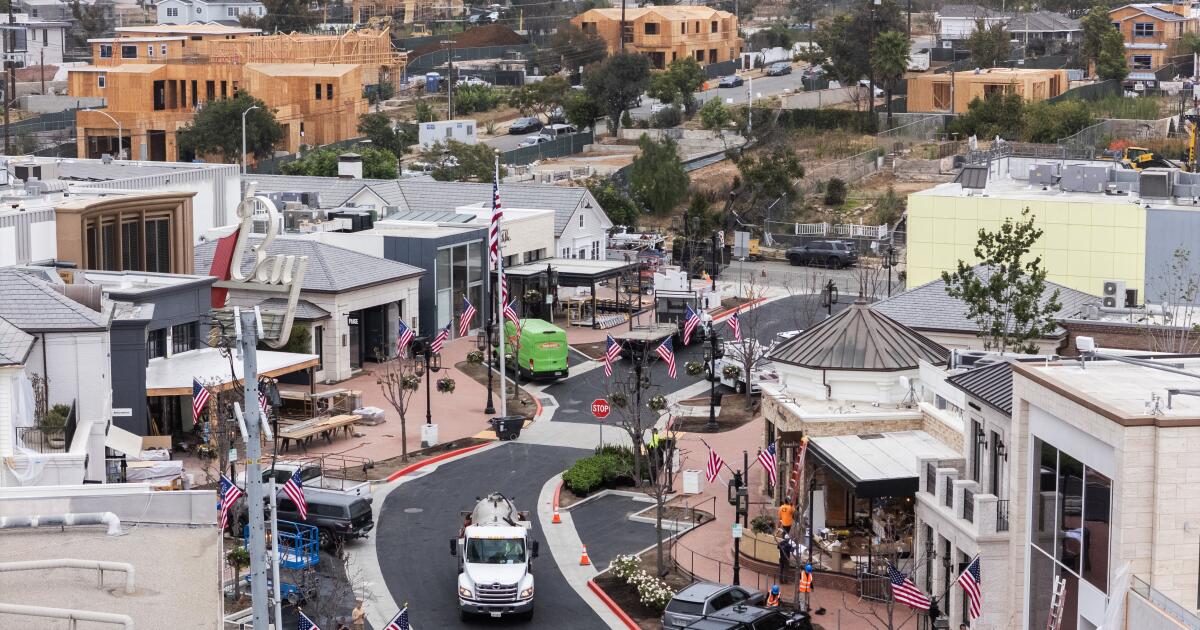
The luxury shopping center in Pacific Palisades will reopen next month after more than $100 million in renovations forced by the January 2025 wildfire that devastated the Los Angeles neighborhood.
Palisades Village will reopen Aug. 15, owner Rick Caruso announced Wednesday. The outdoor center survived the blaze that destroyed homes and other businesses but needed refurbishment to eliminate contaminants that the fire could have spread.
Crews are putting finishing touches on mall buildings after tearing them down to the studs, treating the wood and rebuilding the walls, Caruso said.
“Everybody’s working, and stores are moving their products in,” he said. “It’s a really cool feeling that people have really locked arms and are working together.”
An electrician installs lighting for a restaurant at Rick Caruso’s Palisades Village on Thursday. The shopping center is scheduled to reopen mid-August.
(Myung J. Chun / Los Angeles Times)
Pacific Palisades resident Allison Polhill, who is rebuilding the home of 30 years that her family lost in the blaze, said she is “thrilled” at the prospect of returning to the mall she used to frequent. Its comeback is a boost for the community, she said.
“Every single step that we make to reopen our commercial corridors is going to bring more people back into the Palisades,” said Polhill, who expects to move back into her home at the end of August.
A total of 6,822 structures were destroyed in the Palisades fire, including more than 5,500 residences and 100 commercial businesses, according to the California Department of Forestry and Fire Protection.
Caruso previously attributed the mall’s survival to the hard work of private firefighters and the fire-resistant materials used in the mall’s construction.
The $200-million shopping and dining center opened in 2018 with a movie theater and a roster of upmarket tenants, including Erewhon, which may be the only grocer in the heart of the fire-ravaged neighborhood when it opens.
Caruso’s company was able to fill the mall with tenants despite the long shutdown.
Palisades Village is 99% leased, with the majority of tenants returning, said Jackie Levy, chief financial and revenue officer. Nearly one-third of the shops and restaurants are new to the property.
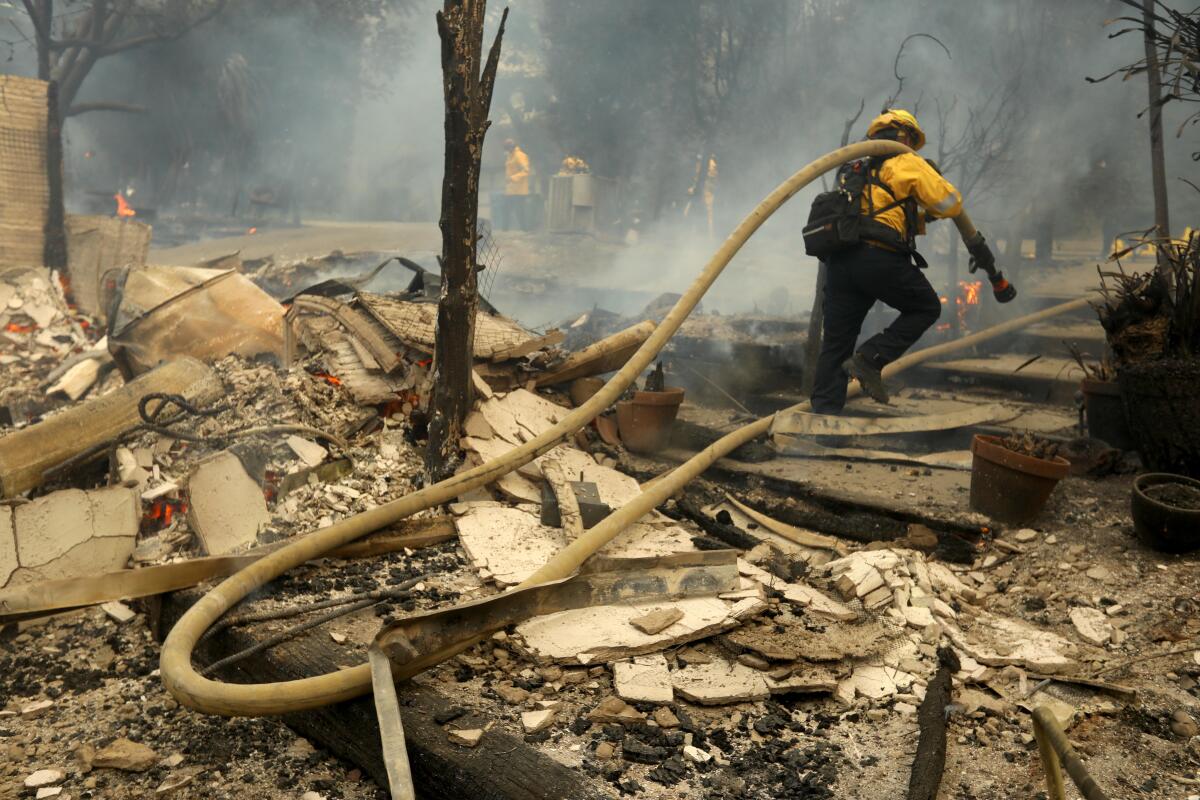
A firefighter carries a hose back to his rig while walking through a destroyed home from the Palisades fire in Pacific Palisades on Jan. 7, 2025.
(Genaro Molina / Los Angeles Times)
Last year, Pacific Palisades-based fashion designer Elyse Walker said she would reopen her eponymous store in Palisades Village after losing her 25-year flagship location on Antioch Street to the inferno.
Other neighborhood shops destroyed in the fire that are reopening at the mall include K Bakery and Loomey’s Toys, which caters to children up to age 12 and used to be across the street from Palisades Elementary Charter School.
“It’s been a journey and I’m excited because I wasn’t sure that there was going to be a place to come back to,” said toy store owner Amanda Rastegar. “Hopefully we can bring some of that magic back.”
Rastegar’s home in the Palisades survived but was damaged by the fire. The family returned about eight weeks ago. Her last memory of the fire was a burning supermarket.
“I just couldn’t wrap my brain around what was happening,” she said. “By the time I left, Gelson’s was on fire.”
Among the returning tenants is Angelini Ristorante & Bar. Well-known Los Angeles chef Gino Angelini said he will be in the kitchen next month for a return of the Italian restaurant.
“We won’t do a big celebrity open,” he said. “We want to have a very soft opening and see our customers come back.”

Construction takes place at Rick Caruso’s Palisades Village on Thursday. The shopping center is scheduled to reopen mid-August.
(Myung J. Chun / Los Angeles Times)
An elaborate celebration would not feel “correct for me,” Angelini said, because the devastation has been “very sad” for so many.
Other new tenants include local chef Nancy Silverton, who has agreed to move in with a new Italian steakhouse called Spacca Tutto. Women’s activewear retailer LESET will open its first West Coast location.
Caruso said he is optimistic that customers will return to the center, even though many Pacific Palisades residents are still dispersed. One tracking system estimated that about 30% of the Village’s customer base was impacted by the fire, he said.
“That means 70% did not get impacted, so there’s a lot of customers still left out there,” Caruso said. Historically, the center drew customers from as far away as Beverly Hills and Calabasas, as well as Malibu, Brentwood and Santa Monica.
He also hopes many will be inspired to visit the revived mall.
“I believe in the goodness of people and I believe that people are going to want to support the Palisades,” he said. “They’re going to want to be there and support the businesses that have had the courage and the heart to reopen.”

Walmart is rapidly expanding its network of electric vehicle chargers designed for customers to use while they shop.
The network could help fill gaps in EV infrastructure in states with greater need for chargers. Walmart, which has more than 5,000 locations in the U.S. and hundreds in California, says more than 90% of Americans live within 10 miles of one of its stores.
The chargers also offer an incentive for customers to choose Walmart — Walmart Plus members will receive a 10% discount off an average price of $0.46 per kilowatt-hour of energy at the company’s chargers.
Walmart chargers are already available at more than 75 locations in 17 states, with Texas boasting the most charging stations, followed by Florida and Arizona.
Matthew Nelson, Walmart’s director of energy policy, said last week on LinkedIn that the network will soon reach 29 states, including California.
“We are delivering on the promise of affordable, reliable and convenient charging,” Nelson said in his post.
According to Walmart’s website, six charging stations are coming to California soon, though the company did not offer a specific timeline.
The chargers will be installed at stores in Antelope, Brea, Fresno, Stockton, Suisun City and Vallejo.
Most charging sites in California will include eight to 16 fast-charging stalls, said Walmart spokesperson Kelsey Bohl.
The company first announced plans in April 2023 to install its own EV chargers at Walmart and Sam’s Club stores, with a goal of installing thousands of chargers by 2030. Partnering with ABB E-Mobility and Alpitronic, it added 25 new charging sites this past May and six more in June.
“Walmart is building a leading retail-integrated EV fast-charging network, focused on delivering an affordable, reliable and convenient charging experience where customers already shop,” Bohl said in an emailed statement. “Customers can charge while they shop, access stations through the Walmart app they already use, and benefit from affordable pricing.”
The charging stations already available include 612 individual charging stalls using 400-kilowatt chargers. Each stall has a dual charging cord with both Combined Charging System and North American Charging Standard connectors. The standard connectors, designed by Tesla, are smaller and lighter than the combined systems.
The primary way to pay for the chargers is through the Walmart app, but the company is also experimenting with built-in credit card readers to allow those without the app to use the stations.
Customers can check charger availability on the Walmart app. The company said the chargers will be available 24 hours a day.

Robotaxis could be turning into robocops.
A self-driving Waymo reported two teens to San Mateo, Calif., police on Monday after they were found drinking alcohol and shooting toy guns in the back of the vehicle.
According to a social media post from the San Mateo Police Department, officers detained two 15-year-olds after the Waymo they were riding in contacted the department and stopped in a parking lot until law enforcement arrived.
“Parents do you know where your teens are?” the San Mateo Police Department wrote on Facebook following the incident. “Waymo does!”
Officers removed both teens from the vehicle and determined they were using toy guns to shoot Orbeez out the windows. Orbeez are small, water-absorbing beads sold at toy stores.
“Toy guns, water guns, and BB guns all pose real dangers, especially to an untrained eye,” the Police Department said. “The simple handling of them can cause fear in [passersby].” “
A video posted on Facebook shows at least five officers and a police dog responding to the scene and approaching the Waymo with their weapons raised.
Waymo did not immediately respond to a request for comment.
Waymo vehicles have internal cameras and microphones that may be used in an emergency or to “promote safety and security,” according to Waymo’s online support page.
The cameras are also used to ensure the vehicles are clean and to help find lost items, according to the support page.
The company said it does not use facial recognition or other biometric identification technologies to identify individuals.
“In more urgent circumstances, support may access live video during a trip,” the Waymo page said.
The San Mateo Police Department’s Facebook post has garnered nearly 60 comments, with one user accusing Waymo of “snitching.”
“At least they got a designated driver?!” one user commented.
-

 Seattle, WA2 minutes ago
Study finds dangerous chemicals in the breast milk of Seattle moms
-

 San Diego, CA5 minutes ago
Tom Krasovic: Justin Verlander’s announcement recalls Padres’ 2004 draft blunder
-
 Milwaukee, WI10 minutes ago
‘Peace on Every Block’ brings Milwaukee community together to fight gun violence
-

 Atlanta, GA17 minutes ago
Atlanta smash-and-grab: Masked men ram U-Haul into clothing store
-

 Minneapolis, MN20 minutes ago
Minneapolis police drone debate sparks privacy concerns
-
Indianapolis, IN25 minutes ago
Adam Vinatieri will celebrate on the field in Indianapolis again as Colts’ Ring of Honor member
-

 Pittsburg, PA32 minutes ago
U.S. launches more strikes against Iran
-

 Augusta, GA35 minutes ago
Augusta groups work to keep veterans housed through SSVF program

