Business
A treasure house of composer Arnold Schoenberg's music destroyed in Palisades fire


On the morning of Jan. 7, Larry Schoenberg was about to prepare the tax filings for Belmont Music Publishers, the august house dedicated to preserving and promoting the works of his late father, Arnold Schoenberg, one of the most influential musicians of the 20th century, when his daughter Camille called and told him to look outside.
“Oh my God,” he said. Thick plumes of smoke were whipping up all around his Pacific Palisades home. Without thinking he jumped into his car, his wife in the other, and they drove to their daughter’s house elsewhere in the Palisades.
The plan was to wait it out. However, before the day was over, Schoenberg’s house was gone. Eventually, the flames reached his daughter’s house, and they fled to Venice to stay with another daughter.
The inferno also blasted to ash Belmont Music Publishers, which was housed in a building behind his home on Bienveneda Avenue. For 60 years, Belmont served as a bridge between Schoenberg — often referred to as the man who invented “modern music” — and performers and scholars, providing access to his music.
The wildfires destroyed Larry Schoenberg’s Pacific Palisades house and Belmont Music Publishers, which stood in a building behind it.
(E. Randol Schoenberg)
While the majority of the composer’s original works remain housed at the Arnold Schönberg Center in Vienna, Belmont’s entire physical inventory, upwards of 100,000 items including manuscripts and original scores, along with correspondence, books, photographs and artworks, had all perished.
For Larry Schoenberg, it wasn’t merely the physical loss, but “a profound cultural blow” — yet another example of how the wildfires have destroyed a trove of L.A.’s cultural heritage.
Schoenberg revolutionized Western compositional techniques and helped shape modern music worldwide, but he also had a profound and still-present influence on the cultural life of Los Angeles.
“The scale of this fire makes it hard to handle how big the losses are,” said Joy H. Calico, chair of the Department of Musicology at UCLA’s Herb Alpert School of Music. “It’s not as if his entire legacy was lost but certainly in terms of the practical reality of performing his music, this is a serious blow.”
***
Schoenberg’s wife, Gertrud, a librettist, and son Larry established Belmont Music Publishers in 1965. Belmont was a play on the family’s surname — “beautiful mountain” — in German.
Following the composer’s death in 1951, numerous people wrote to Gertrud requesting his music. There was so much back-and-forthing with the publisher in Germany that his heirs decided to create Belmont, as Gertrud owned the rights to her husband’s catalog. They initially set up the business in a converted garage behind their Brentwood home, selling and renting curated editions of Schoenberg’s sheet music for performances.
“We’re not very business savvy people,” Larry Schoenberg recalled. “We were spending more than we were collecting.”
They also had to overcome the negative connotation business had in their home. “We grew up where business was kind of a dirty word,” he said. His father used the derisive German term “der Gauner,” which means crook or swindler.
But Belmont, which later moved to the building behind Larry Schoenberg’s Pacific Palisades house, became a business successful in preserving Schoenberg’s legacy, making his works accessible to the world.
Last September marked the 150th anniversary of Schoenberg’s birth. A flurry of performances took place in Europe and the United States, including by the San Francisco Symphony and the Los Angeles Philharmonic. Many of these performances got their scores from Belmont.
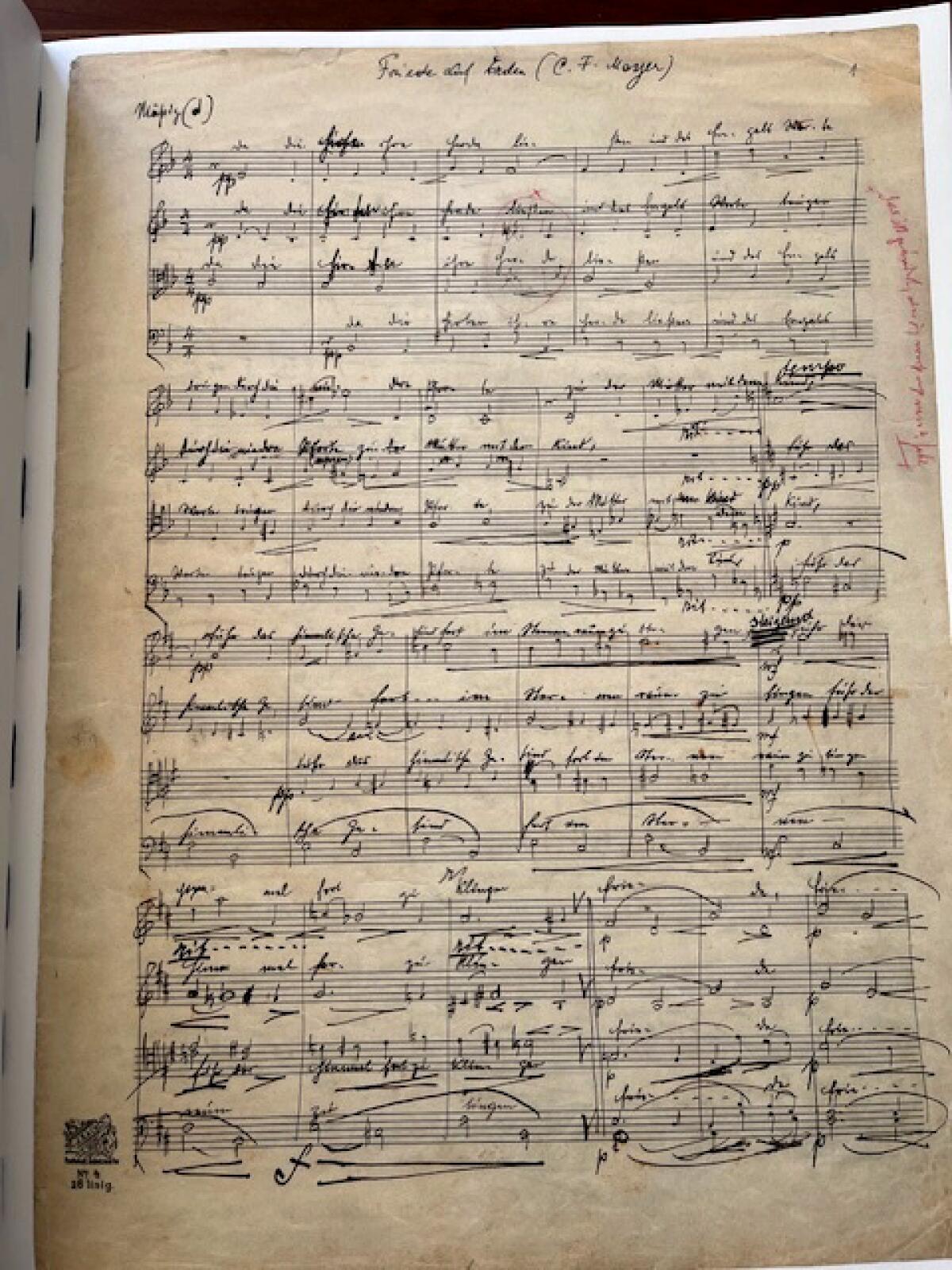
A copy of one of Arnold Schoenberg’s musical scores published by Belmont, still in his grandson E. Randol Schoenberg’s possession.
(Stacy Perman / Los Angeles Times)
At 83, Larry Schoenberg, a former math teacher at Palisades High School, has been Belmont’s steadfast guardian.
He maintained a whiteboard with all of the upcoming performances of his father’s music and what needed to be shipped. Everything was well labeled and organized, but nothing was digitized.
“This is just my stupidity,” he said. “Everything was backed up, except it was backed up locally. I had hard drives and thumb drives. I didn’t use the cloud, I was a little bit worried about using the cloud. Well, of course, now I wish I had everything in the cloud. What that means is essentially we have nothing.”
The fire claimed the full range of Schoenberg’s groundbreaking compositions held there, from early Romantic pieces to his revolutionary 12-tone works and transformative masterpieces like “Pierrot Lunaire.” Also lost were performance posters, a bust of Schoenberg and ephemera such as the fanciful playing card sets the composer designed.
Also gone was the irreplaceable library filled with 50 years worth of manuscripts and correspondence from conductors, such as Zubin Mehta and Claudio Abbado, who performed Schoenberg.
“When the conductors return the scores, they put a lot of information in there. That’s really crucial for performances,” said Larry Schoenberg. “And that’s all gone. The correspondence goes back to the ’70s. In fact, every once in a while I look at some of this correspondence.”
Last December, Larry shipped a box of 16 books to his nephew E. Randol Schoenberg. They are all that remains from Belmont’s library.
Reflecting on all that was lost, he said, “The memories are still there. I didn’t lose those yet.”

Larry Schoenberg sent his nephew a set of 16 books from Belmont in December. Now they are all that remains from its library.
(Stacy Perman / Los Angeles Times)
***
Arnold Schoenberg was already a towering intellectual and cultural figure when he landed in Los Angeles in 1934.
Born in Vienna in 1874, the composer also was a writer, teacher, inventor and painter.
Uncompromising and innovative, he devised the 12-tone method, a musical structure that broke with the traditional rules of tonality and composition. Although it prompted (and still does) enormous debate, it was also considered by many the future of music. The Nazis, however, labeled his music “degenerate.”
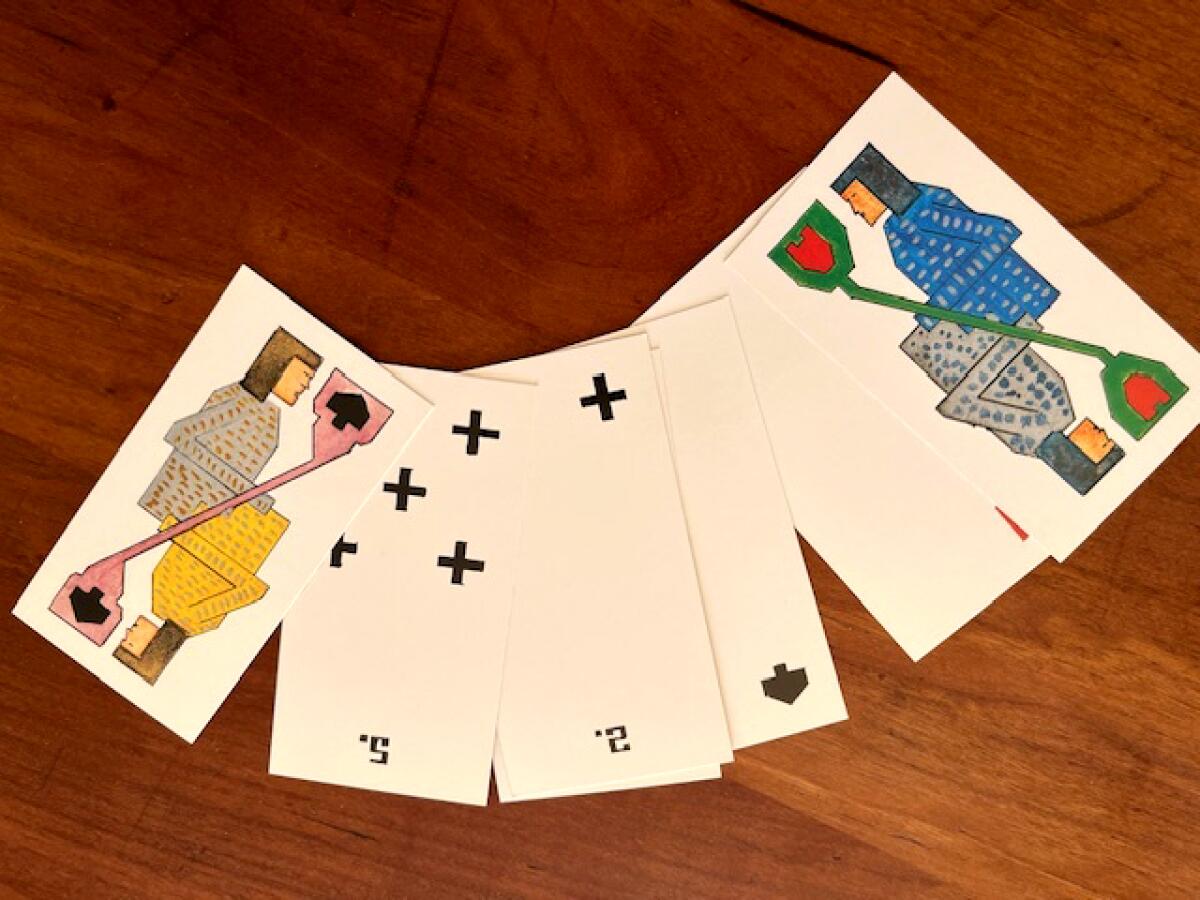
Arnold Schoenberg designed a set of whimsical playing cards.
(Stacy Perman / Los Angeles Times)
In 1933, after receiving a telegram from his brother-in-law, the violinist Rudolf Kolisch, saying “a change of air is recommended,” the composer, then 60, and his family fled Berlin on the midnight train to Paris, leaving everything behind, according to his grandson E. Randol Schoenberg, known as Randy.
Schoenberg spent a brief time in Boston and New York, before fleeing the harsh East Coast winters for Los Angeles. “It is Switzerland, the Riviera, the Vienna Woods, the desert, Salzkammergut, Spain, Italy — everything in one place. And along with that scarcely a day, apparently even in winter, without sun,” he wrote Anton Webern, the Austrian composer and conductor.
His arrival was part of the exodus of German-speaking Jews who emigrated from Nazi-occupied Europe that helped usher in a golden age of classical music in Los Angeles, with many writing film scores.

Arnold Schoenberg’s Brentwood house was a hub for European exiles in Los Angeles.
(Belmont Music Publishers)
In 1936 Schoenberg bought a Spanish Colonial in Brentwood, and the house became a center of cultural life for European exiles, entertaining the likes of Thomas Mann and Franz Werfel and his wife, Alma Mahler-Werfel.
There, Schoenberg befriended Hollywood luminaries. Shirley Temple was a neighbor, and Harpo Marx was a friend, as was George Gershwin, who was also his tennis partner. According to Randy, his grandfather was playing a match with Gershwin when his wife gave birth to Randy’s father, Ronald, in 1937.
Schoenberg, who taught at UCLA, had a reputation as a gifted teacher whose tutelage held cachet. When the German conductor Otto Klemperer came to the city to perform at the Los Angeles Philharmonic, he studied with Schoenberg.
With finances tight, he took on private students, a great deal of them composers who had come to California to work for the movie studios. “They wanted to learn what sort of tricks and techniques, you know, how do I make my music sound like this?” Randy said. “They would come for a couple lessons and then put it on their resume, ‘studies with Arnold Schoenberg,’ and never come back.
“He got wise to this and decided to charge a lot for the initial lessons. And if the person turned into a real student, he would reduce the rates.”

The Los Angeles Philharmonic performs Arnold Schoenberg’s gargantuan “Gurrelieder” at Walt Disney Concert Hall on Dec. 13.
(Carlin Stiehl / For The Times)
Several of Schoenberg’s “real” students, such as John Cage, Alfred Newman and David Raksin, became hugely successful, and their relationships helped to perpetuate the composer’s lasting influence in Hollywood and beyond.
Posthumously, Schoenberg’s impact is undeniable.
Film composers have long used his pioneering 12-tone technique to produce dissonance and unpredictable melodies, such as Jerry Goldsmith, in his benchmark score in the 1968 film “Planet of the Apes.”
While Schoenberg’s music continues to be played all over the world, his notes are all over Los Angeles.
The music building and main concert venue at UCLA are named after Schoenberg. In May the opera “Schoenberg in Hollywood” will be performed at UCLA. It presents three imagined vignettes from the composer’s life.
His heirs who have diligently tended his legacy have also been important civic and cultural figures in the life of this city. In addition to his son Larry, Ronald is a retired judge. He lives with his wife, Barbara, the daughter of the composer Eric Zeisl, in Schoenberg’s original Brentwood home. Their son Randy, a lawyer, won a significant case before the Supreme Court in 2004, leading to the government of Austria returning five Gustav Klimt paintings stolen by the Nazis to the family of Maria Altman.
The Schoenberg family, four members of which have lost homes in the fires, say they hope to create digitized scores from the manuscripts kept in Vienna as well to recreate other documents and correspondence that exists in the hands of others around the world. Larry Schoenberg said they’ve received a wellspring of support and encouragement from all over the world.
“It’s astounding to think about how that legacy was moved out of central Europe because of the peril there — only to find it facing a different crisis here,” Calico said.

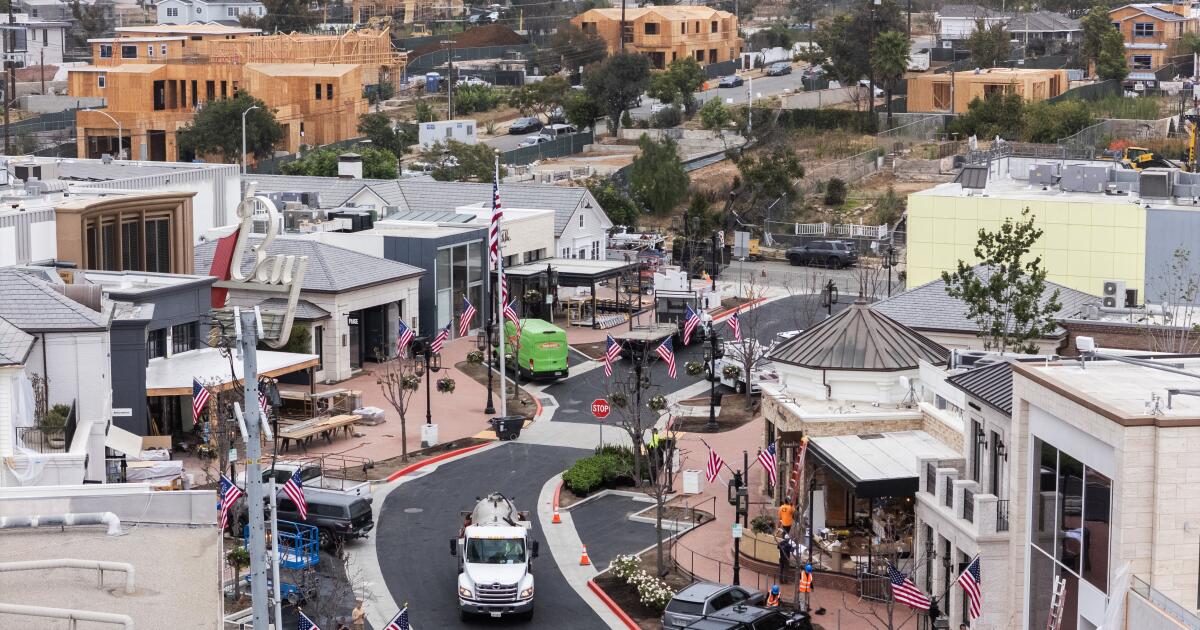
The luxury shopping center in Pacific Palisades will reopen next month after more than $100 million in renovations forced by the January 2025 wildfire that devastated the Los Angeles neighborhood.
Palisades Village will reopen Aug. 15, owner Rick Caruso announced Wednesday. The outdoor center survived the blaze that destroyed homes and other businesses but needed refurbishment to eliminate contaminants that the fire could have spread.
Crews are putting finishing touches on mall buildings after tearing them down to the studs, treating the wood and rebuilding the walls, Caruso said.
“Everybody’s working, and stores are moving their products in,” he said. “It’s a really cool feeling that people have really locked arms and are working together.”
An electrician installs lighting for a restaurant at Rick Caruso’s Palisades Village on Thursday. The shopping center is scheduled to reopen mid-August.
(Myung J. Chun / Los Angeles Times)
Pacific Palisades resident Allison Polhill, who is rebuilding the home of 30 years that her family lost in the blaze, said she is “thrilled” at the prospect of returning to the mall she used to frequent. Its comeback is a boost for the community, she said.
“Every single step that we make to reopen our commercial corridors is going to bring more people back into the Palisades,” said Polhill, who expects to move back into her home at the end of August.
A total of 6,822 structures were destroyed in the Palisades fire, including more than 5,500 residences and 100 commercial businesses, according to the California Department of Forestry and Fire Protection.
Caruso previously attributed the mall’s survival to the hard work of private firefighters and the fire-resistant materials used in the mall’s construction.
The $200-million shopping and dining center opened in 2018 with a movie theater and a roster of upmarket tenants, including Erewhon, which may be the only grocer in the heart of the fire-ravaged neighborhood when it opens.
Caruso’s company was able to fill the mall with tenants despite the long shutdown.
Palisades Village is 99% leased, with the majority of tenants returning, said Jackie Levy, chief financial and revenue officer. Nearly one-third of the shops and restaurants are new to the property.
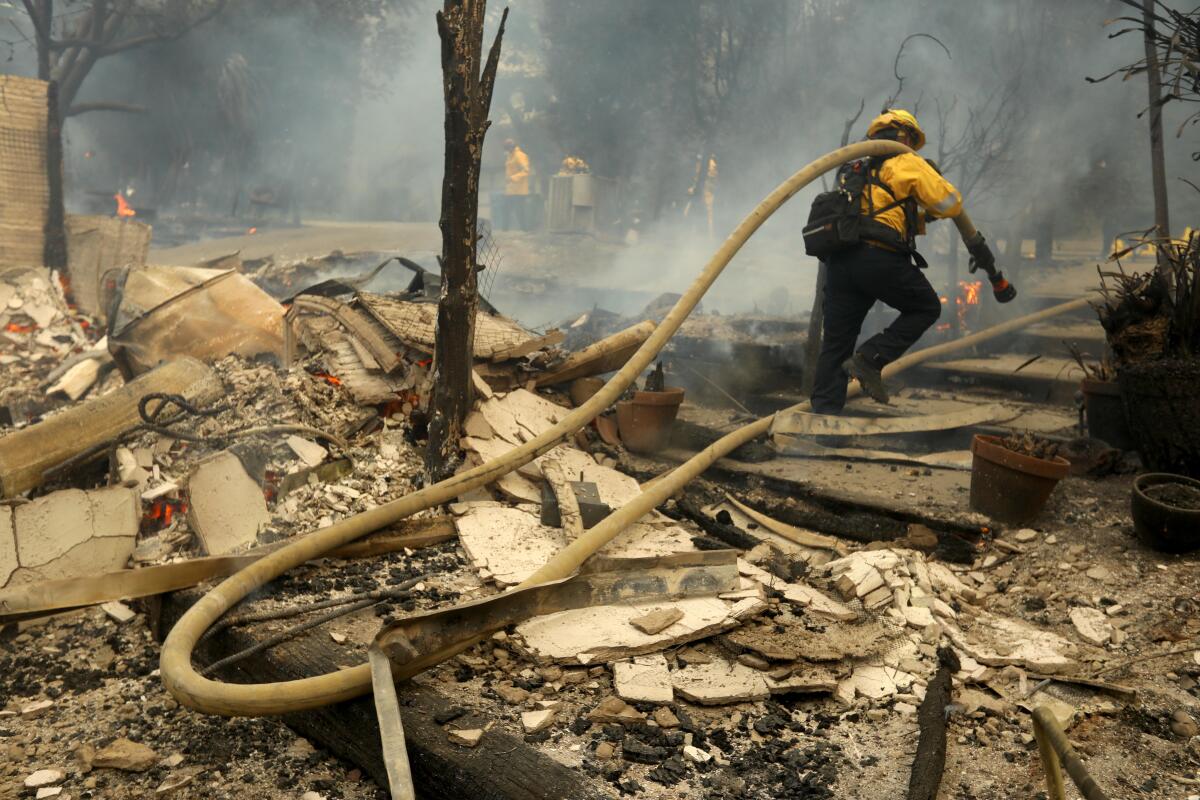
A firefighter carries a hose back to his rig while walking through a destroyed home from the Palisades fire in Pacific Palisades on Jan. 7, 2025.
(Genaro Molina / Los Angeles Times)
Last year, Pacific Palisades-based fashion designer Elyse Walker said she would reopen her eponymous store in Palisades Village after losing her 25-year flagship location on Antioch Street to the inferno.
Other neighborhood shops destroyed in the fire that are reopening at the mall include K Bakery and Loomey’s Toys, which caters to children up to age 12 and used to be across the street from Palisades Elementary Charter School.
“It’s been a journey and I’m excited because I wasn’t sure that there was going to be a place to come back to,” said toy store owner Amanda Rastegar. “Hopefully we can bring some of that magic back.”
Rastegar’s home in the Palisades survived but was damaged by the fire. The family returned about eight weeks ago. Her last memory of the fire was a burning supermarket.
“I just couldn’t wrap my brain around what was happening,” she said. “By the time I left, Gelson’s was on fire.”
Among the returning tenants is Angelini Ristorante & Bar. Well-known Los Angeles chef Gino Angelini said he will be in the kitchen next month for a return of the Italian restaurant.
“We won’t do a big celebrity open,” he said. “We want to have a very soft opening and see our customers come back.”

Construction takes place at Rick Caruso’s Palisades Village on Thursday. The shopping center is scheduled to reopen mid-August.
(Myung J. Chun / Los Angeles Times)
An elaborate celebration would not feel “correct for me,” Angelini said, because the devastation has been “very sad” for so many.
Other new tenants include local chef Nancy Silverton, who has agreed to move in with a new Italian steakhouse called Spacca Tutto. Women’s activewear retailer LESET will open its first West Coast location.
Caruso said he is optimistic that customers will return to the center, even though many Pacific Palisades residents are still dispersed. One tracking system estimated that about 30% of the Village’s customer base was impacted by the fire, he said.
“That means 70% did not get impacted, so there’s a lot of customers still left out there,” Caruso said. Historically, the center drew customers from as far away as Beverly Hills and Calabasas, as well as Malibu, Brentwood and Santa Monica.
He also hopes many will be inspired to visit the revived mall.
“I believe in the goodness of people and I believe that people are going to want to support the Palisades,” he said. “They’re going to want to be there and support the businesses that have had the courage and the heart to reopen.”

Walmart is rapidly expanding its network of electric vehicle chargers designed for customers to use while they shop.
The network could help fill gaps in EV infrastructure in states with greater need for chargers. Walmart, which has more than 5,000 locations in the U.S. and hundreds in California, says more than 90% of Americans live within 10 miles of one of its stores.
The chargers also offer an incentive for customers to choose Walmart — Walmart Plus members will receive a 10% discount off an average price of $0.46 per kilowatt-hour of energy at the company’s chargers.
Walmart chargers are already available at more than 75 locations in 17 states, with Texas boasting the most charging stations, followed by Florida and Arizona.
Matthew Nelson, Walmart’s director of energy policy, said last week on LinkedIn that the network will soon reach 29 states, including California.
“We are delivering on the promise of affordable, reliable and convenient charging,” Nelson said in his post.
According to Walmart’s website, six charging stations are coming to California soon, though the company did not offer a specific timeline.
The chargers will be installed at stores in Antelope, Brea, Fresno, Stockton, Suisun City and Vallejo.
Most charging sites in California will include eight to 16 fast-charging stalls, said Walmart spokesperson Kelsey Bohl.
The company first announced plans in April 2023 to install its own EV chargers at Walmart and Sam’s Club stores, with a goal of installing thousands of chargers by 2030. Partnering with ABB E-Mobility and Alpitronic, it added 25 new charging sites this past May and six more in June.
“Walmart is building a leading retail-integrated EV fast-charging network, focused on delivering an affordable, reliable and convenient charging experience where customers already shop,” Bohl said in an emailed statement. “Customers can charge while they shop, access stations through the Walmart app they already use, and benefit from affordable pricing.”
The charging stations already available include 612 individual charging stalls using 400-kilowatt chargers. Each stall has a dual charging cord with both Combined Charging System and North American Charging Standard connectors. The standard connectors, designed by Tesla, are smaller and lighter than the combined systems.
The primary way to pay for the chargers is through the Walmart app, but the company is also experimenting with built-in credit card readers to allow those without the app to use the stations.
Customers can check charger availability on the Walmart app. The company said the chargers will be available 24 hours a day.

Robotaxis could be turning into robocops.
A self-driving Waymo reported two teens to San Mateo, Calif., police on Monday after they were found drinking alcohol and shooting toy guns in the back of the vehicle.
According to a social media post from the San Mateo Police Department, officers detained two 15-year-olds after the Waymo they were riding in contacted the department and stopped in a parking lot until law enforcement arrived.
“Parents do you know where your teens are?” the San Mateo Police Department wrote on Facebook following the incident. “Waymo does!”
Officers removed both teens from the vehicle and determined they were using toy guns to shoot Orbeez out the windows. Orbeez are small, water-absorbing beads sold at toy stores.
“Toy guns, water guns, and BB guns all pose real dangers, especially to an untrained eye,” the Police Department said. “The simple handling of them can cause fear in [passersby].” “
A video posted on Facebook shows at least five officers and a police dog responding to the scene and approaching the Waymo with their weapons raised.
Waymo did not immediately respond to a request for comment.
Waymo vehicles have internal cameras and microphones that may be used in an emergency or to “promote safety and security,” according to Waymo’s online support page.
The cameras are also used to ensure the vehicles are clean and to help find lost items, according to the support page.
The company said it does not use facial recognition or other biometric identification technologies to identify individuals.
“In more urgent circumstances, support may access live video during a trip,” the Waymo page said.
The San Mateo Police Department’s Facebook post has garnered nearly 60 comments, with one user accusing Waymo of “snitching.”
“At least they got a designated driver?!” one user commented.
-

 News24 minutes ago
Three more people charged with damaging Reflecting Pool after Trump’s multimillion-dollar restoration | CNN Politics
-

 Los Angeles, Ca2 hours ago
Loved ones search for missing 34-year-old Southern California woman
-

 Detroit, MI2 hours ago
Chickens, geese found at vacant home after nonprofit reports them stolen
-

 San Francisco, CA2 hours ago
What’s next for San Francisco Giants as MLB trade deadline approaches?
-
 Dallas, TX2 hours ago
Dallas millionaire files lawsuit against groundwater district
-

 Miami, FL2 hours ago
7 more women arrested at southwest Miami-Dade massage parlors, accused of prostitution in undercover sting
-

 Boston, MA2 hours ago
‘They’re my buddies’: 96-year-old Back Bay woman befriends French soccer team
-

 Denver, CO3 hours ago
Denver officers cited for separate incidents, 1 fired

