Lifestyle
1972 Munich Olympics thriller shows nail-biting decisions in ABC Sports control room
Director Tim Fehlbaum’s team obtained 1970s era television equipment from collectors, museums and television studio storage rooms for the set of his film September 5.
Courtesy of Paramount Pictures
hide caption
toggle caption
Courtesy of Paramount Pictures
The 1972 Munich Olympics kicked off under the banner of hope and peace, hosted by a country eager to turn the page nearly three decades after the fall of the Nazi regime.
Instead, those Summer Games were marred by tragedy when armed militants affiliated with the Palestinian organization Black September took members of Israel’s Olympic team hostage. By the time it all ended, 11 Israelis, five Palestinians and a West German officer were dead.
ABC Sports was already on the ground covering the sporting events from its own production complex outside the Olympic Village. As the situation unfolded, the division took the dramatic decision to broadcast live with developments.
These events are recounted in director Tim Fehlbaum’s new Golden Globe-nominated film September 5. The film is set almost entirely in the ABC Sports control room and focuses on the real-time challenges faced by the broadcasters who improvised to get the audience as close as possible to the story.
YouTube
“It was that group of sports reporters that had to make that switch,” Fehlbaum told NPR’s A Martínez. “They had this almost innocent view. They were not trained or experienced in crisis reporting. And so they made all these decisions on the spot.”
ABC Sports, led by then president Roone Arledge, played by Peter Sarsgaard, vigorously fought for his division to lead the story, refusing to bow to intense pressure from ABC News to take over news coverage from thousands of miles away in the United States.
Some of the team’s heftiest challenges included making sure their live coverage didn’t inadvertently share with the armed extremists — via television screens the hostage takers might access — law enforcement’s moves and potentially broadcast hostage killings to the entire world.
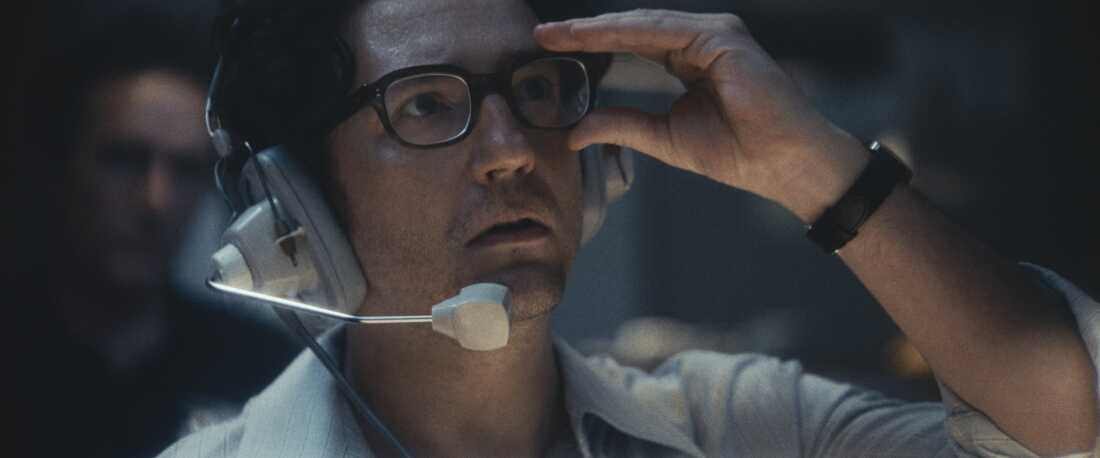
Geoffrey Mason (John Magaro) was a young ABC Sports producer when he played a critical role in deciding what to show the world about the 1972 Munich Olympics massacre. September 5 director Tim Felhbaum consulted with Mason, a 26-time Emmy Award winner, for his film.
Courtesy of Paramount Pictures
hide caption
toggle caption
Courtesy of Paramount Pictures
The seminal moment changed how media covers breaking news in real time as journalists grappled with how evolving technologies might impact the subjects of reporting and the audience consuming the media coverage. The broadcast was also an early instance of news becoming infotainment.
Arledge, who created the primetime Monday Night Football broadcasts, won an Emmy Award for his coverage of the 1972 Munich Games and was inducted into the Olympic Hall of Fame. He produced a total of 10 Olympic Games.
As part of his research for the film, Fehlbaum had conversations with Geoffrey Mason, one of the few surviving members of the ABC Sports team who covered the events. At the time, he was pulled in as coordinating producer of the around-the-clock ABC Sports coverage.
“Everything that they were doing was against a ticking clock. Right. That’s basically the essence of live reporting also, is that you are constantly working against the ticking clock,” Fehlbaum said, recalling one of his exchanges with Mason.
Actress Leonie Benesch plays gregarious German interpreter Marianne Gebhard — a composite character — in September 5. As the ABC Sports interpreter, she brought the news to the team as it unfolded.
Jürgen Olczyk
hide caption
toggle caption
Jürgen Olczyk
Fehlbaum’s team obtained blueprints of the ABC Sports control room and pictures from that time so that the images on screen were “100% accurate.” All of the equipment shown in the film is vintage technology from the era, obtained from collectors and museums, and the cast was trained on using it.
The director, who is based in Switzerland, recalled how production buyer Johannes Pfaller at one point told him that all early 1970s era technology still in Europe was now in the film studio in Munich.
“I wanted these devices to work because I wanted the cast to be able to interact with this technology,” Fehlbaum explained. “So if John Magaro would give a direction to the monitor wall, it could actually have an effect on the wall. These telephones would really ring. And I wanted everything that comes from the outside to the cast in front of the camera to really happen.”
Roone Arledge (played by Peter Sarsgaard), left, almost singlehandedly revolutionized television news and introduced the equivalent of livestreaming when ABC Sports covered the 1972 Munich Olympics massacre.
Jürgen Olczyk
hide caption
toggle caption
Jürgen Olczyk
September 5 makes extensive use of original ABC footage. Securing access to the footage is what initially led the film to become an English-language one with an international production team backed by Sean Penn and his partners John Ira Palmer and John Wildermuth.
Combined with a tightly written script, the footage gives a sense of urgency and dramatic tension, all packed in a small room.
It’s also what distinguishes September 5 from past cinematic treatment, such as Steven Spielberg’s Munich (2005), which focuses on the aftermath, or Kevin Macdonald’s documentary One Day in September (1999).
Cinematographer Markus Förderer, behind the camera, and director Tim Fehlbaum, to his right, on the set of Paramount Pictures’ September 5.
Kenneth Macdonald
hide caption
toggle caption
Kenneth Macdonald
“I thought the media aspect is an interesting story or aspect of that tragic day for today’s audience to learn more about. And we wanted to convey a way for today’s audience to reflect on our complex media environment through that historical lens,” Fehlbaum said.
“The moral and ethical questions are still the same that are being discussed every day. For example, can we show violence on TV or how fast do we let something out just to be the first? Or how many confirmed sources do we need?”
The broadcast version of this story was produced by Barry Gordemer. The digital version was edited by Obed Manuel.

Lifestyle
Mundane, magic, maybe both — a new book explores ‘The Writer’s Room’
There’s a three-story house in Baltimore that looks a bit imposing. You walk up the stone steps before even getting up to the porch, and then you enter the door and you’re greeted with a glass case of literary awards. It’s The Clifton House, formerly home of Lucille Clifton.
The National Book Award-winning poet lived there with her husband, Fred, starting in 1967 until the bank foreclosed on the house in 1980. Clifton’s daughter, Sidney Clifton, has since revived the house and turned it into a cultural hub, hosting artists, readings, workshops and more. But even during a February visit, in the mid-afternoon with no organized events on, the house feels full.
The corner of Lucille Clifton’s bedroom, where she would wake up and write in the mornings
Andrew Limbong/NPR
hide caption
toggle caption
Andrew Limbong/NPR
“There’s a presence here,” Clifton House Executive Director Joël Díaz told me. “There’s a presence here that sits at attention.”
Sometimes, rooms where famous writers worked can be places of ineffable magic. Other times, they can just be rooms.
Princeton University Press
Katie da Cunha Lewin is the author of the new book, The Writer’s Room: The Hidden Worlds That Shape the Books We Love, which explores the appeal of these rooms. Lewin is a big Virginia Woolf fan, and the very first place Lewin visited working on the book was Monk’s House — Woolf’s summer home in Sussex, England. On the way there, there were dreams of seeing Woolf’s desk, of retracing Woolf’s steps and imagining what her creative process would feel like. It turned out to be a bit of a disappointment for Lewin — everything interesting was behind glass, she said. Still, in the book Lewin writes about how she took a picture of the room and saved it on her phone, going back to check it and re-check it, “in the hope it would allow me some of its magic.”
Let’s be real, writing is a little boring. Unlike a band on fire in the recording studio, or a painter possessed in their studio, the visual image of a writer sitting at a desk click-clacking away at a keyboard or scribbling on a piece of paper isn’t particularly exciting. And yet, the myth of the writer’s room continues to enrapture us. You can head to Massachusetts to see where Louisa May Alcott wrote Little Women. Or go down to Florida to visit the home of Zora Neale Hurston. Or book a stay at the Scott & Zelda Fitzgerald Museum in Alabama, where the famous couple lived for a time. But what, exactly, is the draw?

Lewin said in an interview that whenever she was at a book event or an author reading, an audience question about the writer’s writing space came up. And yes, some of this is basic fan-driven curiosity. But also “it started to occur to me that it was a central mystery about writing, as if writing is a magic thing that just happens rather than actually labor,” she said.
In a lot of ways, the book is a debunking of the myths we’re presented about writers in their rooms. She writes about the types of writers who couldn’t lock themselves in an office for hours on end, and instead had to find moments in-between to work on their art. She covers the writers who make a big show of their rooms, as a way to seem more writerly. She writes about writers who have had their homes and rooms preserved, versus the ones whose rooms have been lost to time and new real estate developments. The central argument of the book is that there is no magic formula to writing — that there is no daily to-do list to follow, no just-right office chair to buy in order to become a writer. You just have to write.
Lifestyle
Bruce Johnston Retiring From The Beach Boys After 61 Years
Bruce Johnston
I’m Riding My Last Wave With The Beach Boys
Published
Bruce Johnston is riding off into the California sunset … at least for now.
The Beach Boys legend announced Wednesday he’s stepping away from touring after six decades with the iconic band. The 83-year-old revealed in a statement to Rolling Stone he’s hanging up his touring hat to focus on what he calls part three of his long music career.
“It’s time for Part Three of my lengthy musical career!” Johnston said. “I can write songs forever, and wait until you hear what’s coming!!! As my major talent beyond singing is songwriting, now is the time to get serious again.”
Johnston famously stepped in for co-founder Brian Wilson in 1965 for live performances, becoming a staple of the Beach Boys’ touring lineup ever since. Now, he says he’s shifting gears toward songwriting and even some speaking engagements … with occasional touring member John Stamos helping him craft what he’ll talk about onstage.
“I might even sing ‘Disney Girls’ & ‘I Write The Songs!!’” he teased.
But don’t call it a full-on farewell tour just yet. Johnston made it clear he’s not shutting the door completely, saying he’s excited to reunite with the band for special occasions, including their upcoming July 2-4 shows at the Hollywood Bowl as part of the Beach Boys’ 2026 tour. The run celebrates both the 60th anniversary of “Pet Sounds” and America’s 250th birthday.
“This isn’t goodbye, it’s see you soon,” he wrote. “I am forever grateful to be a part of the Beach Boys musical legacy.”
Lifestyle
On the brink of death, a woman is saved by a stranger and his family
In 1982, Jean Muenchrath was injured in a mountaineering accident and on the brink of death when a stranger and his family went out of their way to save her life.
Jean Muenchrath
hide caption
toggle caption
Jean Muenchrath
In early May 1982, Jean Muenchrath and her boyfriend set out on a mountaineering trip in the Sierra Nevada, a mountain range in California. They had done many backcountry trips in the area before, so the terrain was somewhat familiar to both of them. But after they reached one of the summits, a violent storm swept in. It began to snow heavily, and soon the pair was engulfed in a blizzard, with thunder and lightning reverberating around them.
“Getting struck and killed by lightning was a real possibility since we were the highest thing around for miles and lightning was striking all around us,” Muenchrath said.
To reach safer ground, they decided to abandon their plan of taking a trail back. Instead, using their ice axes, they climbed down the face of the mountain through steep and icy snow chutes.
They were both skilled at this type of descent, but at one particularly difficult part of the route, Muenchrath slipped and tumbled over 100 feet down the rocky mountain face. She barely survived the fall and suffered life-threatening injuries.

This was before cellular or satellite phones, so calling for help wasn’t an option. The couple was forced to hike through deep snow back to the trailhead. Once they arrived, Muenchrath collapsed in the parking lot. It had been five days since she’d fallen.
”My clothes were bloody. I had multiple fractures in my spine and pelvis, a head injury and gangrene from a deep wound,” Muenchrath said.
Not long after they reached the trailhead parking lot, a car pulled in. A man was driving, with his wife in the passenger seat and their baby in the back. As soon as the man saw Muenchrath’s condition, he ran over to help.
”He gently stroked my head, and he held my face [and] reassured me by saying something like, ‘You’re going to be OK now. I’ll be right back to get you,’” Muenchrath remembered.
For the first time in days, her panic began to lift.
“My unsung hero gave me hope that I’d reach a hospital and I’d survive. He took away my fears.”
Within a few minutes, the man had unpacked his car. His wife agreed to stay back in the parking lot with their baby in order to make room for Muenchrath, her boyfriend and their backpacks.
The man drove them to a nearby town so that the couple could get medical treatment.
“I remember looking into the eyes of my unsung hero as he carried me into the emergency room in Lone Pine, California. I was so weak, I couldn’t find the words to express the gratitude I felt in my heart.”

The gratitude she felt that day only grew. Now, nearly 45 years later, she still thinks about the man and his family.
”He gave me the gift of allowing me to live my life and my dreams,” Muenchrath said.
At some point along the way, the man gave Muenchrath his contact information. But in the chaos of the day, she lost it and has never been able to find him.
”If I knew where my unsung hero was today, I would fly across the country to meet him again. I’d hug him, buy him a meal and tell him how much he continues to mean to me by saving my life. Wherever you are, I say thank you from the depths of my being.”
My Unsung Hero is also a podcast — new episodes are released every Tuesday. To share the story of your unsung hero with the Hidden Brain team, record a voice memo on your phone and send it to myunsunghero@hiddenbrain.org.
-
World1 week agoExclusive: DeepSeek withholds latest AI model from US chipmakers including Nvidia, sources say
-
Massachusetts1 week agoMother and daughter injured in Taunton house explosion
-
Wisconsin3 days agoSetting sail on iceboats across a frozen lake in Wisconsin
-
Maryland4 days agoAM showers Sunday in Maryland
-
Denver, CO1 week ago10 acres charred, 5 injured in Thornton grass fire, evacuation orders lifted
-
Florida4 days agoFlorida man rescued after being stuck in shoulder-deep mud for days
-
Oregon6 days ago2026 OSAA Oregon Wrestling State Championship Results And Brackets – FloWrestling
-
Massachusetts2 days agoMassachusetts man awaits word from family in Iran after attacks