Lifestyle
1972 Munich Olympics thriller shows nail-biting decisions in ABC Sports control room


Director Tim Fehlbaum’s team obtained 1970s era television equipment from collectors, museums and television studio storage rooms for the set of his film September 5.
Courtesy of Paramount Pictures
hide caption
toggle caption
Courtesy of Paramount Pictures
The 1972 Munich Olympics kicked off under the banner of hope and peace, hosted by a country eager to turn the page nearly three decades after the fall of the Nazi regime.
Instead, those Summer Games were marred by tragedy when armed militants affiliated with the Palestinian organization Black September took members of Israel’s Olympic team hostage. By the time it all ended, 11 Israelis, five Palestinians and a West German officer were dead.
ABC Sports was already on the ground covering the sporting events from its own production complex outside the Olympic Village. As the situation unfolded, the division took the dramatic decision to broadcast live with developments.
These events are recounted in director Tim Fehlbaum’s new Golden Globe-nominated film September 5. The film is set almost entirely in the ABC Sports control room and focuses on the real-time challenges faced by the broadcasters who improvised to get the audience as close as possible to the story.
YouTube
“It was that group of sports reporters that had to make that switch,” Fehlbaum told NPR’s A Martínez. “They had this almost innocent view. They were not trained or experienced in crisis reporting. And so they made all these decisions on the spot.”
ABC Sports, led by then president Roone Arledge, played by Peter Sarsgaard, vigorously fought for his division to lead the story, refusing to bow to intense pressure from ABC News to take over news coverage from thousands of miles away in the United States.
Some of the team’s heftiest challenges included making sure their live coverage didn’t inadvertently share with the armed extremists — via television screens the hostage takers might access — law enforcement’s moves and potentially broadcast hostage killings to the entire world.
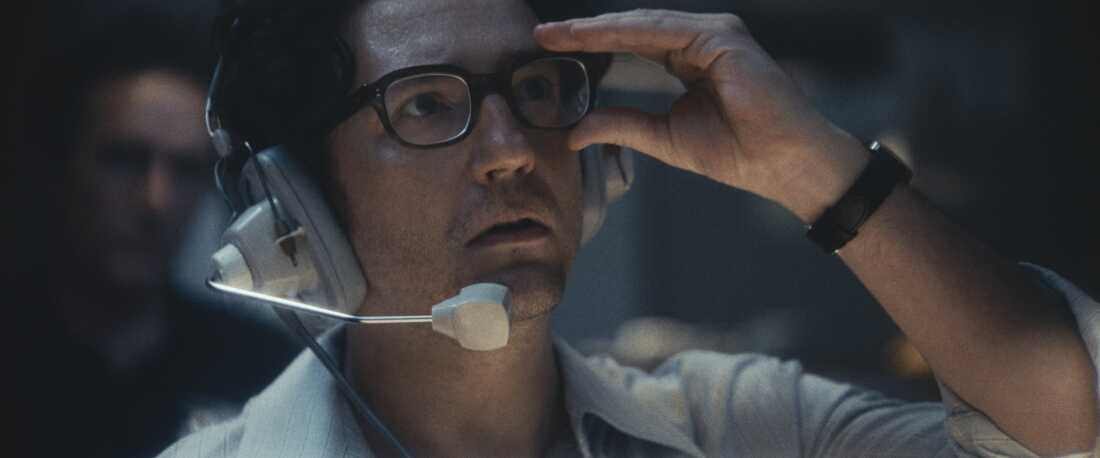
Geoffrey Mason (John Magaro) was a young ABC Sports producer when he played a critical role in deciding what to show the world about the 1972 Munich Olympics massacre. September 5 director Tim Felhbaum consulted with Mason, a 26-time Emmy Award winner, for his film.
Courtesy of Paramount Pictures
hide caption
toggle caption
Courtesy of Paramount Pictures
The seminal moment changed how media covers breaking news in real time as journalists grappled with how evolving technologies might impact the subjects of reporting and the audience consuming the media coverage. The broadcast was also an early instance of news becoming infotainment.
Arledge, who created the primetime Monday Night Football broadcasts, won an Emmy Award for his coverage of the 1972 Munich Games and was inducted into the Olympic Hall of Fame. He produced a total of 10 Olympic Games.
As part of his research for the film, Fehlbaum had conversations with Geoffrey Mason, one of the few surviving members of the ABC Sports team who covered the events. At the time, he was pulled in as coordinating producer of the around-the-clock ABC Sports coverage.
“Everything that they were doing was against a ticking clock. Right. That’s basically the essence of live reporting also, is that you are constantly working against the ticking clock,” Fehlbaum said, recalling one of his exchanges with Mason.

Actress Leonie Benesch plays gregarious German interpreter Marianne Gebhard — a composite character — in September 5. As the ABC Sports interpreter, she brought the news to the team as it unfolded.
Jürgen Olczyk
hide caption
toggle caption
Jürgen Olczyk
Fehlbaum’s team obtained blueprints of the ABC Sports control room and pictures from that time so that the images on screen were “100% accurate.” All of the equipment shown in the film is vintage technology from the era, obtained from collectors and museums, and the cast was trained on using it.
The director, who is based in Switzerland, recalled how production buyer Johannes Pfaller at one point told him that all early 1970s era technology still in Europe was now in the film studio in Munich.
“I wanted these devices to work because I wanted the cast to be able to interact with this technology,” Fehlbaum explained. “So if John Magaro would give a direction to the monitor wall, it could actually have an effect on the wall. These telephones would really ring. And I wanted everything that comes from the outside to the cast in front of the camera to really happen.”

Roone Arledge (played by Peter Sarsgaard), left, almost singlehandedly revolutionized television news and introduced the equivalent of livestreaming when ABC Sports covered the 1972 Munich Olympics massacre.
Jürgen Olczyk
hide caption
toggle caption
Jürgen Olczyk
September 5 makes extensive use of original ABC footage. Securing access to the footage is what initially led the film to become an English-language one with an international production team backed by Sean Penn and his partners John Ira Palmer and John Wildermuth.
Combined with a tightly written script, the footage gives a sense of urgency and dramatic tension, all packed in a small room.
It’s also what distinguishes September 5 from past cinematic treatment, such as Steven Spielberg’s Munich (2005), which focuses on the aftermath, or Kevin Macdonald’s documentary One Day in September (1999).

Cinematographer Markus Förderer, behind the camera, and director Tim Fehlbaum, to his right, on the set of Paramount Pictures’ September 5.
Kenneth Macdonald
hide caption
toggle caption
Kenneth Macdonald
“I thought the media aspect is an interesting story or aspect of that tragic day for today’s audience to learn more about. And we wanted to convey a way for today’s audience to reflect on our complex media environment through that historical lens,” Fehlbaum said.
“The moral and ethical questions are still the same that are being discussed every day. For example, can we show violence on TV or how fast do we let something out just to be the first? Or how many confirmed sources do we need?”
The broadcast version of this story was produced by Barry Gordemer. The digital version was edited by Obed Manuel.



For Iris van Herpen, couture is a laboratory as much as a runway. Our chief fashion critic, Vanessa Friedman, takes us inside this Dutch designer’s latest Paris show — from sci-fi-inspired gowns to an audacious attempt at a dress made of charged plasma.
Lifestyle
The BoF Podcast | Decoding Paris Haute Couture: Wonder, Restraint and the Call of the Void


-

 Augusta, GA2 minutes ago
South Augusta YMCA will not renew Tobacco Road lease
-

 Washington, D.C8 minutes ago
Storm Team4 Forecast: Scattered showers and storms possible Saturday PM
-

 Cleveland, OH15 minutes ago
Cleveland’s First Round woes must end with the 2026 class
-

 Austin, TX17 minutes ago
Texas reports dozens of cyclosporiasis cases tied to contaminated fresh produce
-

 Alabama30 minutes ago
Small Plane Makes Emergency Landing In Peanut Field Near Florida-Alabama Line : NorthEscambia.com
-
Alaska33 minutes ago
An Alaska vacation can remind Israelis the world doesn’t revolve around them | The Jerusalem Post
-
 Arizona38 minutes ago
Arizona AG continues to investigate Glendale apartment complex after Friday deadline to fix A/C
-

 Arkansas44 minutes ago
Office of Keep Arkansas Beautiful Now Part of the ARDOT

