Denver, CO
What’s Working: More than half of Denver-area homes sold last month offered a concession


Now that the election is over, the Colorado housing market seems primed for buyers this winter. And with two interest rate cuts since September, that would seem to make sense.
But traditional 30-year mortgage rates was 7.05% on Friday, up from a week ago’s 6.98% after the Federal Reserve cut interest rates. And even though more houses were for sale — and sold — last month, house hunters may continue to sit out as median sales prices sit at more than a half-million dollars. Colorado’s median sales price inched up 2.3% to $583,000 while the Denver metro stayed put, up just $10 — yes, $10! — to $625,000 from a year ago.
“Affordability is a challenge and is at its highest level of concern in the past couple of decades,” said Cooper Thayer, a Denver-area Realtor at The Thayer Group. “One of my specific concerns is the condo market, which has really struggled.”

Higher condo fees have discouraged buyers looking for something more affordable than a single family house. In Denver, median condo sale prices dropped 6.5% to $402,000 while the number of sales fell 12.9%. Statewide, condo prices fell 4.5% and sales dropped 5.1%.
But what doesn’t show up in Denver County’s numbers could be a good sign for house hunters who’ve been priced out. The county had a 37.6% increase in home sales in October and 55% of the closed transactions had some sort of seller concession, Thayer said. The average was $8,760, which can be anything from a rate buydown or the seller covering closing costs or the cost to fix items after an inspection. Concessions don’t always affect the sale price and don’t show up in the monthly data.
“Being that half of the transactions had a concession,” Thayer said, “when you reframe how you’re thinking about pricing and put it into a net number, it may actually be a little bit lower than the prices that are being reported.”
In the Denver metro area, which includes adjacent counties, sellers were also getting just 98.5% of their asking price. Back in the pandemic heyday, as buyers competed for houses and outbid one another, the average sale price was 105.5% above the asking price in May 2021, according to data from the Colorado Association of Realtors. Statewide, houses were selling for 98.3% of the asking price.

Other agents reported similar trends pointing to a buyer’s market, the latest Colorado Association of Realtors report said. Sellers were negotiating “and dropping their prices to get their places sold before the snow flies,” according to Dana Cottrell, a Realtor in Summit County. Inventory for Summit, Park and Lake counties was up 30% while median prices were down 13%. But affordability is relative in Cottrell’s area — the median sales price in Summit and Park counties was more than $1 million.
Jay Gupta, a Colorado Springs Realtor, noted that 44.2% of active homes for sale reduced the price in El Paso County last month, while Teller County saw 30.7% cut prices.
“Buyers currently have excellent opportunities due to high inventory levels, motivated sellers, and dropping interest rates,” Gupta said in a news release.
But affordability is still one of the biggest issues in the area, said Patrick Muldoon, head of Muldoon Associates in Colorado Springs. In El Paso County, the median sales price increased 2.1% in a year to $475,000, while condo and townhouse prices fell 1.9% to $330,000.
“On my side, it is crickets. Part of it may be the mental side of the election. But I believe it is still affordability and the economy. Buyers have checked out,” Muldoon said in an email, adding that showings have slowed as a result. “I don’t think I have ever seen stagnation in the housing market like this. Nothing happening.”

There was a large jump in homes sold last month compared with a year ago. There are two reasons for that, Thayer said. October 2023 was brutal. The number of homes sold in the Denver metro area fell 17.4% from a year earlier to 2,784 sales. So the 22.1% uptick last month to 3,467 sales gets activity closer to where it was two years ago.
Some pre-approved buyers jumped in last month as mortgage rates hit a low-to-mid 6%. Some lenders offer to “float” the rate for 30 days so the buyer can lock in a rate within the month if rates should drop.
“What happened in that period was we had some houses under contract, and lenders were floating the rate, and then all of a sudden it went down for a week, and everybody locked in,” Thayer said. “Those weekly movements can have some impact on the market (but) don’t really affect the overall trend.”
➔ Around the state: Here’s what Realtors around Colorado are saying about October activity. >> Read CAR blog post
Sun economy stories you may have missed

➔ US Forest Service won’t hire seasonal workers next year, will rely on Colorado volunteer groups to “fill gaps” With an unclear budget for 2025, the Forest Service is not planning to hire seasonal workers next year and warns volunteer groups not to expect big projects >> Read story
➔ The second Trump presidency could mean big changes for health insurance in Colorado. Repealing or substantially rewriting the Affordable Care Act could upend a number of policies in the state, while changes to Medicaid could also be far-reaching >> Read story
➔ A century-old practice allows people to use more than their normal share of Colorado River water. Researchers say it should stop. >> Read story

➔ Denver Broncos on verge of giving fans faster internet at Mile High stadium. Who uses mobile phones at football games? More Broncos fans than ever, as Empower Field at Mile High upgrades wireless technology. >> Read story
➔ UCHealth agrees to $23 million settlement with the feds over false billing accusations. The Colorado U.S. Attorney’s Office alleged that the health system overbilled for some emergency care. UCHealth denies the claims. >> Read story
➔ Denver heat pump incentive targets multifamily, commercial buildings for more efficient heating and cooling. Stores, offices and apartment buildings are in line for $7.5 million in help to cut monthly energy bills by installing new systems >> Read story
Other working bits
➔ Pueblo cannabis company to pay state $225,000 for false claims and lying. The Bee’s Knees CBDs and its owner Joseph Leyba have settled with the Colorado Attorney General’s Office after an investigation found that the Pueblo cannabis company called some of its products “organic” that weren’t, didn’t verify shoppers’ ages online and lied about supporting conservation groups. Bee’s Knees must pay $225,000 in civil penalties that could more than double if the company fails to completely comply. >> View settlement
➔ Got towed? More than 5,000 consumers are getting checks in the mail after being identified as victims of an illegal fee collection by Wyatts Towing, which was acquired this week. The state Attorney General’s Office announced the $1 million settlement late last year and announced this month that the checks are now on the way. >> The FAQ
➔ Larger loans for underserved smaller businesses now available. As a recipient of a $60 million New Markets Tax Credit award from the U.S. Department of Treasury, the Colorado Enterprise Fund will be able to finance larger projects than its usual capacity of $10,000 to $1 million. CEF is a community development financial institution, which manages market-rate loans backed by federal and philanthropic grants or investors. The loans serve lower-income or underserved communities and small businesses that may not qualify for a traditional bank loan. A recent $7 million donation for CEF came from philanthropist MacKenzie Scott. >> Details, inquire
➔ Fort Lupton college gets funding to train 38 truck drivers. Two programs at Aims Community College in Fort Lupton provide training to new truck drivers who need a commercial driver’s license to land decent jobs. A $137,560 grant from the U.S. Department of Transportation will cover driver safety training for 38 students to get their CDL. A second program is aimed at non-native English speakers looking for an opportunity as a professional truck driver. >> Apply
Got some economic news or business bits Coloradans should know? Tell us: cosun.co/heyww
This year has sped by. Thanks to readers who continue to check out this weekly economic update and special thanks to those who support our work at The Colorado Sun. We’re currently getting a match for any donations that come in through the end of the year. Donate and your support is doubled at coloradosun.com/donate! Thanks in advance! ~ tamara
Miss a column? Catch up:
What’s Working is a Colorado Sun column about surviving in today’s economy. Email tamara@coloradosun.com with stories, tips or questions. Read the archive, ask a question at cosun.co/heyww and don’t miss the next one by signing up at coloradosun.com/getww.
Support this free newsletter and become a Colorado Sun member: coloradosun.com/join
Corrections & Clarifications
Notice something wrong? The Colorado Sun has an ethical responsibility to fix all factual errors. Request a correction by emailing corrections@coloradosun.com.



If you use Santa Fe Drive as a part of your daily commute, you will notice full closures this weekend on a popular section, from Florida Avenue to Evans Avenue, for the installation of a pedestrian bridge.
Once the 370-foot pedestrian bridge is completed, it will connect the east and west portions of Denver’s Overland neighborhood. This bridge will be used by pedestrians and bicyclists.
The Denver Department of Transportation and Infrastructure says this closure is needed to keep the traveling public safe. Large cranes will be used to set the two spans in place. Each one weighs about 215,000 pounds and is 180 feet long.
Once the bridge is completed in 2027, it will create a safer connection for pedestrians and bicyclists. It will link neighborhoods to trails, transit, parks, and local businesses without requiring residents to cross heavy traffic.
“Our neighborhood is quartered by transportation routes, so having a safe pedestrian bridge that can take people from one side to the other is an amazing development that neighbors have been asking for for years,” Jenn Greiving, President, Overland Park Neighborhood Association, said.
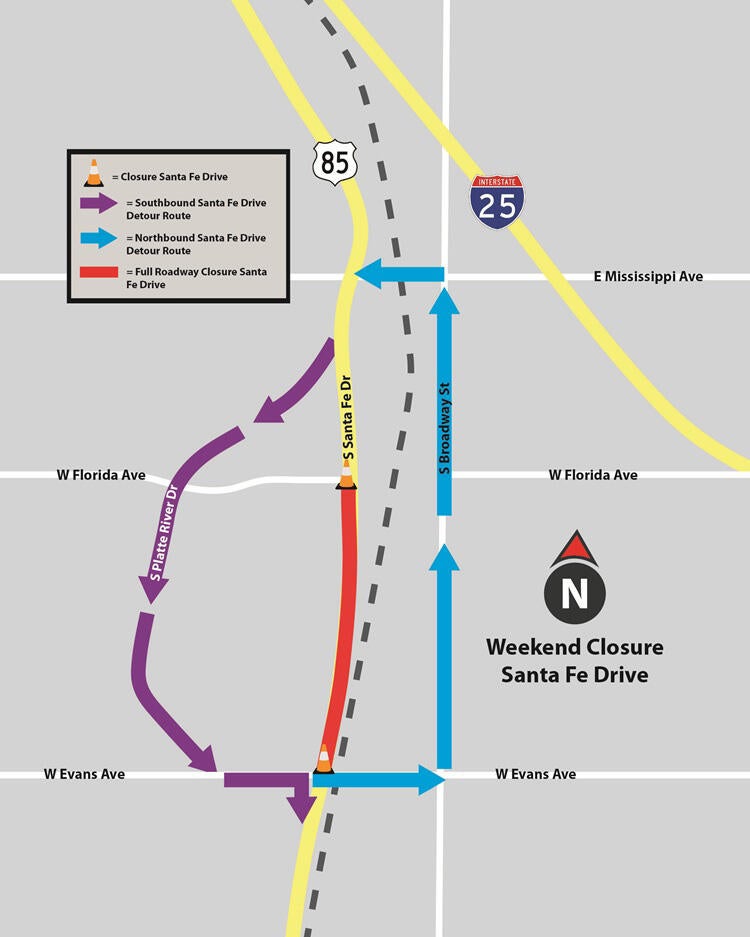
The Santa Fe Drive closure will begin at midnight on Saturday, July 11, and end on Monday, July 13, at 5 a.m. There will be detours in place. This includes:
- Southbound Santa Fe Drive Detour: Traffic will be routed to Platte River Drive to reenter southbound Santa Fe Drive at the West Evans Avenue on-ramp.
- Northbound Santa Fe Drive Detour: Access to northbound Santa Fe Drive will be at Mississippi Avenue via South Broadway Street.
- On-Ramp Closure: The West Evans Avenue on-ramp to northbound Santa Fe Drive will close at noon on Friday, July 10, to prepare for the full weekend closure and will remain closed until 5 a.m. on Monday, July 13. Traffic will be detoured to South Broadway Street to re-enter northbound Santa Fe Drive via Mississippi Avenue.
- Off-Ramp Closure: The southbound Santa Fe Drive off-ramp to West Evans Avenue will close for the full weekend period and remain closed until Friday, Sept. 11, while crews build new sidewalks and perform other concrete work at the southwest corner of the project. Detours will be posted to West Florida Avenue, West Dartmouth Avenue or West Hampden Avenue to bypass the ramp closure
During this closure, DOTI will reopen the underpass on Iowa Avenue. This is a new ADA accessible pathway that will be available between Santa Fe Drive and Acoma Street.

DENVER (KDVR) — Two officers, one now formerly of the Denver Police Department, face multiple charges relating to separate incidents in the past two months.
According to a release, now-former Denver Police Officer Gabriel Lucero was issued a citation for third-degree assault, official misconduct and false reporting, while Officer Javon Leach was cited for reckless driving and eluding.
The incident involving Lucero reportedly occurred on May 22 just before 1 a.m. in the 500 block of 16th Street. According to a release, Lucero was involved in an assault at a business, as he allegedly assaulted a person and walked away as others continued to assault the victim.
Security guards and an off-duty officer escorted him and the group out; however, Lucero reportedly identified himself as a Denver police officer and attempted to re-enter by using his police badge.
Lucero reportedly provided a false name without any other information, and further investigation verified Lucero as the person involved. Lucero was hired in 2025 and, due to his current probationary status, was fired as of Wednesday.
The incident involving Leach occurred around 1:41 a.m. on June 21, when Leach was reportedly pulling out of a parking lot on Larimer Street, attempting to drive against traffic.
Leach reportedly refused commands to stop as he left the area. Officials said he was found just seven minutes later, traveling at high speeds northbound on Park Avenue West.
He reportedly fled a traffic stop and continued to drive away, and officials deemed Leach to be the suspect following an investigation. He was placed in an off-line assignment while the case progresses, as they are considered misdemeanors.
“The Denver Police Department’s administrative review of Leach’s incident will begin once the criminal case is adjudicated, and that process includes the Denver Department of Safety and the Office of the Independent Monitor, a civilian oversight agency,” the release said.

Denver Nuggets standout forward Peyton Watson could find himself on another team before you know it.
With the Nuggets reportedly open to a sign-and-trade of Watson, could Denver really lose a core piece to their rotation?
It’s hard to imagine many teams being able to shoulder the financial weight of a Watson contract at this point because of the aprons and such, but he’s absolutely an asset to any contending team.
We’ve gone through and identified a few teams that make sense for Watson in the fall… including the one he’s already on at the moment. Hey, he might stay home, you never know!
The Clippers have been linked to Watson as a possible destination; he could help them immensely.
The Pistons have also been linked to Watson, which would help them a lot to contend for an NBA title.
Look, HYPOTHETICALLY, the Nets could move around some cap space with some player trades and such and get a deal done. They are one of the only teams in the NBA right now not in the negative with cap space.
The Grizzlies are the team with the least amount of negative cap space right now, per Spotrac. If they really wanted to pull off a Watson sign-and-trade… it would be hypothetically possible from a money standpoint.
Denver Nuggts
Look, it’s very possible Watson just stays in Denver on a brand-new deal. Who knows at this point?
-

 Washington, D.C3 minutes ago
Why Gov. Kim Reynolds turned down previous request to send National Guard to D.C.
-

 Cleveland, OH6 minutes ago
LGBTQ+ Ohio Nonprofit Guide
-

 Austin, TX11 minutes ago
Think tank says state education reforms have set up future of the ‘Texas Miracle’
-

 Alabama18 minutes ago
New Alabama women’s basketball coach Pauline Love credits late mentor for coaching career
-

 Alaska21 minutes ago
Fatal crash closes Glenn Highway southbound lanes near Eagle River
-

 Arizona26 minutes ago
Arizona Cardinals’ Jordan Burch takes lessons from rookie year
-

 Arkansas33 minutes ago
Dino Fest brings interactive experiences, lifelike dinosaurs and reptiles to Arkansas July
-

 California36 minutes ago
Southern California police vow to quash planned ‘takeover’ event following recent chaos

