Entertainment
Review: 'Here' takes the elements of a 'Gump' reunion and flattens them into faux-cosmic tedium


Lately, filmmaker Robert Zemeckis has been a somewhat confounding figure. The director of such beloved movies as the “Back to the Future” series, “Forrest Gump,” “Cast Away,” “Death Becomes Her” and “Who Framed Roger Rabbit” has delivered almost as many duds as hits, if you also take in “The Polar Express,” “Beowulf,” “Welcome to Marwen” and “Pinocchio.” An experimenter obsessed with special effects and the dramatic power they can exert in cinema, Zemeckis is always trying something new, especially with motion-capture technology. It doesn’t always work: Many of these projects drift into an unappealing uncanny valley. Despite his several attempts, he hasn’t quite nailed it yet.
In his new intergenerational family drama “Here,” based on a 2014 graphic novel by Richard McGuire (expanded from a six-page comic strip published in the comics anthology “Raw” in 1989), the experiment is the narrative itself, a family history spanning generations — and centuries — all told from one fixed point of view. In his formally inventive graphic novel, McGuire used frames within frames to visually represent different time periods within one panel.
Zemeckis maintains the frames-within-frames conceit as a transitional flourish in the film version of “Here,” but the plot itself is more about jumping around in time while maintaining the stationary camera. There are many inhabitants of this space, from a Native American couple (Joel Oulette and Dannie McCallum) in pre-Columbian times, to a young family in the Victorian era (Michelle Dockery and Gwilym Lee) who move into their modest Colonial home, and then later, the inventor of the La-Z-Boy recliner (David Fynn) and his ebullient wife (Ophelia Lovibond), who take the home. There’s also a present-day Black family (Nicholas Pinnock, Nikki Amuka-Bird and Cache Vanderpuye) navigating the COVID-19 pandemic and the Black Lives Matter movement.
But the story focuses predominantly on a family that occupies the house for most of the 20th century: a World War II veteran, Al (Paul Bettany), his wife, Rose (Kelly Reilly) and then their son Richard (Tom Hanks) and his wife, Margaret (Robin Wright). And yes, Hanks and Wright have been digitally de-aged — we see them for the first time as teens — and no, it does not work at all (there’s something very strange happening around Hanks’ de-aged mouth). Sure, the Hanks, Wright and Zemeckis trio supplies the gimmick of a “Forrest Gump” reunion, but why do we have to de-age Hanks when there are his real-life sons Colin and Truman at home? Even Wright has a look-alike actor daughter, Dylan Penn.
“Here” also has that Gumpian quality of major historical events lining up with personal stories: Benjamin Franklin (Keith Bartlett) and his son William (Daniel Betts) occupy the Colonial manor across the street; a pregnancy is announced as the Beatles take the stage on “The Ed Sullivan Show”; and seemingly everything relevant happens in this godforsaken living room, including weddings, births and breakups.
The story of “Here” surrounding Richard and Margaret is relatable, entirely predictable and utterly dull. They get pregnant as teens, move in with his family, he gives up art to get a real job, she wants her own space, etc.. Ostensibly, their story is about navigating the ups and downs of life, but ultimately it turns into a rather dispiriting tale about two people taking too long to pursue the things that make them happy, and for her, it’s getting out of that damn house, though if she ever left, there would be no “Here” here.
Changing hands over the years means real estate agents coming in and out throughout the film, and by the time the credits roll, you half expect the logo for a home insurance company to come up, because that’s what this whisper of a film feels like: a commercial for homeowners insurance. To be frank, there are 30-second spots that have inspired more tears and emotion than the flat, pointless “Here.”
Richard and Margaret’s daughter Vanessa (Zsa Zsa Zemeckis) disappears around age 16 and never reappears again, which is a shame, because the more interesting story isn’t the parents’ baby boomer tale, but perhaps how their Gen-X daughter or zoomer grandchildren might benefit from their generational wealth. “Here” doesn’t want to dig into any of the nuances surrounding that. But perhaps property values are just where the mind wanders when the story playing out is so treacly and stale.
This year has seen other daring projects from aging filmmakers who have experimented with cinematic form and function on their own terms — including Francis Ford Coppola’s “Megalopolis,” and Kevin Costner’s “Horizon.” While the efforts have been laudable, unfortunately, the results have all been flops and “Here” is no exception.
Katie Walsh is a Tribune News Service film critic.
‘Here’
Rated: PG-13, for thematic material, some suggestive material, brief strong language and smoking
Running time: 1 hour, 44 minutes
Playing: In wide release Friday, Nov. 1


Comedy is a matter of taste and preference — it’s a deeply personal thing. Which makes it hard for a critic to give a blanket assessment of a specific kind of comedy, especially if it didn’t work for them, but clearly worked for others (the laughter or lack thereof is the indication). “It’s not funny,” the critic says, “well I had fun,” someone else can reply, and then we’re at an impasse.
Which is the dilemma one finds oneself in with “Gail Daughtry and the Celebrity Sex Pass,” a very strange and shaggy Hollywood satire of sorts from David Wain and The State crew, still riding the goodwill of “Wet Hot American Summer” after all these years. If only this were as funny.
“Gail Daughtry” lives in the same world as that iconic summer camp spoof, as well as Wain’s 2014 rom-com parody, “They Came Together,” in that he’s playing with genre convention and expectation, taking well-known norms to the goofiest extremes. But those films hewed more closely to their respective genres, while “Gail Daughtry” is totally scattered, combining crime and spy movie tropes with a fish-out-of-water comedy and a Hollywood send-up. It has far too many ideas for its own good, and yet no ideas that are good enough to sustain this bizarre curio of a comedy.
What’s ironic is that one of the problems driving this wacky plot forward is the characters have to come up with a movie idea to pitch to star Jon Hamm (playing himself of course), leading them to do some pretty inane and shockingly violent things. It’s almost as if Wain and co-writer and co-star Ken Marino had no idea for a movie, then baked their search for an idea into their script, and then turned it into a madcap adventure about a woman on a quest to have sex with Jon Hamm. What an ouroboros!
OK, about the sex quest. Gail Daughtry (Zoey Deutch) is a chipper hairdresser from Kansas born without the part of the brain that recognizes sarcasm or irony. She’s a cheerful, Pollyanna-ish naïf whose literal-mindedness is almost as extreme as Amelia Bedelia. Her childhood sweetheart and fiancé Tom (Michael Cassidy) is the same. She tells him about the concept of the “celebrity sex pass” as a joke, and he promptly boinks Jennifer Aniston at local book reading.
(Nitpicky aside: why didn’t they use the common nomenclature “hall pass”? Is it copyrighted? “Celebrity sex pass” is clunky and sounds like an off-brand version of the well-known slang.)
That infidelity crisis is how Gail ends up in Los Angeles determined to bang Hamm, collecting a motley crew of similarly clueless helpers along the way. There’s her best friend Otto (Miles Guttierez-Riley), her salon bestie; Caleb (Ben Wang), an overly ambitious intern at Creative Artists Agency; Vince (Marino), a screenwriter turned paparazzo with a heart of gold; and John Slattery, as John Slattery, down on his luck. An accidental briefcase swap has a pair of thugs on their tail, in a forgettable and underdeveloped B-plot.
With a parade of celebrity cameos and collaborators in bit parts, “Gail Daughtry” at times feels like an excuse for Wain and co. to make something at home with all of their friends. Fair enough, it’s great to see all these people employed, but what about what we’re watching? Behold, the Los Angeles of the middle-aged working comedian: the CAA lobby, the Chateau Marmont, Griffith Park, etc. And the plot is as half-baked as the pitch they present to Hamm.
What’s actually interesting about this comedy is the distinct streak of despair and even resentment that reveals itself at the climax, a feeling of helplessness and uselessness. Everyone’s been striving to make it in this crazy town: the intern, the actor, the paparazzo. But not even Jon Hamm can help them get a movie made; even he feels inherently powerless. There’s an unexplored anxiety vibrating there that feels the most thematically fruitful, about what it means, some 25 years after bursting onto the scene with a generation-defining comedy, about maintaining the work, the drive, a sense of purpose, after years of strikes, and in the face of a constricting industry. Do they still have it? Is the dream still alive?
Maybe that’s why Wain and Marino need to invent a dreamer stand-in with Gail, a guileless eternal optimist who knows nothing of the craven Los Angeles and accepts everything at face value (though she is filled with a scary bit of rage too). She might behave like she has a head injury, but she’s going to achieve her goal, dammit. “Gail Daughtry and the Celebrity Sex Pass” might not be as funny as “Wet Hot American Summer” (for this critic), but reframed, it serves as a fascinating status update on life in La La Land for this troupe.
‘Gail Daughtry and the Celebrity Sex Pass’
2 stars (out of 4)
MPA rating: R (for sexual content, violence/bloody images and language)
Running time: 1:33
How to watch: In theaters July 10
Entertainment
Emily Ratajkowski’s viral essay on sex life as a single mom scores her a seven-figure book deal
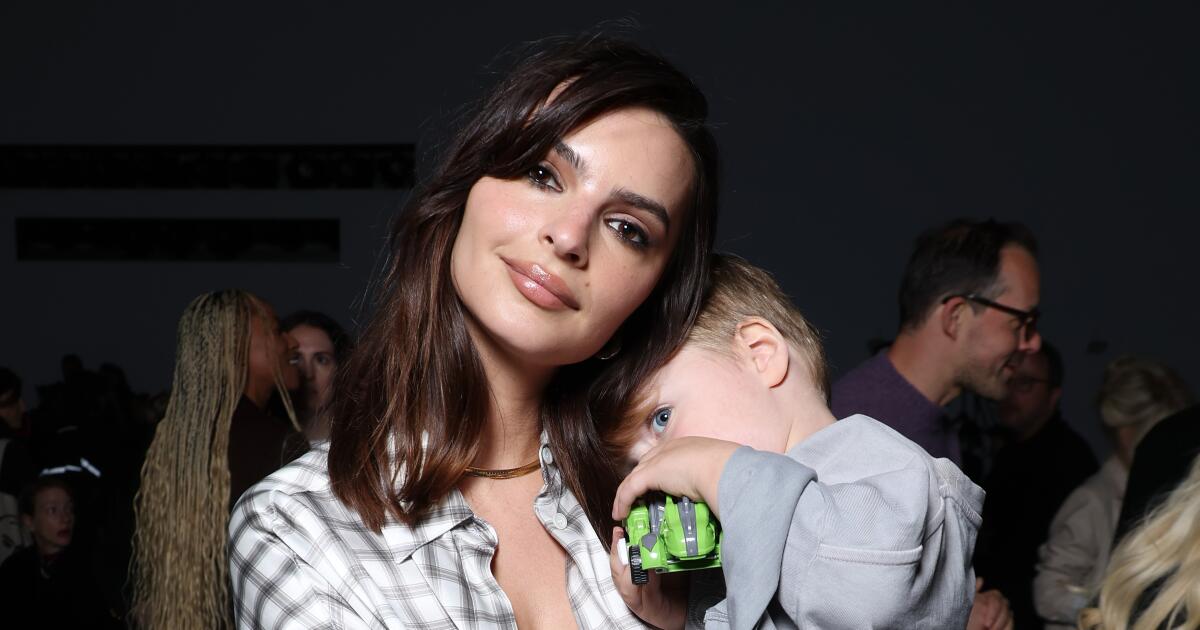
Emily Ratajkowski’s viral essay detailing her sex life as a single mom just landed her a seven-figure book deal.
According to Page Six, the model’s essay in the Cut had publishers champing at the bit in a 12-way bidding war that culminated in the hefty pay day. Editor Helen Rouner at Penguin Press — who also edited Lauren Christensen’s memoir “Firstborn” and Michael W. Clune’s novel “Pan” — reportedly landed the deal.
Penguin Press did not immediately respond to The Times’ request for comment Friday.
Publishers Marketplace announced the forthcoming memoir, describing it as “an examination of modern female identity through the story of the author’s own efforts as a newly single mother in New York City to discover what really constitutes a good life for a woman.”
The essay, which dropped a month ago and quickly broke the internet, drops the veil on EmRata’s sexual adventures (or maybe misadventures) since she and her former husband, Sebastian Bear-McClard, split in 2022.
“It was a violent transition into a new reality of screaming baby on my aching tit and ring on my swollen finger,” Ratajkowski writes of new motherhood. “And then, in a time period that felt both instant and excruciatingly slow, my marriage collapsed. Six months after my son was born, my husband and I stopped having sex. Less than a year later, we separated.”
In the missive, the model interrogates her sexuality — is she a Madonna or a whore? — while untangling bigger questions around gender, power and self-actualization. If Carrie Bradshaw wrote about “Sex and the City,” then Ratajkowski is writing about sex, the city and single motherhood. And naturally, her fleeting paramours have vague monikers: “Vegan Graffiti Artist,” “Spanish Gen-Zer” and “Son of a Billionaire.”
“And then there was the Elder Millennial: obsessed with dental hygiene, psychedelics, and dirty talk,” she writes. “He had approached the subject coyly at first, like it was something he was kind of embarrassed about — the way a kid will test you to see if you’ll talk to them about their dorky obsession of the moment. Do you like Godzilla? What about Star Wars?”
Would-be sleuths with Ratajkowski’s essay and a gossip rag handy will have their work cut out for them.
This will be Ratajkowski’s second book. The first, “My Body,” dropped in 2021 and was a bestselling collection of essays exploring gender, power dynamics, sexuality and the commodification of female beauty in the modeling and entertainment industries.
Ratajkowski’s foray into the spotlight came more than a decade ago when Robin Thicke’s controversial “Blurred Lines” music video made the model an overnight star. She was cast in David Fincher’s adaptation of “Gone Girl,” which hit theaters the following year, and catapulted to top fashion runways — Marc Jacobs, Versace, Victoria’s Secret and Dolce & Gabbana, to name a few. She she’s been romantically linked to Harry Styles, Eric Andre, Shaboozey, Brad Pitt and Pete Davidson, among others.
In 2023, she moonlighted as the host of the “High Low With EmRata” podcast, where she interviewed sex workers, investigated ethical nonmonogamy and pondered the etymology of the word “toxic.” The same year, she told The Times that she was coming into herself post-divorce, “Being able to assert what I want — that feels like it just started: My life as a creator and not as a muse.”

Wainheads will be delighted to see his alums in cameos: Kerri Kenney-Silver, Michael Ian Black, Thomas Lennon, and supporting roles for Zickel and Truglio. A large portion of the cast are his homies. But with Deutch, Gutierrez-Riley, Wang, Slattery, Impacciatore, and yes, Hamm, it’s as if they’re being inducted into a new mad family. Wain and Marino are basically catching Pokémon and hoping they can hold onto the roster (by that logic, yes, Paul Rudd is a legendary Pokémon). The film is anchored by Zoey — everything everywhere all this summer with Voicemails From Isabelle to Minions & Monsters — Deutch in the Dorothy Gale role, exuding a high level of perkiness consistent with the character’s can-do, wide-eyed, midwestern charm and heart.
A major standout, Ben Wang finally gets to show off his comedic abilities, portraying a self-assured, quick-witted agent who makes me laugh every time he reveals his sheltered upbringing in snappy whines at every inconvenience. Sabrina Impacciatore, who has proven to be a comedic juggernaut in The Paper, is having so much fun hamming it up as the mob boss-esque wicked witch counterpart, torturing her henchmen and deliciously chewing up the scenery whenever onscreen. I don’t think they use her to the height of her comedic prowess, but she’s a delight nonetheless. John Slattery is the film’s comedic MVP. The way the writers use his over-the-top character for comedy is downright hilarious every time. They use him as either a punchline or a force of nature, and he’s great. This movie is like Mad Men propaganda, and by God, it works. As someone who’s never seen it, Gail allowed me a better appreciation for Slattery and Hamm.
Man, we don’t deserve Jon Hamm. This is the second time I’ve seen him play a silly, fictionalized version of himself this year (the other being the SXSW crowd-pleasing rom-com Wishful Thinking, which Gail distributor Sony Pictures Classics acquired), and he also voice-acted in his comedic Mayor Jerry role in Hoppers. Maybe working with Wain in 2007’s The Ten was the canon event, but I consider his weird little sex scene with Kristen Wiig in Bridesmaids his awakening. Since then, I’ve only seen him as unserious, and it’s delightful. Oz-like in appearance, he’s funny and befitting the film’s overall light, joyful nature.
LAST STATEMENT
Ultimately, Gail Daughtry and the Celebrity Sex Pass is a campy, delightful romp that succeeds as both a distinctive Hollywood‑centric riff and a Wizard of Oz reimagining, retaining a loving, twisted, demented charm. It’s a weird description, but it’s so high‑spirited and light‑hearted despite being strangely ultraviolent. It might as well be a live‑action episode of Smiling Friends (RIP), yet it’s everything the theatrical market needs today. Ten years ago, this would’ve been a studio production rather than an indie Sundance acquisition, but thank God it exists for the big screen. More absurdist Gail Daughtrys for cinemas (not streaming), please, because this is the most fun to be had in a theater all summer, if not the year thus far.
-
 Politics29 seconds ago
Trump administration clears path for controversial Mojave Desert water pipeline
-
 Sports8 minutes ago
World Cup fans flock to In-N-Out, Erewhon and Trader Joe’s for a taste of California
-

 World18 minutes ago
Hundreds of thousands evacuated as Typhoon Bavi barrels towards China
-
 News45 minutes ago
With the white nationalist group Patriot Front, what you see is not what you get
-

 New York2 hours ago
How ‘The Wire’ Star Jamie Hector Spends a Hot Day in Brooklyn
-

 Los Angeles, Ca2 hours ago
Burglars ransack Sherman Oaks condo building during fumigation
-

 Detroit, MI2 hours ago
Metro Detroit weather forecast, July 10, 2026 — 11 p.m. Update
-

 San Francisco, CA3 hours ago
Classical music series helps reconnect downtown San Francisco community

