Washington, D.C
A D.C. Cocktail Bar Takes on Taboos

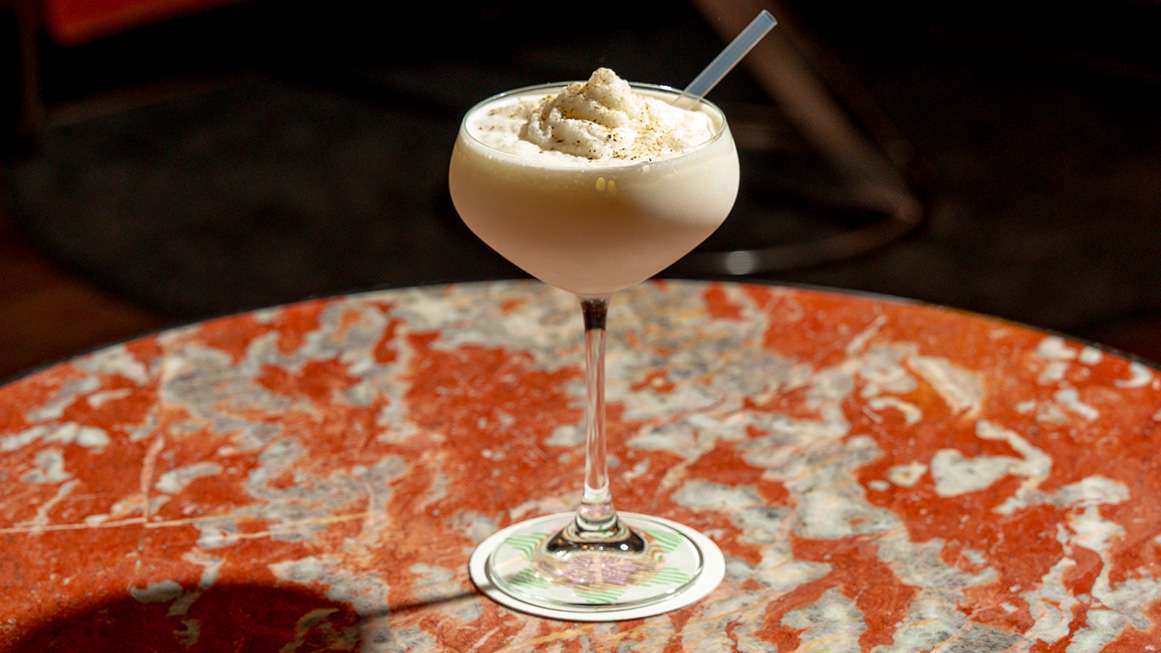
One of Washington, D.C.’s best cocktail bars is Silver Lyan, the only U.S. outpost for award-winning British bar maestro Ryan “Mr Lyan” Chetiyawardana’s cocktail empire. The bar, which is located inside a subterranean vault in a bank that has been converted into a chic downtown hotel, is renowned for its elaborate techniques, its cleverly referential cocktails—one recent drink was designed to mimic a half-smoke, Washington, D.C.’s signature chili dog—and its themed menus.
Over the summer, the bar unveiled its newest menu, devoted to exploring taboos. On this menu, there are drinks devoted to cannibalism, nipples, unspeakable words, and outlawed substances.
For example, there’s the Banned in Boston, which consists of Patrón reposado tequila, pawpaw amazake, cornflake Froyo, white cacao absinthe, and silver pepper mix. Even if you aren’t familiar with most of the ingredients, all you need to know is they’re all part of a high-concept story in a glass.
The drink was inspired by the so-called forbidden fruit effect. As a post on the bar’s Instagram feed explained, “Multiple psych studies have shown that limiting access to something only makes it more desirable—the more you tell people they can’t have something, the more they want it—and the allure of the unattainable has been exploited by canny marketers for centuries.” And thus, multiple ingredients in the cocktail are derived from substances that have either been banned or have been associated with the Garden of Eden, where Eve was tempted to eat a fruit from a particular tree after being told not to.
Pawpaws, for example, are Missouri’s official state fruit, and Missouri is where members of the Church of Jesus Christ of Latter-day Saints believe the Garden of Eden existed. The pawpaws in the drink come from a farm in Ohio, however, and are combined with mango, banana, koji rice, and vodka. And that’s just one part of the drink.
The cornflake Froyo, meanwhile, is a nod to John Harvey Kellogg, a Progressive leader in the late 1800s and early 1900s who advocated abstinence from sex, insisting it provided health benefits. For the drink, cornflakes and whole milk are combined into cereal milk, then added to Greek yogurt, which is then garnished with peppercorns.
If this sounds exhaustingly elaborate, have no fear; the drink itself is creamy and chilled and layered with delicious, unexpected flavors. It’s so unusual, and so good, that it’s not too hard to imagine the drink being, well, banned in Boston, a mid–20th century phrase that achieved meme status referencing the New England city’s historical propensity to ban books, music, movies, and other artistic works with supposedly objectionable content.
The good news? The Banned in Boston is available for drinking in Washington, D.C.
The post A D.C. Cocktail Bar Takes on Taboos appeared first on Reason.com.



Washington, D.C
Lake City’s ArtFields helps bring S.C. stories to national stage in Washington, D.C.

LAKE CITY, S.C. (WPDE) — A community art project with roots in Florence County is now on display on one of the nation’s biggest cultural stages.
ArtFields, the nationally recognized art festival based in Lake City, was selected as South Carolina’s official host for the National Scrollathon, a collaborative artmaking project that brings together people from across the country to share their stories through fabric scrolls.
The project is now being unveiled at the John F. Kennedy Center for the Performing Arts in Washington, D.C., giving Lake City and the Pee Dee region a place in a nationwide artistic celebration.
Created by brothers and artists Steven and William Ladd, Scrollathon invites participants to design personal fabric scrolls that reflect their experiences, hopes and dreams.
The individual pieces are then combined into a larger work of art that represents communities from across the United States.
Earlier this year, dozens of residents in Lake City participated in the project through an initiative called “Tied Together,” creating scrolls that shared their personal stories and connections to their community.
Carla Angus, an ArtFields consultant, said the project’s impact comes from bringing people together through creativity and storytelling.
READ MORE: Death investigation underway in Scotland County; drivers urged to avoid area
“Everyone who was invited receives these strips of material and fabric, and they select their colors, they select what they want to put together and they create a story behind their scroll,” Angus said. “That’s what’s so powerful about the project because it brings all these different people together with different backgrounds and different experiences.”
In addition to Lake City, Scrollathon events were held at other South Carolina cultural institutions, including the Gibbes Museum of Art and the International African American Museum.
Now, those local contributions are part of a much larger display.
More than 250,000 participants from all 50 states and U.S. territories contributed to the National Scrollathon.
The collection is being showcased at the Kennedy Center, where visitors can experience what organizers describe as a visual representation of the American story.
For Angus, seeing scrolls created in Lake City displayed alongside contributions from across the country is a proud moment.
READ MORE: Criminal Investigations Division takes over after deadly crash in Horry County
“When I look at those scrolls, I know those are thousands upon thousands of individuals that have shared their stories,” Angus said. “Now they have become one unified piece of artwork.”
Angus described the experience as surreal and said it demonstrates how art can connect people regardless of where they come from.
“It’s almost surreal because what we want to do is connect people through the arts,” Angus said. “To be a part of something that is so large, bringing so many states together, it shows how powerful art can be.”
The National Scrollathon will remain on display through Labor Day as part of the Kennedy Center’s yearlong celebration of America’s 250th anniversary and the signing of the Declaration of Independence.
For Lake City and Florence County residents, the exhibit represents an opportunity to see their stories become part of a national conversation, one scroll at a time.


WASHINGTON (DC News Now) — A Texas man accused of shooting at a United States Secret Service agent near the Washington Monument earlier this month has been indicted on federal charges, the Justice Department announced Friday.
A federal grand jury indicted 45-year-old Michael Marx with “assaulting, resisting, or impeding certain officers using a dangerous weapon” and “using, carrying, possessing, brandishing, and discharging a firearm during a crime of violence,” in connection with the May 4 incident, in which a stray bullet struck a teenage bystander.
“Today’s indictment reflects the gravity of the defendant’s actions on one of the most heavily visited public spaces in the nation,” U.S. Attorney Jeanine Pirro said Friday, in part. “The evidence shows Marx not only carried an illegal firearm into DC, but he fired it at uniformed officers, wounding an innocent teenage bystander who was simply visiting the National Mall with his family on a spring afternoon.”
Authorities previously charged Marx with assaulting federal officers with a dangerous weapon, using and discharging a firearm during a crime of violence, and unlawful possession of a firearm by a convicted felon.
According to court documents, an undercover Secret Service agent initially noticed Marx trying to conceal a gun on the right side of his body near 15th Street and Madison Drive NW shortly after 3:30 p.m. on the afternoon of the shooting.
At the same time, the motorcade for Vice President J.D. Vance was leaving the White House, passing through the area just up the street.
Uniformed Secret Service officers arrived to provide backup, finding Marx along the path of Vance’s motorcade. The attorney’s office said officers began to give the Texas man verbal commands, but he started running through a crosswalk and eventually fired at one of the agents as he reached the sidewalk.
The bullet struck the teenage bystander, who was walking behind the agent, in the leg, according to the DOJ.
Agents quickly returned fire, striking Marx in the hand, left arm, and upper body, according to court documents.
Court documents state that agents used Marx’s Texas driver’s license, which he was carrying, to identify him as the gunman. Investigators also identified various aliases Marx allegedly went by, including Patrick Michael and Michael Zavici.
While in the hospital, he allegedly made statements to officers, including ”F— the White House,” and “kill me, kill me, kill me,” the DOJ noted in a release.
Police found a Sig Sauer P365 handgun loaded with 9mm ammunition from the street where Marx fell.
-

 Florida7 minutes ago
Florida tax proposal seeks to eliminate homestead property taxes by 2028
-

 Georgia10 minutes ago
Who Mississippi State baseball will play next in NCAA Tournament super regional
-

 Hawaii15 minutes ago
Man charged with murder in killings of 3 on Hawaii’s Big Island
-
 Idaho22 minutes ago
America 250: Famous Idaho Ice Cream Potato helps put Boise landmark on the map
-

 Illinois25 minutes ago
Downtown Springfield revitalization plan passed out of the Senate
-

 Indiana30 minutes ago
Hobart police officer rescues family from house fire
-
Iowa37 minutes ago
Iowa Lottery Pick 3 Midday, Pick 3 Evening results for May 31, 2026
-

 Kansas40 minutes ago
Kansas Baseball Advances to NCAA Super Regionals After Sweeping Arkansas

