Vermont
Report: 4 Vermont hospitals face risk of closure, but all are in financial distress


There’s a metaphorical hurricane bearing down on Vermont’s healthcare system, and we need to prepare now to weather the storm, according to a consultant hired by the Green Mountain Care Board to figure out how to make health care affordable, equitable and sustainable in the state.
“It’s like getting a hurricane warning,” Dr. Bruce Hamory said in an online press briefing. “You can see it coming. You don’t know quite how bad it will be, but you want to get the windows boarded up, get a supply of food or leave town.”
Hamory and his team at Oliver Wyman Life Sciences presented their final report to the GMCB at a public board meeting on Wednesday. The 144-page report includes extensive recommendations on issues ranging from hospital operations to housing and transportation. The Green Mountain Care Board is responsible for overseeing major aspects of the healthcare system in Vermont, including hospital budgets.
Hamory warned that four Vermont hospitals − Gifford Medical Center in Randolph, Springfield Hospital, Grace Cottage Hospital in Townshend and North Country Hospital in Newport − are facing the greatest risk of closure because they don’t have the volume of patients to support their operations, but that all Vermont hospitals are facing severe financial distress.
“Nobody is off the hook here,” Hamory said. “For every hospital, their survival in their current form depends on aggressive control of costs and growing in certain necessary areas.”
Vermonters face challenges getting timely and affordable healthcare
The report lays out the “serious challenges” Vermonters face in obtaining health care:
- Decreasing affordability − Average premiums for silver exchange plans available through Vermont Health Connect are $985 in 2024, a 108% increase in six years.
- Deteriorating sustainability − Nine of the 14 hospitals in the state reported operating losses in 2023 of up to -8.9%. The trend is projected to worsen, with 13 of 14 hospitals expected to report losses by 2028.
- Aging and shrinking population − People over 65 years old are projected to exceed 30% of Vermont’s total population by 2040, exacerbating the strain on the healthcare system because of increasingly complex needs for care. Meanwhile the working population is expected to decline by 13% by 2040, limiting contributions to the commercial healthcare premiums that subsidize the shortfalls hospitals experience in payments from federal programs.
- Lack of healthcare access − Primary and specialty care clinics in Vermont have long wait times, preventing patients from seeing providers for urgent, as well as routine visits in a reasonable timeframe. Also, community-based care, such as primary care and home healthcare, does not fully support Vermonters’ health needs, resulting in increased hospital use.
- Inequity in healthcare − The current system in Vermont fails to adequately support access and affordability needs for low-income populations in rural areas. There’s insufficient affordable housing, a “significant social determinant” to health. Transportation for patients is unreliable and “lacks timeliness,” preventing patients from accessing care. Lastly, “culturally competent” care is not widely practiced to treat patients with unique needs in terms of language, mental health and gender/sexual identity.
Transformation of Vermont’s health system includes regionalized care
The transformation of the health system in Vermont that’s “urgently needed,” according to the report, would be led by the Agency of Human Services, together with the Green Mountain Care Board. The report calls for the state to support the development of infrastructure including a “robust” workforce, greater access to transportation and an affordable housing supply.
The report proposes the development of new regionalized centers of care, to “drive hospital efficiency and shift care outside of the hospital setting.” These “Centers of Excellence” would provide specialized services within the reach of most Vermonters, and would create areas of “sufficient population size” to support the medical professionals and equipment needed.
Decisions concerning the types and locations of Centers of Excellence would be determined by AHS, in combination with the communities and hospitals concerned, Hamory said in an interview with the Burlington Free Press.
Central Vermont Medical Center in Barre, for example, might become a COE for geriatric care, infusion therapy, neurology, psych-adult and radiation therapy. Copley Hospital in Morrisville might become a COE for orthopedics and rheumatology.
Both Brattleboro Memorial Hospital and Rutland Regional Medical Center might become COEs for acute general surgery. The report says additional COE designations for other specialties and other hospitals require further discussion as part of Vermont’s “regionalization plan.”
“Part of the goal is to move care to more convenient and less expensive locations and out of the UVM Medical Center and Dartmouth Medical Center,” Hamory said. “Perhaps one of the benefits of this process will be to give folks some reasonably clear picture of what the future holds that they can use to plan. This is an enormous project.”
Contact Dan D’Ambrosio at 660-1841 or ddambrosio@freepressmedia.com. Follow him on Twitter @DanDambrosioVT.



Stowe Country Club in Stowe, Vermont, has reopened after a restoration by architect Beau Welling.
Erik Matuszewski
Vermont might be best known for its breathtaking ski resorts when it comes to outdoor pursuits, but the golf offerings in the historic community of Stowe are now better than ever with the recently completed redesign of the Stowe Country Club by architect Beau Welling and his team.
The transformation at the course, set on a former dairy farm with views of the Green Mountains, firmly establishes Stowe as one of New England’s top 36-hole golf destinations.
The wide open and walkable nature of Stowe CC complements the ruggedness and dramatic elevation changes at The Mountain Course at Spruce Peak just minutes up the road, with both courses accessible by guests staying at The Lodge at Spruce Peak as well as members of The Club at Spruce Peak.
“This project honors the history of the course while reimagining it for the next generation, creating a place where members, guests, and local residents can gather to enjoy the landscape, the sport, and the shared experiences that define this region,” said Sam Gaines, who is the president of Mt. Mansfield Company, the ownership group behind Stowe Country Club, and lives in the town with his wife and three children.
Golfers return to the course as Stowe Country Club re-opened after a restoration by architect Beau Welling.
Stowe Country Club
Stowe CC has transitioned from a public facility to a private club (with the limited guess access) as part of the redevelopment, which reflects a broader vision for the area as a four-season mountain destination. Also in the plans are a new clubhouse, expanded dining, racquet sports, fitness and wellness activities, and additional recreational offerings.
But improving the golf course was the first step in that evolution and the results are the culmination of a process that started more than a decade ago when Gaines first invited Welling to see the property. The two had met at gatherings of the Urban Land Institute, which puts a focus on the environment in transforming communities, and Gaines was eager to have Welling offer advice on what needed to be done most urgently on “175 acres in the middle of the most affluent and amazing historic town” in Vermont.
Architect Beau Welling at the re-opening ceremony for Stowe Country Club. Stowe Country Club
Welling, who for years has worked with Tiger Woods and his design team, traces his New England ties back to his days playing for the Brown University golf team in Rhode Island.
“I could see the potential, almost immediately, of how special an environment this place is,” said Welling. “But when we first started talking about this project, I think it was more of a dream.”
The revamped 18th hole at Stowe Country Club, a shorter par 4, features a new “lion’s mouth” bunker in front of the green.
Erik Matuszewski Early efforts included Welling redesigning two greens encumbered by wetlands and other issues. But the scope of the project expanded dramatically after the pandemic, as golf surged in popularity.
Around 2022, Welling started to put together a full 18-hole redesign plan for Stowe Country Club, which had long been a welcoming and community-focused public course. It was popular in a hybrid community of sorts that brought together a diverse mix of year-round residents, seasonal residents, and tourists – whether for ski season or during the spring, summer and fall (peak leaf-change season) months. When the work started on the first nine holes in 2024, the breadth of the project continued to grow, becoming much more than new green complexes.
Stowe Country Club is one of two 18-hole championship courses available to members of the Club at Spruce Peak as well as guests staying at the Lodge at Spruce Peak.
Erik Matuszewski Today’s finished product includes complete reconstruction of all greens and tees, a reshaping and regrading of all fairways, modernization of the bunkers, upgraded irrigation and drainage systems, and a full re-grassing of premium bentgrass across greens, tees and fairways.
Several holes were changed significantly, notably the 13th and 15th holes, and a new comfort station – the Sugar Shack – has been added between the 5th and 14th tees. Hundreds of non-native pine trees were removed from the course itself, with about 150 new ones planted on its perimeter. The removal of the interior trees opened views of the surrounding mountains, including Mt. Mansfield, and the addition of waving fescue grasses to replace them helps better frame the holes.
Sam Gaines (middle), the president of Stowe Country Club ownership group Mt. Mansfield Company, at the new Sugar Shack comfort station during opening day at Stowe CC. Stowe Country Club For Welling, the overall focus was on improving playability, variety, strategy, and aesthetics.
“It feels like the sort of classic Northeast golf course, with rolling topography, distinctive bunkering, challenging greens contours, fescue grasses,” said Welling. “The environment feels classic and special to me.”
A secondary club logo, a flying cow, is a nod to the property’s history.
The new flying cow logo alongside Stowe Country Club’s traditional logo.
Stowe Country Club For Gaines, who’s worked in private equity and real estate for well over a decade and was accustomed to executing strategic plans with little deviation, the artistic process of an evolving golf course redesign was something he said he had to “hold onto my seat” for. Especially if it involved the relocation of an entire green complex. He joked that part felt “a little bit building the airplane while you’re flying it, but it’s also pragmatic problem solving. And that’s what you’re after.” The par 3 10th hole at Stowe Country Club.
Erik Matuszewski The initial response to the course changes and broader project have been overwhelmingly positive.
More than 200 new members have been added at Stowe Country Club and The Club at Spruce Peak, many of them coming from the Boston and New York areas.
And for those looking to travel to Vermont for golf (and any number of other outdoor activities) rather than skiing, Stowe and The Mountain Course are both accessible through stay-and-play packages in guestrooms, suites and private residences at the luxurious Lodge at Spruce Peak.
Stowe Country Club sits in the valley, at a different elevation than the nearby Mountain Course at Spruce Peak, but has dramatic topography and scenic views of the surrounding mountains. Stowe Country Club While the Mountain Course remains a wild ride, climbing and diving across elevations of about 1,800 feet, Stowe Country Club in the valley is drastically different – and now better than ever.
“For the most part, we left the topography the way it is, because it’s naturally undulating,” said Gaines. “There are golf course developers who will pay $40 million to end up with this result. The only difference is they start with a flat site.”
Full Redesign
An Artistic Process
Powerball, Mega Millions jackpots: What to know in case you win
Here’s what to know in case you win the Powerball or Mega Millions jackpot.
Just the FAQs, USA TODAY
The Vermont Lottery offers several draw games for those willing to make a bet to win big.
Those who want to play can enter the MegaBucks and Lucky for Life games as well as the national Powerball and Mega Millions games. Vermont also partners with New Hampshire and Maine for the Tri-State Lottery, which includes the Mega Bucks, Gimme 5 as well as the Pick 3 and Pick 4.
Drawings are held at regular days and times, check the end of this story to see the schedule.
Here’s a look at July 9, 2026, results for each game:
Winning Gimme 5 numbers from July 9 drawing
08-15-26-27-30
Check Gimme 5 payouts and previous drawings here.
Winning Pick 3 numbers from July 9 drawing
Day: 1-5-4
Evening: 6-2-8
Check Pick 3 payouts and previous drawings here.
Winning Pick 4 numbers from July 9 drawing
Day: 5-0-2-1
Evening: 2-6-7-6
Check Pick 4 payouts and previous drawings here.
Winning Millionaire for Life numbers from July 9 drawing
02-15-22-54-58, Bonus: 04
Check Millionaire for Life payouts and previous drawings here.
Feeling lucky? Explore the latest lottery news & results
Are you a winner? Here’s how to claim your lottery prize
For Vermont Lottery prizes up to $499, winners can claim their prize at any authorized Vermont Lottery retailer or at the Vermont Lottery Headquarters by presenting the signed winning ticket for validation. Prizes between $500 and $5,000 can be claimed at any M&T Bank location in Vermont during the Vermont Lottery Office’s business hours, which are 8a.m.-4p.m. Monday through Friday, except state holidays.
For prizes over $5,000, claims must be made in person at the Vermont Lottery headquarters. In addition to signing your ticket, you will need to bring a government-issued photo ID, and a completed claim form.
All prize claims must be submitted within one year of the drawing date. For more information on prize claims or to download a Vermont Lottery Claim Form, visit the Vermont Lottery’s FAQ page or contact their customer service line at (802) 479-5686.
Vermont Lottery Headquarters
1311 US Route 302, Suite 100
Barre, VT
05641
When are the Vermont Lottery drawings held?
- Powerball: 10:59 p.m. Monday, Wednesday, and Saturday.
- Mega Millions: 11 p.m. Tuesday and Friday.
- Gimme 5: 6:55 p.m. Monday through Friday.
- Lucky for Life: 10:38 p.m. daily.
- Pick 3 Day: 1:10 p.m. daily.
- Pick 4 Day: 1:10 p.m. daily.
- Pick 3 Evening: 6:55 p.m. daily.
- Pick 4 Evening: 6:55 p.m. daily.
- Megabucks: 7:59 p.m. Monday, Wednesday and Saturday.
- Millionaire for Life: 11:15 p.m. daily
What is Vermont Lottery Second Chance?
Vermont’s 2nd Chance lottery lets players enter eligible non-winning instant scratch tickets into a drawing to win cash and/or other prizes. Players must register through the state’s official Lottery website or app. The drawings are held quarterly or are part of an additional promotion, and are done at Pollard Banknote Limited in Winnipeg, MB, Canada.
This results page was generated automatically using information from TinBu and a template written and reviewed by a Vermont editor. You can send feedback using this form.
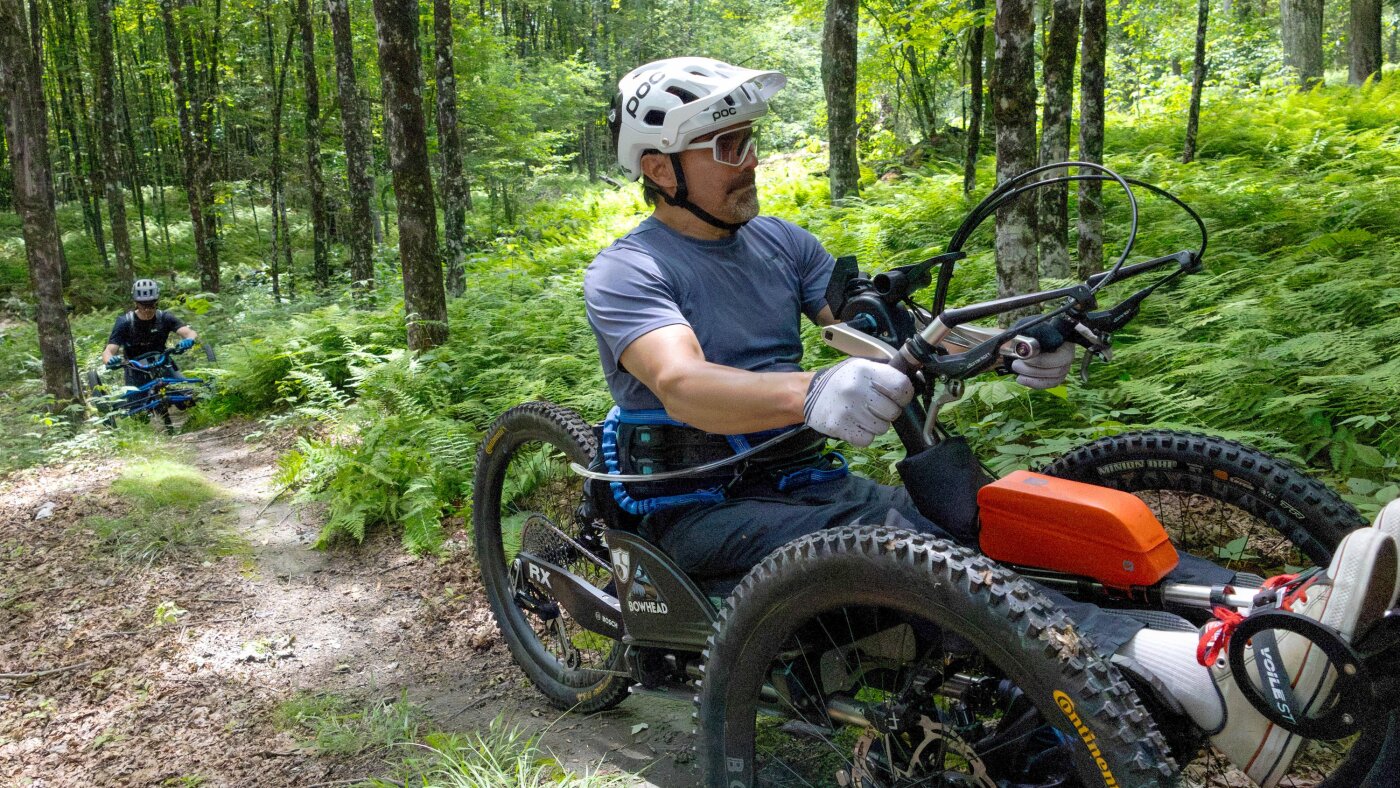
Louis Arevalo rides his adaptive mountain bike through the trails at Randolph Town Forest during an adaptive assessment on Thursday, June 25. Nick Bennette, with the Vermont Mountain Bike Association, rides behind.
Zoe McDonald/Vermont Public
hide caption
toggle caption
Zoe McDonald/Vermont Public
Mountain bike enthusiasts have been working for years on an ambitious 485-mile, multi-use trail called The Velomont that will span the length of the state.
When finished, the collaborative project will knit together existing trail networks, connect 27 communities and include huts and hostels for overnight stays.
New trail construction is finally ramping up after years spent on permits, plans and public input. And organizers say they want to make it as user-friendly as possible.
“For us, it’s not a huge lift to just be mindful when we’re trying to build trail or improve trail to think about the adaptive rider,” said Angus McCusker, the Velomont trail director with the nonprofit Vermont Huts and Trails.
McCusker is referring to the growing number of disabled athletes who mountain bike with specially designed equipment.
“The challenge,” said McCusker, “is we’re connecting to existing trail networks that were never intended for adaptive bikes. So, where we can, we’re trying to do adaptive assessments.”
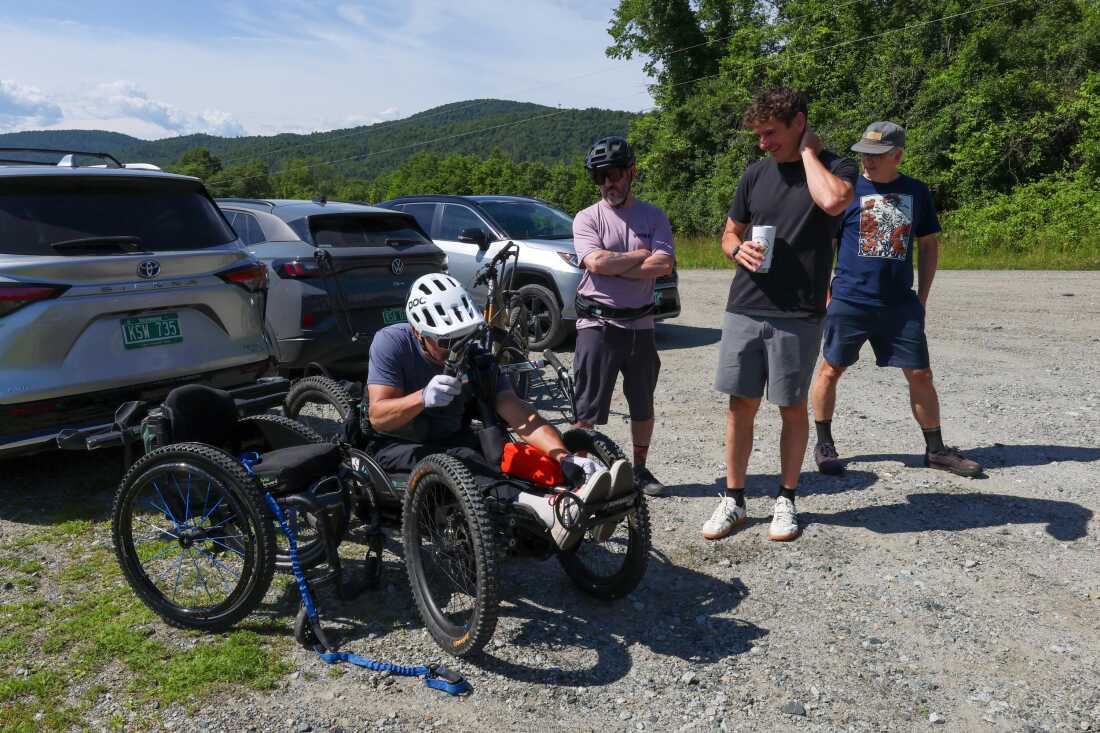
Louis Arevalo, left, straps into his adaptive mountain bike and chats with Jeff Dickson of the Vermont Mountain Bike Association, Angus McCusker with Vermont Huts and Trails, and volunteer Thatcher Hinman (all from left) ahead of a trail accessibility assessment in Randolph, Vermont, on Thursday, June 25, 2026.
Zoe McDonald/Vermont Public
hide caption
toggle caption
Zoe McDonald/Vermont Public
Louis Arevalo of Essex Junction is one of several adaptive athletes helping with that, most recently on some slightly overgrown single track trails in Randolph, a central Vermont town nestled along the eastern edge of the Green Mountains.
Arevalo pedals with his hands. He rides an electric powered recumbent-style three-wheeler that sits low to the ground. His service dog Azul chases along nearby.
“Once you realize what these bikes are capable (of) or this equipment actually opens up, it kind of blows your mind,” he said.
Arevalo was paralyzed in a skiing accident six years ago. Being able to get back on the trails has been a game changer, he said smiling.
“There’s a reason we live in the Green Mountain state. It’s because we like to get outside…you know, seeing the squirrels and chipmunks and birds… I mean, it’s life.”
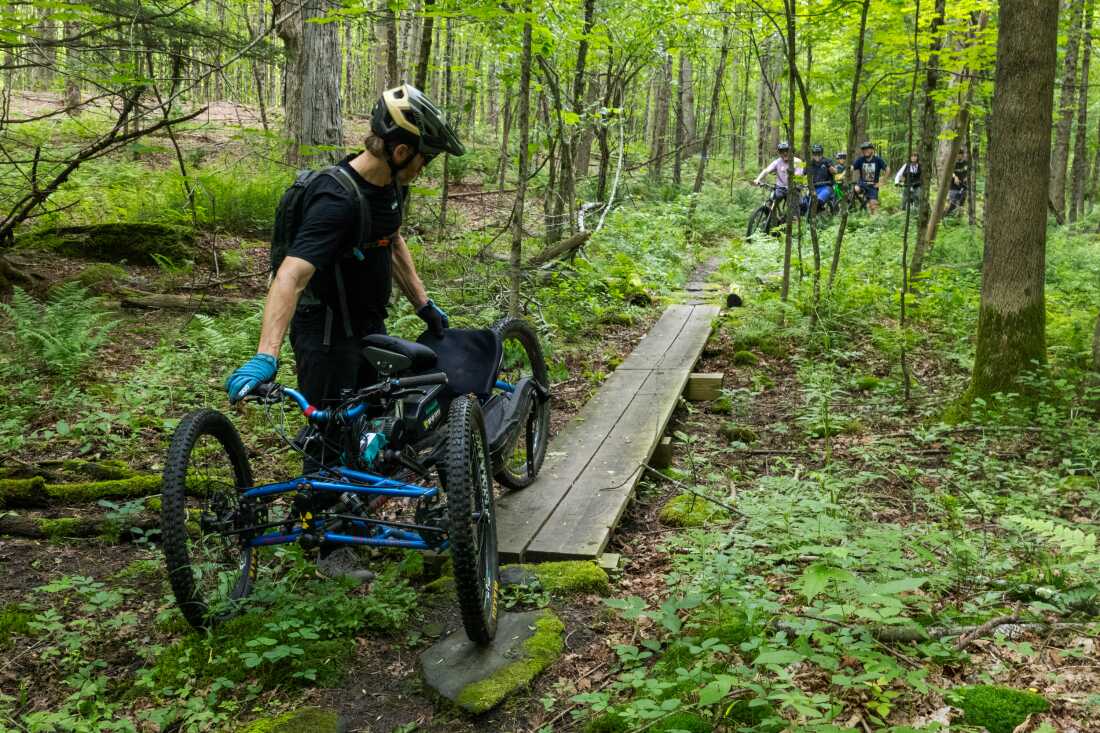
Nick Bennette, of the Vermont Mountain Biking Association, guides an adaptive bike over a narrow bridge, pointing out that other adaptive riders may have trouble getting across.
Zoe McDonald/Vermont Public
hide caption
toggle caption
Zoe McDonald/Vermont Public
But adaptive rigs like Arevalo’s are wider and heavier than regular mountain bikes, and not all trails are user-friendly.
Nick Bennette, who was testing a different type of adaptive bike, got hung up on several tight turns.
“It’s helpful to have different kinds of adaptive bikes on these tests because they all handle a little differently,” he said.
Bennette is executive director of the Vermont Mountain Bike Association, another nonprofit spearheading efforts around the Velomont. He and others involved in the assessment are taking detailed photos and notes on ways to make the trails more accessible.
“Just scalloping out a bit of material on the outside of that corner,” said Bennette, pointing to the area the bike got caught. “That will allow adaptive bikes to make that corner without really changing the way the trail rides.”
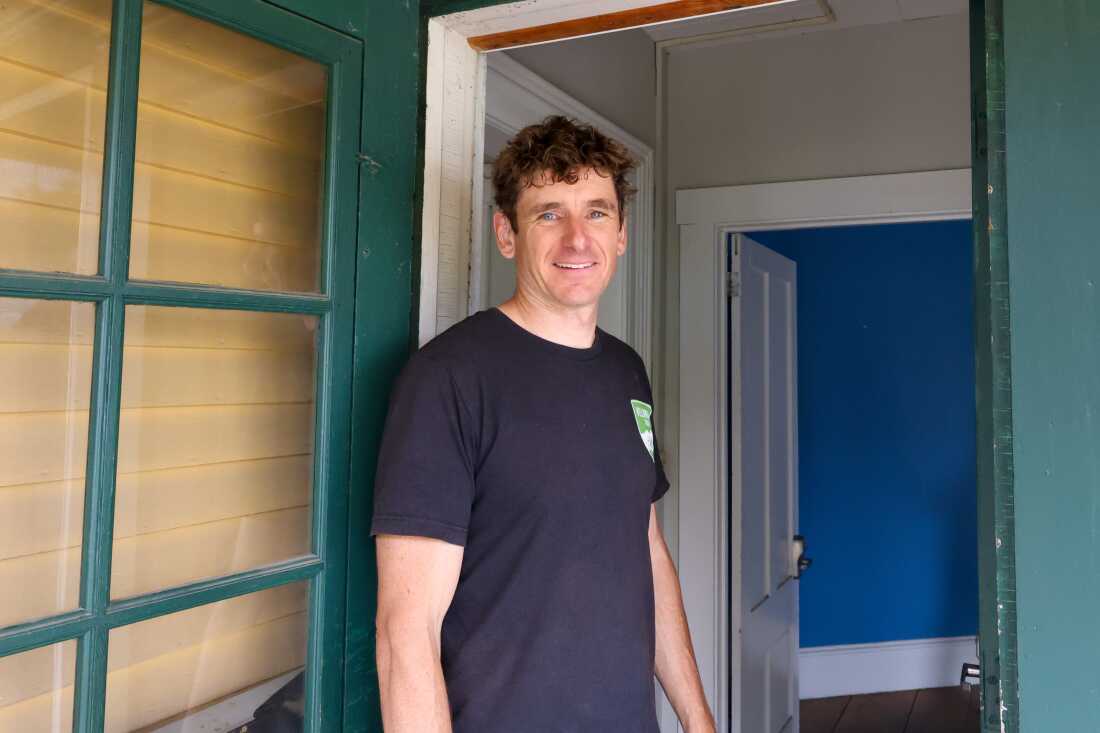
Angus McCusker with Vermont Huts and Trails is working to create accessible accommodations along the Velomont Trail, including a multi-group space in Randolph and a hut in Chittenden that has been outfitted with accessibility in mind.
Zoe McDonald/Vermont Public
hide caption
toggle caption
Zoe McDonald/Vermont Public
Contractors are also trying to reduce barriers at the trail’s overnight accommodations. This summer, contractors are building a new ADA accessible hostel in downtown Randolph.
And two remote huts along the trail will have locked sheds with off-road wheelchairs so bikers don’t have to haul their own.
At the Chittenden Brook Hut, McCusker highlighted a new ramp and wider driveway.
“So if you’re an adaptive rider, you can imagine rolling right up here and you can transfer to your chair that’s available here, and then roll down the ramp and go down to the fireplace, to the privy, to make your meal,” he said.
Louis Arevalo stayed at the hut last summer with other adaptive riders — his first camping trip since his accident.
“There was a babbling brook right there…and it was really refreshing to have easy access to a beautifully built hut that was easy to navigate, and then have these world-class trails right out the door,” he said. “And with these Velomont trails, I can actually plan a hut-to-hut trip with other people.”
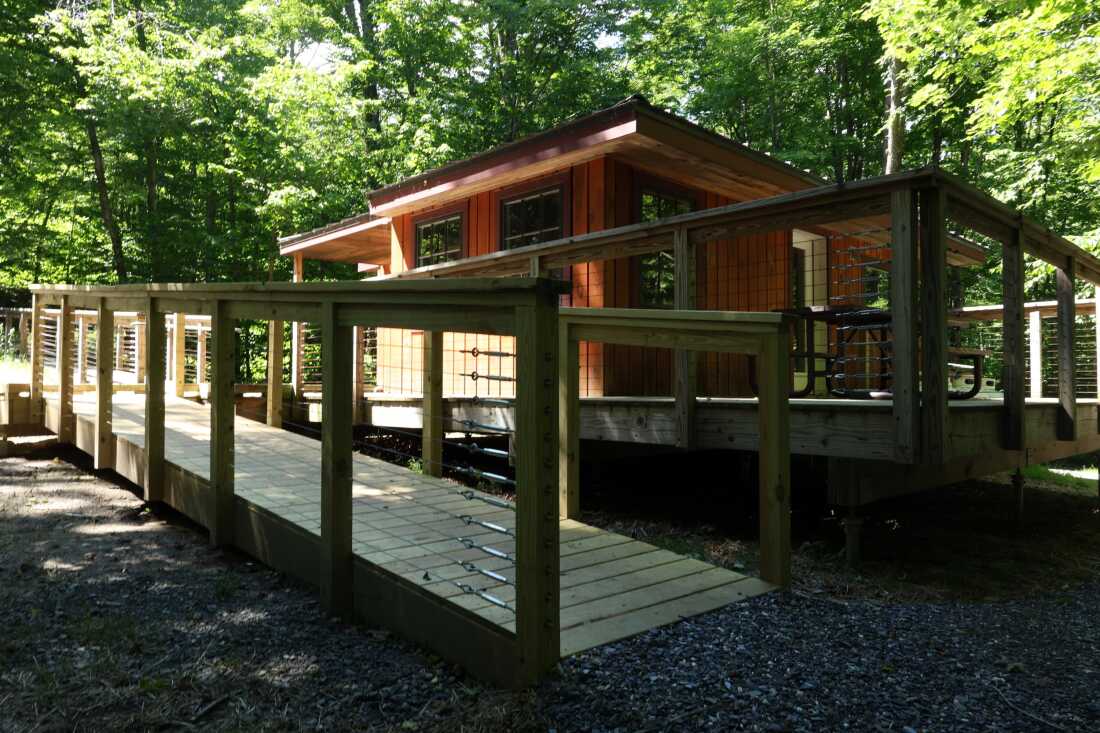
The Chittenden Brook Hut includes accessible ramps, storage for adaptive bikes and specialized off-road wheelchairs for visitors.
Zoe McDonald/Vermont Public
hide caption
toggle caption
Zoe McDonald/Vermont Public
Jeff Alexander is counting on it. He’s director of strategic partnerships with Vermont Adaptive Ski and Sports, a nonprofit that helps people with disabilities access outdoor recreation.
An economic impact analysis the group commissioned estimates their programming generated more than $10 million last year.
“So the adaptive community has money, they travel, they want to travel and they want to play with everybody,” Alexander said. “We just need to level the playing field so that everyone can play together.”
-

 Los Angeles, Ca49 minutes ago
Knee irritation forces Shohei Ohtani out of Friday start, All‑Star game
-

 Detroit, MI1 hour ago
Detroit Evening Report: Waymo cars blocking first responders – WDET 101.9 FM
-

 San Francisco, CA1 hour ago
San Francisco Mayor Daniel Lurie Blocks Vacant Grocery Store Tax Proposal | KQED
-

 Miami, FL1 hour ago
Oregon Battling Miami, Mario Cristobal for Four-Star EDGE Recruit
-

 Dallas, TX1 hour ago
FC Dallas Forward Logan Farrington Inks Contract Extension
-

 Boston, MA2 hours ago
Red Sox face lengthy travel issues ahead of series vs. Mets
-

 Denver, CO2 hours ago
What’s going on with the Nuggets? Unpacking an NBA offseason on hold
-

 Seattle, WA2 hours ago
Seattle Kraken Sign Goaltender Victor Östman and Defenseman Ville Ottavainen to One-Year Deals | Seattle Kraken

