
West
On this day in history, September 19, 1796, President George Washington issues his Farewell Address
A prophetic father of his country, President George Washington issued his Farewell Address as he approached the end of his second term in office on this day in history, Sept. 19, 1796.
He triumphantly celebrated the burgeoning young nation and his role in its creation, while soberly warning of the threat posed by regional and sectarian division.
“In looking forward to the moment which is intended to terminate the career of my public life, my feelings do not permit me to suspend the deep acknowledgment of that debt of gratitude which I owe to my beloved country for the many honors it has conferred upon me,” wrote Washington in an address that first appeared in the American Daily Advertiser, a newspaper in Philadelphia.
ON THIS DAY IN HISTORY, SEPTEMBER 18, 1870, OLD FAITHFUL GEYSER IS DOCUMENTED AND NAMED
Washington was the hero of the American Revolution — and his Abrahamic faith in the cause of independence inspired and held the nation together in the darkest hours of the rebellion.
But party divisions arose in the United States during his time in office. He warned in 1796 of their potential to shred the hard-fought unity of the previous 20 years.
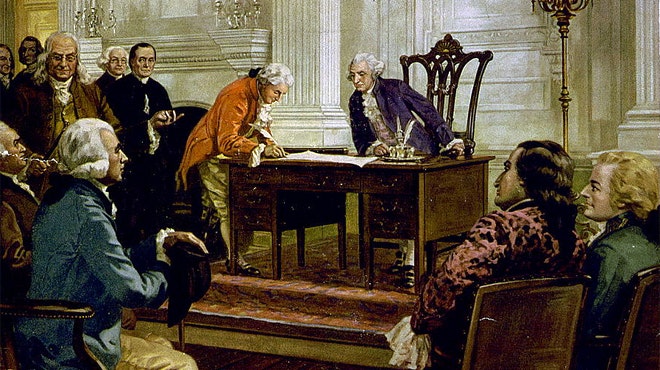
A reproduction of a painting of George Washington, Benjamin Franklin and others signing the U.S. Constitution in Philadelphia, Pennsylvania. The beloved war hero Washington would become the first president of the United States under the new Constitution. (Library of Congress)
“One of the expedients of party to acquire influence within particular districts is to misrepresent the opinions and aims of other districts,” Washington said in his address.
“They tend to render alien to each other those who ought to be bound together by fraternal affection.”
“The name of American … must always exalt the just pride of patriotism.” — George Washington
He added, “The alternate domination of one faction over another, sharpened by the spirit of revenge, natural to party dissension, which in different ages and countries has perpetrated the most horrid enormities, is itself a frightful despotism.”
ON THIS DAY IN HISTORY, SEPT. 6,1757, MARQUIS DE LAFAYETTE IS BORN, HERO OF TWO REVOLUTIONS
Washington issued his farewell statement after choosing not to run for a third term as president.
He proved the rare leader in history who willingly forfeited what might have been many more years of power.
George Washington’s Farewell Address inspired the nation for generations, including during the Civil War. The first line reads, “Upon the couch of death the champion of the free,” and the illustration artist is listed as “Clayton.” (Sheridan Libraries/Levy/Gado/Getty Images)
His decision set the stage for the tradition of presidents to serve only two terms.
The two-term tradition was codified by the 22nd Amendment, ratified in 1951, six years after Franklin D. Roosevelt died in office while serving his fourth term as president.
ON THIS DAY IN HISTORY, AUGUST 22, 1776, THE BRITISH INVADE BROOKLYN BY SEA
Washington was so beloved in his era he was unanimously voted the nation’s first president by the electoral college in late 1788-early 1789.
John Adams was elected the first vice president.
For more Lifestyle articles, visit www.foxnews/lifestyle
Washington and Adams both easily won re-election in 1792.
But the vice presidential race of that second national election began to divide along party lines, setting the stage for Washington’s farewell warning.
George Washington’s Farewell Address to the nation is shown here, as annotated by John Adams. (Tom Allen/The Washington Post via Getty Images)
Adams, of the Federalist Party, defeated Thomas Jefferson, of the Democratic-Republican Party, in Nov. 1796, two months after Washington’s farewell.
The father of his country invoked pride in his new nation, one unique in the history of mankind, as he left public life.
“The name of American, which belongs to you in your national capacity, must always exalt the just pride of patriotism more than any appellation derived from local discriminations,” he said.
“Washington’s Farewell Address spoke to contemporary concerns that the Union was weak and vulnerable to attacks from internal and external enemies,” writes the library of George Washington’s Mount Vernon.
“But even after the uncertainty of the early national period had passed, his message of unity remained powerful.”
Washington’s words, Mount Vernon also says, are “still recited annually in the United States Senate, a tradition dating back to the Civil War. The Farewell Address endures as a critical founding document for issues of Union, partisanship and isolationism.”
Read the full article from Here
Alaska
7 Best Places To Live In Alaska
Choosing a place to settle in Alaska usually comes down to which trade-offs work. Road system or off-road system. Cruise-ship economy or fishing-fleet economy. Anchorage commute or Inside Passage isolation. The seven towns ahead reach across Southcentral, the Kenai Peninsula, and Southeast Alaska. Each runs a working economy, hospital access, and the kind of community infrastructure that supports day-to-day life through the long winters. Median home prices range from $405,000 in Ketchikan to $688,800 in Sitka.
Homer
Homer sits at the end of the Sterling Highway on the Kenai Peninsula, about a five-hour drive south of Anchorage. The town has earned the “Halibut Fishing Capital of the World” tagline and runs one of the state’s largest charter fleets out of the Homer Spit, the 4.5-mile gravel bar that extends into Kachemak Bay. The Pratt Museum on Bartlett Street covers regional natural and cultural history, including the Lower Cook Inlet ecosystems and the 1989 Exxon Valdez oil spill response. Bishop’s Beach gives walkers direct access to the bay shoreline.
The local economy runs on commercial fishing, tourism, the arts community, and small-scale agriculture in the warmer microclimate that the Kachemak Bay creates. The median home price runs about $538,800. The South Peninsula Hospital handles regional medical needs, and the Kenai Peninsula Borough School District operates Homer High School and West Homer Elementary. The Bunnell Street Arts Center on Old Town Bishop’s Beach Road runs gallery rotations and music events year-round.
Seward
Seward sits at the head of Resurrection Bay on the eastern side of the Kenai Peninsula, about a two-and-a-half-hour drive south of Anchorage on the Seward Highway. The town is the gateway to Kenai Fjords National Park, which protects roughly 700 square miles of glaciated coastline along the Gulf of Alaska. Day boat tours from the Seward harbor reach the Aialik Glacier and the Holgate Glacier from late spring through early fall.
The median home price runs about $462,000, more accessible than larger Alaskan cities even though Seward draws the largest summer cruise-ship volume on the peninsula. The economy runs on tourism, marine research at the Alaska SeaLife Center, fishing, and public service. Seward Community Health Center handles primary care; the Providence Seward Medical Center on First Avenue covers acute care and emergency. The Mount Marathon Race, held every July 4 since 1915, sends runners up and down the 3,022-foot Mount Marathon directly behind town and is one of the oldest mountain races in the United States.
Sitka
Sitka sits on the west side of Baranof Island in the Alexander Archipelago, with Tlingit roots going back thousands of years and a Russian colonial history from the founding of the Redoubt Saint Michael settlement in 1799. In 1808, the Russians established Sitka (then New Archangel) as the new capital of Russian America, moving the seat of government away from Kodiak. On October 18, 1867, Sitka was the site of the formal handover of Alaska to the United States, ending Russian colonial rule. The Sitka National Historical Park preserves the site of the 1804 Battle of Sitka along with one of the most accessible totem pole collections in Alaska.
Housing is on the higher end at a median price of about $688,800. Sitka’s economy supports fishing, healthcare, education, and tourism, and the city operates as a borough that covers most of Baranof Island. The Sitka School District serves about 1,100 students. SEARHC Mt. Edgecumbe Medical Center on Halibut Point Road provides regional healthcare. The Alaska Raptor Center rehabilitates eagles, owls, and hawks across a 17-acre forested campus, and the Baranof Castle State Historic Site marks the bluff where the 1867 transfer ceremony took place.
Ketchikan
As Alaska’s southernmost city and the first stop on the Inside Passage cruise route, Ketchikan sits at the southern tip of Revillagigedo Island. The town runs one of the largest commercial salmon harvests in Southeast Alaska. With a median home price around $405,000, Ketchikan is moderately affordable by Alaskan standards. The town is accessible only by sea or air, and the Ketchikan International Airport sits on neighboring Gravina Island, reached by a short ferry crossing.
Ketchikan’s economy runs on fishing, seafood processing, and a cruise-season tourism industry that brings about a million visitors per year between May and September. The Ketchikan Gateway Borough School District operates Ketchikan High School, and the University of Alaska Southeast runs a satellite campus in town. PeaceHealth Ketchikan Medical Center provides full medical services. Recreation centers on the Deer Mountain trail, historic Creek Street (the former red-light district on pilings over Ketchikan Creek), and the Totem Bight State Historical Park with restored and replica Tlingit and Haida totem poles. The Blueberry Arts Festival on the first weekend of August anchors the local summer calendar.
Petersburg
Petersburg sits on the north end of Mitkof Island, halfway between Juneau and Ketchikan along the Inside Passage. The town is known as “Little Norway” because Norwegian immigrant Peter Buschmann founded the settlement in 1897, drawing Scandinavian fishermen who shaped the town’s identity. Petersburg was incorporated in 1910 and still celebrates Norwegian Constitution Day on May 17 with the multi-day Little Norway Festival, the longest Syttende Mai celebration of any Norwegian-American community in the country. Sing Lee Alley holds rosemaling-decorated wooden buildings and the Sons of Norway Hall, built in 1912 on pilings over the water.
Fishing and seafood processing drive the local economy; Petersburg is consistently ranked among the top 25 fishing ports in the United States by dollar value. With a median home price of about $422,500, Petersburg runs moderately affordable by Alaskan standards. Students are served by the Petersburg School District, and Petersburg Medical Center operates a 24/7 emergency department. The Bojer Wikan Fisherman’s Memorial Park at the harbor holds the Valhalla, a miniature Viking ship, as a memorial to local fishermen lost at sea.
Kenai
Kenai sits at the mouth of the Kenai River on the western side of the Kenai Peninsula, with views across Cook Inlet to the active volcanoes of Mount Redoubt and Mount Iliamna. The Kenai River produces the largest sport king salmon runs in the world; the world-record king salmon, weighing 97 pounds 4 ounces, was caught in the river by Les Anderson in May 1985 and the record still stands. The Holy Assumption of the Virgin Mary Orthodox Church, built between 1894 and 1895, is a National Historic Landmark and one of the oldest Russian Orthodox churches in Alaska.
The median home price runs about $429,000. The local economy is fueled by oil and gas, commercial fishing, tourism, and remote-work transplants. Kenai Central High School serves area students, and Central Peninsula Hospital sits a short drive away in Soldotna. Weekends often run on fishing trips along the Kenai River, hiking nearby trails, or watching beluga whales along Cook Inlet from the Erik Hansen Scout Park bluff. The Kenai River Festival in June brings people together at the riverfront.
Wasilla
Wasilla sits in the heart of the Matanuska-Susitna Valley about 45 minutes north of Anchorage on the Parks Highway. The city holds about 10,000 residents, the largest city outside Anchorage in the Mat-Su Borough, with views of the Talkeetna Mountains to the north and Pioneer Peak to the east. With a median home price of about $449,000, Wasilla runs notably more affordable than Anchorage proper and has drawn commuters, young families, and remote workers across the past decade.
The economy runs on construction, retail, logistics, healthcare, and small businesses. The Matanuska-Susitna Borough School District supports the area’s educational needs, while Mat-Su Regional Medical Center handles healthcare for the valley. The Iditarod Trail Sled Dog Race holds its ceremonial start in Anchorage on the first Saturday in March, with the official restart in Willow the next day, about 30 minutes north of Wasilla on the Parks Highway. The Iditarod Trail Sled Dog Race Headquarters is in Wasilla and houses a museum about the race. Lake Lucille Park and Iditapark add walking trails and lake access close to downtown.
Choosing The Right Alaska Town
The seven split roughly into three regional clusters. The Kenai Peninsula produces Homer, Seward, and Kenai. The Inside Passage produces Sitka, Ketchikan, and Petersburg. The Mat-Su Valley produces Wasilla. Road-system access goes to the Kenai Peninsula and Mat-Su towns; the Southeast Alaska towns are reachable only by air or sea. Median home prices run from about $405,000 in Ketchikan to about $688,800 in Sitka. The right choice depends on whether the move favors road connections to Anchorage, the year-round Inside Passage rhythm, or the marine economy of the Kenai Peninsula.
Arizona
Dangerous fire weather leads to central Arizona campfire restrictions
Federal and state officials imposed new fire restrictions across a large portion of central Arizona ahead of a weekend forecasted to bring hot, dry winds that could increase wildfire danger.
On Friday, May 15, Tonto National Forest enacted Stage 1 fire restrictions across the entire forest, while the Arizona Department of Forestry and Fire Management announced similar restrictions for state trust lands in Gila, Maricopa, and Pinal counties.
The restrictions come as fire officials reported major progress on two wildfires in the region, potentially freeing up firefighting resources for future incidents. The Forestry Department announced that the Hazen Fire, which burned nearly 1,200 acres of dense tamarisk along the Gila River near Buckeye, had reached 100% containment. Meanwhile, the Jones Fire near Wickenburg, which prompted evacuations and was also fueled by tamarisk vegetation, was reported at 90% containment.
Tonto National Forest prohibited campfires and the use of wood-, charcoal-, or coal-burning stoves outside Forest Service-provided fire structures. Liquid petroleum or LPG stoves are still allowed if they can be switched off and are kept at least three feet away from overhead or surrounding flammable materials. Similar restrictions apply on state lands, except fires are permitted in developed campsites or picnic areas. The ban also extends to wildlife areas managed by the Arizona Game and Fish Department, state parks, and highway rights-of-way.
The National Weather Service forecasted high temperatures in the upper 90s across metro Phoenix through Saturday, cooling slightly into the upper 80s and low 90s by Sunday. In Arizona’s high country, forecasters warned of elevated fire danger due to low humidity and strong southwest winds, with gusts expected between 20 and 30 mph on Saturday and 25 to 40 mph on Sunday.
“Gusty winds, dry fuels, and low humidity will lead to critical fire weather danger with easier fire starts and uncontrollable spread of new or existing fires,” the agency said in its Friday afternoon briefing.
The weather service declared a red flag warning for the Tonto National Forest and for southern Gila County, effective Sunday. The agency’s Tucson office also put out a Sunday, May 17, red flag warning covering Santa Cruz, Cochise, Graham and Greenlee counties, and the far eastern parts of Pinal and Pima counties.
Beyond the fire prohibition, the Tonto’s restrictions ban recreational shooting except for legal hunting activity.
The Tonto fire restrictions are in place through Sept. 30 unless rescinded. The state order is in effect until further notice.
Brandon Loomis covers environmental and climate issues for The Arizona Republic and azcentral.com. Reach him at brandon.loomis@arizonarepublic.com.
Environmental coverage on azcentral.com and in The Arizona Republic is supported by a grant from the Nina Mason Pulliam Charitable Trust.
Follow The Republic environmental reporting team at environment.azcentral.com and @azcenvironment on Facebook and Instagram.
California
Central California Red Cross seeing uptick in Gen Z volunteers
Friday, May 15, 2026 11:31PM
FRESNO, Calif. (KFSN) — Gen-Z is now the fastest-growing and largest volunteer group in the Central California Red Cross.
The organization says that’s thanks to a boom in student-led Red Cross clubs.
We sat down with two presidents of local clubs to hear what inspired them to lead their peers.
Copyright © 2026 KFSN-TV. All Rights Reserved.
-
Alabama3 minutes agoAlabama Shakespeare Festival announces 2026-27 season
-
Alaska9 minutes ago7 Best Places To Live In Alaska
-
Arizona15 minutes agoDangerous fire weather leads to central Arizona campfire restrictions
-
Arkansas21 minutes ago
LIVE SCORE UPDATES & ANALYSIS: Arkansas baseball at Kentucky Game 2 | Arkansas Democrat Gazette
-
California27 minutes agoCentral California Red Cross seeing uptick in Gen Z volunteers
-
Colorado33 minutes agoColorado county and city team up to address local food accessibility
-
Connecticut39 minutes ago‘Shaping Connecticut’s Future’: Business leaders, lawmakers gather at SCSU for summit
-
Delaware45 minutes agoHistoric School House Opens at Bellevue State Park – State of Delaware News
