West
Los Angeles homeowner stabs suspect who broke into his house in the middle of the night

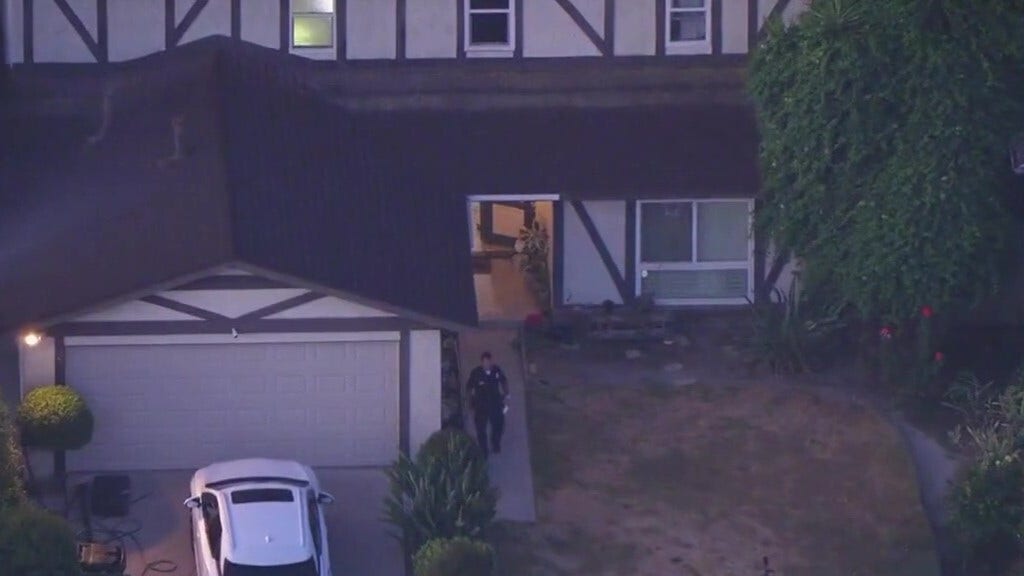
A homeowner in Los Angeles’ San Fernando Valley stabbed a suspect in his mid-20s who broke into his home in the middle of the night this week, the Los Angeles Police Department (LAPD) confirmed to Fox News Digital.
After the suspect rammed his way through the front door just after 4 a.m. in the Winnetka neighborhood, he was confronted first by the homeowner’s daughter. Then he got into a fight with the homeowner, who stabbed the intruder in the stomach, police said.
The suspect, who collapsed not far from the house, was found by police soon after leaving a trail of blood from the house.
CALIFORNIA HOMEOWNER SHOOTS AT HOME INVASION SUSPECTS, INJURING 1
A homeowner in Los Angeles’ San Fernando Valley stabbed a suspect in his mid-20s who broke into his home in the middle of the night this week, the Los Angeles Police Department confirmed to Fox News Digital. (KTTV)
The suspect, who has not yet been identified, was arrested and taken to a hospital, where he is in stable condition, police told Fox News Digital.
A neighbor told police the suspect also tried to break into her home, FOX 11 reported.
The home invasion was caught on video, and the homeowner’s Ring video camera showed the suspect slamming his body against the door. Another surveillance camera captured him prowling outside.
CRIME TOURISM GROUP OPERATING OUT OF LA CAR RENTAL FACILITY STOLE MILLIONS IN HEISTS, HOME THEFTS, FEDS SAY
The suspect left a trail of blood as he fled. (KTTV)
“They struggled for the door. The guy eventually broke the door open,” Joseph Santos, the homeowner’s son, who lives nearby, told KABC-TV. “My dad acted in self-defense. The guy jumped in the room, and they all warded him off. My sisters took a vacuum cleaner and started hitting him over the head.”
Another neighbor, Tigran Sargsyan, agreed that “everybody has a right to defend himself.”
The suspect broke into a home in the Winnetka neighborhood of Los Angeles’ San Fernando Valley. (KTTV)
“The suspect was on my property, I heard, at night,” he told the station. “Someone was walking on my roof. My neighbor was aware. She called me at night. My phone was on silent. I didn’t hear, but she was alone. She needed help. She called me. I went out, and she was very scared.”
There have been other home invasions in the area this week, including in Sherman Oaks and Canoga Park, where the residents scared a suspect away. Three suspects were arrested in the Sherman Oaks robbery.
“We will continue our urgent work to make Los Angeles safer and combat crime throughout the city,” Los Angeles Mayor Karen Bass said in a statement. “I have met with Angelenos who live in areas experiencing an uptick in burglaries and have been in close coordination with LAPD as we take steps to suppress crime in those areas. Those responsible for crimes must be held accountable, and I thank LAPD for their work.”
Read the full article from Here


New Mexico’s top prosecutor says federal officials are slow-walking key Jeffrey Epstein files, and it may be costing the state its chance to build a case. In a sharply worded June 30 letter released on Thursday, Attorney General Raul Torrez accused the Justice Department of blocking access to unredacted records tied to Epstein’s Zorro Ranch, warning that evidence degrades and witnesses disappear with each passing day, reports CNN. The agency’s refusal to release the files “is causing real and escalating harm,” Torrez wrote in a letter last week to acting US Attorney General Todd Blanche, per the New York Times.
The state reopened its criminal probe in February after the federal release of millions of Epstein-related documents, including an unverified tip about two foreign girls allegedly buried near the property at the behest of Epstein and a “Madam G.” The DOJ says it responded to New Mexico last month and stands ready to assist if the state uncovers possible federal crimes, notes Reuters.
Torrez counters that his office has made six attempts since February to secure documents or at least an in-person meeting, calling the more than 130-day delay “unreasonable,” per CNN. The dispute unfolds as lawmakers condemn heavy redactions in the Epstein files and an internal DOJ watchdog reviews the process. Zorro Ranch, near Santa Fe, has been named by multiple survivors, including Chauntae Davies and the late Virginia Giuffre, as a site of sexual abuse.

JACKSON COUNTY, Ore. (KATU) — Additional firefighting resources are being sent to the fast-moving East Evans Creek Road fire in Jackson County as the blaze grows and threatens homes and nearby communities.
In a statement posted at 6:26 a.m. on July 11, the Oregon State Fire Marshal said it is mobilizing four structural task forces and its Blue Incident Management Team to support local response efforts. The fire sparked Friday and “quickly grew to over 1,500 acres,” the agency said.
By Saturday morning, the Oregon Department of Forestry’s Southwest Oregon District estimated the fire at approximately 2,000 acres. Firefighters are working on private and Bureau of Land Management lands about 26 miles north of Medford near the 18000 block of East Evans Creek Road.
The fire was reported Friday afternoon just after 2:40 p.m., according to ODF, when dispatch received a report of a car crash involving a power pole and a downed power line.
Firefighters arrived to find fire burning in nearby vegetation. ODF and the Jackson County Sheriff’s Office are conducting a further investigation into the incident.
Evacuation information
Evacuation orders remained in place as of the Jackson County Sheriff’s Office morning update on Saturday. The sheriff’s office issued Level 3 “Go Now,” Level 2 “Be Set” and Level 1 “Be Ready” evacuation notices for areas surrounding the fire.
Evacuation Level 3 Go Now: JAC-148A
Evacuation Level 2 Be Set: JAC-016, JAC-124, JAC-147, JAC-148B
Evacuation Level 1 Be Ready: JAC-003, JAC-004, JAC-017, JAC-026, JAC-036, JAC-109, JAC-126, JAC-149B
The above zone names can be understood by visiting the following map through Genasys Protect at protect.genasys.com. The map lets users plug in their address to see what zones are under evacuation.
The state fire marshal urged people looking for further evacuation information to follow the local sheriff’s office or check the map at the following website with the latest evacuation information: Jacksoncountyor.gov.
An evacuation shelter for residents and domestic pets has been established at Hanby Middle School, 806 6th Avenue, Gold Hill.
Road closures and traffic blocks remained in effect. The Jackson County Sheriff’s Office said there is an additional roadblock at the 8 mile marker of Antioch Road.
Traffic remains blocked on East Evans Creek Road at Meadows Road on the east side and West Fork Evans Creek Road on the west side. ODF also reported traffic is blocked on East Evans Creek Road at Meadows Road, and said residents will be allowed through the closure when it is safe to do so. The public is asked to avoid the area to allow firefighters and heavy equipment to operate safely.
Livestock shelters
Livestock sheltering options are also available. Horses can be taken to the Jackson County Expo at 21 Peninger Road in Central Point, where expo staff and volunteers are prepared to receive horses. Owners are asked to bring feed, water containers and any necessary medications when possible. Josephine County Fairgrounds can take pigs, goats and smaller animals at 1451 Fairgrounds Road, Grants Pass, OR 97527. Anyone needing livestock sheltering assistance can call 541-776-7206.
Emergency Conflagration Act invoked
Gov. Tina Kotek invoked the Emergency Conflagration Act on Friday night for the East Evans Creek Road Fire in Jackson County, allowing the Oregon State Fire Marshal to mobilize additional resources through the Oregon Fire Mutual Aid System.
The Jackson County Fire Defense Board chief requested assistance with life, safety and structural fire protection, and the state fire marshal concurred with that request.
The agency said it is the first time the Emergency Conflagration Act has been invoked in 2026.
Task forces from Lincoln, Linn, Marion and the south coast—Coos, Curry, Lane and Douglas counties—are being mobilized, according to the state fire marshal. Those resources will join a task force from Klamath County and a strike team from Douglas County that were mobilized Friday evening through Immediate Response to support local structural resources.
“This fire is a reminder how quickly things can change with the dry conditions we have across the state,” Oregon State Fire Marshal Chief Deputy Travis Medema said. “We have a long way to go this fire season, and I ask every Oregonian to do their part to prevent wildfires.”
ODF said warm, dry and breezy conditions were expected to continue across southwest Oregon Saturday, increasing the potential for active fire behavior and spotting.
More than 400 personnel were assigned to the incident Saturday, including 20-person hand crews, engines, dozers, water tenders, heavy equipment, aviation resources and structural task forces, according to ODF. Aviation resources include one Type 3 helicopter with Air Attack, three Type 2 helicopters and two Type 1 helicopters.
Firefighters worked through the night strengthening fire line, reinforcing wet line and mitigating hazardous snags, ODF said. Saturday’s objectives include reinforcing and strengthening existing fire line, extending hose lays along East Evans Creek Road and improving access for firefighters working throughout the incident. Crews are operating in steep terrain, across an old burn scar and around numerous hazard trees.
The Oregon State Fire Marshal Blue Incident Management Team is expected to be in unified command with the Oregon Department of Forestry Team 1, according to the state fire marshal. ODF said Incident Management Team 1 will assume command of the incident this evening, citing the fire’s size and complexity and the need to maintain initial attack capability across southwest Oregon.
Traffic is blocked on East Evans Creek Road at Meadows Road, ODF said. Residents will be allowed through the closure when it is safe to do so, and the public is asked to avoid the area to allow firefighters and heavy equipment to operate safely.
ODF said updates on the East Evans Creek Fire will be provided each morning and evening on their Facebook page at ODF Southwest Oregon District, with additional updates shared throughout the day as significant information becomes available.
Sign up for emergency alerts from Jackson County at this link: Jacksoncountyor.gov.
Gert Zoutendijk, a public information officer for the Oregon State Fire Marshal’s Blue Team, confirmed the fire was caused by a downed power line that came down because of a motor vehicle crash.
Zoutendijk said an Oregon Department of Forestry local unit engine was on scene “within 30 seconds,” rendered aid to passengers and noticed the fire started.
As of today, fire officials were estimating the blaze at around 2,000 acres, though Zoutendijk said that number could change because crews have not yet been able to get an infrared flight to confirm the perimeter. An infrared flight was planned for tonight, and the acreage estimate could go up or down once the fire line is mapped more accurately.
Firefighting resources include both wildland and structural protection teams. Zoutendijk said local fire departments and districts have been overwhelmed protecting structures, and the Oregon State Fire Marshal has sent a conflagration delegate. Zoutendijk said six different counties sent resources from five different fire agencies—equipment and firefighters—on the structural side. On the wildland side, Zoutendijk said resources include the Oregon Department of Forestry, the Bureau of Land Management and private resources.
He said the total number of firefighters on the fire, not including structural firefighters who arrived today, was reported at 750.
Evacuations were in place at multiple levels. Zoutendijk said a briefing mentioned that in Level 3 evacuation zones, approximately 100 people were evacuated or affected, including 73 structures. Zoutendijk noted those structures are not all homes and could include commercial buildings. In Level 2 zones, Zoutendijk said about 166 structures were affected, including about 300 people.
Zoutendijk said Gov. Kotek invoking the Conflagration Act allows the state to send additional resources when local fire jurisdictions are overwhelmed and cannot safely and adequately protect their communities.
He stated that local agencies requested resources from the state yesterday because conditions changed quickly. Two task forces arrived and began work, and additional resources were brought in today after the conflagration was enacted last night, including four task forces from four different counties. Those resources are intended to focus on protecting structures in and around threatened areas and to relieve local jurisdictions so they can return to day-to-day emergency response.
Zoutendijk urged Oregonians statewide to sign up for emergency alerts through local fire agencies, emergency management offices, counties or cities, saying the systems can send evacuation notices and other emergency messaging for large-scale incidents.

SALT LAKE CITY — A Riverton woman is proving that one moment of compassion can change a life.
On May 21, LaCinda Thackeray was flying home to Utah from Southern California after attending a family funeral when someone outside the window caught her attention.
As she waited to board her plane at John Wayne Airport, she noticed an airport worker struggling to walk across the tarmac.
“I just saw somebody who needed a little bit of support and love and kindness,” Thackeray said. “What really was hard for me was just the conditions he was in, and I didn’t even know his story at that point.”
Before her flight departed, Thackeray recorded a short video of the man and shared it on TikTok, asking if anyone knew who he was.
“Immediately when I sat on the airplane, my thought was, if anybody knew who he was, could we get him retired?” Thackeray said. “I didn’t know it was going to take off. I had no idea.”
Within a few hours, the video had been viewed more than a million times. Thousands of people shared it, and strangers from around the world began asking how they could help.
The internet soon identified the man as 64-year-old James Blair, a Navy veteran who works as a fuel injector and fuel mechanic at the airport.
By all accounts, Blair has lived a life of service. He served in the Navy from 1980 to 1990.
“We were 20 minutes from launching against Iran when the hostages were in Iran. We had all of our planes loaded with bombs and missiles on our ship and were just waiting for President Reagan to give the go-ahead,” Blair said.
After the Navy, Blair said he worked at LAX airport for 13 years and, after a three-year stint as a truck driver, returned to working on planes at John Wayne Airport.
“I’ve been at John Wayne Airport since April of 2006,” Blair said.
Though Blair turned 64 in March, retirement is not on his horizon.
“My plan was to work until I can’t work, until I physically can’t work,” he said. “I have inquiries out about getting knee operations; I’m working on that right now.”
Despite ongoing knee problems, Blair said his priority is his elderly mother, whom he lives with.
Thackeray said much of Blair’s income goes toward her hospice care.
“She has her good days, and she has her bad days,” Blair said.
Encouraged by people online, Thackeray started a GoFundMe campaign. She said donations quickly poured in.
“At one point, I remember telling my husband, ‘What did I do?’” Thackeray said. “When we needed to get him the money, that is when we were a little panicky, but then it changed really fast.”
The overwhelming support, Thackeray said, presented an exciting opportunity but also some challenges in ensuring that Blair would receive the money.
Until recently, Blair didn’t have a smartphone or social media accounts.
His boss volunteered to drive 1.5 hours to his home to help him set up a GoFundMe account so that he could receive the funds as a beneficiary.
“When his boss went out there, it eased so much anxiety,” Thackeray said.
Recently, Thackeray returned to California to personally deliver a $174,000 check to Blair.
For Blair, the support from complete strangers has restored his faith in humanity.
“Not in a million years,” Blair said when asked if he ever imagined something like this would happen.
“I’m just a person trying to do a job, trying to survive, and the way people give their own money. I have a hard time working to pay bills, so other people probably have the same problems. When they’re giving money they really can’t spare, that amazes me. I’m just blown away.”
Thackeray said the generosity extended far beyond the United States.
“I was speechless because I felt like the world showed up, and I think in these times we need people like that.” She said.
“I’ve been speaking to people all over the world, and they’re just, ‘Tell James hi!’ Give him a hug for us!” she said.
Blair also reflected on how deeply the experience has affected him personally.
“I believed in God, but I didn’t really believe in God. But now, with the angel sitting next to you, it’s amazing,” Blair told Thackeray. “I can’t believe how God works in mysterious ways.”
Although Blair is still going to work, he recently used some of the funds to buy himself a bed. He continues to care for his mother.
“I mean, I don’t know what Salt Lake City living is now, but California is really expensive,” Blair said.
What began as a brief glance through an airplane window has grown into an unlikely friendship — and a powerful reminder that a single act of kindness can inspire thousands of people to make a difference.
“I’m so happy for him and that he gets to experience this,” Thackeray said.
“I told him, I’m just a little part of your story, I’m happy that I could do that, but I hope you can always remember the ones that showed up and donated.”
To date, nearly 6,000 people have donated to the fundraiser. It has raised $180,521.00 for Blair.
Thackeray’s TikTok video of Blair has been viewed more than 9 million times, garnering nearly 800,000 likes and 8,000 comments.
For more information about the fundraiser, visit: https://gofund.me/51f1c9e16
*KSL.com does not assure that the money deposited to the account will be applied for the benefit of the persons named as beneficiaries. If you are considering a deposit to the account, you should consult your own advisers and otherwise proceed at your own risk.
The Key Takeaways for this article were generated with the assistance of large language models and reviewed by our editorial team. The article, itself, is solely human-written.
-

 New Jersey4 minutes ago
Ex-NJ GOP aide accused of staging slashing attack shows off horrific scars — and mystery man — in new snap
-

 New Mexico7 minutes ago
New Mexico AG Wants to Know Where Epstein Records Are
-
North Carolina7 minutes ago
UNC shortstop selected in first round of MLB Draft by Red Sox; list of NC players drafted
-
North Dakota19 minutes ago
The Crookston Masonic Lodge and Order of the Eastern Star present a donation check to Honor Flight of North Dakota and Minnesota
-

 Ohio22 minutes ago
Ohio’s first mountain coaster coming to Hocking Hills
-

 Oklahoma27 minutes ago
Housing affordability act becomes law, Oklahoma lawmakers react
-

 Oregon34 minutes ago
East Evans Creek Road wildfire swells to about 2,000 acres; homes threatened
-

 Pennsylvania37 minutes ago
Indicators 2026: How walkable is Northeast Pennsylvania?


