News
Indigenous and Black people tell their own stories at the Mystic Seaport Museum


“Wail on Whalers, a Portrait of Amos Haskins” by Felandus Thames, an “homage to escaped enslaved people who found autonomy in whaling,” is comprised of hairbeads strung on coated wire. The piece is part of the “Entwined” exhibition, which reimagines thousands of years of maritime history through Black and Indigenous worldviews and experiences. (Ryan Caron King/Connecticut Public)
Ryan Caron King/Connecticut Public Radio
hide caption
toggle caption
Ryan Caron King/Connecticut Public Radio
“Entwined: Freedom, Sovereignty and the Sea” at Mystic Seaport Museum in Connecticut explores Indigenous and African ties to the waterways of New England. The exhibition calls on visitors to think about history, water and spirituality in new ways.
“Walking through the exhibition space you get the sense that time is cyclical, not linear. And that everything cycles and has a birth, a life, a death and a rebirth, as do our histories,” said curator Akeia de Barros Gomes.
There are loaned “belongings” — or objects — from Indigenous and African communities dating back 2500 years. They show maritime navigational skills and spiritual connections to the ocean on both sides of the Atlantic.

Senior Curator of Maritime Social Histories Akeia de Barros Gomes said a first step in creating the ‘Entwined’ exhibition was to ask local tribal and Black communities how they would tell their maritime history. “What came from that conversation was the ocean as a place of creation and rebirth,” she said.
Ryan Caron King/Connecticut Public Radio
hide caption
toggle caption
Ryan Caron King/Connecticut Public Radio
“Yes, for the last 500 years, colonialism, slavery and dispossession have been a major factor in our histories,” de Barros Gomes said. “But if you think about African and Indigenous Dawnland, or New England, maritime histories, they go back over 12,000 years.”
“Dawnland” is the Indigenous term for New England.
Mystic Seaport Museum was founded in 1929 to preserve America’s seafaring past. Visitors can walk through a 19th-century coastal village and climb aboard a wooden whaling ship. But for decades, most Black and Indigenous maritime histories were missing. Inside the gallery space, de Barros Gomes points to an ancient ceramic cooking pot that’s partly broken in pieces.
“We are going to continue to do the work until the vessel is whole and holds water once more.”

“Drums from All Directions” is a piece created by Sherenté Mishitashin Harris of the Narragansett tribe. It sits on display as part of the “Entwined” exhibition.
Ryan Caron King/Connecticut Public
hide caption
toggle caption
Ryan Caron King/Connecticut Public
The exhibition includes a brightly painted dugout canoe, traditional masks and jewelry, and a first edition Eliot Bible translated into the Algonquin language. There are also wampum beads found just across the river at the site of the Pequot Massacre of 1637.
Mystic Seaport Museum stands on Indigenous ancestral homelands, said designer Steven Peters, a member of the Mashpee Wampanoag tribe.

Believed to be the first translation of a Christian bible into an indigenous language is on display in the “Entwined” exhibition at the Mystic Seaport Museum in Connecticut.
Ryan Caron King/Connecticut Public
hide caption
toggle caption
Ryan Caron King/Connecticut Public
“There was a lot of healing that had to take place so that the communities became comfortable sharing within those spaces.”
Before loaning any materials, local tribes wanted to be sure that along with the hard history there would be stories of strength and resilience. Peters and de Barros Gomes spent nearly two years meeting with Native and Black community members from around New England to shape the narrative.
“It had to be both African and Indigenous communities that were saying, ‘Here’s the story that we want to tell,’” he said.

Director of Research and Scholarship Elysa Engelman said she hopes that visitors can gain a new perspective from the exhibition. “I think, like with reading, like with movies, one of the powers of museums is to transport you outside of your own experience.”
Ryan Caron King/Connecticut Public
hide caption
toggle caption
Ryan Caron King/Connecticut Public
This is not the first time Mystic Seaport has worked with outside advisers, says Elysa Engelman, the museum’s Director of Research and Scholarship, “but (it’s) the first time that we’ve had an outside committee that was responsible for the content and really was the voice of the exhibit.”
Advisor Anika Lopes traces her ancestry to enslaved Africans and members of the Niantic tribe.
“It reminds me always of your foundation, foundation, foundation,” she says. “Like, who is at the table and who are you involving in the discussions from the very beginning is so important.”

Anika Lopes is an Afro-Indigenous woman who was a member of the committee that helped to shape the narrative of ”Entwined: Freedom, Sovereignty and the Sea.” To create it, the curator and designer asked Indigenous and Black communities in New England (or the “Dawnland”) how their ancestors would have wanted their history and stories to be told? The exhibition runs through spring of 2026.
Mark Mirko/Connecticut Public
hide caption
toggle caption
Mark Mirko/Connecticut Public
Standing outside the gallery, visitor Susie Gagne said ‘Entwined’ makes Mystic Seaport better. She appreciated the language of the exhibition.
“It was for the most part written in like, ‘we’ and ‘I’ perspectives; written by people in the groups that it’s about. And obviously there are historical atrocities associated with Mystic alongside all of the good historical connotations.”
Back inside, de Barros Gomes walked through two smaller darkened rooms. First, an attic space with ship carvings and spiritual objects of enslaved Africans. Next, an Indigenous hut called a Wetu. And finally, into a light, bright contemporary space with a large collection of art by current Native American and Black artists. There are paintings, sculpture, and traditional clothing.
“Art that really speaks to contemporary artists reclaiming their ancestry and their ancestral stories,” said de Barros Gomes.
For too long, others told America’s maritime history, she said. ‘Entwined: Freedom, Sovereignty and the Sea’ shifts the tide.

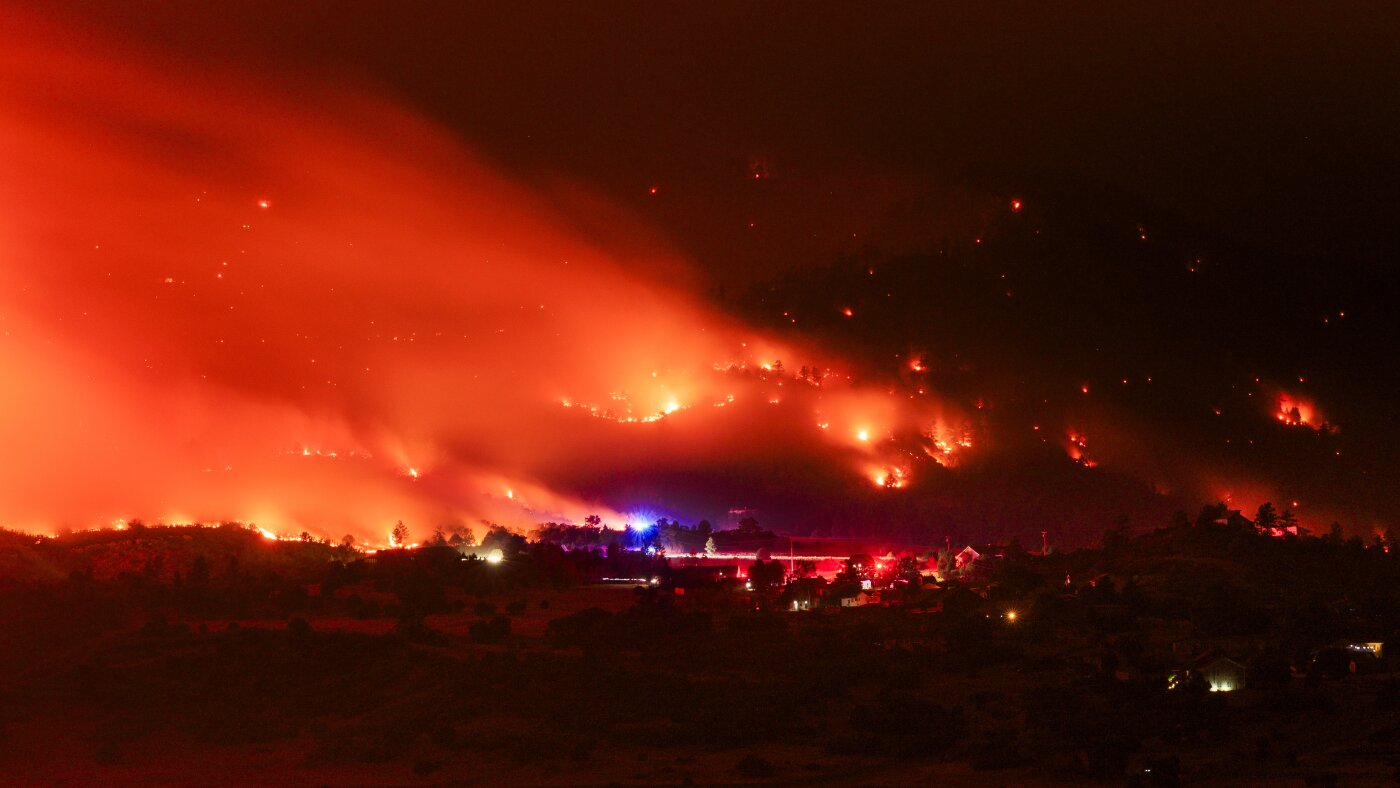
The Aspen Acres Fire burns on Friday in Rye, Colo.
Michael Ciaglo/Getty Images
hide caption
toggle caption
Michael Ciaglo/Getty Images
Thunderstorms with high winds on Sunday could hamper efforts to contain a massive wildfire that has scorched parts of southern Colorado.
The Aspen Acres Fire, which is burning south of Colorado Springs across Pueblo and Custer counties, has grown to more than 86,000 acres. It began nearly a week ago and is 13% contained, officials said on Sunday morning.

Authorities have ordered people to evacuate or to prepare to evacuate across counties including Custer, Pueblo, Huerfano and Fremont.
Scattered showers and thunderstorms could hit south central and southwest Colorado on Sunday, according to the National Weather Service.
Officials and forecasters say the rain could be beneficial for firefighting but are concerned it could lead to road damage in burned areas and cause flash flooding.
“The main threats from storms will be gusty outflow winds up to 50 mph and lightning,” the NWS office in Pueblo said.
Red flag warnings and air quality alerts have also been issued across the state, with the Colorado Department of Public Health and Environment on Sunday warning residents to limit time outdoors because of heavy smoke.
Other wildfires are burning in the state, including the Ferris Fire in southwest Colorado that has grown to more than 42,000 acres and is 7% contained as of Sunday afternoon. The Gold Mountain Fire, which is also in the southwest portion of the state, has grown to more than 25,000 acres and is 0% contained as of Sunday.
A memorial service was held on Sunday for three firefighters who were killed battling wildfires on the Colorado-Utah border on June 27: Emily Barker, Sydney Watson and Nick Hutcherson.
The firefighters, along with two others, were involved in a “burnover incident,” which happens when firefighters are overtaken and have to shelter as best they can while a fire passes directly over them, according to the Department of Interior. Two firefighters survived and were treated for burns.
Colorado Gov. Jared Polis ordered flags to fly half-staff in honor of the deceased firefighters.

“These three brave heroes ran towards the flames, put themselves in harm’s way, and gave the ultimate sacrifice to protect Coloradans, our communities and our families,” Polis said in a social media post on Sunday.
Another fire across the border in southern Utah, the Babylon Fire, has grown to more than 90,000 acres and is O% contained as of Sunday afternoon. It is expected to be hot and dry through Monday, with very little humidity, officials said, making conditions challenging for containment.

At least about two dozen people have died amid the perilous climate crisis-driven heatwave that has scorched swaths of the US with record temperatures.
As a huge heat dome sits over the county’s eastern half, extreme heat gripped millions of people in the days leading up to the US’s semiquincentennial on Saturday – and beyond it. More than 20 states experienced have reported stifling temperatures more than 100F (38C), marring celebrations. And more than 140 million people remained under active heat alerts across the US on Sunday.
Officials in New Jersey believe the extreme heat was a factor in the deaths of 22 people across 10 counties there, mostly in central and northern parts of the state. Many of the individuals were found in homes with no air conditioning, outside their residences, on the street and in parked cars, according to officials.
The first of those deaths occurred on Thursday, and the ages of the deceased in question mostly range from their mid-30s to their 80s. Preliminary findings cause investigators to believe the deaths are heat-related, though the chief state medical examiner for New Jersey would later determine the exact cause of death for each.
“This is not a typical summer heatwave,” the New Jersey department of public health said in a statement. “This type of heat can quickly become life-threatening to humans and to animals of all ages.”
The National Weather Service (NWS) has said cool air from the north in the coming days is going to lower some of the most extreme temperatures in the region, including New Jersey. The Fifa World Cup final is scheduled to be held in the New Jersey city of East Rutherford on 19 July.
Elsewhere, a heat-related death was reported in Cook county, Illinois, Natalia Derevyanny, a government spokesperson, told NBC News. The cause of that death was recorded as organic cardiovascular disease – with heat stress as a contributing factor.
Hinds county in Mississippi reported the death of 74-year-old Mitchell Ray Cooley due to heat exposure on Thursday, state officials said. Cooley had been reported missing, and his body was found the next day behind a gas station, the county coroner said in a statement.
“Mr Cooley suffered from a medical condition that impaired his judgment,” the coroner’s office said. “Based on the investigative findings, scene examination, and subsequent evaluation, the cause of death has been determined to be weather-related heat exposure. At this time, there is no indication of foul play.”
Meanwhile, on 27 June, Martha Irene Van Egmond, 83, died in Bolton, Mississippi, after falling in her garden. When her husband, Rick, tried to help her up, he fell too. The couple were unable to get up and spent hours in the heat.
Rick Van Egmond said he and his wife called out for help, and eventually two men from a nearby apartment complex came – but it was too late for Martha. She died surrounded by flowers, doing what she loved, he said to local news outlet WAPT.
Jeramiah Howard, Hinds county’s chief death investigator, attributed her death to the heat combined with her age, WAPT reported.
after newsletter promotion
As Donald Trump spoke during rain-dampened celebrations in Washington DC on Saturday, emergency services there had treated 51 people with heat-related issues as of 8pm ET, with 12 taken to nearby hospitals, according to local emergency response officials.
Other events scheduled for Saturday – including the Independence Day parade in DC – were cancelled amid the blistering heat. Among other weather-related disruptions, Trump’s so-called Great American State Fair on the National Mall also temporarily closed down on Friday after reports that 44 visitors had been treated for heat-related illnesses.
The worst of the heat started moving out of the US’s north-east and midwest regions by Sunday, shifting farther south into the mid-Atlantic and south-eastern parts of the country.
But scientists warn that heatwaves with extreme temperatures are indications that the world must lower the greenhouse gas pollution driving the global climate crisis.
The NWS is urging the public to avoid heat sickness by drinking plenty of fluids as well as staying out of the sun and in air-conditioned environments. Officials have also asked people to check on relatives and neighbors.

Rep. Nancy Pelosi, D-Calif., and her husband Paul arrive at the funeral services for Clive Davis at Central Synagogue in New York, Monday, June 29, 2026.
Adam Gray/AP
hide caption
toggle caption
Adam Gray/AP
LOS ANGELES — The husband of former House Speaker Nancy Pelosi was involved in a hit-and-run in California that left a parked car with “major” damage authorities said Saturday, and he could face misdemeanor charges.
Paul Pelosi was driving his brown convertible Friday in Yountville, a town in the heart of wine country, when he struck a legally parked car on the side of the road, briefly stopped and then drove away, the Napa County Sheriff’s Office said in a statement. No injuries were reported.

A witness saw the collision and called 911. Shortly afterward sheriff’s deputies found Pelosi with damage to the front of his car on a road roughly a quarter of a mile away. He reportedly told officers he knew he hit something but was not sure when or what caused the damage.
Pelosi, 86, did not have any alcohol in his system, according to the statement. The sheriff’s office referred him to the Department of Motor Vehicles for a process to determine whether he may continue to drive — something that officials say is common for older drivers.
Pelosi was not arrested, and because no one was injured, the sheriff’s office recommended a misdemeanor charge for fleeing the scene of an accident.
A staffer for Nancy Pelosi did not immediately respond to an email seeking comment.
Paul Pelosi pleaded guilty in 2022 to misdemeanor charges of driving under the influence in Napa County and was sentenced to five days in jail and three years of probation. However, he served only two days in jail and received good conduct credit for two other days, leaving just one day to serve in a work program at the courthouse.
As part of his probation, Pelosi was required to attend a three-month drinking driver class and install an ignition interlock device, which forces drivers to provide a breath sample to prove sobriety before the engine will start. He also was ordered to pay about $5,000 in victim restitution for medical bills and lost wages, along with nearly $2,000 in fines.
That same year he was attacked and severely beaten with a hammer at the couple’s San Francisco home.
-

 Culture22 minutes ago
Try This Quiz on Literary Quotations About American Life
-
 Lifestyle28 minutes ago
‘Alice and Steve’ might be a mess — but it’s also too fun to stop watching
-

 Technology36 minutes ago
America’s greatest idea is still under threat
-

 World43 minutes ago
Zelenskyy pressures US and Europe for more ‘air defense’ assistance amid ongoing war with Russia
-

 Politics46 minutes ago
ICE renews hunt for El Chapo’s last two fugitive sons with massive reward
-

 Health58 minutes ago
Biohacker hoping to live to 160 reveals alarming diagnosis: ‘My stomach is eating itself’
-

 Sports1 hour ago
FIFA president addresses Trump call amid scrutiny over decision on USA World Cup star
-

 Technology1 hour ago
Fake Booking.com travel credit scam targets travelers

