Kansas
Saving a neighborhood park in this Kansas town was a necessary lesson in community — and democracy • Kansas Reflector


It would be easy to overlook Quaker Park.
Located on the corner of First and Sylvan in Emporia, it’s less than an acre in size. It has trees and grass and a ball court and a weathered basketball goal, just what you’d expect of a neighborhood park in a working-class part of town. It’s a nice place to shoot hoops or play catch, but it doesn’t seem special. It’s not the oldest park in town. Others are bigger and more beautiful and have better amenities, including a zoo and several disc golf courses.
So it was no wonder that earlier this year Emporia added the park to its surplus property list, a sort of municipal equivalent of gathering up items for a garage sale. Who would really miss Quaker Park? The city could rid itself of the burden of maintenance and provide land for a modest housing development.
Then something surprising happened.
Residents fought back.
I am reminded of the petition drive to save Quaker Park because of recent news from Wichita that the city is considering selling some of its parks to make up a projected $3.6 million budget shortfall by 2026. At a public hearing earlier this month, Wichita Mayor Lily Wu said she wasn’t advocating to eliminate some of the city’s 146 parks, but that all options were on the table.
The future and function of municipal parks is something that cities of all sizes have long debated. Parks are both an expression, and a metaphor, for democracy; expression because they are policy made concrete-and-grass, and metaphor because they represent a community’s priorities, no matter the lofty marketing language you might find on a city’s website. If you want a glimpse of the soul of a community, look at its parks.
Although it would be reasonable to think there would be a metric for how many acres of parks a city should have given a certain population, that isn’t the case. While just about every other indicator does scale with population — road networks and crime rates, for example — it doesn’t work that way for parks and other green spaces.
“There’s no neat relationship between city population and parks per capita, or tree cover or even space that’s simply unpaved,” Emily Badger wrote in a 2013 Bloomberg article, citing the nonprofit Trust for Public Land’s study of parks in America’s 40 biggest cities.
We’ll return to an updated version of the Trust for Public Land study later, but first — of course! — a little history.
The first city park in America was Boston Common, founded in 1634 and initially used for cattle grazing, militia drills and public hangings. By the Civil War, it had become a place for non-lethal civic events and for free speech.
While the rich have always had private green spaces, the concept of a public park didn’t come along until the mid-1800s, with the rise of industrialization and the need for the tired and poor to, well, breathe free. The visionary who gave us municipal parks in the form we’d recognize was Frederick Law Olmsted. Known today as one of the designers of Central Park, Olmsted was more than a landscape architect. What he did best was travel and think, sometimes committing a little journalism on the way, and in 1850 he went on a six-month walking tour of England that would forever shape his — and our — way of thinking about public spaces. There, he visited Birkinhead Park, a “people’s garden” that was as open (in theory, at least) to the poorest British peasant as it was to Queen Victoria.
In parks, Olmsted imagined democracy in action.
Public spaces brought citizens together “with a common purpose,” Olmsted wrote, “not at all intellectual, competitive with none, each individual adding by his mere presence to the pleasure of all others, all helping to the great happiness of each.”
Central Park was opened to the public in 1858 and has gone through cycles of decline and restoration since. Like other American parks that would come later, it has reflected the sensibilities and sometimes the passions of its community, from the Victorian dinosaur craze to the massively attended free concert by Simon and Garfunkel in 1981.
Out here in the hinterland, our parks are heavy on history. You can scarcely visit any older city park here in Kansas that doesn’t have a monument to the Civil War or some later conflict. In Emporia, I like to walk Peter Pan Park, a 52-acre space that for about 40 years had monkeys on display in a WPA-built stone house in the middle of a lake. Most people around here know about monkey island, but the park still has some surprises. My route through the park takes me through a wooded area where stands a lonely, pylon-shaped monument to the Spanish American War.
While many parks started as memorials — and originally had the look and feel of cemeteries — in later decades the emphasis has been on recreation, from ball fields to splash pads to pickleball courts. This reflects conventional municipal wisdom that parks should be useful in some way, that public spaces should offer utility in addition to, or perhaps instead of, reflection.
But public parks offer more benefits than just playing or thinking.
In addition to being essential for our health, according to the Trust for Public Land, access to green spaces conserves nature, fights climate change, reduces crime, and strengthens communities. The trust’s original ranking of the nation’s 40 largest cities has expanded and offers insight into how equitable communities are, based on what percentage of its residents are within a 10-minute walk of a park.
Called ParkScore, the project has now expanded to the 100 largest cities and many smaller ones, and on its website you can look up metrics for just about any urban area. ParkScore uses five metrics: acreage, access, investment, amenities, and equity. Washington, D.C., is ranked the best among America’s large cities.
Wichita is ranked 66. It scores below average on acreage, access and investment, and about average in amenities and equity. Only 4% of Wichita’s land is used for parks and recreation, compared with a national median of 15%.
For acreage, Emporia fares even worse.
Only 3% of the land is used for parks and recreation. Emporia is above average for access, however, because 74% of its residents are within a 10-minute walk of a park.
Hahrie Han, a political science professor at Johns Hopkins, was quoted in a recent Trust for Public Land study that over the past 50 years, American society has seen a “withering” of common spaces for people to gather. But, she said, that trend can be combatted by investing in parks and other green spaces.
“The audacious, beautiful, and exciting promise at the heart of democracy is the idea that putting people into community with each other creates opportunities to learn the capacities, skills, and motivations needed to forge a common life together,” Han said.
Sound like wishful thinking?
It sounded like it to me at first. Then I remembered the petition drive to save Quaker Park.
In March, the Emporia City Commission voted 3-1 to designate the park as surplus property and authorize its sale. The plan called for three houses to be built on the property, two by private developers and one by the local Habitat for Humanity. Some saw it as a step toward providing housing for the community, but others questioned whether the city should be shedding a park in a part of the city that didn’t have many to being with.
The park was acquired by the city in 1952 from the Conservative Friends of Galena. It was an empty lot then and had been for years. An original Quaker meeting house had been built on the site in 1881, but as the number of Quakers in Emporia dwindled, the building had been sold to another denomination and moved.
The grassroots effort to save the park had to be done in a hurry. The goal was to gather, within a 30-day window, the required 462 signatures on a petition to halt the sale. The signatures had to be from registered voters and the number was equal to 10% of those who had voted in the previous city election.
The organizers held a barbecue, talked to reporters and community members, and established a website. In the end, they came up with more than 800 signatures. The city commission rescinded its previous action to declare Quaker Park surplus and for sale.
“We talked to so many people in this process and the vast majority of people we met were eager to sign the petition,” the five organizers said on the website. “Those few who didn’t were always respectful and we didn’t have a single contentious interaction. … Parks are a precious asset in our town, and we want to preserve them — even when they aren’t necessarily ‘our’ neighborhood park.”
There are at least a couple of lessons here for Wu, the Wichita mayor.
The first is that people will fight for their city parks.
The second is that they will do so in ways that are confoundingly civil.
I use the word confounding because in this day and age just about any political activity is likely to get you into a shouting match with your neighbor over the backyard fence. But not this. Not a single “contentious interaction.” That has to be some kind of civic miracle in 2024.
Because Wu is a registered Libertarian, I’m guessing she wouldn’t be particularly troubled by the transfer of public land to private ownership. Libertarians are notorious in their belief that free markets and private interests can better manage assets than can government. But Wu should take notice of a community coming together to save a city park in a neglected neighborhood.
So, let’s hear it for “Save Quaker Park!”
It may be just the lesson we need in how to save democracy. Or at least it might make opportunistic politicians think twice before sizing up the office furniture for a municipal garage sale.
Max McCoy is an award-winning author and journalist. Through its opinion section, the Kansas Reflector works to amplify the voices of people who are affected by public policies or excluded from public debate. Find information, including how to submit your own commentary, here.



Editor’s note: The video above aired in May.
WICHITA, Kan. (KSNW) — Voters in a southwest Kansas County have decided to remove their sheriff from office.
On Tuesday, Morton County residents voted 311-206 to recall Sheriff Thad Earls.
The sheriff came under heavy criticism from the Board of County Commissioners and the county attorney, who accused him of everything from mishandling evidence to falsifying employee time sheets.
In a letter posted on Facebook, the commissioners said 12 grams of methamphetamine went missing “under Mr. Earls’ watch.”
The sheriff denied any wrongdoing. He said that the officer who mishandled the meth was fired and that all county departments have incorrect time sheets, which are “revised all the time.”
Last month, the Kansas Bureau of Investigation told KSN that it was looking into the allegations.
The results of the election will be certified on Monday. Earls will leave his office the next day, under state law.
For more Kansas news, click here. Keep up with the latest breaking news by downloading our mobile app and signing up for our news email alerts. Sign up for our Storm Track 3 Weather app by clicking here. To watch our shows live on our website, click here.

KSHB 41 anchor/reporter Daniela Leon covers transportation-related issues in Kansas City. Share your story idea with Daniela.
—
The first express toll lanes in Kansas are seeing slow but steady growth as most drivers along U.S. 69 continue to use the free lanes.
As part of our effort to capture a range of commuter perspectives, we spoke with drivers who regularly travel the corridor. Opinions were split.
First-of-its-kind 69Express lanes see rising but limited use
Amanda says the 69Express lanes have made a noticeable difference in her commute.
“I use it every day when I go to work, especially if there’s traffic. It really helps when I’m in a rush,” she said.
KSHB 41
But others, like Andrew, avoid the express toll lanes altogether.
“I moved here from a small town, so this construction was new to me. I’m glad it’s over,” Andrew said. “I never take the express lanes. I don’t think there’s a purpose for them.”
KSHB 41

Some drivers fall somewhere in between.
“The express lanes are there for you to use,” Larry said. “If you want to use it, use it. If you don’t, then don’t. Quit worrying about it.”
KSHB 41

The Kansas Department of Transportation says roughly 90,000 vehicles travel U.S. 69 every day.
In March, about 51,000 drivers used the express lanes — in total for the month, not per day. That number climbed to 64,000 in April, indicating growing interest in the new pay-to-drive option.
But when you compare monthly express lane usage to the total traffic on the highway, only about 1% to 2.5% of drivers are choosing the express toll lanes. The rest are sticking with the free lanes.
KSHB 41
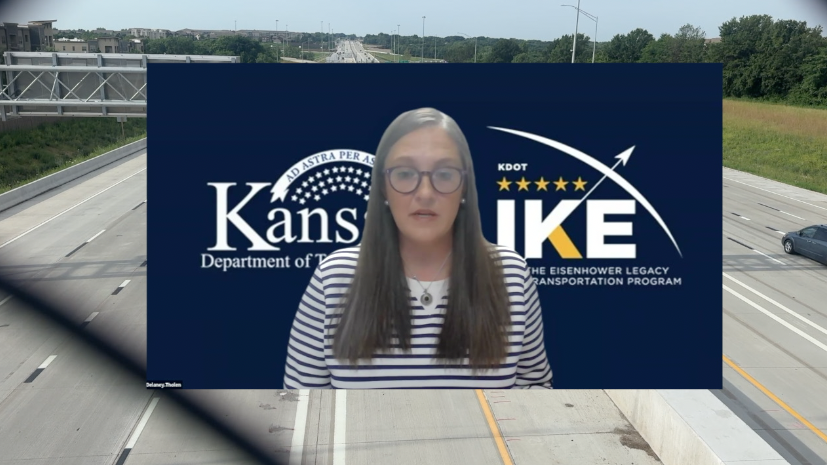
“As construction has been wrapping up and the express lanes opened in February, we anticipated that there would be a time period of folks getting used to the express lanes. And we also knew that because of some of the interchange improvements and other work that was part of the 69Express project that congestion would be relieved on its own without people having to choose to use those lanes,” said KDOT spokesperson Delaney Tholen. “As we look down the road into the future, we see that there will be more people living in the area, more people traveling through the corridor, and we expect that more people will be choosing on a daily basis to utilize the express lanes.”
The 69Express lanes stretch from 103rd Street to 151st Street. Toll prices vary depending on the direction of travel, time of day, traffic congestion and whether drivers are paying with KTAG.
According to KDOT, the lanes generated more than $43,000 in revenue in March. Figures for April have not yet been released.
Daniela Leon 
“Funding for this project came from state, local and federal sources,” Tholen said. “The city of Overland Park also committed money to the project, and that money will be repaid through revenue collected from the express lane tolls.”
KDOT has not yet calculated exactly how much time drivers are saving by using the lanes.
A reminder: express toll lanes follow the same speed limit as other lanes. In May, Overland Park police reported issuing 42 warnings and 20 citations for lane violations on U.S. 69.
This story was reported on-air by a journalist and has been converted to this platform with the assistance of AI. Our editorial team verifies all reporting on all platforms for fairness and accuracy.
—


WICHITA, Kan. (KSNW) — A day after the Kansas Department of Health and Environment issued a public health advisory for blue-green algae in Kansas lakes, a fisherman found hundreds of dead fish in Clearwater’s Chisholm Ridge ponds.
He said what he found surprised him.
“I was kind of in shock,” Ryder Frickey said. “It started out by I just saw one, and I looked more down the bank, and I just saw hundreds of them. Didn’t really know what to say or do.”
According to the KDHE, blooms of blue-green algae can impact how much oxygen is in the water, and low oxygen can result in fish mortality.
Walter Dodds, a professor of biology at Kansas State, said warm temperatures also help blue-green algae grow and spread.
“So, it’s just kind of a one-two whammy of making the algae grow more, but there’s less oxygen in the water,” Dodds said.
This is not uncommon. Dodds said several lakes in Kansas have routine blooms.
Although the cause of the spread is unclear, Dodds speculates that fertilizer runoff could be a factor, which helps algae grow.
“We did get those spring rains, pretty hard spring rains,” Dodds said. “And so, it’s possible that people fertilized and then just shot it all in there and just dumped a whole bunch of fertilizer into the system.”
Clearwater is cleaning up the fish in both ponds on Tuesday, but, for now, there is not much to do other than let the algae take its course and wait a couple of weeks.
For more Kansas news, click here. Keep up with the latest breaking news by downloading our mobile app and signing up for our news email alerts. Sign up for our Storm Track 3 Weather app by clicking here. To watch our shows live on our website, click here.
-

 New Jersey1 minute ago
New Jersey Food Council kicks off nationwide search for new CEO
-

 North Carolina4 minutes ago
4 charged after massive party in Alamance County ends with gunfire, stabbing, fights
-

 New Mexico4 minutes ago
The Battle of Socorro, New Mexico and the Uprising Against AI Data Centers
-

 North Dakota16 minutes ago
North Dakota election results: Latest on US House primary race
-

 Ohio19 minutes ago
$150,000 funding to be voted on for the Lisbon pool
-

 Oklahoma31 minutes ago
Oklahoma primary election guide for Bartians
-

 Oregon34 minutes ago
‘Changed my life’: Portland man warns of Facebook Marketplace dangers after robbery leaves him injured
-
 South-Carolina39 minutes ago
Evette and Wilson advance to runoff for South Carolina governor while Graham clinches nomination

