Kansas
Saving a neighborhood park in this Kansas town was a necessary lesson in community — and democracy • Kansas Reflector


It would be easy to overlook Quaker Park.
Located on the corner of First and Sylvan in Emporia, it’s less than an acre in size. It has trees and grass and a ball court and a weathered basketball goal, just what you’d expect of a neighborhood park in a working-class part of town. It’s a nice place to shoot hoops or play catch, but it doesn’t seem special. It’s not the oldest park in town. Others are bigger and more beautiful and have better amenities, including a zoo and several disc golf courses.
So it was no wonder that earlier this year Emporia added the park to its surplus property list, a sort of municipal equivalent of gathering up items for a garage sale. Who would really miss Quaker Park? The city could rid itself of the burden of maintenance and provide land for a modest housing development.
Then something surprising happened.
Residents fought back.
I am reminded of the petition drive to save Quaker Park because of recent news from Wichita that the city is considering selling some of its parks to make up a projected $3.6 million budget shortfall by 2026. At a public hearing earlier this month, Wichita Mayor Lily Wu said she wasn’t advocating to eliminate some of the city’s 146 parks, but that all options were on the table.
The future and function of municipal parks is something that cities of all sizes have long debated. Parks are both an expression, and a metaphor, for democracy; expression because they are policy made concrete-and-grass, and metaphor because they represent a community’s priorities, no matter the lofty marketing language you might find on a city’s website. If you want a glimpse of the soul of a community, look at its parks.
Although it would be reasonable to think there would be a metric for how many acres of parks a city should have given a certain population, that isn’t the case. While just about every other indicator does scale with population — road networks and crime rates, for example — it doesn’t work that way for parks and other green spaces.
“There’s no neat relationship between city population and parks per capita, or tree cover or even space that’s simply unpaved,” Emily Badger wrote in a 2013 Bloomberg article, citing the nonprofit Trust for Public Land’s study of parks in America’s 40 biggest cities.
We’ll return to an updated version of the Trust for Public Land study later, but first — of course! — a little history.
The first city park in America was Boston Common, founded in 1634 and initially used for cattle grazing, militia drills and public hangings. By the Civil War, it had become a place for non-lethal civic events and for free speech.
While the rich have always had private green spaces, the concept of a public park didn’t come along until the mid-1800s, with the rise of industrialization and the need for the tired and poor to, well, breathe free. The visionary who gave us municipal parks in the form we’d recognize was Frederick Law Olmsted. Known today as one of the designers of Central Park, Olmsted was more than a landscape architect. What he did best was travel and think, sometimes committing a little journalism on the way, and in 1850 he went on a six-month walking tour of England that would forever shape his — and our — way of thinking about public spaces. There, he visited Birkinhead Park, a “people’s garden” that was as open (in theory, at least) to the poorest British peasant as it was to Queen Victoria.
In parks, Olmsted imagined democracy in action.
Public spaces brought citizens together “with a common purpose,” Olmsted wrote, “not at all intellectual, competitive with none, each individual adding by his mere presence to the pleasure of all others, all helping to the great happiness of each.”
Central Park was opened to the public in 1858 and has gone through cycles of decline and restoration since. Like other American parks that would come later, it has reflected the sensibilities and sometimes the passions of its community, from the Victorian dinosaur craze to the massively attended free concert by Simon and Garfunkel in 1981.
Out here in the hinterland, our parks are heavy on history. You can scarcely visit any older city park here in Kansas that doesn’t have a monument to the Civil War or some later conflict. In Emporia, I like to walk Peter Pan Park, a 52-acre space that for about 40 years had monkeys on display in a WPA-built stone house in the middle of a lake. Most people around here know about monkey island, but the park still has some surprises. My route through the park takes me through a wooded area where stands a lonely, pylon-shaped monument to the Spanish American War.
While many parks started as memorials — and originally had the look and feel of cemeteries — in later decades the emphasis has been on recreation, from ball fields to splash pads to pickleball courts. This reflects conventional municipal wisdom that parks should be useful in some way, that public spaces should offer utility in addition to, or perhaps instead of, reflection.
But public parks offer more benefits than just playing or thinking.
In addition to being essential for our health, according to the Trust for Public Land, access to green spaces conserves nature, fights climate change, reduces crime, and strengthens communities. The trust’s original ranking of the nation’s 40 largest cities has expanded and offers insight into how equitable communities are, based on what percentage of its residents are within a 10-minute walk of a park.
Called ParkScore, the project has now expanded to the 100 largest cities and many smaller ones, and on its website you can look up metrics for just about any urban area. ParkScore uses five metrics: acreage, access, investment, amenities, and equity. Washington, D.C., is ranked the best among America’s large cities.
Wichita is ranked 66. It scores below average on acreage, access and investment, and about average in amenities and equity. Only 4% of Wichita’s land is used for parks and recreation, compared with a national median of 15%.
For acreage, Emporia fares even worse.
Only 3% of the land is used for parks and recreation. Emporia is above average for access, however, because 74% of its residents are within a 10-minute walk of a park.
Hahrie Han, a political science professor at Johns Hopkins, was quoted in a recent Trust for Public Land study that over the past 50 years, American society has seen a “withering” of common spaces for people to gather. But, she said, that trend can be combatted by investing in parks and other green spaces.
“The audacious, beautiful, and exciting promise at the heart of democracy is the idea that putting people into community with each other creates opportunities to learn the capacities, skills, and motivations needed to forge a common life together,” Han said.
Sound like wishful thinking?
It sounded like it to me at first. Then I remembered the petition drive to save Quaker Park.
In March, the Emporia City Commission voted 3-1 to designate the park as surplus property and authorize its sale. The plan called for three houses to be built on the property, two by private developers and one by the local Habitat for Humanity. Some saw it as a step toward providing housing for the community, but others questioned whether the city should be shedding a park in a part of the city that didn’t have many to being with.
The park was acquired by the city in 1952 from the Conservative Friends of Galena. It was an empty lot then and had been for years. An original Quaker meeting house had been built on the site in 1881, but as the number of Quakers in Emporia dwindled, the building had been sold to another denomination and moved.
The grassroots effort to save the park had to be done in a hurry. The goal was to gather, within a 30-day window, the required 462 signatures on a petition to halt the sale. The signatures had to be from registered voters and the number was equal to 10% of those who had voted in the previous city election.
The organizers held a barbecue, talked to reporters and community members, and established a website. In the end, they came up with more than 800 signatures. The city commission rescinded its previous action to declare Quaker Park surplus and for sale.
“We talked to so many people in this process and the vast majority of people we met were eager to sign the petition,” the five organizers said on the website. “Those few who didn’t were always respectful and we didn’t have a single contentious interaction. … Parks are a precious asset in our town, and we want to preserve them — even when they aren’t necessarily ‘our’ neighborhood park.”
There are at least a couple of lessons here for Wu, the Wichita mayor.
The first is that people will fight for their city parks.
The second is that they will do so in ways that are confoundingly civil.
I use the word confounding because in this day and age just about any political activity is likely to get you into a shouting match with your neighbor over the backyard fence. But not this. Not a single “contentious interaction.” That has to be some kind of civic miracle in 2024.
Because Wu is a registered Libertarian, I’m guessing she wouldn’t be particularly troubled by the transfer of public land to private ownership. Libertarians are notorious in their belief that free markets and private interests can better manage assets than can government. But Wu should take notice of a community coming together to save a city park in a neglected neighborhood.
So, let’s hear it for “Save Quaker Park!”
It may be just the lesson we need in how to save democracy. Or at least it might make opportunistic politicians think twice before sizing up the office furniture for a municipal garage sale.
Max McCoy is an award-winning author and journalist. Through its opinion section, the Kansas Reflector works to amplify the voices of people who are affected by public policies or excluded from public debate. Find information, including how to submit your own commentary, here.



KANSAS CITY, Mo. (KCTV) – A house fire broke out early Tuesday morning in the 3300 block of Bales Avenue in Kansas City.
Firefighters arrived to find heavy smoke and flames coming from a two-story home and two people stranded on the roof. Both were brought safely to the ground.
The fire was under control within about 18 minutes after crews arrived. No injuries were reported.

The cause of the fire is under investigation.
Copyright 2026 KCTV. All rights reserved.

KSHB 41 reporter Rachel Henderson covers neighborhoods in Wyandotte and Leavenworth counties. Share your story idea with Rachel.
—
I first told you two weeks ago about the Love Lot at 3306 Main St., in Kansas City, Missouri.
Some of the food trucks there are still capitalizing on World Cup traffic as others move in to capture new business for their trucks.
Tameisha Martin, the owner of Love Is Key, has been welcoming vendors to the space.
Al Miller/KSHB 41
“We’re calling it the Love Lot,” Martin said on June 10. “Come show these different food trucks some love.”
With month-to-month agreements in place, there are already some new trucks on the lot.
One of them is Pancake Dreams, a brand founded in Kansas City, Kansas, by Julia Abuoun and her 10-year-old daughter, Amirah.
The two created the concept about two years ago, and Monday was their first day at the Love Lot.
Abuoun spent more than 20 years in the restaurant industry before launching the food truck.
Rachel Henderson/KSHB 41
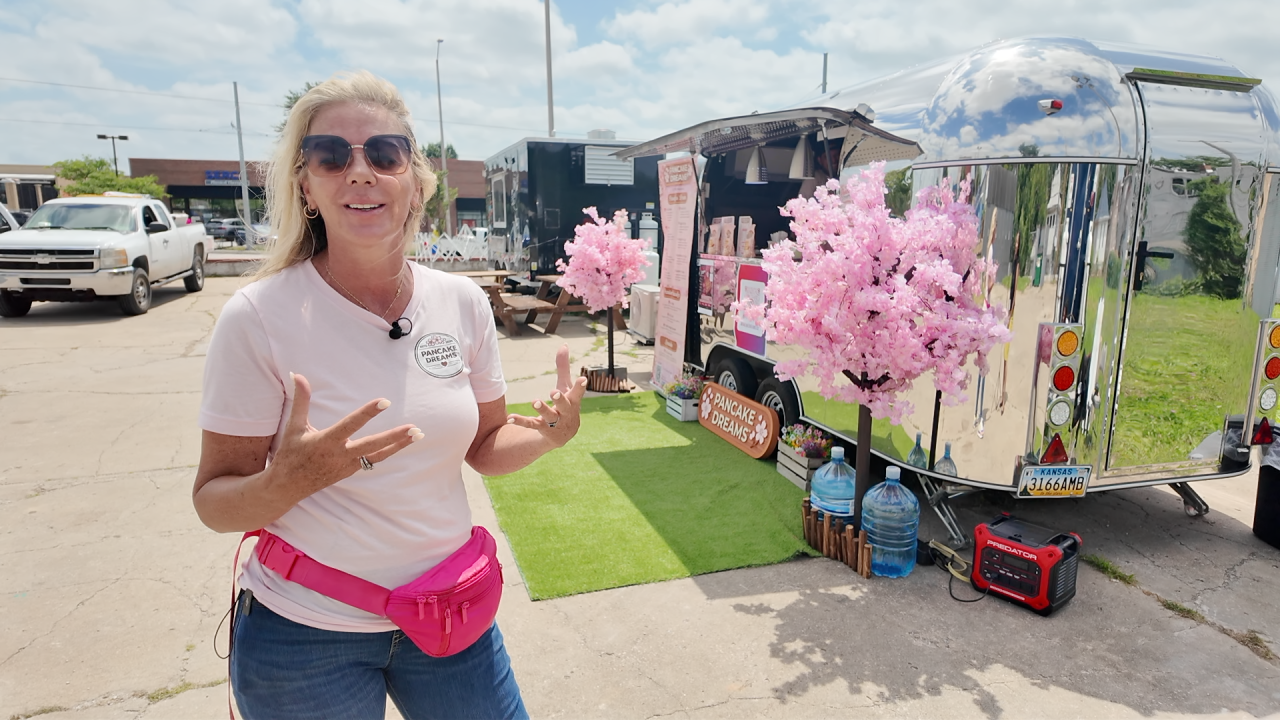
“Pancake Dreams was created based on love and family,” Abuoun said.
She said the goal was to stand out from traditional breakfast spots.
“We wanted to create something that was different than the mundane, regular breakfast restaurants, so that’s where we came up with Pancake Dreams,” Abuoun said.
The FIFA World Cup 26 in Kansas City made the Love Lot feel like the right fit.
“I was like ‘that’s the perfect fit for Pancake Dreams’ because you know the Love Lot, Pancake Dreams with the World Cup in town everybody with all the excitement going on, and we’re right here by the trolley stop, so hopefully that will get us some exposure,” Abuoun said.
Abuoun said the timing was intentional.
“Kansas City’s got a lot of excitement going on right now, so we wanted to get in on that excitement out there and get our name out there while we were up in with the World Cup and everything that’s going on,” Abuoun said.
The transition from a traditional restaurant building to a food truck has come with adjustments, especially the extreme heat their opening week.
“I’m used to being in a restaurant that has four walls and an air conditioner, so this is something new that we’re learning, but I mean hey, it is what it is and if you love what you do, then it doesn’t really affect you,” Abuoun said.
In addition to the Love Lot, Abuoun says Pancake Dreams is rolling out pancake batter this week at World Fresh Market at West 103rd Street and Metcalf Avenue.
The Abuouns hope to open a brick-and-mortar location in 2027.
Amirah handled the truck’s design, which features cherry blossoms.

Rachel Henderson/KSHB 41
She said one of the brand’s messages reflects the spirit behind it.
“One of these messages is, ‘A Dream in Every Bite,”’ Amirah said.
For Amirah, the venture means more than just business.
“Beauty, and it means memories, and these will always be memories to me and my mom,” Amirah said.
She also shared what she hopes visitors take away from the experience.
“I’m hoping that they can really see that we worked hard on this and that they enjoy,” Amirah said.
Pancake Dreams is not the only truck cooking up dreams at the Love Lot.
Jims Desauguste, the founder of Creole KC, is also set up on the lot.
It is the truck’s second week there.
Desauguste, who is from Haiti, said he asked about a spot after driving by the lot and seeing the trucks there.
Rachel Henderson/KSHB 41

“I’ve been dreaming about it, and then the opportunity came, and we just make that happen,” Desauguste said. “Cooking is my passion. I love cooking, I love doing it and just giving back to the community the Haiti cuisine flavor.”
I met Desauguste a week ago at his restaurant, Black Garlic, where he shared his disappointment over the lack of World Cup traffic there.
That prompted him to remove the 18% gratuity he charged during the World Cup.
“It did not happen for us very well,” Desauguste said on Tuesday.
His new truck has since seen its fair share of traffic, especially on weekends.
Creole KC is open Monday through Thursday from 11 a.m. to 10 p.m., and Friday and Saturday until 2 a.m. — or later, depending on the crowd.
Desauguste said he is also looking forward to more events, including the Reggae Fest.
While the World Cup brought energy to the lot, Desauguste said his long-term focus is closer to home.
“Definitely, we’re going to get some more business after the World Cup,” Desauguste said. “We’re not banking on that, no. But I’m banking on local Kansas Citians.”
His truck’s bright exterior is hard to miss.
“Right on the Main Street, you can see the bright-colored truck,” Desauguste said.
Martin says the list of trucks may change in July with the month-to-month agreements, but that the list should be updated by July at loveiskeykc.com.
This story was reported on-air by a journalist and has been converted to this platform with the assistance of AI. Our editorial team verifies all reporting on all platforms for fairness and accuracy.
—


KANSAS CITY, Kan. (KATV) — A few members of Little Rock Police’s Mounted Patrol Unit had a field trip this past month, traveling to Kansas City to assist with public safety during FIFA World Cup matches.
In a statement, police said these officers “provided high-visibility patrol, supported crowd management, and engaged with fans from around the world.”
They posted these pictures to their Facebook page:
Little Rock mounted police assist with public safety at Kansas City World Cup matches (Photo LRPD via Facebook)
Little Rock mounted police assist with public safety at Kansas City World Cup matches (Photo LRPD via Facebook)
Little Rock mounted police assist with public safety at Kansas City World Cup matches (Photo LRPD via Facebook)
“We are proud of our Mounted Patrol Unit for representing the Little Rock Police Department with professionalism, dedication, and excellence while helping provide a safe and welcoming environment for everyone attending this world-class event,” the Department said.
-

 Maine2 minutes ago
Cooling centers to open in Maine as heat, air quality advisories take effect Wednesday
-

 Maryland5 minutes ago
Teen allegedly hits off-duty officer, crashes into Maryland home
-

 Michigan10 minutes ago
Michigan mayor’s 7-year-old nephew found dead in Menands, New York, authorities say
-

 Massachusetts17 minutes ago
Missing Massachusetts cat miraculously found underneath owners’ new bathtub — after disappearing for 30 hours
-

 Minnesota20 minutes ago
St. Paul resident’s special connection to the Declaration of Independence
-

 Mississippi25 minutes ago
Amy Carruth named director of Mississippi State Hospital – SuperTalk Mississippi
-

 Missouri32 minutes ago
Gov. Kehoe signs Missouri FY27 budget totaling $50.7B. What you need to know
-

 Montana35 minutes ago
New health care system director appointed at Montana VA

