Midwest
Northern Lights may be seen across some portions of US this week after 'strong solar activity'

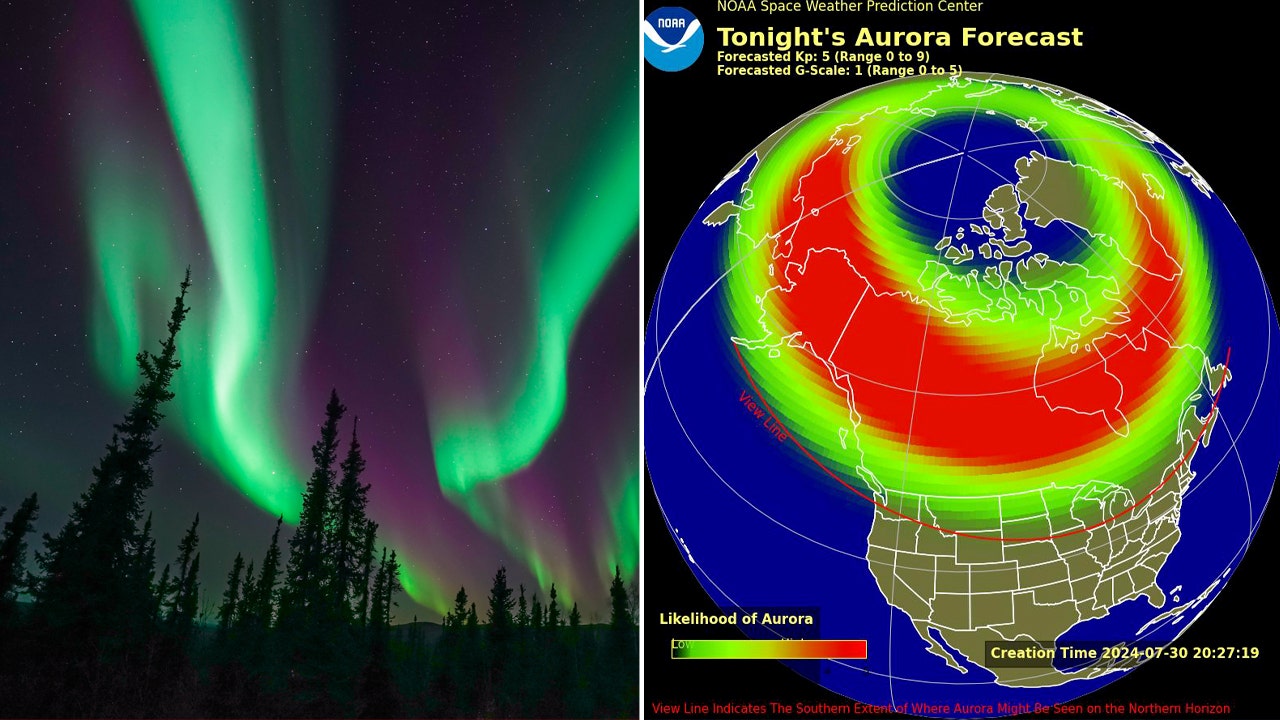
After a series of recent solar storms, residents of a number of northern U.S. states may be able to see the stunning Northern Lights this week.
The National Oceanic Atmospheric Association’s (NOAA) Storm Weather Prediction Center (SWPC) announced that several coronal mass ejections (CMEs) were released by the Sun and are on a path toward Earth.
“Solar activity was elevated through the weekend and various events, including solar flares and filament eruptions, were associated with CMEs,” the NOAA’s publication stated.
NORTHERN LIGHTS: HERE ARE THE BEST TIPS TO HELP YOU SPOT THE STUNNING DISPLAY IN THE US AND ABROAD
“Some of these CMEs were determined to have Earth-directed components and arrival could begin” as of yesterday, the 29th, “due to an event early on July 27.”
A series of other CMEs also occurred, pointing to an arrival on June 30 that will continue into the 31st, due to the amount of time it takes for the ejections to progress over and surpass the Earth’s magnetic field.
The National Oceanic Atmospheric Association’s Storm Weather Prediction Center announced that the dancing lights of the Aurora Borealis may be visible in several northern states across the U.S. this week. (NOAA SWPC)
The NOAA reported that additional CME arrivals are still a possibility.
“Additional CMEs continue to erupt from the Sun due to the number of active regions and the associated complex sunspot groups, and additional CME arrivals are possible,” the Weather Prediction Center reported.
RARE SOLAR STORM WOWS STARGAZERS ACROSS AMERICA: ‘SO AWESOME!’
A Geomagnetic Storm Watch has been issued and will remain in effect until Wednesday, the center said.
Earlier this summer, the dancing lights of the Aurora Borealis were seen across the U.S. and even in some of the southern states, after the strongest geomagnetic storm in 20 years took place.
“While strong X-class solar flares can cause high-frequency radio blackouts, the charged particles of a CME create the beautiful dancing lights known as Aurora Borealis or the Northern Lights,” Fox Weather reported.
NASA satellites observed the CME’s blast away from the Sun and on a path toward the Earth’s magnetic field.
For more Lifestyle articles, visit www.foxnews.com/lifestyle.
The SWPC’s website is monitoring the CMEs and offering a forecast for this evening and tomorrow — mapping out the possible sightline of the Northern Lights and which U.S. states may be able to enjoy the view.
The NOAA’s SWPC website is monitoring the Northern Lights and mapping out which states may get a view of the Aurora Borealis. (NOAA SWPC)
“Possible G2 (moderate) magnetic storm levels could happen early Tuesday morning between 5 a.m. and 8 a.m. ET,” Fox Weather detailed ahead of July 30.
“The most intense solar storms with G3 (strong) levels will happen while most of the eastern U.S. is in daylight between 8 a.m. and 12 p.m. ET.”
The other reported CME arrivals may lead to even more possible sightings throughout the week — while G3 sightings mean people in the upper U.S. states and some of the Midwest may get a glimpse of the lights.
The weather also plays a large role in the visibility of Aurora Borealis.
The great dancing lights are coming out again this year and if you live up north, you may get a chance to take in the stunning sights. (iStock; NOAA SWPC)
Fox Weather reported that most of Canada, and most northern states across the U.S., will have fair weather conditions in order to take in the lights.
“For much of Canada and the northern tier of the U.S., weather conditions look pretty good Monday night and early Tuesday morning, with minimal cloud cover across Minneapolis in Minnesota, Casper in Wyoming and Buffalo in New York.”
Overnight between Tuesday and Wednesday, as Fox 5 New York noted, “Under strong geomagnetic storm conditions, the Northern Lights can be visible in places such as Chicago, Casper, Wyoming; and Iowa … The cloud cover in the Upper Midwest and Northeast will create fair to poor viewing conditions.”
Read the full article from Here

Detroit, MI
Power outage forces flaring at Marathon’s Detroit refinery; portion of Schaefer Road closed

Southwest Detroit – A power outage at Marathon’s Detroit refinery has led to operating conditions that made flaring necessary, the company said Sunday.
Flares are safety devices that allow for the safe combustion of excess gases under certain operating conditions, according to Marathon.
Refinery personnel are conducting off-site air monitoring, the company said.
As a precaution, a section of Schaefer Road from I-75 to Dix Road is closed. Local law enforcement is managing the closure.
Marathon said the company’s top priorities are the safety of employees, responders and the community, as well as limiting any environmental impact.
Detroit Mayor Mary Sheffield said her administration is monitoring the situation closely.
“EGLE (the Michigan Department of Environment, Great Lakes, and Energy) and refinery personnel are conducting air quality monitoring both on-site and in the surrounding neighborhoods. At this time, monitoring has not detected gas readings of concern,” the statement said.
Local 4 reached out to EGLE and a spokesperson said the agency is sending all media inquiries to the city of Detroit.
Copyright 2026 by WDIV ClickOnDetroit – All rights reserved.


MILWAUKEE – Two Milwaukee female officers were injured on duty over the weekend. Police said one was hit by a car, while the other was hurt by fireworks.
Video shared on social media shows a blast blowing a Milwaukee police officer to the ground.
“The next thing you know, police coming from everywhere,” said Tracey Dent, a community activist.
Witnesses told FOX6 News it happened around midnight Sunday. They said someone was setting off and throwing fireworks in a crowded parking lot near Brady Street and Cambridge Avenue.
“It’s just a small minority of people who want to mess it up for everybody and think it’s funny, and it’s not funny,” Dent said.
But this was not the only overnight incident where an officer was hurt on duty. Milwaukee Police Chief Jeffrey Norman said a suspect hit a female officer with a car, which led to an officer-involved shooting around 2:15 a.m. near Knapp and Water streets.
“Uniformed Milwaukee police officers patrolling our downtown entertainment district heard multiple gunshots,” said Norman.
Norman said officers responding on foot saw an Audi leaving the area. He said the 18-year-old male suspect hit a 25-year-old female officer with his vehicle while fleeing.
“Officers, including the injured officer, discharged their weapons at the vehicle,” Chief Norman said.
The officer was taken to the hospital with nonfatal injuries. The suspect was found and also taken to the hospital with nonfatal injuries. He was later arrested.
Police found the unoccupied suspect’s vehicle with a gun inside on Fond du Lac Avenue near Walnut Street.
Police told FOX6 News all the officers involved in this morning’s shooting will be placed on administrative duty which is standard protocol.
Additional officers involved in this incident are a 28-year-old male with over 7 years of service and a 27-year-old male with over 8 years of service. The injured officer has served for less than year.
Chief Norman said two other people arrived at hospitals with gunshot wounds, though it is unclear if they are connected to the officer-involved shooting.
FOX6 News is still waiting on more information from the Brady Street fireworks incident.
The Source: Information in this story was gathered from Tracey Dent, Milwaukee Police Chief Jeffrey Norman, a police scanner broadcast, Facebook video and the Milwaukee Police Department.

Crews located him submerged in the basin and brought him to shore, according to the department.
Fire personnel immediately began lifesaving measures, including CPR, and transported the teen via a small utility vehicle to a staged ambulance in the parking area, the release said.
-

 New York32 minutes ago
10-Minute Challenge: The Ceiling at Grand Central
-

 Los Angeles, Ca39 minutes ago
1 killed, multiple people injured in Tarzana 4-car crash
-

 Detroit, MI57 minutes ago
Power outage forces flaring at Marathon’s Detroit refinery; portion of Schaefer Road closed
-

 San Francisco, CA1 hour ago
San Francisco’s fireworks show ends in hours of gridlock involving Waymo cars
-

 Dallas, TX1 hour ago
FIFA Fan Fest in Dallas paused due to lighting in the area Sunday evening
-

 Miami, FL1 hour ago
Venezuelan Independence Day: Aid efforts continue after devastating earthquake
-

 Boston, MA1 hour ago
Timeline: Looking back on Jaylen Brown’s Celtics career – The Boston Globe
-

 Denver, CO1 hour ago
Denver police arrest suspect in fatal July 4 triple stabbing

