West
Colorado deputies remove 600-pound moose from resident's yard

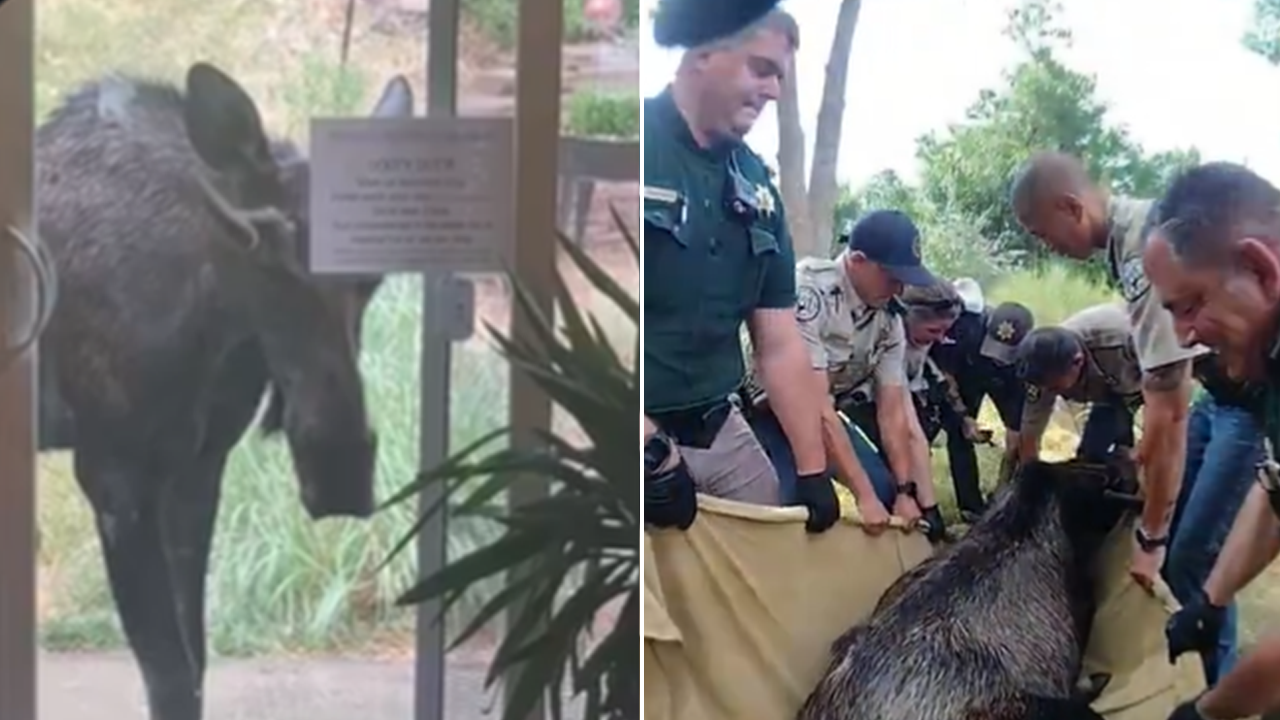
A large moose is back where it belongs after wandering into the backyard of a Colorado home.
Officials with the Jefferson County Sheriff’s Office shared the successful rescue of the “meandering moose” on X along with photos and videos.
“How do you move a 600lb #moose? We found out because it took 8 people to move this one. Mr. Moose was peering in windows & taking a break in a yard,” the post read.
FIREFIGHTERS CARRY 160-POUND DOG DOWN OREGON MOUNTAIN AFTER PUP IS INJURED ON TRAIL
Moose are the largest member of the deer family.
Moose are the largest member of the deer family, standing up to 7 feet tall, according to the Maine Department of Inland Fisheries and Wildlife. The moose that was found wandering in Jefferson County, Colorado, is pictured here. (Jefferson County Sheriff’s Office)
The animal could stand up to 7 feet tall, according to the Maine Department of Inland Fisheries and Wildlife.
The eight officers, including animal control officials, are seen in the video lifting the moose on a large tarp before slowly carrying the animal into the back of a trailer.
Adult male moose weigh between 1,200 to 1,600 pounds while adult females weigh 800 to 1,300 pounds, according to the Alaska Department of Fish and Game.
For more Lifestyle articles, visit www.foxnews/lifestyle.
Only the males, known as “bulls,” have antlers.
Adult males weigh between 1,200 to 1,600 pounds while adult females weigh 800 to 1,300 pounds, according to the Alaska Department of Fish and Game. (Jefferson County Sheriff’s Office)
This “meandering moose” was said to be transported back to its natural habitat.
Fox News Digital reached out to the Jefferson County Sheriff’s Office and the Colorado Parks and Wildlife for additional comment.
This “meandering moose” was transported back to its natural habitat, according to Jefferson County Sheriff’s Office officials. (Jefferson County Sheriff’s Office)
This isn’t the first moose rescue that has occurred in the U.S. in recent months.
In June, a baby moose in Alaska was saved from what police described as its “sure demise” after it fell into a lake and became wedged between a floatplane and a dock.
Though one of the calf’s legs was stuck across the top of the plane’s float, the rescuers were still able to pull the moose safely from the water.
An officer helped the calf stand up on the boardwalk and watched it reunite with its mother.
Fox News Digital’s Elizabeth Pritchett and The Associated Press contributed to this report.
Read the full article from Here


JUNEAU, Alaska (KTUU) – The Supreme Court of Alaska will be taking up the case of the State of Alaska, Division of Elections v. Daniel J. Sullivan, Jr.
The oral arguments will be held Monday at 10 a.m. via Zoom, according to an order and opening notice.
The document also specifies that a decision is expected to be made before noon on Tuesday.
According to documents from the Division of Elections, the state must start printing ballots at noon on the same day.
This comes after an Anchorage Superior Court Judge ordered Dan J. Sullivan on to the ballot Friday.
See a spelling or grammar error? Report it to web@ktuu.com
Copyright 2026 KTUU. All rights reserved.
California
CA state senator physically, verbally harassed at pride parade for Israel stance | The Jerusalem Post

California State Senator Scott Wiener was harassed for his stance on Gaza during the San Francisco Trans March on Friday, to the point where it was no longer safe for him to remain, Wiener said.
A group of people were so “physically and verbally aggressive that it was impossible for me to safely remain in the park,” Wiener stated, adding that this was the first time he did not participate in the march.
Wiener was surrounded by people who made statements about his “Israeli handlers, among many other inaccurate, extreme, and vile statements,” Wiener said.
“We f***ing hate you. You stopped being queer the moment you started supporting Israel,” one person yelled in a video later shared on social media.
Wiener stated that while he has no objection to anyone disagreeing, opposing, or protesting him, the “harassment, including cornering me, touching me, or trying to physically bully me out of a public event, that crosses a line.”
“In San Francisco, we’re better than that,” he added.
Mayor Daniel Lurie made a statement on X/Twitter condemning the harassment, calling the language used “targeted, hateful, and antisemitic.”
In San Francisco, we welcome disagreement and respectful dialogue around issues many of us feel passionately about – but we cannot allow harassment and threats of violence,” Lurie wrote.
The California State Senate Democratic Caucus also released a statement on X, condemning the hate Wiener received.
“The harassment and violence shown from yesterday’s march in San Francisco towards Senator Scott Wiener is unacceptable and must be called out,” the statement read.
The caucus also pointed to Wiener’s work on legislation “advancing the rights and protections for Transgender, Gender Expansive and Intersex people.”
“The CA Senate Democratic Caucus and CA LGBTQ Caucus jointly denounce the verbal harassment and attacks he experienced,” the statement said.

PHOENIX — 89-year-old Robert Young is battling Arizona State University in court over the Louis Emerson home, one of the oldest remaining houses in the Phoenix Churchill area.
At the corner of 4th and Pierce streets sits a home that pre-dates Arizona statehood, and now sits at the center of a legal battle between its owner and Arizona State University.
ASU wants the land where the Louis Emerson home stands. The university is planning a medical and technology school nearby and says it wants to exercise its right of possession over the property.
But Young, who has owned the home since 1975, is not backing down.
“It’s not gonna happen. That’s what I thought then and that’s what I think today. I will not let it happen,” Young said.
Marshall Shore, known as the Hip Historian, says the home is one of the oldest remaining houses in the Phoenix Churchill area, built before Arizona was even a state.
“This house was here before statehood, before Arizona even thought of becoming a state; this house was here, and so it deserves to tell that story and continue on,” Shore said.
Shore says the home’s history is rooted in everyday life.
“It was an everyday man’s house. He was a butcher,” Shore said.
Young says he and his wife lived in the home for 8 years before renting it out. He calls it an architectural and historic treasure that is irreplaceable. He says the legal battle is taking a toll on both of them.
“It’s stressful. You don’t know from day to day if you’re gonna find the house on the corner,” Young said.
Young says the university offered him between $290,000 and nearly $1 million for the property. Maricopa County Superior Court records show the Arizona Board of Regents sued Young for the home earlier this month.
According to the Arizona Republic, ASU gave a written statement explaining that they made several offers to Young on his home. Their final offer was based on an appraisal, and it was not accepted.
Shore says the home does not need to come down and has a vision for how it could coexist with the planned medical school.
“I mean there’s nothing more sustainable than keeping a house where it is. Create a pocket park around it, so that way people can come and enjoy that little pocket park and make it really a gem in the community,” Shore said.
Shore says an online petition in support of preserving the home has gathered more than 10,000 signatures.
Young wants ASU and the public to understand what is truly at stake.
“It’s the way it’s placed on the corner, and it’s the fact that this corner itself is historic,” Young said.
Young is expected to appear in court on Sept. 4 to explain why the home should not be torn down.
Want more news in your community? Add ABC15 as a preferred source on Google below:

-

 Indianapolis, IN59 seconds ago
Where to find cooling stations in central Indiana
-

 Pittsburg, PA6 minutes ago
Pittsburgh horror film history honored with new award
-

 Augusta, GA13 minutes ago
Augusta Fire Department holds hurricane season preparedness event
-

 Washington, D.C16 minutes ago
Trump targets Washington mayoral nominee ahead of DC election
-

 Cleveland, OH21 minutes ago
E. 9th Street exit to close Monday, affecting downtown Cleveland commuters through late October
-

 Austin, TX28 minutes ago
Austin-area schools compete at Texas 7-on-7 tournament
-

 Alabama30 minutes ago
Authorities searching for missing boater on Logan Martin Lake
-

 Alaska36 minutes ago
Alaska Supreme Court to take up case on Dan J. Sullivan, decision expected by Tuesday

