Lifestyle
“Who is buying this?!” Has Erewhon’s ‘raw animal smoothie’ taken L.A. health food too far?

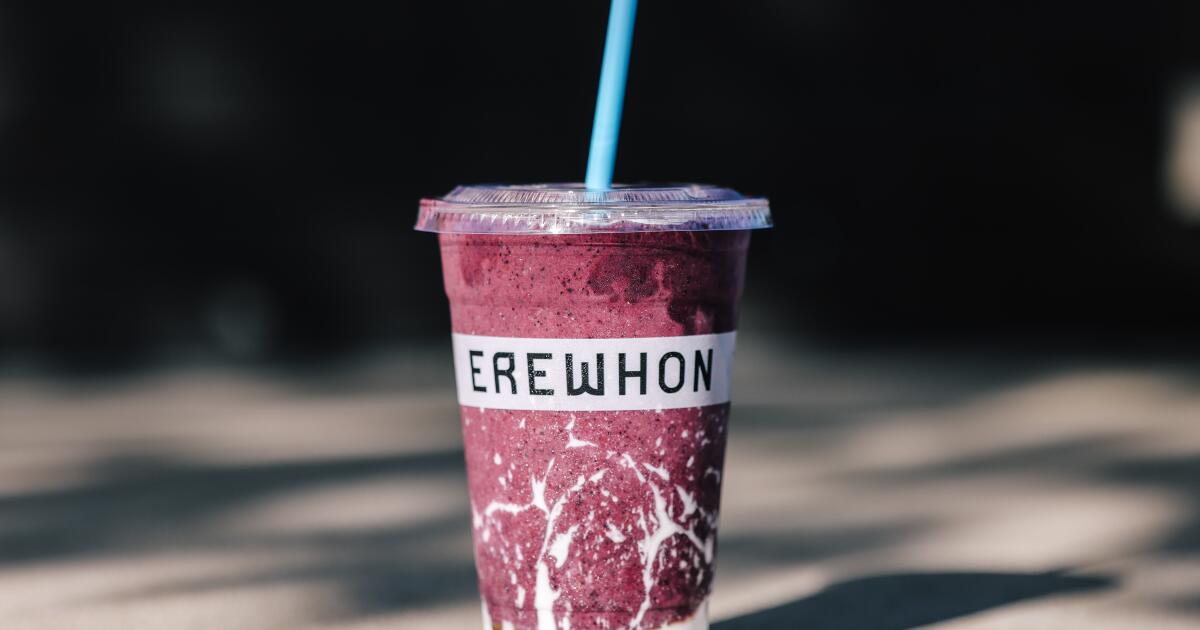
I was at a cocktail party a few months ago in Studio City when, suddenly, one conversation rose above the din of guest’s chatter, and quickly arrived at a consensus: Erewhon had gone too far.
“Animal organs, ground up!” one guest squealed, crinkling his nose.
“Oh my god, yes,” his friend agreed. “Erewhon’s smoothies are Out. Of. Control!”
They were referring to the luxury grocery store’s “Raw Animal Smoothie,” a concoction of Kefir (fermented milk), beef organs, so-called Immunomilk (freeze-dried cow’s colostrum, which is its initial breast milk after giving birth), raw honey, blueberries, bananas, lucuma fruit sweetener, coconut cream, sea salt and maple syrup.
The beverage is one of many celebrity and influencer collaborations within Erewhon’s extended smoothie universe. This one credited to fitness influencer Dr. Paul Saladino, author of “The Carnivore Code,” who proselytizes the health benefits of eating animal organs. He says they aid with immunity, gut health, weight loss and bone strength, among other things. His Austin-based company, Heart & Soil, provides the beef organs and Immunomilk for Erewhon’s Raw Animal Smoothie. Erewhon’s website describes it as having a “creamy texture with a hint of sweetness and a touch of tartness.”
You may be thinking: Ew. And also: How? But, despite the smoothie’s official name — “Dr. Paul’s Raw Animal-Based Smoothie” — there’s one giant asterisk to this gambit. Erewhon says the mix of uncooked beef livers, hearts, pancreases, kidneys and spleens swirling through the coconut cream in the beverage should not be considered “raw.”
“They’re desiccated, or freeze-dried, to preserve the organs as a nutrient-dense powder,” a representative of the store said via email.
Erewhon’s Organic Tonic Bars, where their frothy smoothies are made fresh to order, have cultivated a posh scene unto themselves. Lithe, well-groomed customers in Gucci flip flops and leisurewear regularly crowd these areas at all times of the day in Erewhon’s 10 L.A. locations.
New smoothie partnerships, developed in conjunction with — and heavily promoted by — celebrities and social media stars are announced regularly. Others include Kendall Jenner’s $23 “Peaches and Cream Smoothie,” the most expensive on the menu, and a recently released “Sunscreen Smoothie,” a sea blue and cloudy swirl inspired by the sunscreen brand Vacation. “Hailey Bieber’s $19 Strawberry Glaze Skin Smoothie” is by far the store’s most popular since debuting in 2022 alongside Bieber’s skincare line, Rhode.
But the Raw Animal Smoothie, which debuted on the menu a year ago, might be the store’s biggest conversation-starter yet.
“Who is buying this?!” one shopper ranted on TikTok. “I just can’t — like, it makes me want to barf looking at the ingredients. If you are super-rich and you’re spending your money on this smoothie, if this is something you’re into, I need some explanations.”
There are scores of people online who’ve filmed their own taste-tests, plenty of them positive.
“You can feel the iron in this. It’s a little bit beefy,” a fan of the drink said in a TikTok post captioned “Worth it.”
The drink may be clickbait, but it also speaks to a growing lifestyle trend that espouses going back to basics. And by that, we mean the Neanderthal era. A step beyond trends like the Paleo (or caveman) diet, it includes eating raw meat; rising and sleeping with the rhythms of the sun; and “barefoot” walking or running in thin or no shoes (or sneakers with the bottom cut out).
A selection of smoothie’s including Dr. Pauls Raw Animal-Based Smoothie are seen at Erewhon in Culver City.
(Dania Maxwell/Los Angeles Times)
Erewhon’s Raw Animal Smoothie fits right into this. But at what cost? With an outbreak of H5N1 “bird flu” sweeping through dairy cows in the U.S., is it safe to ingest unpasteurized milk right now — or ever?
For the record:
10:05 a.m. July 19, 2024An earlier version of this article stated that four cases of “bird flu” have been detected in humans since March. Nine have been detected.
Only nine cases of “bird flu” have been detected in humans since March, so the current public health risk is low, the Centers for Disease Control and Prevention says. But it recommends avoiding unpasteurized dairy in general, as drinking raw milk “can lead to serious health risks, especially for certain vulnerable populations,” it states on its website.
The U.S. Food and Drug Administration adds that it’s unclear as to whether or not the H5N1 viruses can be transmitted through consuming raw colostrum from infected cows. But it advises against drinking unpasteurized milk ever, as it may harbor germs leading to serious health issues, such as Salmonella, E. coli and Listeria.
What about raw meat, freeze-dried or otherwise? No, says the United States Department of Agriculture.
“There are a lot of different trends now with people encouraging eating raw meat, but the reality is it’s still a really risky thing to do without knowing if there is bacteria causing food borne illnesses,” said USDA Food Safety Specialist, Meredith Carothers. “When you reduce the moisture — basically dry it out [by freeze-drying] — the bacteria might not be able to multiply and thrive, but it does not kill it.”
Erewhon stands behind the “nutrient dense” ingredients in its Raw Animal Smoothie, but makes one thing clear: “We are not a healthcare provider, and we do not make health claims about our products. If you are interested in exploring health benefits, we encourage you to explore the scientific literature on the smoothie’s ingredients,” the representative said.
Obviously, Erewhon’s gleaming produce aisles are a far cry from a doctor’s office. But the store’s comment lays plain an important distinction: Erewhon doesn’t take responsibility for your health, just for making you feel healthy.
With that in mind, I took my health into my own hands, and made a trip to the Silver Lake Erewhon.
The raw smoothie has been popular, cashier Ahly Guevara told me. She doesn’t drink it herself, but her 70-year-old grandmother, Maria, swears by it.
“She buys one every Saturday and Sunday,” Guevara said. “It makes her feel stronger.”

A customer checks out from an Erewhon store in Culver City.
(Dania Maxwell/Los Angeles Times)
If Maria could do it, so could I. At first sip, I gagged ever-so-slightly, visions of Looney Tunes farm animals dancing through my head. But it was a sweltering afternoon; and glistening beads of condensation dribbled down the outside of the plastic cup, which was topped with generous amounts of thick coconut cream drizzled with honey. It looked beyond refreshing.
When I was able to put the ingredients out of mind, it went down easily. The smoothie was off-the-charts yummy — rich and sweet and creamy, with notes of blueberry and banana and a lingering coconut base. Erewhon says it’s one of the store’s top-selling smoothies and is now a staple on the menu.
“This store, it’s like the Louis Vuitton of supermarkets.”
— Jordan Ben-Yehuda, Erewhon patron
As I sipped, I noticed three customers, with identical pink-hued smoothies (unmistakably Hailey Biebers) in hand, clustered together by the entrance. The 19-year-olds were visiting Los Angeles from Arkansas for the week. On the agenda: the Hollywood sign, the Hollywood Walk of Fame, the Santa Monica Pier and … Erewhon. They regularly ogle the luxury store’s jewel-toned smoothies on social media and wanted a sip of the aspirational lifestyle.
“You see them on TikTok — it makes you want to be part of it,” one of them, Natalie Vivar, said of Erewhon’s smoothies.
Parsons School of Design student Jordan Ben-Yehuda , 20, added that the beverages’ high prices match the luxurious vibe of the store.
“It feels exclusive being here, it makes you feel special,” she said, awaiting her drink. “This store, it’s like the Louis Vuitton of supermarkets.”
Even so, she wasn’t quite ready to try the Animal Smoothie.
“It doesn’t particularly appeal to me,” Ben-Yehuda said. “But if it’s marketed as healthy, and sold at a store like this, who am I to question it? It’s Erewhon.”

Lifestyle
Terry Tempest Williams on why women with big ideas get labeled ‘crazy’ : Wild Card with Rachel Martin
A note from Wild Card host Rachel Martin: I met Terry Tempest Williams about 25 years ago at a writer’s conference in Yosemite Valley. I was a young reporter who was there to do a story about how literature was addressing climate change and she made such a huge impression on me. I had never heard someone talk about the natural world the way Terry did and she had a spiritual depth I hadn’t encountered in my life at that point.
To this day, Terry’s writing always reorients me towards what is good, what is beautiful, and what is true. Her newest book is called “The Glorians.”

For its upcoming Los Angeles venue, experiential art firm Meow Wolf will focus on the art of storytelling, with a specific eye toward skewering our city’s moviemaking magic. To help bring that vision to life, Meow Wolf has entered into a creative partnership with Titmouse, one of L.A.’s most renowned independent animation houses.
The Hollywood-based studio behind popular series such as “Big Mouth” and “Star Trek: Lower Decks” will create animation that will be shown throughout the West L.A. venue, which is on target for a late 2026 opening at the Howard Hughes entertainment complex.
It’s a move that represents a shift for Santa Fe, N.M.-based Meow Wolf. Over the last decade-plus, the art collective has grown beyond its anything-goes, punk-meets-psychedelic roots into an organization with full-scale, maximalist installations in its hometown, Denver, Las Vegas, Houston and the Dallas suburbs. In the past, Meow Wolf kept most of its media in-house.
As part of its larger-than-life participatory art installations, Meow Wolf L.A. will feature a mix of live action and animation, the former filmed by Meow Wolf in its Santa Fe studio. Meow Wolf’s James Stephenson, a senior VP with the company and its creative director of emerging media, said the degree to which the L.A. exhibition will lean into various animation styles necessitated an outside partner. Titmouse’s work, in development by a number of directors with contrasting tones, will be shown on a variety of formats, ranging from cinema screens to full-room projections.
“I really believe in animation as an art form, and I know the Titmouse folks do too,” Stephenson says. “Animation is made by artists. It’s made by artists with their own hands. It’s something that is still very rooted in craft.”
Meow Wolf’s L.A. space is set in a former cinema complex, and will champion its location, taking guests on a journey through a converted movie house and beyond, into a sci-fi-inspired fantasyland with sentient spaceships and a 30-foot-tall mushroom tower. Meow Wolf creatives have spoken of the fantastical movie theater as one that will feature animated, self-aware candy before attendees enter the main exhibition space, making Titmouse’s work some of the first art guests will encounter. Titmouse co-founder Chris Prynoski has said the studio has lined up at least six directors for the exhibit.
An in-progress art installation destined for Meow Wolf L.A. at the art collective’s Santa Fe, N.M., headquarters. The L.A. exhibition will feature animation from Titmouse.
(Gabriela Campos / For The Times)
Titmouse, says Stephenson, is the right partner because “they’re known less for a house style, and more for a house vibe.” Over the years, Titmouse has been behind such diverse shows as “Scavengers Reign,” owning a Jean Giraud influence rooted in French and Spanish surrealism, the lively “Jentry Chau vs. the Underworld,” with an unique color palette that took inspiration from anime and Chinese mythology, the exaggerated comic book feel of Adult Swim’s “Metalocalypse,” and the approachable yet expressive tone of “Star Trek: Lower Decks.”
“Meow Wolf’s vibe is similar to Titmouse’s vibe,” Stephenson says. “It’s artist-first, artist-driven, independent and kinda edgy. They are always trying to find the edge of what’s possible. They try to see how far they can go, and it’s done for fun and in the spirit of taking risks.”
Prynoski says working with Meow Wolf will give Titmouse a sense of artistic freedom it doesn’t always have when delivering content for more traditional Hollywood partners. He says the multi-director approach is a callback to the early days of Warner Bros. Animation, when individual creators put their own stamp on Looney Tunes material.
“I use Bugs Bunny as an example,” Prynoski says. “You’ve got a Friz Freleng Bugs Bunny short. You’ve got a Chuck Jones Bugs Bunny short. You’ve got a Tex Avery Bugs Bunny short. They’re all different versions of Bugs Bunny, and people who are really paying attention can tell which director directed each one. Even though to the layman, these are all Bugs Bunny, but if you lined them up, they are drawing in different styles, sensibilities and techniques.”
Prynoski says that was a centerpiece of his pitch to Meow Wolf, noting that characters will reappear in multiple installations, each handled by a different artist. Meow Wolf L.A., in fact, will be the firm’s most character-driven exhibition, as guests will follow the storylines of three main protagonists throughout the space.
In announcing the partnership, Meow Wolf and Titmouse released an image from an animated work directed by Luca Vitale. It features a key character having a moment with a hummingbird and it’s done in an elegant, slightly anime-influenced style. It’s an image full of movement, reflecting a character in transition with inviting pastels and bold dashes.
“I like that image because I think it captures some of the sense of wonder that we want people to feel,” Stephenson says. “The character is having an encounter with the elusive nature of creativity and reality in a way that makes them have a different perspective of what’s possible.”
Other contributing animation directors to Meow Wolf L.A. include Space Dawg, Felix Colgrave, Alexander Vanderplank and Phimémon Martin, and Jun Ioneda.
Titmouse’s partnership with Meow Wolf will extend beyond the L.A. exhibition. The two will be working on the development of Meow Wolf New York, which is slated to open some time after Los Angeles, and are collaborating on a planned animated series, which Prynoski is spearheading.
Meow Wolf exhibits are the result of sometimes hundreds of disparate artists coming together in a shared space. Distilling that into a signature, singular style for a series could be a challenge. Stephenson pinpoints some guiding principles.
“You really need to feel the hand of the artist,” he says. “You need to feel a DIY aesthetic. You need to feel the materiality. Those are very specific to what we are.”

The Kennedy Center on June 28, with its facade signage still covered by a tarp and scaffolding.
Alex Wroblewski/AFP via Getty Images
hide caption
toggle caption
Alex Wroblewski/AFP via Getty Images
On Wednesday, a federal appeals court denied President Trump’s request to stop the removal of his name from Washington, D.C.’s Kennedy Center. The signage on the building has been covered with tarp and scaffolding since June 13, but in a court filing last month, the center’s current executive director said that Trump’s name has been removed.
In their decision, three judges from the U.S. District Court of Appeals for the District of Columbia Circuit said that the president had failed to prove that the arts center would be “irreparably injured” without Trump’s name attached to it.

NPR requested comment from the Kennedy Center, but did not receive an immediate reply.
This latest round of court decisions is part of the ongoing litigation filed by Rep. Joyce Beatty, D-Ohio, against President Trump and the board of the Kennedy Center. In a statement emailed Wednesday to NPR, Beatty said: “Today’s ruling again affirms that this administration’s efforts to rename the Kennedy Center were unlawful. His name no longer desecrates this sacred memorial, which belongs to the American people. Now it is time for the Trump administration to accept this, comply with the law, and take the tarps down.”
In previous court filings, Trump’s legal team had asserted that removing the president’s name from the arts complex, both on the physical building and in its digital materials, would inflict irreparable harm in both time and money already spent. In the denial, the three judges — Patricia Millett, Robert Wilkins and Gregory Katsas — wrote that since Trump’s name has already been removed, “a stay would not avert those harms.”
Furthermore, Trump had claimed that without his name attached, future fundraising would be threatened “and [will] contribute to the financial decline of the Center.” In response, the appeals judges wrote: “Appellants, however, have failed to support this assertion with any specific facts or evidence. They offer only the conclusory assertions of the Kennedy Center’s Executive Director that were made in a factually unsupported declaration.” The center’s current executive director, Matt Floca, specializes in physical plant management.

The presiding judge in the case, Christopher R. Cooper, has ordered that the center provide him a status report on the center’s operation and programming before the end of this month. As of Wednesday, the center’s calendar lists a small roster of programs, including outdoor free movie screenings, workshops for children, and five free live performances in July on its Millennium Stage. In the past, the Kennedy Center presented over 2,000 arts and education events each year, including free daily Millennium Stage performances.

-
 Idaho3 minutes ago
Brush fire prompts GO NOW evacuations near Mesa in Adams County
-

 Illinois10 minutes ago
Illinois waives tax penalties for 11 counties hit by storms, including Stephenson and Winnebago
-

 Indiana13 minutes ago
Attempted murder suspect arrested in Indianapolis for Bloomington shooting
-

 Iowa18 minutes ago
Iowa WWII veteran approaching 100th birthday honored in Cedar Rapids
-

 Kentucky23 minutes ago
Exantus may be subject to involuntary hospitalization due to Kentucky law
-

 Louisiana33 minutes ago
Parasitic stomach illness that can cause explosive diarrhea rises in Louisiana
-

 Maine40 minutes ago
Is prison in play for Graham Platner?
-

 Maryland43 minutes ago
Office building in Glen Burnie evacuated after shift in parking garage floor

