Northeast
Karen Read murder case: Lead Massachusetts State Police investigator relieved of duty following mistrial
The lead Massachusetts State Police investigator in the Karen Read murder trial has been relieved from duty, officials said Monday, hours after she walked free when jurors were unable to reach a verdict.
Trooper Michael Proctor was relieved following a mistrial in which Read was accused of killing her Boston police officer boyfriend.
“Upon learning today’s result, the Department took immediate action to relieve Trooper Michael Proctor of duty and formally transfer him out of the Norfolk County District Attorney’s Office State Police Detective’s Unit,” a statement from State Police Colonel John Mawn read in part, on Monday.
KAREN READ TRIAL COULD SINK OTHER HIGH-PROFILE MURDERS, EXPERT WARNS: ‘HARD TO SEE HOW IT DOESN’T’
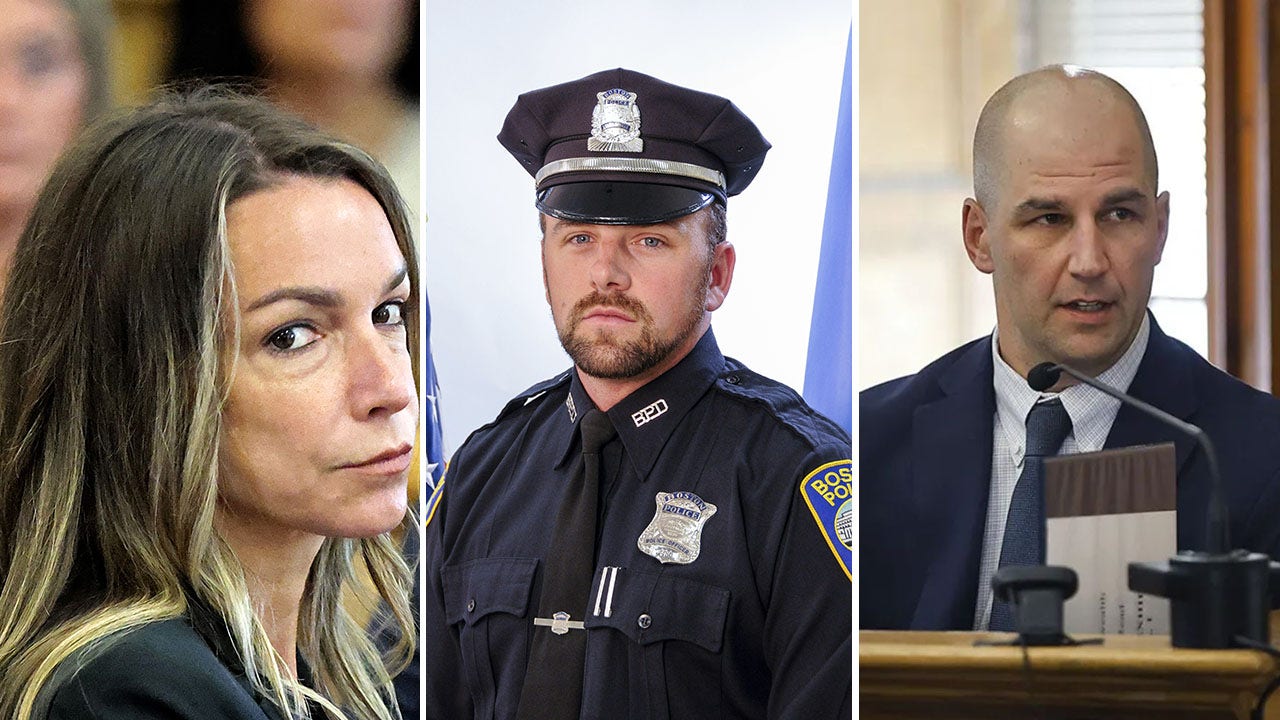
Massachusetts State Trooper Michael Proctor testifies during Karen Read’s trial, Wednesday, June 12, 2024, in Norfolk Superior Court in Dedham, Mass. (Greg Derr/The Patriot Ledger via AP, Pool)
Proctor’s last day with the DA’s office will be July 7, Boston 25 News reported. Fox News Digital has reached out to the state police.
Proctor came under fire for a series of text messages he sent regarding Read which were read aloud in court, in which he admitted on the witness stand that these messages were “unprofessional.”
In the personal texts, he called Read a “wack job,” a “babe … with no a–” and a “c—.” He also said he wished that she would kill herself and joked about looking for nude images on her phone.
Many law experts believe Proctor’s testimony sank the prosecution’s case.
The Massachusetts jury had been deadlocked for days and couldn’t come to a unanimous decision about Read’s innocence or guilt after nearly 26 hours of deliberations.
STATE TROOPER’S VULGAR TEXTS ABOUT ‘BABE’ MURDER SUSPECT COULD AFFECT OTHER HIGH-PROFILE CASE, EXPERT WARNS
Karen Read smiles as defense attorney David Yannett speaks to reporters in front of Norfolk Superior Court, Monday, July 1, 2024, in Dedham, Mass. A judge declared a mistrial Monday after jurors deadlocked in the case of Read, who was accused of killing her Boston police officer boyfriend by striking him with her SUV and leaving him in a snowstorm. (AP Photo/Steven Senne)
Read, 44, was accused of killing her boyfriend John O’Keefe. After leaving court, she stood next to her lawyers, who said prosecutors relied on a compromised investigator.
“We will not stop fighting,” Read’s lawyer, Alan Jackson said.
“The Commonwealth intends to re-try the case,” the Norfolk County District Attorney’s Office said within minutes of the outcome.
O’Keefe’s body was found in several inches of snow outside the home of Boston police officer Brian Albert in January 2022.
Prosecutors alleged Read intentionally backed into him with her SUV during a booze-infused fight and let him die on the front lawn of a Canton, Massachusetts, home during a nor’easter.
Read claimed she was framed in an elaborate cover-up to protect the Albert family, which has deep law enforcement ties.
Supporters of Karen Read gather outside the courthouse in Dedham, MA on Friday, June 28, 2024. Read is facing three charges, including second-degree murder of her Boston police officer boyfriend John O’Keefe in January 2022. (Patriot Pics/Backgrid for Fox News Digital)
She pleaded not guilty to charges of second-degree murder, motor vehicle manslaughter while driving under the influence and leaving the scene of a collision causing injury and death.
Jurors heard from dozens of witnesses and were presented with 700 pieces of evidence during the trial.
Fox News Digital’s Chris Eberhart contributed to this report.
Read the full article from Here
New York
Brian Scott Lorenz Convicted of Murder at Third Trial for Deborah Meindl’s Death
A jury on Friday convicted a man of the brutal 1993 killing of a woman outside Buffalo, closing the latest chapter in a winding, decades-long saga, with a swift guilty verdict on all counts.
The defendant, Brian Scott Lorenz, was facing his third trial for the murder of Deborah Meindl, a 33-year-old nursing student who walked into her Tonawanda, N.Y., home on a cold February afternoon and encountered a terror.
Ms. Meindl was murdered in her own dining room. She was strangled, stabbed and handcuffed, and her bloodied body was discovered by her young daughter returning home from school.
Mr. Lorenz, 56, was originally convicted of Ms. Meindl’s murder in 1994, alongside another man, James Pugh, though the two long denied any involvement in the killing. Their pleas of innocence eventually found the support of several legal advocates, defense lawyers from New York City, who lobbied for new DNA testing in the case.
That testing, performed in 2018, resulted in stunning findings: There was no genetic link to either Mr. Lorenz or Mr. Pugh at the crime scene. Nor was there any other physical evidence — like hair or fiber samples — or any eyewitnesses linking either man to Ms. Meindl’s murder.
Those DNA results, and evidence violations by prosecutors, led to the dismissal of the men’s convictions in 2023, though Erie County continued to pursue the prosecutions.
The case was a challenge: Many of the state’s witnesses from 1994, who said Mr. Lorenz had bragged about the crime, had died; others told investigators they did not remember details of their initial testimony. Still other witnesses had criminal records and, the defense said, were seeking deals for themselves.
A second trial of Mr. Lorenz last year ended in a mistrial after the jury deadlocked. And in December, Mr. Pugh, 63, who had been released on parole after serving more than 25 years in prison, saw his charges dropped. But on Friday, Mr. Lorenz was again found guilty, after less than a full day of deliberation, on two counts of murder and a burglary charge.
The verdict, after two weeks of testimony and arguments in Buffalo, is a defining moment in a case that has perplexed and fascinated residents of Western New York and beyond.
And it was vindication for the Meindl family, represented in court by the victim’s sister, Lynne MacGill, and Ms. Meindl’s younger daughter, Lisa Payne.
During closing arguments on Wednesday, Ms. Payne wore a blouse that belonged to her mother and sat in the front row of the courtroom clutching a Mickey Mouse pillow that her older sister, Jessica, had used as a comfort while testifying in 1994. (Jessica Meindl, who discovered her mother’s body, struggled with addiction and died in 2020, at 37.)
Ms. Payne also carried a small silver spoon that Jessica had used as a reminder to stay sober, and wore rings from her parents around her neck, including the wedding ring her mother had on when she was killed. As the verdict was read, Ms. Payne nodded slightly while Mr. Lorenz sat placidly, just a few feet away. He faces sentencing on July 13.
After the verdict, the two family members thanked the Erie County district attorney, Michael J. Keane.
“This outcome is not just a legal victory: It is a testament to the persistence of truth and the unwavering commitment of dedicated public servants tasked with the pursuit of justice,” Mr. Keane said in a statement.
Mr. Lorenz’s lawyers said they planned to appeal. They had spent years building a case for exoneration, citing the lack of DNA evidence connecting Mr. Lorenz to the crime and the possibility of other suspects.
“It’s very, very scary,” said Ilann M. Maazel, one of Mr. Lorenz’s lawyers. “I think innocence should matter. I think the truth should matter.”
One of the initial suspects in the case was Ms. Meindl’s husband, Donald Meindl, who had been having a sexual relationship with a 17-year-old girl he worked with at a Taco Bell at the time of his wife’s killing. Before the murder, he had mentioned to a friend that he wanted to have his wife killed, though he later said he was joking.
But the defense suggested that Mr. Meindl was serious about finding someone to kill his wife, at one point playing audio of Mr. Meindl laughing with a friend — who was wearing a wire for the police — about his wife’s death. Mr. Meindl died in 2023, though he attended hearings about the case in 2021 and 2022.
In his summation, Earl Ward, a defense attorney, emphasized the lack of hard evidence.
“You have to ask yourself why there was none of Scott’s DNA in that house,” Mr. Ward said. “Because he wasn’t there.”
Deepening the mystery, DNA from an unknown person was found on some items used in the murder, including a knife and a necktie that was used to strangle Ms. Meindl. (The authorities in Erie County say they have not done additional testing to determine who that DNA belongs to because “the genetic material is insufficient for comparison.”)
One of the case’s lead investigators in the early 1990s, David Bentley, a Tonawanda detective, also came under scrutiny for seemingly feeding details to some witnesses. Even current prosecutors called his actions sloppy and inappropriate.
And Mr. Bentley had a close relationship with Richard Matt, a convicted killer from the Buffalo area who rose to infamy in 2015 when he and another inmate, David Sweat, escaped from a maximum-security prison in upstate New York. Mr. Matt was killed by a federal agent after a three-week manhunt. Mr. Sweat was recaptured.
Then, during a re-investigation of the Meindl case brought on by the new DNA evidence, two Erie County prosecutors came to believe that Mr. Matt might have been involved in killing Ms. Meindl, a theory promoted by Mr. Sweat, himself a convicted killer who remains in prison. The judge in the case, Paul B. Wojtaszek, later discredited that theory, but nonetheless set aside Mr. Lorenz’s and Mr. Pugh’s convictions in 2023.
The dismissal of charges against Mr. Pugh in December and the lack of physical evidence seemed to lead to a shift in prosecutors’ strategy in the third trial; previously, they had argued that the two men had been burglarizing the Meindl home and killed Ms. Meindl to cover their tracks.
This time, prosecutors offered little in the way of motive, though a suggestion toward the end of their closing arguments that Mr. Lorenz might have killed Ms. Meindl for money drew an angry protest from the defense and a rebuke from Justice Wojtaszek. After the verdict on Friday, Mr. Lorenz’s lawyers suggested that those comments by the prosecutors could be part of their appeal.
The state’s case hinged on six associates of Mr. Lorenz who said he’d told them various details about the crime, and his involvement, back in the early 1990s. Several of those people have died, so their past testimony was read to the jury. Other witnesses for the prosecution had criminal records and troubled personal histories, including addiction and mental health issues.
The lead prosecutor in the case, Eugene T. Partridge III, conceded in his closing that “it would have been great had he confessed to a busload of nuns,” but argued that “those vulnerabilities is the reason the defendant chose them.”
Mr. Partridge also defended the long pursuit of a conviction in the case, saying “there is no expiration date on justice.”
The jury’s foreperson, Cindy Musacchio, 61, a retiree living in Tonawanda, said that prosecutors’ compilation of various statements attributed to Mr. Lorenz had swayed her.
“All the people he confessed to, all the similarities, I felt was compelling,” she said, after leaving the jury room.
For her part, Ms. Payne said in a statement that while “nothing in this world could ever justify the brutal death of my mother,” the verdict “shows that as flawed as our justice system is, it can still provide a little piece of comfort.”
“May she now finally be able to rest in peace,” she wrote.
Jonah E. Bromwich and Mark Sommer contributed reporting.
Boston, MA
Pols & Politics: Boston’s $325M White Stadium deal could be killed with booze ban
Plans to serve booze at White Stadium’s professional soccer matches in Boston have encountered pushback by critics of the city’s public-private rehab plan, but a ban on alcohol would effectively kill the $325 million project.
Buried in the city’s 321-page lease agreement with Boston Legacy FC, the National Women’s Soccer League team set to play home games at the rebuilt stadium, is a provision that allows the team to walk away from the deal should the city’s Licensing Board choose not to grant its application for a liquor license.
“If … both the Boston Licensing Board and the Alcoholic Beverages Control Commission issue a final non-appealable decision in which the applicable entity refuses to grant such a liquor license (for White Stadium) … then the tenant may terminate both this lease and the stadium usage agreement,” the lease states.
“Upon delivery of such termination notice, the parties’ rights, responsibilities, and the obligations under this lease and the stadium usage agreement shall be null and void, and without recourse to either party,” the lease states.
Boston Legacy FC has signed a 10-year lease agreement with the city to share use of Franklin Park’s White Stadium with Boston Public Schools student-athletes.
The team is paying more than $190 million for its half of the stadium renovations, with the city’s $135 million half of the costs paid for by taxpayers.
The Boston City Council defeated a resolution last month, by a 9-3 vote, that sponsors Ed Flynn and Julia Mejia said sought to uphold state law restricting alcohol at public school facilities.
Mejia and Flynn argued that booze should not be sold during professional soccer matches and other private events held at Franklin Park’s White Stadium, given that it is a city-owned public school facility.
“The Boston Public School policy is clear and the state law is clear,” Mejia said last month. “Alcohol is not permitted on public school premises, except under very limited circumstances, which this situation does not meet.”
Most councilors disagreed, including Gabriela Coletta Zapata, who called the rule “antiquated” and said it was not applicable in this instance.
“I think generally this is an antiquated viewpoint of how we regulate alcohol,” Coletta Zapata said last month. “It ignores how Boston responsibly balances public use, economic opportunity and community activation. We can’t pretend that a blanket prohibition is the only pathway forward, especially in a shared-use facility like White Stadium.”
The Emerald Necklace Conservancy and a group of park neighbors suing the city to try to block the project have also argued that alcohol should be banned at the facility. The lawsuit, which alleges the professional soccer stadium use would illegally privatize public parkland, is under consideration by the state Supreme Judicial Court.
— Gayla Cawley
No boos this time
Not sure what to make of Lt. Gov. Kim Driscoll tossing out the ceremonial first pitch the other night at Fenway Park while the governor was away in California. The stands were still filling up, but nobody seemed to be voicing their political feelings. Is that good? As the saying goes, any publicity is good publicity.

Pittsburg, PA
A grieving mother’s undying effort to keep her son’s spirit alive in the Strip District
-
New York47 minutes agoBrian Scott Lorenz Convicted of Murder at Third Trial for Deborah Meindl’s Death
-
Detroit, MI1 hour agoDetroit Red Wings 2025-26 grades feature some A’s, some D’s
-
San Francisco, CA1 hour agoThe 2026 NFL Draft is complete. See the 49ers projected depth chart
-
Dallas, TX2 hours agoDAL@MIN Postgame: Jason Robertson | Dallas Stars
-
Boston, MA2 hours agoPols & Politics: Boston’s $325M White Stadium deal could be killed with booze ban
-
Denver, CO2 hours agoPHOTOS: Denver Nuggets vs. Minnesota Timberwolves in Game 4 of first-round NBA playoff series
-
Seattle, WA2 hours agoFC Dallas Suffers 2-1 Defeat to Seattle Sounders FC | FC Dallas
-
San Diego, CA2 hours agoHector Estevane – San Diego Union-Tribune