West
Bryan Kohberger trial set to begin June 2025 in Idaho murders case


Bryan Kohberger, the 29-year-old former criminology Ph.D. student accused of killing four University of Idaho students, is one step closer to trial after a scheduling hearing Thursday, more than a year after the 2022 massacre and 13 months after Kohberger’s arraignment.
Attorneys were instructed to prepare to address several other scheduling issues, including setting a time for the defense to challenge the death penalty and pre-trial deadlines. Kohberger appeared wearing a suit and tie and did not speak in the hearing, which wrapped up in under 20 minutes.
Judge John Judge appeared ready to move things forward.
“We’re getting to a point of diminishing returns,” he said.
WHAT BRYAN KOHBERGER’S COURTROOM SEATING SAYS ABOUT LAWYER’S CONFIDENCE: EXPERTS
Bryan Kohberger enters the courtroom, looking at defense attorney Anne Taylor, for his arraignment hearing in Latah County District Court, Monday, May 22, 2023, in Moscow, Idaho. Kohberger is accused of killing four University of Idaho students in November 2022. (Zach Wilkinson/Pool via REUTERS)
Both sides were amicable to a trial date next summer, when the high school across the street is out of session, and Judge ordered the trial to start on June 2, 2025.
Kohberger was studying at Washington State University in Pullman, Washington, at the time of the murders. The school is just a 10-mile drive across the state line from the crime scene.
A 4 a.m. home invasion stabbing left four undergrads dead on Nov. 13, 2022 – Madison Mogen, 21, Kaylee Goncalves, 21, Xana Kernodle, 20, and Ethan Chapin, 20.
Read the judge’s sentencing order
SIGN UP TO GET TRUE CRIME NEWSLETTER
GET REAL TIME UPDATES DIRECTLY ON THE TRUE CRIME HUB
FOLLOW THE FOX TRUE CRIME TEAM ON X
Madison Mogen, top left, smiles on the shoulders of her best friend, Kaylee Goncalves, as they pose with Ethan Chapin, Xana Kernodle, and two other housemates in Goncalves’ final Instagram post, shared the day before the four students were stabbed to death. (@kayleegoncalves/Instagram)
Police found a Ka-Bar knife sheath under Mogen’s body that allegedly had Kohberger’s DNA on the snap.
IDAHO MURDERS: BRYAN KOHBERGER DEFENSE ‘FIRMLY BELIEVES’ IN HIS INNOCENCE
According to court documents, investigators also tracked Kohberger’s Hyundai Elantra on a meandering route around the area to and from the crime scene.
The trial has already been postponed for more than a year as defense attorneys accuse the prosecution of slow-walking the disclosure of evidence through discovery.
Judge John Judge speaks during a hearing Friday, Aug. 18, 2023, at the Latah County Courthouse in Moscow, Idaho. (August Frank/Pool via REUTERS)
Investigators said cellphone pings placed Kohberger near the house the day of the murders, but defense lawyers have argued that he was nowhere near the house where the killings happened and was instead driving around the steep mountain roads in the dark, as he often liked to “see the moon and stars.”
Kohberger faces four charges of first-degree murder and a felony burglary count.
If he is convicted, he could face the death penalty.
He’s due back in court in August for a hearing on his defense team’s motion to change venue.
Fox News’ Louis Casiano contributed to this report.
Read the full article from Here

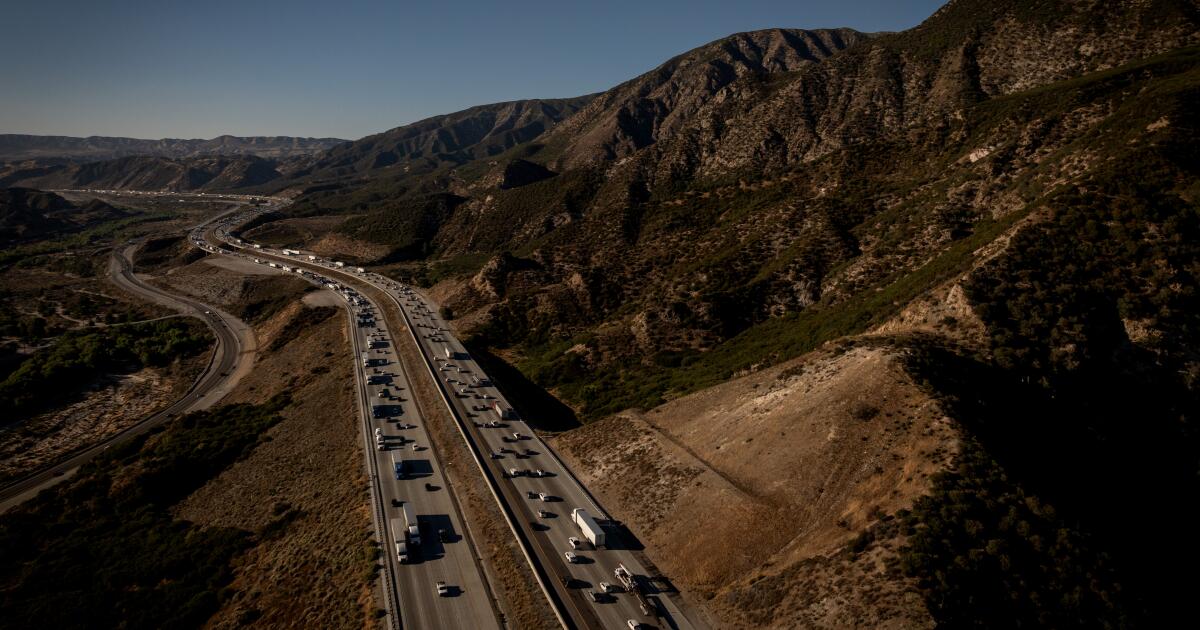
It lurks ominously beneath California’s many natural wonders, a reminder that nothing in this landscape is truly permanent.
It’s been described as “the mother of all earthquake faults,” the source of both our geological birth and, perhaps, our ultimate undoing.
But the most unnerving thing about the San Andreas fault these days may be its silence. It’s a mystery scientists are still trying to unlock.
The San Andreas is central to any discussion of California. It’s the massive 800-mile spine of the state, trundling up the Coachella Valley to the San Gabriel Mountains, and pushing along the edge of Silicon Valley to beyond the Golden Gate.
There is no simple answer for why California’s longest fault, responsible for some of America’s most powerful earthquakes, has produced so few in the last century.
But it is clear that the quiet period is only increasing strain on the San Andreas, as well as on the state’s second-longest fault, the San Jacinto.
A new study underscores the concern. Researchers estimated that key sections of the fault in Southern California are at their highest level of tectonic strain in the last 1,000 years.
The San Andreas, in other words, is locked, loaded and inevitable.
A red-hot San Andreas
Tectonic stress on these sections of the San Andreas and San Jacinto faults is high — shown in red — a product of no significant quakes on them for more than a century. At the Cajon Pass, sections of the faults are at their highest strain in 1,000 years, calculations suggest.
Average tectonic stress, in megapascals

Liliane Burkhard / University of Bern / University of Hawai’i at Manoa; Statewide California Earthquake Center Community Fault Model
Sean Greene LOS ANGELES TIMES
Ticking tectonics
There are generations of Californians who have never experienced the fury of the San Andreas.
The fault was responsible for a megaquake that ripped through the then-sparsely populated state in 1857 — an event that, if repeated today, would reap mass destruction.
In 1906, “a crack in the edge of the world,” as author Simon Winchester described it, flattened San Francisco.
Modern Californians have been forced to make do with Hollywood’s CGI versions of the fault, which cast it as one of our state’s darkest villains.
But sooner or later, scientists say, California’s earthquake faults will rupture in a way not seen in the modern era. While California has seen sizable temblors since the great San Francisco quake of 1906, the state’s faults are capable of producing intense shaking over a much larger area than seen during more modern events such as the Sylmar, Loma Prieta or Northridge quakes.
“We keep accumulating that earthquake energy, and it has to be released. And the only way it gets released is through large earthquakes,” said U.S. Geological Survey geologist Kate Scharer, one of the new study’s co-authors. “The small ones don’t really do it.”

A section of the California Aqueduct crisscrosses the San Andreas fault dozens of times.

-
Share via
The latest study, published last month in the Journal of Geophysical Research: Solid Earth, set out to create a model that calculated the seismic strain on three key segments of the San Andreas and San Jacinto faults where they intersect at the Cajon Pass in San Bernardino County.
The model is based on a number of factors: the estimated timing of earthquakes on the faults over a record of the last 1,000 years; satellite observations of how fast tectonic plates are moving; and estimates of how rigid Earth’s crust is, which determines how much stress can be accommodated and then released, Scharer said.
The computer model “found that tectonic stress has now reached higher levels than at any point in that entire record. From the model, we see that the conditions that historically preceded large joint ruptures crossing both fault systems are now approaching,” said Liliane Burkhard, the lead author of the study and a scientist at the University of Bern in Switzerland and the Hawaii Institute of Geophysics and Planetology at the University of Hawaii.
The last major temblor to strike urban Southern California, the magnitude 6.7 Northridge earthquake of 1994, resulted in severe damage and the deaths of about 60 people. But it was also mostly limited to a relatively small area of Los Angeles County.
By comparison, a hypothetical magnitude 7.8 earthquake on the southern San Andreas would simultaneously bring violent shaking to L.A., Orange, Riverside, San Bernardino, Ventura and Imperial counties and could result in 1,800 deaths, according to a U.S. Geological Survey estimate published in 2008.
The findings of the latest study don’t change the overall expectation of a big earthquake hitting Southern California. But they underscore the persistent risk — as well as the possible scale of the disaster.
There’s a 60% chance of a magnitude 6.7 or greater earthquake striking the Los Angeles region by 2045, according to USGS estimates published in 2015. There’s about a 1 in 5 chance of such a quake striking on the San Andreas fault within L.A. County and the Inland Empire.
Why the drought?
The decades-long relative earthquake drought “is an unusually long interseismic period, and stress has been accumulating continuously throughout,” Burkhard said.
The authors created a 28-second animation, showing how tectonic strain increased along the faults over the last 1,000 years. Big earthquakes then release that strain, before the cycle starts again.

This animation condenses 1,000 years of the Cajon Pass’s earthquake history into 28 seconds. Tectonic stress, shown in shades of orange and red, builds up along three fault segments. Following an earthquake, that stress is released. (Liliane Burkhard / University of Bern / University of Hawai’i at Manoa)
The study calculated that the San Andreas fault just northwest of the Cajon Pass and the San Jacinto fault just southeast of the pass are at their highest tectonic strain since the year 1100.


The pass, located roughly 50 miles northeast of downtown Los Angeles, marks the dividing line between the San Gabriel Mountains to the west and the San Bernardino Mountains to the east.
Specifically, the study’s authors calculated that the current tectonic stress was 2.8 megapascals on the San Andreas northwest of the pass, surpassing the previous highs of 2.7 just before big quakes in 1469 and 1691.
For the San Jacinto, the authors calculated a current seismic stress of 3.6 megapascals, surpassing the previous high of 2.9 before an earthquake in the year 1249.
The study noted that it has been an unusually long time since a megaquakes has hit Southern California. The San Andreas fault northwest of the Cajon Pass usually has big quakes every 100 to 150 years, Scharer said, though intervals of about 200 years are not unheard of.
On the San Andreas southeast of the pass, big quakes usually happen every 200 to 250 years. But the most recent quake on the San Andreas along the Salton Sea, close to the Mexican border, was about 300 years ago.
There are some limitations to the study’s model, scientists acknowledge. For instance, the model presumes that when large earthquakes hit, all the tectonic stress that had been accumulated in the fault gets released, “so you start at a ground state of zero and then you accumulate back up until you have that next big event,” Scharer said.
But whether all that stress actually gets released during a big quake is not definitively known.

The Mormon Rocks in Phelan, Calif.
Tectonic risks
Whenever it strikes, a supersized earthquake on the southern San Andreas would be like no earthquake seen in living memory in California.
The 1857 quake, estimated to be a magnitude 7.9, produced 63 times more shaking energy than the 1994 Northridge earthquake, and across a much larger swath of the state.
In 1994, “violent shaking,” or Level 9 on the Modified Mercalli Intensity Scale, causing great damage in substantial buildings, affected only part of the San Fernando Valley.

But a magnitude 7.8 San Andreas quake hypothesized by the USGS in its 2008 ShakeOut scenario would cause that kind of shaking across Southern California.
In 1994, emergency responders from across Southern California were able to focus the bulk of their efforts on especially hard-hit areas. That wouldn’t be possible in a regionwide disaster.


It might be tempting for Californians to tune out talk of the “Big One” after hearing about it for most of their lives. But generational catastrophes do strike — be they an earthquake in San Francisco in 1906, a hurricane in New Orleans in 2005 or tsunamis in the Indian Ocean in 2004 or Japan in 2011.
Tectonic rewards
Earthquakes are part of the bargain of living in California, a product of the same forces that allow people to ski and surf on the same day. The same tectonics that drive earthquakes act as the state’s landscape artists, said Julian Lozos, associate professor of geological sciences at Cal State Northridge.
“Because we are on the edge of the continent, we’re on a plate boundary, and have been a plate boundary for a couple hundred million years. There’s constantly been stuff crashing into North America, and getting stuck to it, and getting uplifted, and erupted through, and slid around,” Lozos said.
The Sierra Nevada, California’s mightiest mountain range, “are the guts of the volcanoes that used to be there when there was a subduction zone … and then when those volcanoes stopped erupting, the guts of them lifted up through the crust,” Lozos said.

Big Pines Highway rises out of a valley to ride a ridge created by the tectonic forces of the San Andreas fault, two miles southeast of the unincorporated Mojave Desert community of Valyermo, home to about 450 residents.
The same forces that produce earthquakes are also what led gold to form in the Sierra foothills, inciting the state’s famous rush.
Tectonic movement also created today’s Central Valley, a highly productive agricultural area that was once part of the ocean, then an inland sea, and then a freshwater lake, Lozos said.
“Everything about what we see here is stuff that formed because of that plate boundary then, and it’s getting moved around by the plate boundary now,” Lozos said. “And so if we didn’t have anything like that, we would be Nebraska.”
But the risks, like the rewards, are significant. The San Andreas runs right through cities in the Inland Empire. The Los Angeles Basin is also at risk.
If an earthquake on the San Andreas comes from the south and heads north, it would shuttle all that shaking energy “right into downtown,” Lozos said, causing shaking that could last two to three minutes.
“Geologically, L.A. is a bowl of Jell-O. It is a hard rock bowl full of really soft, squishy stuff that shakes very easily,” Lozos said.

It is business as usual at the Wrightwood Inn on a recent Tuesday night. According to a recent study, seismic pressure has been gradually building in the area for more than a century.
It’s not certain why it’s been so quiet between earthquakes, said Scharer. Another study, published in 2023, suggested the lack of sudden, major floodwaters funneling into Lake Cahuilla, the larger historical predecessor to the Salton Sea, may have something to do with it.
Scharer said the study’s results are a good reminder to prepare for the next big earthquake.
To be sure, the computer model’s results are not a prediction, and all models have their limitations and uncertainties. Still, its suggestion that the fault systems are “more loaded than at any point in the 1,000-year record,” Burkhard said, “is a finding worth taking seriously.”
“In the end, the most important message is a simple one: Let’s make sure we are prepared,” she said.

Three-quarters of Colorado residents said they were worried about whether they would be able to afford to continue living in the state, according to a poll conducted this spring.
Last year, about 70% of people responding to the Colorado Health Foundation’s annual Pulse poll said they weren’t sure living here would remain financially feasible. That rose to 76% this year.
“That majority concern was cutting across regions, across income levels, across racial and ethnic groups,” said Lucia Del Puppo, senior vice president at FM3 Research, which works with Democrats.
The poll found that the majority of those sampled said they had already cut back on entertainment spending and charitable giving, with smaller shares saying they’d skipped meals, delayed medical or dental care, or paid a utility bill late.
Only about one in four people said they hadn’t changed their spending or dealt with a financial setback in the last year, with older people and Republicans reporting less budget strain.
“It’s significant and it affects the overall economy” when people reduce their discretionary spending, said Lori Weigel, principal of New Bridge Strategy, which works with Republicans.
The responses suggested a significant minority expected further financial strains in the coming year:
- About two in five worried they or a family member would lose health insurance
- Three in 10 worried about affording enough food
- One-third thought they might lose their housing because they couldn’t afford their mortgage or rent
Notably, more than half of renters were worried about whether they could continue to afford their housing, Weigel said. One-third said they’d avoided asking their landlords to fix problems to avoid rent increases, and one-quarter said they’d taken on high-interest debt, such as payday loans or credit card balances, to deal with housing costs, she said.
Lower-income people and those who identified as Black, Hispanic or Native American reported greater financial struggles than other groups.
Even people who haven’t had to cut back are worried about affordability. When asked to rate the seriousness of a list of potential problems, 85% said both the general cost of living and the cost of housing were either “very serious” or “extremely serious.” Additionally, 82% said the cost of health care was a very serious or extremely serious problem.
Younger people were particularly worried about housing costs, with 94% of millennials and 90% of Generation Z members describing the problem as very or extremely serious.
At the same time, when respondents got the chance to name the most important issue facing the state, the largest share — 28% — chose government and politics. The cost of living and inflation came close behind, with 25% deeming it the top issue.
Just one year ago, only 13% of people considered cost of living and inflation their top concern, Del Puppo said.
“It has jumped really since 2025,” she said.
The two may be related, as 72% of respondents said they weren’t satisfied with the government’s response to economic issues. The only question where a slight majority said they were satisfied with the state government’s performance was making the state “safe and welcoming” to everyone, Del Puppo said.
The poll asked more than 2,200 people about their personal finances, experiences with health care and perceptions of the state between March and April, then weighted their results to represent Colorado’s demographics.
As usual, both a Democratic and a Republican firm ran the poll, to reduce the risk of bias.
Sign up for our weekly newsletter to get health news sent straight to your inbox.

-

 Arkansas5 minutes ago
Fayetteville, Arkansas, draws Razorback fans, cyclists, history buffs
-
California11 minutes ago
The San Andreas fault has gone ominously silent. Scientists fear when it finally snaps
-

 Colorado17 minutes ago
Three-quarters of Coloradans are worried they can’t afford to live here, poll finds
-

 Connecticut23 minutes ago
Love Food Names the Best Place for Ramen in Connecticut
-

 Delaware29 minutes ago
Family of Kadir Skinner to sue Wilmington over police killing
-

 Florida35 minutes ago
Florida TODAY: Homes get expensive, license to blush, fuzzy invader
-

 Georgia41 minutes ago
Georgia Youth Symphony Orchestra Announces Expanded Artistic Leadership Team for 2026–2027 Season
-

 Hawaii47 minutes ago
Traffic fatalities in Hawaii ticked up after Memorial Day – The Garden Island

