California
RWE to start California offshore wind project surveys


June 16, 2024

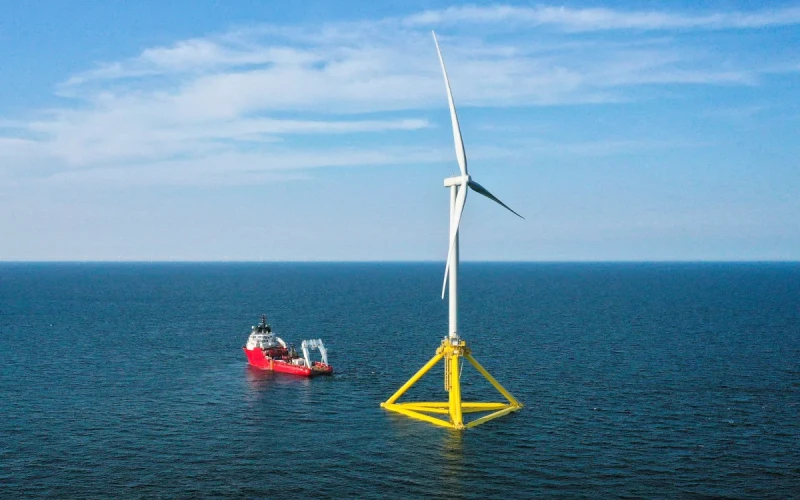
Offshore wind developer RWE announced it will start site investigation surveys for its planed 1.6-gigawatt Canopy Offshore Wind Farm off northern California.
Located 20 miles off Humboldt County, the Canopy project would anchor floating wind turbines on a 63,338-acre lease RWE obtained in a 2022 auction by the federal Bureau of Ocean Energy Management.
“Surveying is an important step on the path toward developing Canopy Offshore Wind and helping provide clean energy that meets California’s ambitious climate goals,” said Sam Eaton, CEO of RWE Offshore Wind Holdings, in a June 12 statement. “RWE is committed to responsible, inclusive development by engaging Humboldt residents, Tribal Nations, and working closely with the fishing community as we begin offshore activities on the project.”
RWE selected subsea service provider Argeo to perform the Canopy site investigation work. “Argeo is pleased to partner with RWE on their first commercial scale floating offshore wind project. We will conduct subsea surveying utilizing proven, state-of-the-art technology,” said Dave Gentle, vice president for North and South America at Argeo.
Argeo will utilize an autonomous underwater vehicle (AUV) to conduct surveys in the Humboldt lease area, where depths range from 500 to 1,100 meters (1,640 to 3,600 feet) according to BOEM.
“The use of an AUV as the survey platform during this initial site characterization effort will enable high-quality data collection close to the seafloor, including photographs of biological communities,” according to a summary by RWE.
Using the autonomous vehicle “significantly reduces the potential for entanglement of fishing gear as they are not towed equipment,” the company says. The sensors carried by the AUV operate at safe sound levels and meet California low energy equipment requirements for geophysical surveys that are in place to minimize impacts to marine mammals and other wildlife.”
Groups opposing offshore wind projects off the U.S. East Coast have worked to tie survey work to whale strandings and deaths. West Coast wind power is just entering that first phase of development, and RWE officials said they are planning to deploy protected species observers on survey vessels.
The company has engaged Geo SubSea and Coastal 35 Consulting to provide PSOs on survey vessels. Smultea Sciences will provide PSO training “to Tribal citizens and Humboldt County community members to increase the involvement and workforce opportunities for individuals who possess local and Indigenous knowledge of the area during the site investigation campaign,” according to RWE.
The first survey work is planned to start in June to map the seafloor and begin assessing best locations for turbines, anchors and cables, and charting habitat and environmental factors.
“Protected Species Observers are an essential part of ensuring site surveys occur safely in a way that avoids interactions with wildlife,” said Jeff Gardner, president of Geo SubSea, in a joint statement with RWE. “They are an important way to ensure offshore wind surveys are conducted in a manner that results in minimal disturbance to the marine ecosystem.”
“The role of the PSO is solely dedicated to monitoring for protected species,” said Jenn Klaib, owner of Coastal 35 Consulting. “PSOs work to enforce environmental regulations that protect marine wildlife and also provide valuable data for Canopy to better understand marine mammals, their habitats, behaviors, and migration routes.”
In April, Smultea Sciences trained 19 members of the local Humboldt and Tribal communities as Protected Species Observers. Several graduates of this program subsequently participated in Global Wind Organization safety training
“The Smultea Sciences team is pleased with the strong turnout of local CalPoly Humboldt and other students, local Tribal members, and community members attending and successfully completing our Marine Protected Species training,” said “It was very fulfilling to share our collective knowledge and experience in my hometown community and to open the door to work opportunities in the realms of marine biology and green energy development for Humboldt residents.”
RWE says its consultations with the northern California fishing industry “resulted in Canopy survey planning intended to avoid and minimize the potential for activity overlap, with activities sequenced in different areas during varying fishing seasons.”
The company is sending local commercial fishermen to Global Wind Organization safety training. Local fishing captains, identified by the area’s fishing industry, “will serve as an Onboard Fisheries Liaison (OFL) on the survey vessel to manage at-sea communication and coordination with the fishing fleet during survey activities,” the company says.


The body of singer Oliver Tree was back in California this weekend after he was listed as a passenger on a helicopter that crashed above Rio de Janeiro one week ago.
His social media accounts on Sunday afternoon announced the return of his body after the June 14 collision of two helicopters, which killed all six people on board.
“Oliver is now back in California where he can finally rest,” the post said.
According to The Associated Press, police identified the five other people as Gaspar Prim Díaz, a popular Argentine YouTuber known as Gaspi; another Argentine, Lucas Vignale; and Brazilians Lucas Brito, Charles Marsillac and Alexandre Souza.
The cause of the collision was under investigation. The AP reported last week that authorities were investigating the possibility of human error by a pilot or air traffic controllers.
Tree, 32, had been performing in South America as part of a world tour. He had a show scheduled for June 6 in São Paulo, according to a schedule on his Facebook page.

The post Sunday thanked fans and supporters for an outpouring of devotion to the memory of the quirky and uplifting artist.
“The constant love, support and positivity is helping the family, friends and collaborators make it through these extremely difficult times,” it said.
Tree, whose real name was Oliver Tree Nickell, was from Santa Cruz. His father, Jesse Nickell, said he learned of his son’s death from a producer working on music with him in Brazil.
“Peace be with Oliver,” he said by text last week.
Tree was recognizable for his bright fashion, mullet haircut with prominent bangs, thin mustache and encouraging outlook. A motto on his Instagram account says, “No matter how strange you think you look, no matter how ugly you feel, you are beautiful.”
Tree also worked with marquee names in pop and electronic dance music. His biggest tracks were “Life Goes On,” which peaked at 71 on the Billboard Hot 100 in 2022, and “Miss You,” with German musician Robin Schulz, which peaked at 84 on the chart the same year.
Tree’s influence spread beyond chart data, however, and tributes poured in far and wide following last week’s news that he was on the passenger list of one of the aircraft.
The post on his social media accounts said he had been working on an endowment that would produce a grant and that the plan would be moving forward.
“‘Dr. Oliver Tree’s Extremely Epic Grant For Baby Geniuses’ coming soon,” the post said. “We will make sure his wish comes to fruition so that more joy, love and art can be spread into the world, that was his final wish.”
Speaking on the “Zack Sang Show” on YouTube in April, Tree discussed the grant and said his music was likely to be more valued after he died.
“That’s when people appreciate you, when you’re not there anymore,” he said.
The Instagram statement offered some assurance.
“Your legacy will live on forever,” it said.

California property owners can expect the nation’s steepest insurance premium hikes this year.
Nevertheless, that surge will leave California property owners paying below U.S. norms, according to my trusty spreadsheet‘s peek at a report by policy tracker Insurify. Its numbers reflect what private insurers charge to cover properties across all 50 states and Washington, D.C.
For Californians, that means an estimated 16% jump in premiums for 2026. It’s the biggest jump in the country, four times the 4% hike a typical American faces.
Years of rising property damage are largely behind this, with the 2025 Los Angeles wildfires as the latest example.
After California, Nebraska is seeing a 13% increase, followed by New Mexico at 11% and Georgia at 10%. Meanwhile, policies are actually getting cheaper in Hawaii and Massachusetts (down 2%) and Maine (down 1%).
Relative bargain
Please do not be mad at me for relaying this insurance math.
Even after the 2026 increase, California property insurance remains a relative bargain compared with the rest of the country.
Lower California rates are one reason why many property owners have trouble finding coverage. State insurance regulation has made it difficult for insurers to raise their rates, even as their costs and risks surge.
Owners who cannot obtain insurance coverage most often use the state’s FAIR Plan. Those premiums are expected to rise by 29% next year.
Note that Insurify projects the average annual premium in California for 2026 will be $2,843, ranking 21st-highest among all states.
Do you know of many housing-related expenses where you can say California prices are 7% below the national norm?
The most expensive premiums are found in Florida at $8,458 per year, followed by Oklahoma at $5,205, Louisiana at $5,035, Nebraska at $4,560 and Texas at $4,529. These states face high risks from hurricanes, tornadoes or hail.
The cheapest insurance is in Vermont at $1,094 annually, followed by Maine at $1,359 and Utah at $1,370.
Even cheaper?
Keep in mind, the average Californian is insuring a very expensive property.
California insurance policies commonly cover $488,000 in repairs, according to Insurify. This is the second-highest amount among the states and 43% above the national average of $342,000.
Only Hawaii is higher at $500,000. The lowest policy coverage is in Oklahoma at $292,000.
Stack up what homeowners pay against how much coverage they get, and California’s pricing looks even more reasonable.
This premium-to-coverage ratio indicates that the typical Californian pays 0.6% of the coverage offered. That ranks No. 30 among the states and is one-third below the nation’s 0.9% ratio.
The highest ratios are in Florida (2.6%), Oklahoma (1.8%), Louisiana (1.7%) and Texas (1.4%). The lows were in Vermont, Alaska, the District of Columbia, New Hampshire and New Jersey, all at 0.4% or less.
Loss likelihood
If you own property in California, you probably already know this, but here’s a reminder of a never-ending risk: natural disasters.
My trusty spreadsheet also reviewed data from various government and industry sources to see how often disasters strike – and how much those ugly events cost. The incidents tracked include wildfires, floods, earthquakes, hurricanes, tornadoes, blizzards and hail.
To grade the 50 states and the District of Columbia on their relative natural disaster risks, five measures were developed that account for the frequency and damage of calamities, weighted against population and geographic size.
When you add it all up, California ranks third for the likelihood of expensive disasters.
Florida is the riskiest state, followed by Hawaii, California, Louisiana and Tennessee.
If you want a safer place, consider Alaska, Nevada, Utah, Arizona, or Wisconsin.
Of course, this is just a simple way to look at a complex problem that befuddles property owners, insurance companies and policymakers alike.
Clearly, these aren’t just California headaches. One-third of Americans live in 10 states with the highest risk.
How often
The history of disasters offers us clues as to where the next one may hit.
Look at the five measures used to create the risk rankings, starting with how often these disasters actually happen.
Using the number of federal disasters declared over the past decade and dividing that by each state’s square miles, California comes in at No. 9.
By this measure, the most disaster-prone are D.C., Rhode Island, Hawaii, Connecticut and Washington state. The least are Ohio, Wisconsin, Pennsylvania, Alaska and Michigan.
Next is the number of major storms per square mile.
California is much lower on this list, ranking 41st. The stormiest are D.C., New Jersey, Maryland, Hawaii and Rhode Island. The calmest are Alaska, Oregon, Nevada, Utah and Idaho.
The price tag
Think about what it costs to clean up after disasters. This is a major driver of home insurance premiums.
First, look at the dollar amount of damages divided by the number of people in each state. California ranks ninth-highest for disaster costs per person.
The biggest bills? Louisiana, Hawaii, Texas, Florida and Colorado. The smallest? Delaware, Rhode Island, Massachusetts, Connecticut and New Jersey.
Next, check out the cost per storm. California’s disasters are the fifth most expensive.
The most expensive storms happen in Florida, Louisiana, Texas and Oregon. The least expensive are in Delaware, Montana, Wyoming, Rhode Island and Kentucky.
Finally, if you look at insurance losses per person, California ranks fourth highest.
The largest insurance losses are in Colorado, Nebraska and Florida. After California, Wyoming is next. The lowest losses are in Utah, Hawaii, Nevada, Alaska and Oregon.
Clearly, the property-loss odds are stacked against Californians.
Skipping the costs
Some property owners take one look at their insurance bill and decide to go without.
LendingTree, using Census housing cost data, estimates 11% of California property owners have no homeowner’s insurance policy.
That’s the 11th-lowest level of no coverage among the states. The national rate is 14%.
West Virginia has the highest share of owners without coverage at 24%, followed by New Mexico at 23% and Louisiana at 21%. The fewest uninsured homes are in Colorado, Oregon and New Hampshire at 10%.
So why do so many Californians still pay for coverage?
Contemplate the estimated California premium against statewide household income to see that the cost is relatively affordable.
This 2.8% insurance-cost burden ranks No. 25 among the states. It’s also one-fifth of the nation’s 3.6%.
The highest burden? Florida at 11%, and Louisiana and Oklahoma at 8%. Lows? Vermont, New Hampshire, Utah and Maine, all 1%.
Jonathan Lansner is the business columnist for the Southern California News Group. He can be reached at jlansner@scng.com
- Try Jonathan Lansner’s Substack collection of economic trends. CLICK HERE!
California
California man arrested for impersonating bank official, coercing money from Colorado victim

A 25-year-old California man is charged with three felonies after intercepting a package in Colorado containing $11,000 in cash he allegedly obtained via a computer scam.
Earlier this year, a Mesa County resident contacted authorities after receiving a message. The sender reportedly claimed to be an employee of the Federal Deposit Insurance Corporation (FDIC). The FDIC is an independent agency created by the Congress that insures and oversees the banking industry.
The resident claimed the purported FDIC representative stated the resident’s bank account had been compromised and needed to be secured. The resident was instructed to send cash from the account to an address in southern California, according to the Mesa County Sheriff’s Office.
The resident later chose to stop the shipment. But, according to the sheriff’s office, the box containing the cash was already in the process of being shipped.
A man later identified as Youbin Huang of El Monte, Calif., a Los Angeles suburb, came to the package’s location in Grand Junction and picked it up using documents which contained the Colorado resident’s personal information, per the sheriff’s office.
A nationwide warrant for Haung’s arrest was issued by the Mesa County Sheriff’s Office on Feb. 25. Huang was arrested by the California State Patrol on April 13, according to a press release from the sheriff’s office. Huang was brought to Colorado and booked into the Mesa County Detention Facility on May 10.
Huang is charged with theft, identity theft, and computer fraud, all felonies, and all state charges. He was advised June 11 and posted an $11,000 cash bond to obtain his release from jail that day. He has another court hearing on July 9.
The Mesa County Sheriff’s Office stated in its press release that Huang was “intimately involved in the perpetration of the scam.” It did not specifically state that Huang acted alone, nor if he was the person who impersonated an FDIC employee and communicated with the Colorado resident online.
MCSO recommended Coloradans never give out their personal or financial information to an unsolicited caller, allow remote access to their phones or computers, send gift cards or crypto currency as a form of payment, or send cash in the mail. As well, if they are unsure about what they are being asked to do, call law enforcement, family members, or a trusted friend to get advice.
-

 Illinois2 minutes ago
Video shows deadly tornado that hit southern Illinois, killing 2
-
Indiana5 minutes ago
Where to watch Phoenix Mercury vs Indiana Fever on June 22: TV channel, start time and streaming
-

 Kentucky10 minutes ago
All of the 4th of July events, fireworks taking place in Louisville this year
-
Iowa10 minutes ago
Iowa home sales up 17.3% in May – KBOE 104.9FM Hot Country
-

 Louisiana25 minutes ago
Driver dies from gunshot wound after Louisiana State Police chase in New Orleans
-

 Maine32 minutes ago
Matt Dunlap wins primary in Maine’s 2nd District as Democrats seek to hang on to Jared Golden’s seat
-

 Maryland35 minutes ago
AP Decision Notes: What to expect in Maryland’s state primary – WTOP News
-

 Michigan40 minutes ago
WNEM Morning Extra: Lane closures begin across mid-Michigan for bridge inspections, road work

